July, 2026
Home › Banking Systems › Where Your Paycheck Should Go First › What to Do When Your Paycheck Goes to the Wrong Account
What You Need to Know
— If your paycheck or client payment just landed in the wrong account, the immediate fix is simple: do not spend from it, transfer it to the correct account today, and check whether any automated transfers or payments misfired as a result.
— Income routing to the wrong account triggers a cascade — tax reserves do not get set aside, buffer accounts do not get funded, bills accounts run short. One wrong deposit can destabilize the entire month if not caught quickly.
— The root cause is almost always a routing setup that was never fully configured, a direct deposit form that was never updated, or a one-account system that has no routing rules at all.
— The permanent fix is a deliberate routing architecture — a defined sequence that tells every dollar where to go the moment income arrives, automatically, without manual intervention.
— This article covers the immediate fix first, then the structural explanation, then how to build the routing system that makes this mistake impossible going forward.
Something went wrong with your paycheck. It landed somewhere it was not supposed to — the spending account instead of the holding account, or the bills account instead of the main checking, or a bank account you forgot was still active. Now the money is in the wrong place and you are trying to figure out what breaks as a result and how to fix it.
Knowing what to do when your paycheck goes to the wrong account is more than a one-step fix. The immediate problem is the misrouted deposit. The downstream problem is everything that was supposed to happen automatically as a result of that deposit — the tax reserve transfer, the buffer contribution, the bills funding — that either did not happen or fired from the wrong source. Both need to be addressed, and the sequence matters.
This article covers the immediate fix, the downstream damage to check for, the most common causes of routing mistakes, and the permanent structural solution that makes paycheck routing automatic and error-resistant going forward.
Do This First: The Immediate Fix Sequence
If the deposit just landed in the wrong account, work through this sequence before doing anything else. The goal is to get the money in the right place and verify nothing broke downstream before the day is over.
The Immediate Fix Sequence
Step 1 — Do not spend from the wrong account. The most damaging mistake after a misrouted deposit is spending from wherever it landed. That money has jobs assigned to it. Spending it before it reaches its correct destination means those jobs do not get done — bills do not get funded, taxes do not get reserved, the buffer does not build. Leave it untouched until it is moved.
Step 2 — Transfer the full amount to the correct account today. Move the entire deposit to where it was supposed to land. If it should have gone to your Income Holding Account, move it there now. If tax reserves should have been separated immediately on arrival, do that transfer from the Holding Account once it arrives. Do not split the transfer at the wrong-account level — move the whole amount first, then distribute from the correct starting point.
Step 3 — Run your normal distribution sequence from the correct account. Once the full deposit is in the right place, execute your standard routing: tax reserve percentage to Tax Savings, then the normal monthly allocations to Operating and Bills on their scheduled dates. The money is now starting from the right place and the rest of the sequence runs normally.
Step 4 — Check for any automated transfers that already fired from the wrong account. If any scheduled transfers pulled from the wrong account before you caught the misrouting, those accounts may now be short. Check the balance of the account that received the wrong deposit and verify no automated payments pulled from it unexpectedly. If any did, adjust accordingly.
Step 5 — Log the date and fix the root cause today. Note what caused the misrouting and fix it before the next payment cycle. This is the most important step for preventing recurrence — and the most frequently skipped. The urgency of the moment passes, the problem does not get addressed, and the same misrouting happens again next month.
What Actually Breaks When Income Hits the Wrong Account
A single misrouted deposit does not just create an inconvenience. For anyone running a multi-account income routing system, it triggers a cascade of downstream problems that are easy to miss if you only fix the surface issue.
Tax reserves do not get set aside. If income lands in the spending account instead of the holding account, the immediate tax reserve transfer never fires — because the trigger point was the holding account, not where the money actually landed. You have now spent thirty percent of that payment before knowing it. When quarterly taxes are due, the reserve is short.
The buffer does not build. For freelancers and variable earners, the Income Holding Account balance is the buffer. Income that lands in the spending account instead gets spent at the spending account rate. A high-income month that should have strengthened the buffer instead disappeared into discretionary spending because it was never structurally separated.
Bills account runs short. If the monthly transfer to the Bills Account pulls from a holding account that did not receive the deposit, the bills account may be underfunded when autopay runs. Depending on timing, this can mean an overdraft, a missed payment, or a late fee on a bill that was supposed to be handled automatically.
Operating account receives wrong signal. If the deposit landed in the Operating Account, the balance looks inflated. The brain registers more available spending money than actually exists after obligations are accounted for. This is the psychological version of the single-account problem — a large balance that feels like freedom but is actually mostly spoken for.
Month-end reconciliation is off. Even if nothing catastrophic breaks in the short term, a misrouted deposit means the monthly financial picture is distorted. Accounts show balances that do not reflect their actual state. Any review of how the month went — whether the buffer grew, whether spending stayed within the Operating allocation — produces inaccurate conclusions.
What I've Seen
The downstream consequence I see missed most often is the tax reserve gap. Someone's income lands in the spending account, they transfer it to the right place within a day or two, and they feel like the situation is handled. What they do not account for is that the 25–30% tax reserve transfer never fired — because the trigger was the holding account, not wherever the money actually landed. Three months later a quarterly estimated tax payment is due and the reserve is $800 to $1,200 short. The original routing error felt minor. The quarterly shortfall does not.
Why This Happens: The Four Most Common Causes
Misrouted income is almost never a bank error. It is almost always a setup problem — a routing instruction that was never given, never updated, or was given to the wrong institution. Identifying which of these applies determines the permanent fix.
Cause 1 — Direct Deposit Form Was Never Updated
The most common cause. A direct deposit was set up years ago pointing to an old account. Income has been going there ever since — sometimes to an account that is still active and being spent from normally, sometimes to an account that was supposed to be closed but was not.
Fix: Contact your employer's payroll department or the platform that issues your payments (Venmo, PayPal, Stripe, direct client ACH). Update the routing and account number. Request written confirmation that the change was processed and note the effective date.
Cause 2 — Client or Platform Paying to the Wrong Account
A client has an old bank account on file. A payment platform is connected to a personal account rather than the intended income holding account. This is common when the multi-account structure was built after client relationships were already established.
Fix: Audit every active client and payment platform. Update the payment destination in each one. For recurring clients, send a brief note confirming the new account details. For platforms like Stripe, PayPal, or Venmo, update the linked bank account in account settings and verify the change with a test transaction if possible.
Cause 3 — No Routing Architecture Exists Yet
All income is going to a single checking account because no multi-account routing system has been built. There is no wrong account — there is only one account, and everything piles into it. The problem is not a routing error. The problem is the absence of routing entirely.
Fix: Build a deliberate paycheck routing system. The where your paycheck should go first guide covers the complete income routing framework — how to define the correct destination for every dollar the moment it arrives, including direct deposit splitting, transfer automation, and distribution sequencing.
Cause 4 — Split Direct Deposit Was Set Up Incorrectly
Many employers and platforms offer split direct deposit — sending a fixed amount or percentage to one account and the remainder to another. If the split was configured incorrectly, amounts are going to the wrong destinations. This is particularly common after a bank change where one account number was updated and the other was not.
Fix: Pull up your direct deposit configuration with your employer's payroll system. Verify every account number, routing number, amount, and percentage against the accounts that actually exist and their intended roles. Resubmit the form with corrected information and confirm the effective date with HR or payroll.
The Permanent Fix: A Routing Architecture That Cannot Misfire
The fundamental reason income routing errors cause so much downstream damage is that most people are running either a single-account system with no routing rules at all, or a multi-account system where the routing depends on manual transfers that can be forgotten, delayed, or misdirected.
The permanent fix is an architecture where income routing is structural rather than behavioral. Each account has a defined role. Every transfer fires automatically at a defined trigger. No manual decision is required after the initial setup is complete. When income arrives in the correct starting account, the entire distribution sequence runs without any further action.
What Correct Routing Architecture Looks Like
One defined entry point. All income — from every client, every platform, every source — is directed to one account: the Income Holding Account. Not the spending account. Not the bills account. Not whichever account happens to be linked to a payment platform. One account, all income. This single rule eliminates the most common class of routing errors.
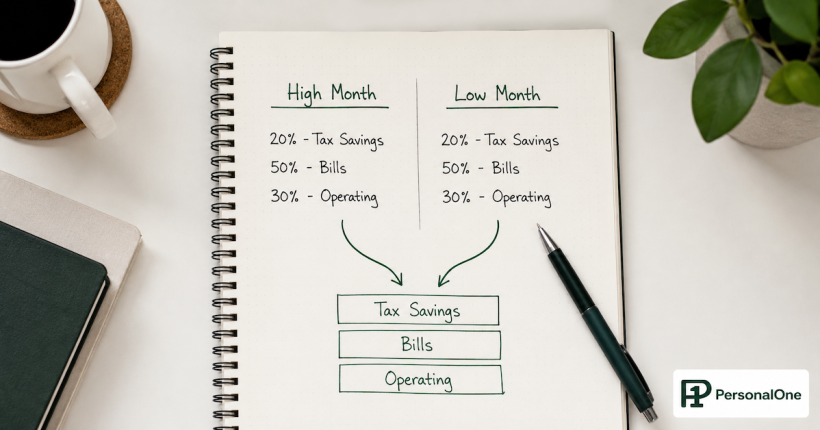
Immediate automated tax transfer. A recurring transfer fires as soon as the deposit clears — 25–30% of the net deposit to the Tax Savings Account. For freelancers and 1099 earners, this is non-negotiable. The transfer is automated so it does not depend on remembering to do it in the moment.
Fixed monthly transfers to Operating and Bills. On the 1st of each month, two scheduled transfers fire from the Income Holding Account: a fixed amount to the Operating Account for variable spending, and a fixed amount to the Bills Account to cover all autopay obligations. Same amounts every month regardless of what income arrived that month. The Income Holding buffer absorbs the difference.
Annual routing audit. Once per year, pull up the payment destination settings in every client portal, payment platform, and payroll system. Verify every account number against the accounts that currently exist and their intended roles. This takes 30 minutes and prevents a full year of misrouting.
The result of a correctly configured routing architecture is that income arriving in the right starting account produces the right outcome automatically. There are no manual steps that can be forgotten. There are no routing decisions to make in the moment. The system runs the same way whether the deposit is $800 or $8,000, whether it arrives on the 3rd or the 27th. That consistency is what makes the financial picture accurate and what makes routing errors immediately visible when they do occur.
How to Audit Your Current Routing Setup
If income has been going to the wrong account for more than one payment cycle, a routing audit surfaces the full scope of the problem and identifies every source that needs to be updated.
Step 1 — List every income source. Every client, employer, platform, or institution that sends you money. Freelance clients, W-2 employers, gig platforms, payment apps, affiliate programs, rental income, side income of any kind. Every source.
Step 2 — Identify where each source is currently sending payments. Log into each platform or contact each client to confirm the account number on file. Cross-reference against the account that is actually supposed to receive each payment.
Step 3 — Update every source that is pointing to the wrong destination. Change the bank account or routing information in each platform or payroll system. For clients paying by ACH, send updated banking details with a note that the change is effective immediately.
Step 4 — Verify the first payment to each updated source. After updating each source, verify that the next payment arrives in the correct account. Do not assume the update was processed correctly without confirming the deposit location.
Step 5 — Set a calendar reminder to repeat this audit annually. Routing setups drift over time. New income sources get added without deliberate routing decisions. Payment platforms get updated and default to a new linked account. An annual 30-minute audit catches these before they become month-long misrouting problems.
Build the Routing System That Makes This Impossible
A misrouted deposit is a symptom of a routing architecture that was never fully built. The complete framework for where your paycheck should go first — direct deposit splitting, transfer automation, and the distribution sequence that makes every dollar land correctly — is in the Where Your Paycheck Should Go First guide.
Frequently Asked Questions
My paycheck went to a closed account. What happens now?
If a direct deposit is sent to a closed account, the bank typically returns the funds to the sender within one to five business days. Contact your employer's payroll department immediately — they can either reissue the payment once the funds are returned, or issue a manual check. The timeline depends on your employer's payroll cycle. Update your direct deposit information at the same time to prevent recurrence.
Income landed in my spending account and I already spent some of it. What do I do?
Transfer whatever is remaining to the correct account immediately. For the amount that was already spent, treat it as an advance against your next Operating allocation — meaning your spending account gets a reduced or skipped transfer at the next pay cycle to compensate. If tax reserves were part of what was spent, that shortfall needs to be made up before the next quarterly payment. Reduce Operating spending in the next one to two months to rebuild the reserve.
How do I change my direct deposit if my employer uses a payroll platform?
Most payroll platforms (ADP, Gusto, Paychex, Rippling, QuickBooks Payroll) allow employees to update direct deposit information directly in the employee portal. Log in, find the direct deposit or banking section, and update the account and routing numbers. Changes typically take one to two pay cycles to take effect. Confirm the effective date with HR or payroll to know exactly when the change will apply.
Can I set up split direct deposit to route income to multiple accounts automatically?
Yes. Most employers and many payment platforms support split direct deposit — sending a fixed dollar amount or percentage to one account and the remainder to another. This is the ideal setup for the four-account architecture: a fixed tax reserve percentage goes directly to the Tax Savings Account, and the remainder goes to the Income Holding Account. The Operating and Bills transfers then fire from Income Holding on the 1st of each month. Contact your employer's payroll department or check your platform's payment settings to configure the split.
A client paid the wrong account by mistake. Whose responsibility is it to fix?
If you provided the client with incorrect banking details, the fix is yours — provide the correct account information and request the payment be redirected. If the client used old details they had on file, contact them immediately with updated information and ask them to reissue to the correct account. Most clients will cooperate without issue. If the payment was sent via ACH and you need it recalled, your bank can initiate an ACH recall request, though success depends on timing and the receiving institution.
How do I know if this has been happening for multiple pay cycles without me noticing?
Check three months of transaction history on every active account. Look for deposits that should have gone elsewhere. If income has been landing in the spending account instead of the holding account, the spending account will show higher balances and the holding account will show a depleted or non-existent buffer. If tax reserves were never being separated, the Tax Savings Account will be lower than it should be relative to income received. Calculate what the reserve should be based on income received over the period and make up the shortfall before the next quarterly payment.
Official Sources
CFPB — What Is a Routing Number?
FDIC — Deposit Insurance Coverage and Account Verification
Nacha — How the ACH Network Works
More From This Cluster
Return to Where Your Paycheck Should Go First for the complete income routing framework — direct deposit splitting, transfer automation, and the distribution sequence that makes every dollar land in the right place automatically. For the broader banking infrastructure, see Banking Systems.
This content is for educational purposes only and does not constitute financial or legal advice. PersonalOne is not a licensed financial advisor. Banking products, ACH processes, and direct deposit procedures vary by institution and employer. Always verify account and routing numbers directly with your financial institution before making changes. If income was sent to a closed or incorrect account, contact your employer's payroll department and your bank immediately for guidance specific to your situation.