June 1, 2026
Home › Banking Systems › Online Banks vs Traditional Banks › Best Hybrid Banking Setup: Why Many People Use Both
What You Need to Know
— The best hybrid banking setup is not a single bank that calls itself hybrid. It is two institutions working together — a traditional bank or credit union for daily operations and cash access, and an online bank for high-yield savings where the rate differential actually matters.
— Most people already run an informal version of this setup without realizing it. The hybrid system makes it deliberate — each institution is chosen for the specific job it does best, not as a compromise that does everything adequately.
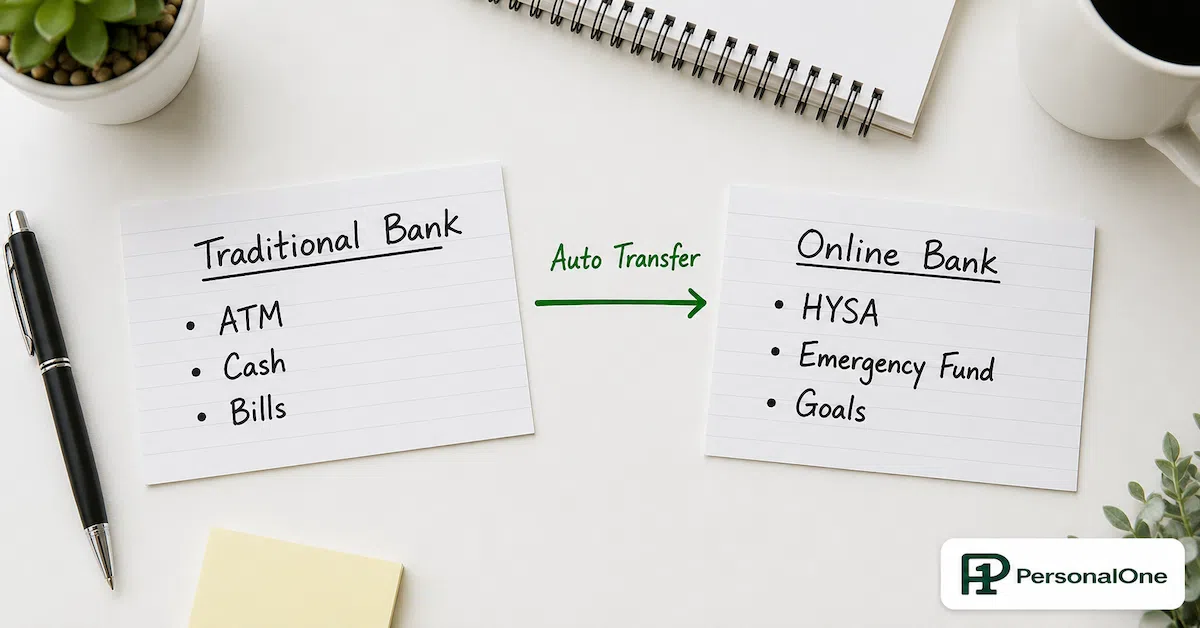
— The traditional bank handles: branch access, cash deposits, in-person support, ATM network, local business relationships. The online bank handles: emergency fund, savings goals, high-yield accounts, sinking funds. Clear role separation eliminates the tradeoffs that come from asking one institution to do both jobs.
— The one to two business day transfer delay between institutions is not a problem to solve — it is the feature that protects savings from impulse spending. The friction is structural protection built into the setup.
— The hybrid setup is not permanent. It is the right structure for most people at most income levels. As financial complexity grows, the setup evolves — but the core principle of matching each institution to a specific job remains constant.
The best hybrid banking setup is not a product. It is a structural decision — the deliberate choice to use two different banking institutions simultaneously, each assigned to the specific jobs it does better than the other. An online bank for savings. A traditional bank or credit union for daily operations. Not one institution compromising across both, but two institutions each performing their specialized role without tradeoff.
Most people arrive at some version of this setup informally. They open a high-yield savings account at an online bank because the rate is better, while keeping their main checking account at a traditional bank because they need ATM access or occasional branch visits. What they have built accidentally is the correct structure. The hybrid system makes that choice deliberate — defining which institution holds which accounts, why, and how the two connect to form a complete banking architecture. If you are currently at a single institution and ready to make the move, how to switch banks without missing bills covers the complete transition process.
This article covers why the hybrid setup outperforms single-institution banking for most people, how to build it correctly, which types of accounts belong at each institution, and how it connects to the complete online banks vs traditional banks framework for choosing a system that fits how you actually use money.
Why Neither Institution Wins Outright
The online bank vs traditional bank debate is framed as a choice because most financial advice assumes you are picking one. That framing misses the point. Online banks and traditional banks are not competing options for the same jobs — they are different tools optimized for different financial functions. Asking which one is better is like asking whether a checking account or a savings account is better. The right answer is both, each in its correct role.
What Each Institution Does Better
Traditional banks and credit unions do better: Branch access for cash deposits, notary services, cashier's checks, and complex transactions. ATM networks with no-fee cash access. In-person relationship with a loan officer for mortgage or business credit applications. Local wire transfer services. Safe deposit boxes. Immediate overdraft resolution with a human. Trust and familiarity for older household members who are part of the financial picture.
Online banks do better: Savings APY — typically 4–5% versus 0.01–0.50% at traditional banks. No monthly maintenance fees with no minimum balance requirements. HYSA accounts with no branch overhead cost passed to the customer. Sub-account or bucket features for goal-based savings. 24/7 digital access with strong mobile apps. No geographic restrictions.
A traditional bank optimized for operations will always underperform an online bank on savings rates. An online bank optimized for rates will always underperform a traditional bank on physical access and relationship banking. Neither is a failure — they are different products built for different priorities. The hybrid setup stops asking one institution to do both jobs and assigns each job to the institution built for it.
The Standard Hybrid Architecture
The hybrid setup has a specific account structure. Every account has a home institution based on its primary function. The two institutions are connected by a single recurring transfer that moves money from the operational side to the savings side automatically.
Traditional Bank — The Operations Layer
Primary Checking Account: Where income deposits. Where daily spending money lives. Debit card and ATM card attached here. Bills autopay from here or from a dedicated Bills Account at the same institution.
Bills Account (optional but recommended): A second checking account at the same traditional bank, dedicated exclusively to autopay obligations. Keeps bill money structurally separated from spending money without requiring a second institution.
Why traditional bank for operations: ATM access, cash deposits, branch availability, immediate transfer between internal accounts, familiar interface for daily use. These are daily-use features where branch infrastructure adds real value.
Online Bank — The Savings Layer
High-Yield Savings Account: Emergency fund lives here. Earning 4–5% APY instead of 0.01%. On a $10,000 emergency fund, that difference is $400–$500 per year in additional earnings for no additional effort or risk.
Goal-Based Sub-Accounts or Separate HYSAs: Sinking funds for irregular expenses (car maintenance, annual subscriptions, holiday spending), down payment savings, vacation fund. Each goal gets its own labeled account or sub-account. Balance is always accurate to the specific goal — no mental accounting required.
Why online bank for savings: The rate differential is the entire reason. No branch network means lower overhead means higher rates passed to the customer. Savings money does not need ATM access, branch visits, or daily interaction. It needs a high rate and friction against casual withdrawal. Online banks provide both.
What I've Seen
The most consistent outcome I see when clients move their emergency fund from a traditional bank savings account to an online high-yield account is surprise at the earnings difference. A client with $8,500 in a traditional bank savings account earning 0.06% APY was earning approximately $5 per year. After moving to an online HYSA at 4.5% APY, the same balance earned $382 in the first year. No additional contribution. No additional risk. No change in access — the money was still FDIC-insured and reachable within two business days. The only thing that changed was the institution holding the account. That $377 annual difference compounds. Over five years at the same rate differential, the gap exceeds $2,000 in foregone earnings on a balance that never grew beyond the original $8,500.
The Transfer Connection: How the Two Institutions Work Together
The two institutions connect through one automated transfer: a fixed amount moves from the traditional bank checking account to the online bank savings account on every payday. This single transfer is what makes the hybrid setup a system rather than just two unrelated accounts.
The transfer amount is set based on the savings allocation in the budget — whatever percentage of take-home pay is designated for savings fires automatically to the online bank on payday. It does not require a decision each pay cycle. It does not compete with spending decisions. It arrives at the online bank before the spending account has had a chance to absorb it.
The one to two business day transfer delay between institutions is a feature, not a limitation. Money in the online bank is accessible in an emergency — two business days is fast enough for any real emergency that is not a same-day cash need. But the delay creates enough friction to prevent the savings from being casually accessed for non-emergency spending. The traditional bank savings account, sitting at the same institution as the checking account with instant transfer capability, does not provide this protection. The online bank does.
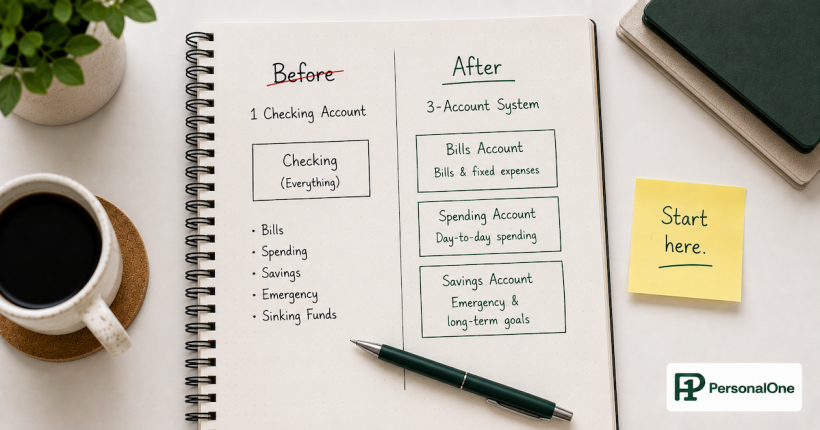
For anyone running a multi-account banking system with Bills, Spending, and Savings accounts, the hybrid setup simply assigns the savings layer to the online bank and the operational layers to the traditional bank. The architecture stays the same. The institutions are optimized.
Choosing the Right Online Bank for the Savings Layer
Not all online banks are equal for the savings role in a hybrid setup. The criteria that matter are specific to this use case — the account is holding emergency fund money and goal-based savings, not being used for daily transactions.
APY rate: The primary criterion. The rate differential over a traditional bank savings account is the entire reason for the hybrid setup. Look for accounts currently paying 4.00% APY or above. Rates change with the federal funds rate environment — compare current rates at the time of opening, not historical rates from when a review was written.
No monthly fees and no minimum balance: The savings account should not cost money to maintain. Any fee structure that charges a monthly fee or requires a minimum balance to earn the advertised APY reduces the net return below what is advertised.
FDIC or NCUA insured: Non-negotiable for an emergency fund. Verify that the institution is directly FDIC-insured or NCUA-insured, not just a fintech that partners with an insured bank. The distinction matters for coverage clarity.
Sub-account or bucket feature: Online banks that allow labeled sub-accounts or savings buckets within one account make goal-based savings structurally cleaner. Instead of opening five separate savings accounts for five different goals, one account with five labeled buckets produces the same separation with less management overhead.
Transfer speed to external accounts: Standard ACH transfers take one to two business days. Some online banks offer faster external transfers. For an emergency fund, standard ACH is sufficient. If faster access is a priority, look for institutions that offer same-day or next-day external transfer options. Once you have identified the right online bank, the step-by-step process for opening the account and connecting it to your existing setup is in how to switch from a traditional bank to an online bank.
Choosing the Right Traditional Bank for the Operations Layer
The traditional bank in a hybrid setup is optimized for operational convenience, not rate. The criteria here are different from the savings layer — what matters is ATM network, branch availability, fee structure on checking accounts, and the quality of the digital banking tools for daily use.
ATM network: The number of fee-free ATMs within your regular geographic range. A traditional bank with a strong ATM network in your city eliminates the per-withdrawal fees that quietly drain checking balances. Credit unions in particular often offer excellent ATM access through shared networks like CO-OP.
No monthly maintenance fee (or an easily waivable one): Many traditional banks charge $10–$15 per month in maintenance fees unless a minimum balance or direct deposit requirement is met. The checking account in the hybrid setup will have direct deposit, which typically waives the fee. Confirm the waiver condition before opening.
Branch access that matches actual usage: If you deposit cash, need notary services, or deal with complex banking transactions occasionally, branch access matters. If everything is digital and the only physical need is ATM access, a credit union with a strong ATM network and no branches may be a better fit than a traditional bank with branches you never visit.
Overdraft policy: The operations layer handles daily spending and bill payment — the accounts most likely to experience timing gaps. A traditional bank with a reasonable overdraft policy (overdraft transfer from a linked account rather than a per-item fee) provides meaningful protection against the occasional timing gap without the predatory fee structure of $35 per overdraft item.
When the Hybrid Setup Needs to Expand
The standard hybrid setup — one traditional bank for operations, one online bank for savings — handles the financial needs of most people at most income levels. As income and financial complexity grow, the setup expands rather than changes fundamentally. The core principle stays the same: each account lives at the institution best suited for its specific job.
Adding a brokerage account: When investment contributions begin, the investment account at a brokerage (Fidelity, Vanguard, Schwab) becomes a third institution in the system. It connects to the traditional bank checking account via automated transfer, the same way the online bank does. The hybrid becomes a three-institution setup: traditional bank for operations, online bank for liquid savings, brokerage for investments.
Adding a business checking account: Freelancers and self-employed earners who add a dedicated business checking account — typically at the same traditional bank for simplicity, or at a business-focused online bank — extend the hybrid setup to include a business operations layer. The personal hybrid architecture stays intact; business income routes through the business account before distributing to personal accounts.
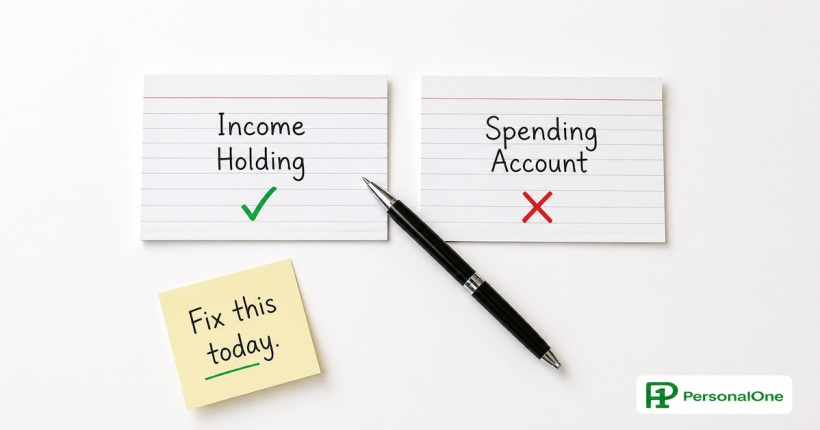
Variable income earners: For freelancers and contractors who use an Income Holding Account to buffer variable income, the holding account sits at the traditional bank (for instant internal transfers to the Bills and Operating accounts), while the Tax Savings Account sits at a separate online institution for maximum separation and rate. The hybrid principle is the same — the architecture just has more accounts serving more specific roles.
The Hybrid Setup Is One Decision in a Larger System.
Choosing the right institutions is the first step. Building the account structure that connects them — Bills, Spending, Savings, and the automated transfers between them — is what makes the setup work as a system. The complete framework is in Online Banks vs Traditional Banks and the Banking Systems hub.
Frequently Asked Questions
Is it complicated to manage two separate banking institutions?
No — and the management load is lower than most people expect. The two institutions connect through one automated transfer that fires on payday. After setup, the day-to-day interaction with the online bank is minimal: check the balance occasionally, watch it grow. The traditional bank handles daily spending and bill payment as it always has. The additional complexity is one login and one automated transfer. The return is hundreds of dollars per year in additional savings earnings and structural protection against spending the emergency fund.
What if I need emergency fund money quickly? Will the two-day transfer be a problem?
For the vast majority of financial emergencies, no. A car repair, medical bill, home repair, or any expense that requires payment within a few days is fully handled by a two business day transfer. The only scenario where the transfer delay creates a real problem is a same-day cash emergency — which is why maintaining a small cash buffer in the traditional bank checking account (one to two weeks of expenses) is part of a complete setup. The online bank holds the emergency fund. The traditional bank checking account provides the immediate-access buffer.
Should I use a credit union instead of a traditional bank for the operations layer?
Credit unions are often the better choice for the operations layer. They are member-owned nonprofits, which typically means lower fees, better overdraft policies, and stronger ATM network access through shared networks like CO-OP (which provides fee-free access to 30,000+ ATMs). The tradeoff is fewer branches and sometimes less sophisticated digital banking tools than major national banks. If ATM access and low fees matter more than branch density and a premium mobile app, a credit union is frequently the better operations-layer institution.
Can I use two online banks instead of one online and one traditional?
Yes, with one caveat: cash deposit capability. If you ever need to deposit physical cash — from tips, cash side income, selling items, or any cash payment — a fully online setup has no clean solution. Most online banks do not accept cash deposits. If cash deposits are not part of your financial life, a two-online-bank setup works: one for daily spending (look for a fee-free online checking account with a strong ATM network like Ally or Charles Schwab) and one for high-yield savings. If cash deposits are occasional, a traditional bank or credit union in the operations role is the more practical choice.
How do I connect the two institutions for the automated savings transfer?
Log into the online bank account. Navigate to external account linking or transfers. Add your traditional bank checking account by entering the routing number and account number. The online bank will verify the connection, typically by making two small test deposits (under $1 each) that you confirm on the traditional bank side within one to two business days. Once linked, set up a recurring transfer: the savings amount, the frequency (every payday), and the source account (traditional bank checking). The transfer fires automatically from that point. Total setup time is approximately 10 minutes.
Official Sources
FDIC — Deposit Insurance Coverage and Verification
NCUA — Share Insurance Fund (Credit Union Coverage)
CFPB — Bank Account Consumer Tools and Rights
More From This Cluster
Return to Online Banks vs Traditional Banks for the complete framework on choosing the right banking system. Related: How to Switch Banks Without Missing Bills or Direct Deposits — the transition guide for moving to the hybrid setup. For the complete account architecture the hybrid setup sits within, see Banking Systems.
PersonalOne Money System
This content is researched, written, and owned by PersonalOne — a free financial education platform built to help Millennials and Gen Z build real financial systems.
Disclaimer: This content is for educational purposes only and does not constitute financial advice. APY rates referenced are current as of the publication date and change with the federal funds rate environment. Always verify current rates directly with financial institutions before opening accounts. FDIC and NCUA insurance coverage limits apply per depositor per institution — verify coverage for your specific account configuration. PersonalOne is not a licensed financial advisor.