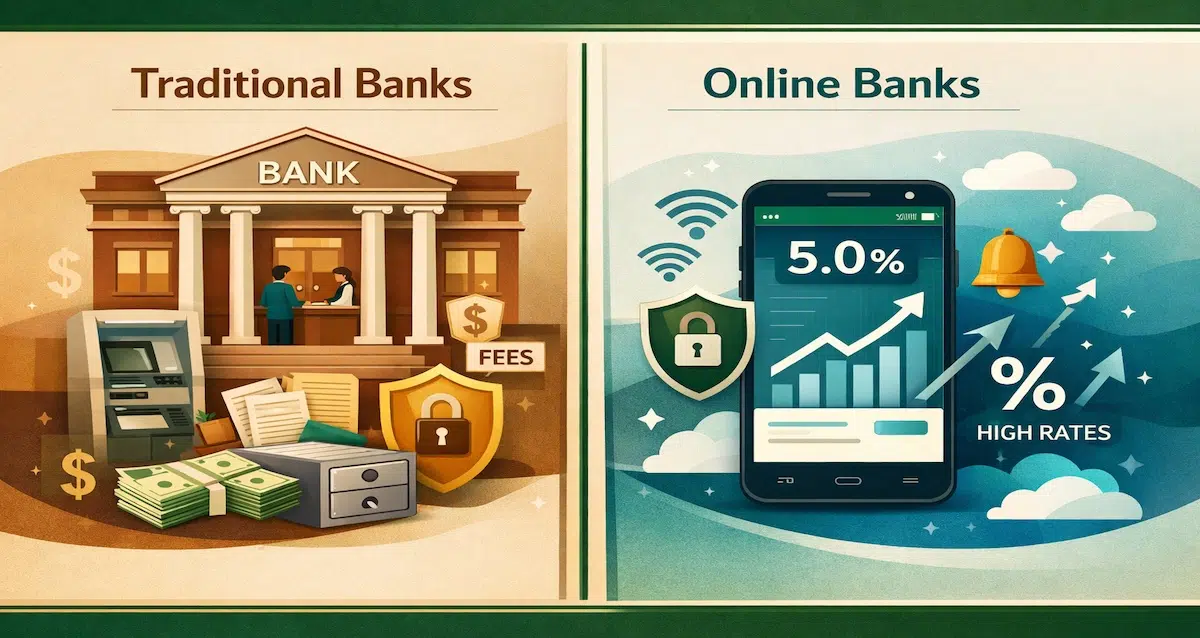
Updated: May 29, 2026
Home › Banking Systems › Online Banks vs Traditional Banks: Which System Fits Your Money
What You Need to Know
— The right question is not which type of bank is better. It is which institution belongs in which role in your financial system.
— Online banks win on fees, savings rates, ATM access, and automation tools. Traditional banks win on cash deposits, lending, and in-person services. Most people need both.
— Most online banks are FDIC-insured. The difference between traditional and online banking is access and experience — not safety. Verify any institution at FDIC.gov before opening.
— The most common efficient setup: online bank for daily spending and high-yield savings, traditional bank or credit union for loans and services requiring physical access.
— Choosing the right institution is one decision. Building the structure that makes money move correctly across those institutions is the larger system — covered in the clusters below.
If you are deciding between a traditional bank and an online bank, you are asking the right question — but not the complete one. The real issue is not which type of bank is better in some general sense. It is which institution belongs in which role in the way your money is actually structured.
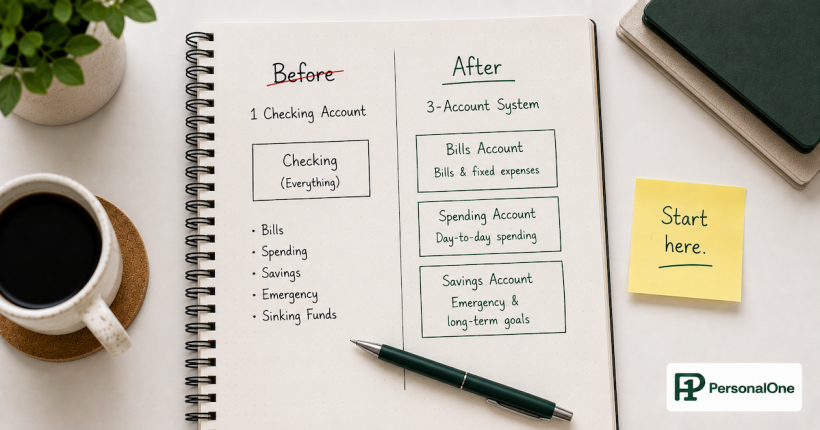
Most comparisons between traditional and online banking treat this as a product decision — fees vs branch access, APY vs in-person service. That framing is useful but incomplete. The more useful frame is systems thinking: which institution does the bills account job best, which does the high-yield savings job best, which handles the lending relationship you will eventually need. Understanding the banking systems account structure is the foundation this institution decision sits on top of.
This cluster covers the institution selection layer — the comparison, the hybrid setup most people need, and the support articles that go deeper on each decision this comparison exposes.
What Counts as a Traditional Bank vs an Online Bank
Traditional banks are institutions with physical branches, long operating histories, and full-service offerings including checking, savings, loans, and mortgages. They operate on relationship banking — in-person interactions, local presence, and a broad product suite under one roof.
Online banks operate primarily through apps and websites. They skip branches, reduce overhead, and focus on digital speed, automation, and lower fees. Most are FDIC-insured directly or partner with FDIC-insured institutions.
The safety question is settled: Most online banks are FDIC-insured. The difference between traditional and online banking is access and experience — not the security of your deposits. Verify any institution at FDIC.gov before opening an account.
Traditional Banks vs Online Banks: Side-by-Side
Eight categories that determine which institution belongs in which role in your financial system.
| Category | Traditional Bank | Online Bank | Edge |
|---|---|---|---|
| Monthly Fees | $5–$25/month unless minimum balance is maintained. Waiver conditions vary and change. | No monthly maintenance fees. No minimum balance requirements at most institutions. | Online |
| Savings Rate (APY) | National average 0.42% APY on standard savings accounts as of May 2026. | High-yield savings accounts offering 4.00–5.00% APY at top-tier institutions as of May 2026. | Online |
| FDIC / NCUA Safety | FDIC-insured up to $250,000 per depositor per institution. | Most are FDIC-insured or partner with FDIC banks. Verify at FDIC.gov before opening. | Tie |
| Cash Deposits | Branch and ATM cash deposits. Immediate and straightforward for regular cash handlers. | Limited. Some partner with Green Dot retail locations but process is inconvenient for regular use. | Traditional |
| Loans & Mortgages | Full lending suite — mortgages, auto loans, personal loans, business lending, HELOCs. | Most online banks focus on deposit accounts. Lending products vary significantly by institution. | Traditional |
| ATM Access | Proprietary ATM networks. Out-of-network fees apply — average $4.64 combined per transaction in 2026. | Large ATM networks (Allpoint, MoneyPass). Many reimburse out-of-network fees. No proprietary ATM lock-in. | Online |
| Automation & Tools | Basic bill pay and transfers. Digital tools improving but typically behind online-native platforms. | Built-in recurring transfers, savings goals, round-ups, early direct deposit, real-time notifications. | Online |
| Customer Service | In-person branch access. Phone and digital support. Relationship banking for complex needs. | App chat, phone, and email. No in-person access. Quality varies — check reviews before opening. | Traditional |
Online Banks Win
Fees, savings rates, ATM access, automation tools
Traditional Banks Win
Cash deposits, loans & mortgages, in-person service
No Difference
FDIC safety — verify either institution at FDIC.gov
The takeaway: Online banks win on the metrics that affect everyday money management. Traditional banks win on services that require physical presence. Most people get better results using both — assigning each institution the role it does best.
Where Traditional Banks Still Make Sense
Traditional banks are not obsolete. They work well in specific, clearly defined situations — and the PersonalOne systems approach treats them as the right tool for those situations, not as an inferior option to be replaced entirely.
— In-person support for complex or high-dollar transactions
— Services like cashier's checks, safe deposit boxes, or business lending
— Long-standing local relationships that carry value for lending purposes
— Frequent cash deposits that require branch or ATM access
If you deposit cash regularly or need branch access for specific services, a traditional bank plays a specific role in a well-structured system — particularly as the institution holding loans or handling in-person financial needs. The goal is not to eliminate traditional banks. It is to stop using them for jobs online banks do better.
Where Online Banks Clearly Win
This is where the gap between traditional and online banking has widened significantly over the past five years — and where most people are still leaving money on the table by keeping the wrong accounts for the wrong jobs.
— No monthly maintenance fees or minimum balance requirements
— Early direct deposit and faster ACH transfers
— Meaningfully higher savings rates through high-yield savings accounts
— Built-in automation tools for recurring transfers and savings goals
— Real-time transaction notifications and spending visibility
For freelancers, side hustlers, and anyone managing irregular income, online-first setups typically outperform branch-based banking. The lower overhead of online institutions gets passed to account holders as higher interest rates and fewer fees — not as a trade-off for security, but as a structural advantage of not paying for physical branches. The full breakdown of why online banks pay higher interest rates explains the structural mechanics and the dollar impact at every balance level.
The Most Common Mistake: Choosing One When You Need Both
The framing of "traditional vs online" assumes you have to pick one. Most people who have built functional banking systems do not make that choice — they assign each institution a specific job and stop asking which is better in the abstract.
The most common efficient hybrid setup:
— A traditional bank or credit union for loans, mortgages, and services that require a physical presence
— An online bank for daily spending, savings, and fee-free everyday transactions
— A high-yield savings account at a separate online institution to hold the emergency fund at a competitive rate
This approach cuts fees, increases interest earnings, and creates structural separation between spending money and savings that makes financial consistency easier to maintain. The complete guide to building this setup is in the best hybrid banking setup.
How to Evaluate Any Bank Before Opening an Account
FDIC or NCUA insured? Non-negotiable. Verify at FDIC.gov before depositing a dollar.
Monthly fees? Any fee that is not waivable unconditionally is a cost you will eventually pay. The banks with no monthly fees guide covers the top fee-free options for 2026.
Minimum balance requirements? Requirements you cannot always meet become fees.
Overdraft policy? How the bank handles transactions that exceed your balance matters significantly for the spending account role.
Transfer speed? Slow transfers between institutions create cash flow problems in a multi-account system. Same-day or next-day ACH matters.
Does it fit its assigned role? A checking account should move money efficiently. A savings account should earn competitive interest. Evaluate each account for the specific job it needs to do — not as a general banking relationship. The best savings accounts for 2026 covers the top HYSA options currently available.
Go Deeper: Online Banks vs Traditional Banks Guides
Institution selection is one decision inside a larger banking system. The guides below go deeper on the specific questions this comparison surfaces.
How to Switch From a Traditional Bank to an Online Bank
"I want to move but I'm not sure how to do it without disrupting my bills."
The step-by-step switching process — how to move direct deposit, migrate autopay, keep both accounts running in parallel during the transition, and close the old account without creating cash flow gaps. The most common switching errors and how to avoid them.
Why Online Banks Pay Higher Interest Rates
"I keep seeing high APY numbers. How are they actually that much higher?"
The structural reason online banks offer 10–15x the national average savings rate — overhead elimination, the Federal Reserve connection, and how to evaluate whether a high APY offer is sustainable or promotional. What the rate difference actually means in dollar terms over 1, 3, and 5 years at every balance level.
Online Banks vs Credit Unions: Which Is Better?
"I've heard credit unions are better than regular banks. Where do they fit?"
Credit unions are not traditional banks — they are member-owned cooperatives with different fee structures, rate offerings, and service models. How credit unions compare to online banks on the eight categories in this hub's comparison table, and the hybrid setups where a credit union replaces or supplements a traditional bank.
The Best Hybrid Banking Setup for Most People
"I want to stop paying fees and earn more on savings without overcomplicating things."
The specific account combination that eliminates most fees, maximizes savings rates, and keeps money organized without requiring more than two to three institutions. How to implement the setup, which accounts to open first, and how to connect them to the account structure that makes everything run automatically.
Banks With No Monthly Fees: Top Options for 2026
"I'm tired of paying maintenance fees on an account I barely use."
The top checking and savings accounts with zero monthly maintenance fees and no minimum balance requirements — the right infrastructure for a banking system that should not cost money to maintain.
Best Savings Accounts for 2026: High-Yield Picks
"Which savings accounts are actually paying competitive rates right now?"
The top FDIC-insured high-yield savings accounts for 2026 — current rates, minimum balance requirements, and which accounts work best at different balance levels for emergency funds and goal-based savings.
How to Avoid Bank Fees: Every Common Fee and How to Eliminate It
"I keep getting hit with fees I didn't see coming."
How overdraft charges, ATM fees, monthly maintenance fees, and minimum balance penalties quietly drain accounts — and the specific account choices and operating rules that eliminate every one of them permanently.
How to Switch Banks Without Missing Bills or Direct Deposits
"I want to switch but I'm worried something will break in the transition."
What actually goes wrong during bank switches — hidden annual charges, the direct deposit timing gap, multi-account routing reconfiguration, and the freelance payment landmine — and how to prevent every failure before it hits.
Can Online Banks Replace Traditional Banks Completely?
"Do I actually need a traditional bank anymore, or can I go fully online?"
For most people, the answer is yes — with four specific exceptions. A five-question test identifies exactly which side of the line your current financial situation falls on, and what minimum traditional bank footprint you need if you cannot go fully online yet.
Mobile-Only Banking: What You Gain and What You Lose
"I only use my phone for everything. Do I even need a desktop banking relationship?"
Mobile-only platforms like Chime and Varo are not the same as online banks like Ally — they have different FDIC structures, different savings rates, and different feature sets. What mobile-first banking does well, where it falls short, and which role it should play in a complete banking system.
The Institution Is One Decision. The Structure Is the System.
Choosing between traditional and online banking is one input. The larger question is how to structure accounts so money moves correctly, savings grow automatically, and bills never create overdrafts. The complete framework is in the Banking Systems hub.
Frequently Asked Questions
Are online banks as safe as traditional banks?
Yes, provided they are FDIC-insured or NCUA-insured. FDIC insurance covers up to $250,000 per depositor per institution regardless of whether the bank has physical branches. Verify any institution's insurance status through the FDIC BankFind tool at FDIC.gov before opening an account.
Do online banks offer loans and mortgages?
Some do, but the product range varies significantly. Most online banks specialize in deposit accounts rather than full lending services. If you anticipate needing a mortgage, auto loan, or personal loan, a traditional bank or credit union typically offers more competitive rates and a more complete lending process.
Can I deposit cash with an online bank?
Cash deposits are the most significant limitation of online-only banking. Some online banks partner with retail networks like Green Dot locations, but the process is less convenient than walking into a branch. If you regularly handle cash — tips, in-person sales, cash-based income — maintaining a traditional bank account for that purpose makes practical sense.
What happens if I have a problem with an online bank?
Online banks handle support through app chat, phone, and email rather than in-person service. Quality varies by institution. Check customer service reviews before opening. For complex account issues, the CFPB's complaint portal at consumerfinance.gov is available for any federally regulated institution.
Is it worth having accounts at both a traditional bank and an online bank?
For most people, yes. The added management overhead is minimal — checking two apps instead of one — and the financial benefits are concrete: higher savings rates, lower fees, and structural separation between account types. The most common efficient setup is an online bank for daily spending and savings, paired with a traditional bank or credit union for loans and services requiring physical access.
Government & Official Sources
FDIC — Verify Bank Insurance Status and Consumer Resources
CFPB — Bank Account Consumer Tools and Complaint Filing
PersonalOne Money System
This content is researched, written, and owned by PersonalOne — a free financial education platform built to help Millennials and Gen Z build real financial systems.
Disclaimer: This article is for educational purposes only and does not constitute financial advice. Account features, fees, and interest rates vary by institution and are subject to change. Always verify FDIC or NCUA insurance status and review current account terms directly with the institution before opening an account. PersonalOne provides educational content and does not provide personalized financial planning services.