June, 2026
Home › Banking Systems › Online Banks vs Traditional Banks › Why Online Banks Pay Higher Interest Rates
What You Need to Know
— Online banks pay higher interest rates because they have structurally lower costs — no branches, fewer employees, no real estate overhead. Those savings flow directly to depositors as higher APY rather than to shareholders or branch infrastructure.
— The rate gap between online and traditional banks is not a promotional offer or a temporary condition. It is a structural feature of the business model that has persisted for over two decades and widens when the Federal Reserve raises rates.
— Research from the University of Chicago Booth School of Business found that online banks pass rate increases to depositors 0.25–0.35 percentage points faster per 1-point Fed rate move than traditional banks — meaning the gap actually grows during rising rate environments.
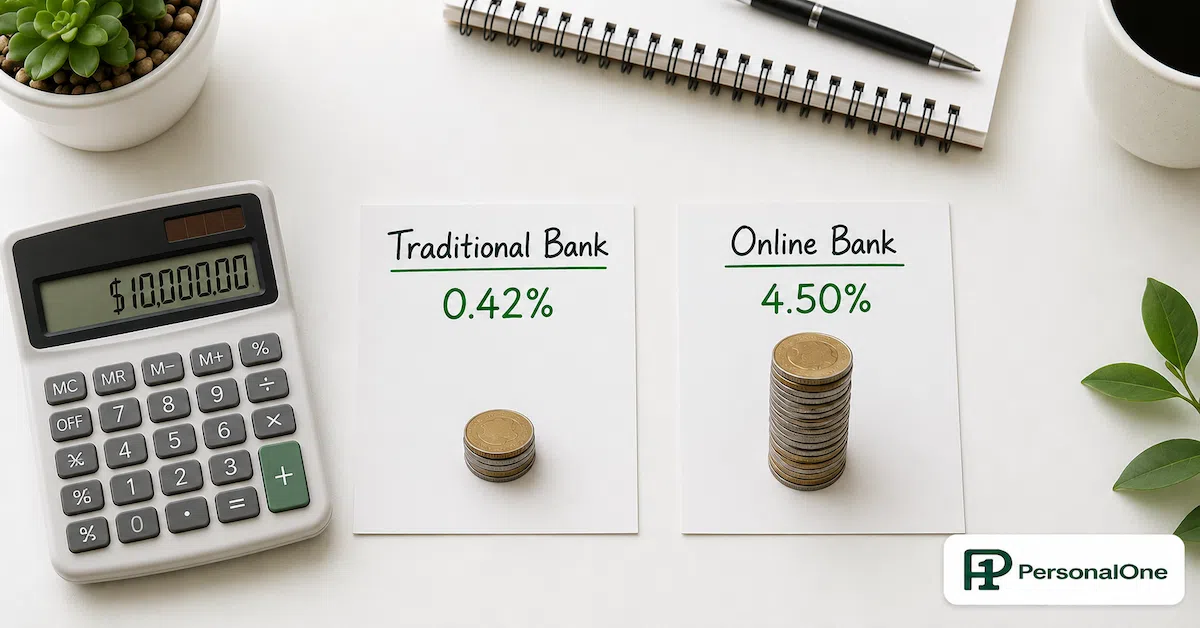
— The dollar impact of keeping savings at a traditional bank is significant and concrete. On a $10,000 balance at 0.42% APY (national average) versus 4.50% APY (competitive online rate), the annual difference is $408. Over five years with no additional contributions, the compounding gap exceeds $2,300.
— FDIC insurance, safety, and regulatory oversight are identical at online and traditional banks. The rate differential is not a risk premium. It is an overhead cost differential passed directly to the depositor.
Why do online banks pay higher interest rates? The answer most financial sites give is "lower overhead costs because no physical branches." That is correct but incomplete — it is the conclusion without the mechanism. Understanding why online banks pay higher interest rates means understanding how deposit competition actually works, why the cost structure difference is permanent rather than promotional, and what it produces in actual dollar terms over real time horizons at real balance levels.
The rate differential between online and traditional banks is one of the most consequential and most ignored financial facts in personal finance. A traditional bank savings account paying the national average of 0.42% APY on a $15,000 emergency fund earns $63 per year. The same balance at a competitive online bank paying 4.50% APY earns $675 per year. That $612 annual gap requires no additional contribution, no investment risk, no change in access to the money, and no complexity — only moving the account to a different institution. Most people are not doing it, largely because the full dollar math has never been made concrete for them.
This article covers the structural reasons why online banks pay higher interest rates, why the gap persists, how it behaves when the Fed moves rates, and what the difference produces in dollars across every balance level and time horizon that matters. The practical decision about whether to use an online bank, a traditional bank, or both is covered in the online banks vs traditional banks framework and the best hybrid banking setup guide.
The Structural Cost Difference: What Actually Drives the Rate Gap
A bank's ability to pay depositors is directly constrained by its operating costs. Every dollar spent maintaining branches, paying tellers, leasing real estate, and supporting the infrastructure of physical banking is a dollar that cannot be paid to depositors as interest. Traditional banks carry this cost structure as a permanent feature of their business model. Online banks do not.
The cost difference is not marginal. A traditional bank with 500 branches across a region is maintaining 500 physical locations, the associated staff, security systems, maintenance contracts, utility costs, and the corporate infrastructure required to manage all of it. An online bank serving the same number of depositors operates from a single technology platform with a fraction of the headcount. The overhead gap per dollar of deposits held is substantial — and it translates directly into the APY that can be offered on savings accounts while maintaining the same profit margin.
The competitive dynamics amplify this further. Online banks acquire customers almost entirely through rate competitiveness — they appear at the top of savings rate comparison sites, and depositors move to the highest available rate. This creates a structural incentive to keep rates high that traditional banks do not face in the same way. A traditional bank retains deposits through branch relationships, convenience, and inertia. An online bank retains deposits by maintaining competitive rates. The business model forces the rate discipline that the cost structure makes possible.
The result is a rate differential that has persisted for over two decades across multiple interest rate environments, multiple Fed cycles, and multiple rounds of traditional banks adding digital features. Adding a mobile app to a traditional bank does not eliminate the branch cost structure. The overhead exists whether or not a customer uses the branch. Until that cost structure changes, the rate differential persists.
How the Federal Reserve Rate Environment Affects the Gap
The rate differential between online and traditional banks does not stay constant — it widens when the Federal Reserve raises rates and narrows when rates fall. Understanding this behavior is important for anyone deciding when and why to prioritize an online savings account.
When the Fed raises the federal funds rate, banks earn more on the money they hold and lend. They can choose to pass that increase to depositors as higher APY, or retain it as increased margin. Research published by the University of Chicago Booth School of Business found that online banks increase deposit rates by 0.25–0.35 percentage points more than traditional banks for every 1-point increase in the federal funds rate. Over the Fed's rate hiking cycle from March 2022 to April 2023 — a 5-point increase — this cumulative difference in rate transmission represented a meaningful and measurable advantage for online bank depositors that traditional bank depositors did not receive.
The mechanism is straightforward: online banks need competitive rates to attract and retain deposits. Traditional banks retain deposits through convenience and inertia regardless of rate. When rates rise, the competitive pressure on online banks to pass the increase through is stronger than it is on traditional banks — so they do it faster and more completely.
When rates fall, the pattern partially reverses. Online banks reduce rates more quickly than traditional banks in declining rate environments — though they still tend to maintain a rate premium above the traditional bank average. The practical implication is that the online bank rate advantage is largest and most impactful during rising rate environments, and the current 2026 rate environment — with the Fed holding steady and J.P. Morgan forecasting no cuts — represents near-peak conditions for the online bank rate differential.
The Dollar Math: What the Rate Differential Actually Produces
The rate gap between online and traditional banks is most commonly discussed in percentage terms — 4.50% versus 0.42%. Percentages are abstract. Dollars are not. The table below shows what the rate differential produces in actual dollar earnings across common balance levels and time horizons, comparing the national average traditional bank savings rate (0.42% APY) against a competitive online bank rate (4.50% APY) as of May 2026.
| Balance | Traditional Bank (0.42%) Year 1 |
Online Bank (4.50%) Year 1 |
Year 1 Gap | 5-Year Gap (compounded) |
|---|---|---|---|---|
| $5,000 | $21 | $225 | $204 | $1,161 |
| $10,000 | $42 | $450 | $408 | $2,322 |
| $15,000 | $63 | $675 | $612 | $3,483 |
| $25,000 | $105 | $1,125 | $1,020 | $5,805 |
| $50,000 | $210 | $2,250 | $2,040 | $11,610 |
Calculations assume static balance with no additional contributions. 5-year figures are compounded annually at each respective rate. Traditional bank rate based on FDIC national average savings rate May 2026 (0.42%). Online bank rate based on competitive HYSA offerings available May 2026 (4.50%). Rates change with the federal funds rate environment.
The five-year gap figures make the most important point: the rate differential is not just an annual convenience. It is a compounding gap that widens every year the money stays at the wrong institution. A $15,000 emergency fund kept at a traditional bank for five years foregoes $3,483 in earnings compared to an online bank — with no additional risk, no lock-up period, and no change in FDIC insurance coverage. That money does not disappear. It simply stays with the bank rather than returning to the depositor.
From Don's Work
The conversation that changed how I present this to clients happened with a 29-year-old marketing manager who had $11,400 in a savings account at the same bank her parents had used since she was a child. The account was paying 0.06% APY — below even the national average. She was earning $6.84 per year on $11,400. When I showed her the dollar math against a 4.50% HYSA — $513 per year, $2,900 over five years — her response was not "that's interesting." It was "why has nobody told me this before." She opened the online account that afternoon. The rate had not changed. The balance had not changed. The only change was the institution holding the account. That conversation is why I present the dollar math first, not the percentage comparison. Percentages are easy to ignore. $2,900 is not.
Is the Money Safe? FDIC Insurance at Online Banks
The most common hesitation about moving savings to an online bank is safety. It is worth addressing directly: the rate differential between online and traditional banks is not a risk premium. Online banks that are FDIC-insured carry exactly the same deposit protection as traditional banks — up to $250,000 per depositor per institution, for the same account categories, with the same government guarantee.
FDIC insurance does not distinguish between a branch-based bank and an online bank. It covers deposits at any member institution regardless of how that institution delivers its services. The same federal government guarantee that protects a deposit at Chase or Bank of America protects a deposit at Ally, Marcus by Goldman Sachs, American Express Personal Savings, or any other FDIC-member online bank.
One distinction worth understanding: some online financial products are offered by fintech companies that are not banks themselves but partner with FDIC-insured banks to hold deposits. In these arrangements, the FDIC insurance applies through the partner bank, not the fintech. The coverage is real, but it is one step removed. Verifying that a fintech's FDIC coverage is genuine and understanding which bank holds the deposits is worth doing before opening an account. The FDIC's BankFind tool at fdic.gov allows anyone to verify whether a specific institution is directly insured.
For the purpose of an emergency fund or goal-based savings held at an established online bank — Ally, Marcus, American Express Personal Savings, Discover, Capital One 360, SoFi — FDIC insurance is direct, verified, and identical to traditional bank coverage. The higher APY at these institutions is not compensation for higher risk. It is the structural consequence of lower operating costs.
Why Traditional Banks Have Not Closed the Gap
A reasonable question: if online banks can offer 4.50% APY and traditional banks offer 0.42%, why have traditional banks not simply raised their rates to compete? The answer is that they do not need to — and the economics of their deposit base make it unprofitable to do so.
Traditional banks retain the vast majority of their deposits through inertia, convenience, and relationship banking rather than rate competitiveness. Most depositors do not compare savings rates regularly. Most do not move their accounts in response to rate differentials. The traditional bank deposit base is structurally sticky — it stays regardless of whether the rate is competitive. There is no competitive pressure forcing a rate increase because the deposits are not leaving.
Additionally, traditional banks carry the fixed cost of their branch infrastructure regardless of whether rates rise. Raising savings rates increases the cost of deposits — the interest paid out — without reducing the branch costs. For a bank with high fixed overhead, increasing the deposit rate compresses the net interest margin (the difference between what the bank earns on loans and what it pays on deposits) in a way that online banks, with their lower fixed cost base, can absorb more easily.
The result is a stable equilibrium that has persisted for decades: traditional banks retain deposits through convenience and inertia at below-market rates, online banks compete for rate-sensitive depositors by passing through their cost savings as higher APY. Both models work for their respective customer bases. The depositor who understands this dynamic and acts on it captures the entire rate differential as additional earnings. The depositor who does not stays in the traditional bank at a permanent rate disadvantage.
What to Do With This Information
The rate differential between online and traditional banks is not an argument for switching all banking to an online institution. Branch access, cash deposit capability, ATM networks, and in-person relationship banking are genuine advantages that traditional banks provide and that online banks cannot fully replicate. The practical decision is not which institution to use — it is which accounts belong at which institution.
Savings accounts belong at the institution paying the highest rate, which is consistently an online bank. Checking accounts and daily operating accounts belong at the institution that provides the best operational convenience for daily use, which is often a traditional bank or credit union. This is the hybrid banking setup — two institutions, each doing the job it does best, connected by one automated transfer.
The action is straightforward: identify what savings balance is currently sitting at a traditional bank earning below-market rates, calculate the annual dollar gap using the rate at an online bank that is currently FDIC-insured and fee-free, and open the account. The process takes 10–15 minutes. The earnings difference begins accruing immediately. If the transition from a traditional bank to an online savings account feels complex, how to switch from a traditional bank to an online bank covers the complete process step by step.
The Rate Is Higher. The Safety Is Identical. The Dollar Gap Is Real.
Understanding why online banks pay more is the first step. Building the account structure that captures the difference is the next one. The complete framework for choosing, building, and connecting the right banking system is in Online Banks vs Traditional Banks and the Banking Systems hub.
Frequently Asked Questions
Will online bank rates stay high or will they drop?
Online bank savings rates move with the federal funds rate set by the Federal Reserve. When the Fed raises rates, online bank APYs rise — and they rise faster and further than traditional bank rates. When the Fed cuts rates, online bank APYs fall — but they still maintain a premium over traditional banks. In the current 2026 environment with the Fed holding rates steady, competitive online bank savings rates remain near their recent highs. Depositors who want to capture maximum earnings should act during rate-hold or rate-rise environments rather than waiting for a better time that may not come.
Are online bank rates promotional or permanent?
Introductory bonus rates that some online banks offer for new accounts are promotional and expire. The ongoing base APY for established accounts at competitive online banks is not promotional — it reflects the bank's actual cost structure and competitive positioning. When comparing rates, look at the standard APY, not the introductory bonus rate. The standard APY is the rate the account will earn after any promotional period ends and the rate the dollar math in this article is based on.
Is there a minimum balance required to earn the high APY?
At the best online banks — Ally, Marcus by Goldman Sachs, American Express Personal Savings, Discover, and others — no minimum balance is required to earn the advertised APY. The rate applies from the first dollar deposited. Some online banks have tiered structures where larger balances earn higher rates, but the baseline rate applies to all balances. Avoid accounts that require a minimum balance of $1,000, $5,000, or more to earn the advertised rate — the effective rate at lower balances is dramatically lower than advertised.
How quickly can I access my money at an online bank?
Standard ACH transfers between an online bank and an external checking account take one to two business days. This is the timeline for moving money out of an online savings account to your checking account. For any emergency that requires payment within a few days — car repair, medical bill, home repair — this timeline is sufficient. The only scenario requiring same-day cash access is not served by a savings account at any institution. Keep a small cash buffer in your daily checking account for immediate-access needs and use the online bank for the emergency fund balance that covers larger, planned expenses.
Should I move my entire savings to an online bank?
Move savings accounts — emergency fund, sinking funds, goal-based savings — to an online bank where the rate differential produces meaningful earnings. Keep checking accounts and daily operating accounts at a traditional bank or credit union where ATM access, cash deposit capability, and operational convenience matter. This is the hybrid setup. It captures the full rate advantage on the savings layer without sacrificing the operational convenience of the traditional bank on the checking layer. The savings belong where they earn the most. The checking belongs where it is most convenient to use.
Official Sources
FDIC — Deposit Insurance Coverage and BankFind Verification Tool
Federal Reserve — Selected Interest Rates (H.15 Statistical Release)
FDIC — National Average Deposit Rates
CFPB — Bank Account Consumer Tools and Rights
More From This Cluster
Return to Online Banks vs Traditional Banks for the complete framework. Related articles: Best Hybrid Banking Setup — how to use both institutions to capture the rate advantage without losing operational convenience. How to Switch From a Traditional Bank to an Online Bank — the step-by-step transition process. How to Switch Banks Without Missing Bills — the complete transition checklist. For the full banking architecture, see Banking Systems.
PersonalOne Money System
This content is researched, written, and owned by PersonalOne — a free financial education platform built to help Millennials and Gen Z build real financial systems.
Disclaimer: This content is for educational purposes only and does not constitute financial advice. APY rates, national averages, and dollar calculations referenced are based on rates available as of May 2026 and change with the federal funds rate environment. Always verify current rates directly with financial institutions before making account decisions. FDIC insurance limits apply per depositor per institution — verify coverage for your specific account configuration at fdic.gov. PersonalOne is not a licensed financial advisor.