July 2026
Home › Credit Building & Protection › Credit Score Building Strategies › Why Your Credit Score Changes Every Month
What You Need to Know
— A credit score is not a static number — it is a live calculation recalculated every time it is pulled, using the most recent data your lenders have reported to the bureaus. Monthly movement is normal, expected, and does not mean something is wrong.
— Most month-to-month score changes are driven by three factors: credit utilization changing as card balances are reported, payment history being updated, and the slow progression of account age. All three are predictable once you understand the reporting cycle.
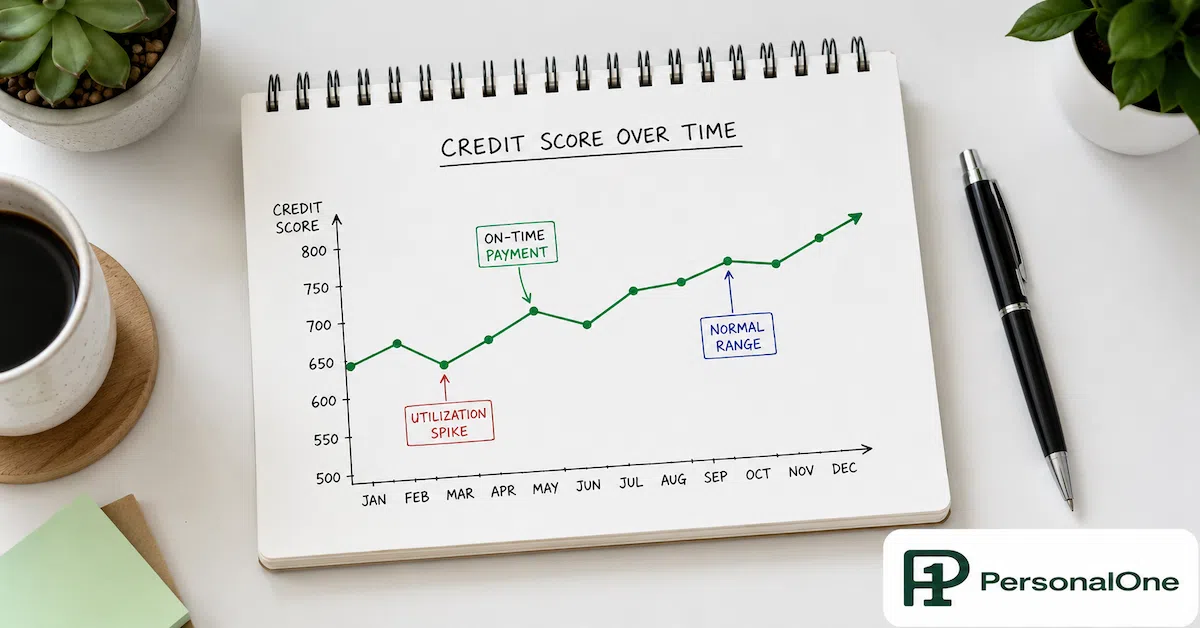
— Utilization is the most volatile factor. A balance that is high when your statement closes gets reported as high utilization — even if you pay it in full the following week. This is the most common cause of confusing score drops for people who pay on time.
— Small fluctuations of 5–20 points in either direction are normal and carry no lasting significance. Large drops of 30+ points almost always have a specific, identifiable cause that appears in your credit report.
— Understanding why your score changes is the first step. Building the habits and structure that produce consistent upward movement over time is the second — covered in the Credit Score Building Strategies cluster.
You check your credit score and it moved. Last month it was 714. This month it is 708. You did not miss any payments. You did not open any new accounts. Nothing unusual happened — and yet the number changed. This is the most common experience that produces the search "why did my credit score change," and the answer is less mysterious than it feels in the moment.
A credit score is not a fixed number that only changes when something significant happens. It is a calculation that runs fresh every time it is requested, using whatever data the three major credit bureaus — Equifax, Experian, and TransUnion — currently have on file. That data is being continuously updated by every lender that reports to the bureaus, on their own reporting schedule, independent of when you check your score. The result is a number that reflects your credit picture at a specific moment in time — and that moment changes month to month even when your financial behavior does not.
Most monthly score movement is driven by a small set of predictable factors that operate in the background regardless of what you are actively doing. Understanding them transforms score fluctuation from a source of anxiety into readable information. The complete framework for building consistent score improvement is in the Credit Score Building Strategies cluster.
How a Credit Score Actually Works: The Live Calculation Model
Most people mentally model a credit score as something that stays fixed until a significant event changes it — a missed payment, a new account, a paid-off loan. This model is wrong, and the wrongness of it is what makes normal score movement feel surprising.
The correct model is this: your credit score is calculated fresh every time someone requests it, by running an algorithm against the data currently on file at the bureau being queried. The algorithm uses the five FICO factor categories — payment history (35%), credit utilization (30%), length of credit history (15%), credit mix (10%), and new credit (10%) — but it applies them to live data, not a static snapshot from some fixed point in the past.
That live data is being updated constantly. Every credit card issuer typically reports your balance and payment status to the bureaus once per month, usually on or around your statement closing date. Loan servicers report monthly. Collections agencies report when accounts enter collections. The bureaus process these updates on a rolling basis, meaning the data behind your score is almost always slightly different from what it was 30 days ago.
The practical implication: even if your behavior has been identical month over month — same spending patterns, same payment timing, no new accounts — the data the algorithm runs against may be slightly different, producing a slightly different score. This is not a system error. It is the system working correctly.
The Three Factors That Drive Most Monthly Movement
Of the five FICO factors, three produce the majority of month-to-month score movement. Understanding each one makes fluctuation readable rather than random.
Factor 1 — Credit Utilization (30% of Score)
Utilization is the most volatile factor month to month because it reflects your current balance-to-limit ratio, which changes every time a card issuer reports your statement balance. A card with a $5,000 limit that had a $1,200 balance last month and a $2,400 balance this month produces a utilization change from 24% to 48% — which can move a score meaningfully even if every payment was made on time.
The critical detail most people miss: utilization is measured at the moment the balance is reported to the bureaus, which is typically the statement closing date — not the payment due date. If your statement closes on the 15th with a $2,400 balance and you pay it in full on the 22nd, the bureaus received a report showing $2,400. The payment arrives too late to affect what was reported. This is why utilization fluctuates even for people who pay their full balance every month.
The good news is that utilization resets every reporting cycle. A high-utilization month does not permanently damage the score — it resolves itself as soon as the next lower balance is reported.
Factor 2 — Payment History (35% of Score)
Payment history is the largest single factor in the FICO score and produces both the most significant positive updates and the most significant negative ones. Every on-time payment reported to the bureaus adds a small positive data point to the payment history record. Over time, a consistent history of on-time payments produces measurable score improvement.
The movement in payment history is gradual in the positive direction — a single on-time payment produces a small improvement, not a dramatic jump. The negative direction is different: a payment reported as 30 or more days late produces an immediate and significant drop, ranging from 17 to 37 points for a fair-credit score to 63 to 83 points for an excellent-credit score per FICO data. A 90-day late payment is worse.
Payment history updates also explain why a score can move slightly upward on a month when nothing dramatic happened — simply having another month of on-time payments added to the record produces a small positive effect that compounds over time.
Factor 3 — Length of Credit History (15% of Score)
Account age factors consider the age of your oldest account, the age of your newest account, and the average age of all accounts. These numbers change every month as every account gets one month older. The changes are typically small and gradual — a few points upward as accounts age toward the optimal range, a temporary dip when a new account lowers the average age.
This factor also explains why closing an old credit card can produce a score drop: removing an old account from the active report lowers the average account age, which reduces the length-of-credit-history score contribution. The account stays on your report for up to ten years after closure, but its contribution to the average age calculation changes at closure.
Normal Fluctuation vs a Score Problem: How to Tell the Difference
Not all score movement is equally significant. The practical question is whether a given change indicates a genuine problem or simply reflects normal data updating.
The Fluctuation Reference Guide
5–15 points in either direction: Normal month-to-month variation. Almost always reflects utilization changes from balance reporting or the small positive effect of payment history updating. No action required. No lasting significance.
15–30 point drop: Likely caused by a significant utilization increase (a large purchase on a card that closed its statement before it was paid off) or a new hard inquiry from a credit application. Check recent card statements and credit applications. If neither explains it, pull a full credit report and look for unexpected updates.
30–60 point drop: Almost always has a specific identifiable cause. The most common are a first late payment reported, a collection account appearing, a significant credit limit reduction, or a large new account being opened. Pull the full credit report at annualcreditreport.com and identify the specific change.
60+ point drop: Serious negative event. Most likely causes are a 90-day late payment, a new collection or charge-off, a maxed-out account, or a combination of negative items. Requires specific remediation steps rather than general improvement habits. Pull the full credit report immediately and identify every change since the last check.
What I've Seen
The anxiety around unexplained score movement is real and almost always disproportionate to the actual cause. The most common situation I see is a client who checks their score monthly, sees a 9-point drop, and spends significant time trying to diagnose a problem that does not exist. In about 80% of these cases, the entire movement is explained by a single card's statement closing date falling before a larger-than-usual purchase was paid off — a utilization blip that resolves itself the next month without any intervention. The useful habit is not checking the score more frequently but understanding what drives it, so that a 9-point variation in either direction is immediately readable as normal rather than alarming.
Why Your Score Might Not Be Growing Even When You're Doing Everything Right
A common frustration is consistent on-time payments and responsible credit use that do not produce visible score improvement month over month. Several specific structural situations produce this pattern.
Utilization is consistently high at statement close. If card balances are regularly high when statements close — even if paid in full afterward — the reported utilization stays elevated and offsets the positive payment history updates. The fix is making a mid-cycle payment before the statement closing date to lower the balance that gets reported. Understanding how credit card payments affect your credit score covers the exact timing mechanics that drive this.
Thin credit file with limited account history. A credit file with only one or two accounts has limited data for the algorithm to work with. Positive payment history on a single card produces smaller improvements than the same history across three or four accounts with different types. Adding a second card or a credit-builder loan adds a new positive payment stream without adding debt, which accelerates score building. The specific tactics for a thin file are in the Credit Score Building Strategies cluster.
A derogatory item is offsetting positive progress. A collection account, a late payment, or a charge-off that is still on the credit report creates a ceiling on score improvement. Positive payment history accumulates but the derogatory item remains a drag until it ages off or is resolved. Identifying and addressing derogatory items is a prerequisite for meaningful score growth when they are present.
Score is already high and improvement is incremental. A score above 750 has less room to grow and grows more slowly than a score in the 600s. The algorithm rewards improvement relative to baseline, and there is less room for improvement at the top of the scale. This is normal — the practical value of moving from 780 to 800 is minimal compared to moving from 620 to 720.
Common Credit Score Myths That Cause Unnecessary Anxiety
Myth: Checking your own credit score lowers it. False. Checking your own score is a soft inquiry and has zero effect on the score. Hard inquiries — from lender applications — can lower the score by a few points. Soft inquiries from your own checks, credit monitoring services, or pre-qualification checks never do.
Myth: Carrying a small balance on your credit card helps your score. False. This is one of the most persistent credit myths. Carrying a balance means paying interest. The credit score benefits from having active card usage, not from carrying a balance. Spending a modest amount on the card and paying it in full produces the same payment history benefit as carrying a balance — without the interest cost.
Myth: Closing unused credit cards helps your score. Usually false. Closing a card reduces total available credit, which raises utilization on remaining cards. It may also lower average account age. The only reason to close an inactive card is if it charges an annual fee that is not justified by the card's benefits.
Myth: Your income affects your credit score. False. Income does not appear in your credit report and is not a factor in any credit score calculation. High income with poor credit management produces a low score. Low income with strong credit management produces a high score.
Myth: All credit scores are the same number. False. Different scoring models produce different numbers for the same person. FICO 8, FICO 9, FICO 10, and VantageScore 3.0 and 4.0 use different algorithms and weight factors differently. In 2026, BNPL payment history is starting to appear on credit reports, and newer models like VantageScore 4.0 now consider rent, utility, and telecom payments — which means the same person can have meaningfully different scores across models. The score that matters is the one the specific lender uses for the specific application.
What to Do When Your Score Drops Unexpectedly
A score drop that is larger than 15 points and has no obvious cause warrants a systematic check before any other action.
Step 1: Pull the full credit report from annualcreditreport.com — not just a score check from a banking app. The full report shows every account, every balance, every payment status, and every inquiry. The score check only shows the number.
Step 2: Compare to the prior month. Look specifically for: new accounts you did not open (identity theft signal), payment status changes on existing accounts, significant balance increases on any card, new collection accounts, and hard inquiries from applications you do not recognize.
Step 3: If the cause is utilization, no action is needed beyond managing balances more carefully before statement close going forward. If the cause is an error or an account you do not recognize, file a dispute with the relevant bureau immediately.
Step 4: If the cause is a genuine negative event — a missed payment, a collection — address it directly. For specific remediation steps, the Credit Score Building Strategies cluster covers the recovery sequence for each type of derogatory item. For recovery tactics that can show results quickly, the guide on how to increase your credit score quickly covers the highest-leverage actions available.
Understanding Why It Changes Is the First Step. Building It Is the Next.
Score fluctuation becomes readable once you understand the factors driving it. The complete system for building consistent score improvement — payment strategy, utilization management, account structure, and derogatory item resolution — is in the Credit Score Building Strategies cluster within the Credit Building & Protection hub.
Frequently Asked Questions
How often does my credit score update?
Your credit score can technically update every time it is calculated, which happens each time a lender or credit monitoring service requests it. The underlying data that drives the score updates on a rolling basis as lenders report to the bureaus — typically once per month per account, usually around the statement closing date. In practice, most people see monthly score updates from credit monitoring services or banking apps, which pull the score on a schedule rather than in real time.
Why did my credit score go down when I paid off a loan?
Paying off a loan can temporarily lower a score for two reasons. First, the closed account is no longer an active positive payment stream, which can affect payment history calculation. Second, if the paid-off loan was the only installment account (car loan, student loan, personal loan), closing it reduces credit mix diversity, which is a minor factor but can produce a small drop. The effect is usually temporary. The score typically recovers and improves as the overall credit picture strengthens without the debt obligation.
Is it possible for my credit score to change without me doing anything?
Yes — and this is one of the most important things to understand about credit scores. Every month, lenders update the bureaus with your current balance, payment status, and account information. Even if your behavior is completely unchanged, a balance that fluctuates month to month due to regular spending will produce a changing utilization number, which produces a changing score. Account ages increase by one month. Hard inquiries age by one month. All of these passive changes update the calculation even when active behavior is identical.
How long does it take for a credit score to recover after a drop?
It depends on the cause. A utilization spike that was paid down typically resolves within one to two billing cycles — the next lower balance reporting resets the utilization calculation. A single late payment takes 12 to 18 months to lose most of its score impact, though it remains on the report for seven years. A collection account has its largest impact in the first two years and fades significantly after that. The most important variable is how many positive data points are accumulating alongside the negative item — consistent on-time payments accelerate recovery regardless of the negative item type.
Does having multiple credit cards hurt my credit score?
Not inherently. Multiple credit cards increase total available credit, which lowers overall utilization at the same spending level. They also add multiple positive payment streams, which builds payment history faster. The potential negative effect is during the application period, when hard inquiries temporarily lower the score by a few points each. Once the accounts are established and aged, multiple cards are generally a positive structural feature. The key variable is management: multiple cards with consistently low utilization and on-time payments are a credit score asset. Multiple cards with high balances or missed payments are not.
Official Sources
myFICO — What's in Your Credit Score (official FICO factor breakdown)
AnnualCreditReport.com — Free Weekly Credit Reports from All Three Bureaus
CFPB — Credit Reports and Scores Consumer Tools
CFPB — What Is a Credit Score?
More From This Cluster
Return to Credit Score Building Strategies for the complete framework. Related articles: How to Increase Your Credit Score Quickly — the highest-leverage actions when a faster improvement is needed. How Credit Card Payments Affect Your Credit Score — the timing mechanics that control utilization reporting. For the complete Credit Building & Protection system, see Credit Building & Protection. For the connection between financial stability and credit performance, see Financial Stability.
PersonalOne Money System
This content is researched, written, and owned by PersonalOne — a free financial education platform built to help Millennials and Gen Z build real financial systems.
Disclaimer: This content is for educational purposes only and does not constitute financial advice. Credit score factors, scoring model weights, and score change impacts vary by individual credit profile, scoring model, and bureau. FICO data referenced for score drop impact ranges is sourced from published FICO research. Always review your full credit report at annualcreditreport.com for account-specific information. PersonalOne is not a licensed financial advisor.