August 2026
Home › Credit Building & Protection › Credit Utilization & Payment Strategy › The Best Credit Utilization Ratio for Your Score
What You Need to Know
— The scoring model doesn't respond to utilization linearly. It responds to threshold crossings. Moving from 35% to 28% produces less score improvement than moving from 35% to 9% — not because the reduction is larger but because the second movement crosses a meaningful scoring threshold.
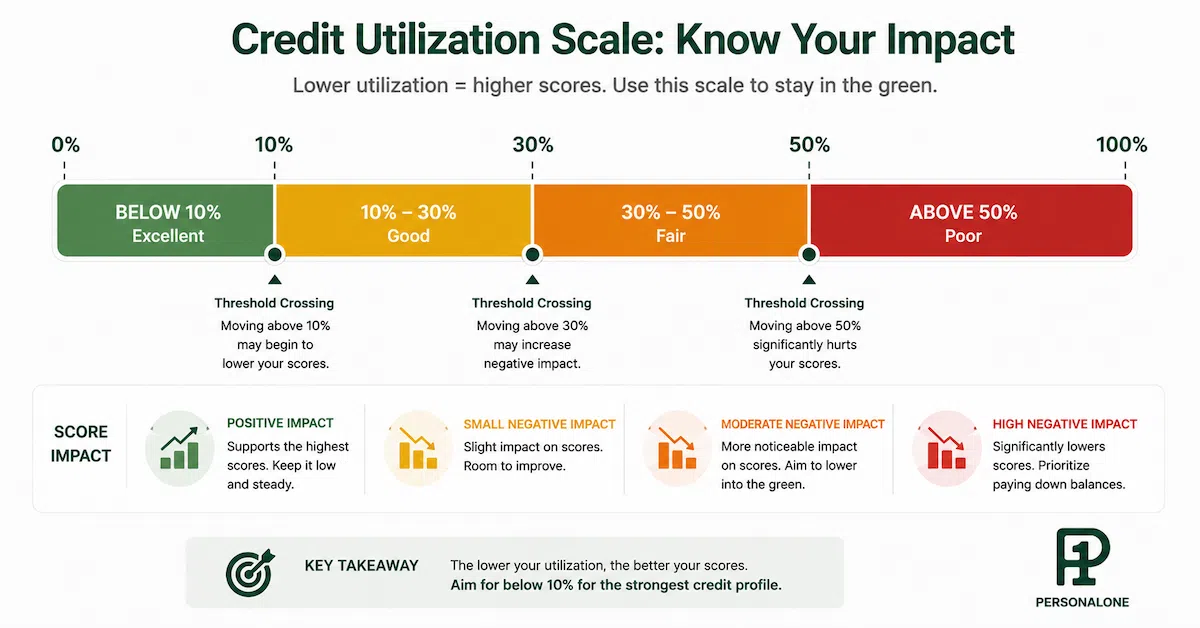
— There are four utilization bands that matter: above 50% (severe damage), 30% to 50% (moderate damage), 10% to 30% (acceptable but suboptimal), and below 10% (optimal). Each band produces a different score response.
— The best credit utilization ratio for the highest possible scores is between 1% and 9% — not 0%. A 0% utilization is marginally worse than 1% because it signals no current credit usage, which scoring models treat slightly less favorably than responsible low usage.
— Both overall utilization and per-card utilization matter simultaneously. A single card above 50% damages your score even when overall utilization is low.
— Utilization has no memory. A high utilization month doesn't compound — the month you report a low balance is the month your score improves. It resets every billing cycle.
The best credit utilization ratio is the number that produces the highest credit score for your specific profile — and every guide on the internet gives you the same answer: below 30%, ideally below 10%. That answer is correct as far as it goes. What it doesn't tell you is why the scoring curve isn't linear, which threshold crossing produces the most score improvement per dollar of balance reduction, or why 1% is better than 0%. Those details are what separate people who know their utilization target from people who understand how to reach it strategically.
Credit utilization accounts for 30% of your FICO score — the second-largest factor after payment history. It's also the fastest-moving factor in your score. Unlike a late payment that sits on your report for seven years, utilization resets every single billing cycle. The month your statement closes with a low balance is the month your score reflects that low balance. No waiting period, no gradual recovery. That combination — high scoring weight plus immediate responsiveness — makes utilization the highest-leverage variable available for anyone who wants to move their score quickly. Understanding exactly where the best credit utilization ratio sits and why it sits there is what makes that leverage precise.
The Four Utilization Bands and What Each One Does to Your Score
The scoring model doesn't treat utilization as a smooth curve where every percentage point of reduction produces the same score improvement. It responds to bands — ranges of utilization where your score sits in a certain tier — and to the threshold crossings between those bands. Moving within a band produces modest improvements. Crossing from one band to the next produces significant ones. Understanding the four bands is what makes utilization management strategic rather than directionally correct.
Band 1 — Above 50%: Severe scoring impact. Any card reporting above 50% per-card utilization is in the highest-damage range. Overall utilization above 50% across all cards combined is similarly damaging. Scores in this band reflect what lenders see as a high-risk borrower — someone using more than half of available credit, which correlates statistically with financial stress and higher default rates. The score penalty in this band is steep. Moving from 80% to 55% produces a meaningful improvement. Moving from 80% to below 50% — crossing the band threshold — produces a significantly larger one. If any card in your portfolio is above 50%, that card is your highest priority regardless of its absolute dollar balance.
Band 2 — 30% to 50%: Moderate scoring impact. This is the range where most financial advice focuses because 30% is the widely cited threshold. The advice is correct — 30% is a meaningful boundary — but the nuance is that being at 32% versus 48% produces different score outcomes even within the same band. The most important movement in Band 2 is crossing below 30%, not just reaching 30%. A card at 31% is materially better than a card at 49%, but both are still in a range that suppresses scores below their potential.
Band 3 — 10% to 30%: Acceptable but suboptimal. A card in this range is not actively damaging your score in the way that Band 1 or Band 2 cards are. But it is leaving score points on the table compared to what the same card at under 10% would produce. For someone actively building toward a specific score goal — a mortgage application, a rate tier target — getting every card from Band 3 into Band 4 is often the difference between reaching the goal and falling just short.
Band 4 — Below 10%: Optimal. This is where people with scores above 780 live. FICO data consistently shows that consumers with exceptional scores carry average utilization in the low single digits — typically 4% to 7%. The band below 10% is where the score responds most favorably, and within that band the difference between 1% and 9% is minimal. The more meaningful distinction is between above 10% and below 10% — that crossing is where the most significant improvement per dollar of balance reduction occurs for cards currently in Band 3.
What I've Seen
The most common misconception I encounter is someone who has worked their utilization down to 28% and is puzzled that their score hasn't improved more. They crossed the 30% threshold but stayed in Band 2 territory — and they're now targeting 25%, then 22%, expecting incremental gains. The reality is that the meaningful score improvement comes from crossing into Band 4 — below 10% — not from optimizing within Band 3. The same dollars that reduced them from 35% to 28% would have produced a much larger score improvement if applied to a single card to bring it from 28% to 8%. Threshold crossings, not gradual reductions within a band, are where the score responds.
Why 1% Is Better Than 0% — and What It Means in Practice
The 0% utilization question is one of the most counterintuitive facts in credit scoring — and one that produces genuine confusion when people first encounter it. A 0% utilization rate is marginally worse for your score than a utilization rate in the low single digits. The explanation matters because it affects how you manage dormant cards and low-use accounts.
Credit scoring models interpret 0% utilization on a revolving account as a signal that the account is not being actively used for credit. The model is designed to evaluate how you manage credit you actually use, not how well you avoid using it. A consumer who maintains a 1% to 5% utilization rate is demonstrating that they use credit and manage it responsibly. A consumer at 0% is not demonstrating credit management — they are demonstrating credit avoidance, which the model treats slightly less favorably.
The practical implication is small — the difference between 0% and 2% utilization on a given card is not significant enough to prioritize as a standalone goal. What it means in practice is that leaving cards completely unused is slightly suboptimal compared to maintaining a minimal recurring charge on each card that produces a low but non-zero reported balance. A $10 monthly subscription on a dormant card with a $5,000 limit produces 0.2% utilization — far below 1%, but non-zero. Combined with consistent payment, this keeps the account active, prevents issuer-initiated closure, and registers a small positive utilization signal.
The broader utilization framework — including how the 30% guidance understates what's actually optimal for high-score profiles and what the research on scoring band thresholds actually shows — is covered in depth in the companion article on what credit utilization is and why the 30% rule is a myth. That article is the foundational piece for understanding why the common guidance points to a floor rather than a target.
Overall Utilization vs. Per-Card Utilization: Both Matter
Every utilization target applies to both your overall utilization rate and to each individual card's per-card rate simultaneously. This is the detail most utilization guides mention briefly and then proceed to ignore — focusing exclusively on overall utilization while the per-card calculation does its own damage in the background.
Overall utilization is calculated by dividing your total card balances by your total card limits across all accounts. Per-card utilization is each individual card's balance divided by that specific card's limit. The scoring model evaluates both numbers independently. A single card at 75% per-card utilization damages your score regardless of whether your overall utilization is 8% because your other cards are empty. The per-card signal is that you are using 75% of a credit line — which the model treats as a risk indicator independent of your other accounts.
The practical target, stated precisely: every individual card below 10% per-card utilization AND overall utilization below 10%. Both conditions produce the optimal scoring outcome. Overall utilization at 8% with one card at 65% per-card is not an optimal utilization profile — it is an overall-optimal profile with a per-card liability. The comprehensive strategy for managing per-card utilization across multiple cards simultaneously — including the triage sequence for which card to address first when cash flow is limited — is covered in the article on how to manage credit utilization across multiple cards.
How to Calculate Your Current Utilization Rate
Knowing your target ratio requires knowing your current ratio — both overall and per-card. The calculation is straightforward and takes less than five minutes with the information available in your credit card accounts.
Overall utilization calculation. Add up the current reported balances on every credit card and revolving line of credit you carry. Add up the credit limits on those same accounts. Divide total balances by total limits. Multiply by 100. The result is your overall utilization percentage. Example: $2,400 in total balances across all cards divided by $18,000 in total limits equals 13.3% overall utilization — Band 3, above optimal but not in a damage range.
Per-card utilization calculation. For each individual card, divide the card's current reported balance by that card's credit limit. Multiply by 100. Example: Card A has a $1,800 balance on a $3,000 limit — 60% per-card utilization (Band 1, severe). Card B has $400 on a $8,000 limit — 5% per-card utilization (Band 4, optimal). Card C has $200 on a $7,000 limit — 2.9% (Band 4, optimal). Overall utilization: $2,400 / $18,000 = 13.3% (Band 3). Per-card: Card A is the problem despite acceptable overall utilization.
What balance to use in the calculation. Use your most recently reported balance — the balance that appeared on your last statement, not your current real-time balance. Your score is calculated from reported balances, not current balances. If your statement closed yesterday with a $1,500 balance but you've made $800 in payments since then, your reported utilization is still based on the $1,500 until your next statement closes with the lower balance. This is why pre-close payment timing matters — what you report at statement close determines the utilization your score calculates from, not what your balance is on any given day during the cycle.
Setting Your Utilization Target Based on Your Credit Goal
The precise utilization target worth pursuing depends on what you're trying to achieve with your credit score and over what timeline. Not every situation requires Band 4 optimization — and understanding which target fits your situation prevents over-engineering a system that produces marginal score gains for significant effort.
If your goal is score maintenance. You have an established credit profile, no major credit applications planned, and you want to keep your score stable without active management. Target: all cards below 30% per-card utilization and overall utilization below 30%. This is the minimum responsible target — it keeps you out of the damage bands without requiring monthly active management. Set it and monitor it quarterly.
If your goal is score building. You are actively working toward a score milestone — a specific tier, a 50-point improvement, or a range that unlocks a better rate on a future product. Target: every card below 10% per-card utilization and overall utilization below 10%. This is the Band 4 target that produces the score response associated with excellent credit profiles. It requires active pre-close payment management but produces the most significant score improvement available from the utilization factor alone.
If your goal is pre-application optimization. You are 90 to 180 days from a major credit application — mortgage, auto loan — and want your score at its highest possible point for the lender pull. Target: every card below 5% per-card utilization and overall utilization below 5%. This aggressive target produces the highest score reading available from utilization and is worth the active management effort in the pre-application window specifically. The score improvement from moving cards from 8% to 4% is modest but real, and in a rate-tier context where 0.25% better rate saves $15,000 over a mortgage term, modest is worth pursuing. Achieving and maintaining this level requires the two-payment strategy applied to every card consistently in the months before application. The mechanics of paying your credit card twice a month to control reported balances at statement close is the execution tool for this level of utilization management.
The Fastest Path From Your Current Ratio to Your Target
Utilization management is the fastest-moving factor in credit scoring, which makes the path from current ratio to target ratio a tractable problem with a predictable timeline. The variables are your current band position, your available cash flow for balance reduction, and the specific threshold crossings that produce the most improvement per dollar spent.
The highest-leverage actions in order. First, pay any card above 50% per-card utilization below 50% — this crossing produces the largest single-cycle score improvement available. Second, pay any card above 30% below 30% — the next most significant threshold crossing. Third, bring overall utilization below 30% if it's currently above. Fourth, work every card from Band 3 (10% to 30%) into Band 4 (below 10%). Fifth, maintain Band 4 across all cards through pre-close payment discipline and close date management.
Without a balance paydown — using limit increases. If cash flow constraints prevent balance reduction, a credit limit increase on high-utilization cards achieves the same band improvement without reducing what you owe. A $2,000 balance on a $3,000 limit (67% — Band 1) moves to $2,000 on a $7,000 limit (29% — Band 3) with a single approved limit increase — crossing two band thresholds without paying a dollar of additional balance. The timing, preparation, and issuer selection for requesting a limit increase strategically is covered in the article on how to request a credit limit increase to lower your utilization.
The timeline for seeing results. Utilization changes appear in your score within one billing cycle after the new balance reports at statement close — typically 30 to 45 days from when you make the payment. There is no accumulation period, no waiting for the improvement to phase in. The billing cycle that closes with your target balance is the cycle your score reflects the improvement. This immediate responsiveness is what makes utilization the preferred lever for score improvement before a time-sensitive credit application.
For anyone managing utilization reduction as part of a broader credit improvement effort — addressing errors, building payment history, and managing utilization simultaneously — the article on how to increase your credit score quickly provides the complete multi-factor framework for coordinating all the levers available and sequencing them for the fastest compound score improvement.
Build the Complete Utilization System
Knowing your target ratio is the starting point. The Credit Utilization & Payment Strategy cluster covers every tool for reaching it — payment timing, limit increases, multi-card management, and the reporting mechanics that control what your score actually sees each month.
Explore the Full StrategyGovernment Resources
CFPB — What Is a Credit Utilization Rate? — Official guidance on how utilization is calculated and how it affects your score.
CFPB — Credit Reports and Scores — Consumer rights regarding credit reporting, score factors, and how to access your full credit reports.
FTC — Understanding Your Credit — Federal overview of how credit scores are calculated and what factors lenders evaluate.
Return to the full credit building and protection guide for a complete overview of every credit strategy covered on PersonalOne.
Frequently Asked Questions
What is the best credit utilization ratio for the highest credit score?
Between 1% and 9% per card and overall — this is the Band 4 range associated with the highest scoring profiles. FICO data shows that consumers with scores above 800 carry average utilization in the low single digits, typically 4% to 7%. The exact number within that range matters less than consistently staying below 10% on every card and overall. The difference between 2% and 7% utilization is marginal. The difference between 7% and 11% crosses a scoring threshold and produces a measurable score difference.
Is 0% credit utilization bad for your score?
Marginally, yes — 0% is slightly worse than 1% to 5%. A 0% utilization rate signals that you aren't actively using your revolving credit, which scoring models interpret slightly less favorably than low but non-zero usage. The practical impact is small — the difference between 0% and 2% is not significant in absolute terms. The more important principle is to avoid leaving cards completely unused to the point where issuers close them for inactivity, which removes the available credit from your utilization calculation entirely and typically produces a larger score drop than the 0% signal does.
Does lowering utilization improve your score immediately?
Yes — within one billing cycle. Utilization has no memory in the credit scoring model. The month your statement closes with a lower balance is the month your score reflects the improvement. There is no phase-in period, no compounding requirement, no waiting for the credit bureaus to average the change over several months. If your card closes this month with 8% utilization after closing last month at 65%, your score this month reflects 8% utilization — not a blend of both. This immediate responsiveness is what makes utilization the fastest lever for moving your score before a time-sensitive application.
Does my utilization ratio affect my score if I pay in full every month?
Yes — and this is one of the most important facts about credit utilization that most people don't know. Paying in full by the due date does not mean your reported utilization is low. Your card issuer reports your balance on the statement close date — typically 21 to 25 days before the payment due date. If your statement closes with a $2,000 balance and you pay it in full three weeks later, the bureaus already received the $2,000 balance. Your utilization was calculated from that figure for that cycle. Full payment clears the balance from your account but cannot retroactively change the reported balance from the statement that already closed.
How does utilization affect different credit score ranges differently?
The impact of utilization is proportionally larger at higher score ranges — a move from 35% to 8% utilization produces a bigger point improvement for someone at 740 than for someone at 580. This is because at lower score ranges, other negative factors (late payments, collections, derogatory marks) are suppressing the score more significantly than utilization, so utilization improvements produce smaller net gains. At higher score ranges where payment history is clean and the profile is strong, utilization becomes a primary differentiating factor. The person at 740 trying to reach 780 will often find that utilization management is the highest-leverage remaining tool available.
What happens to my score if my utilization spikes one month?
Your score drops for that cycle and recovers the following cycle when the lower balance reports. One high-utilization month does not leave a lasting mark the way a late payment does. If your utilization spikes to 70% in December due to holiday spending and drops to 8% when January's statement closes, your score reflects 70% utilization in December and 8% utilization in January. The December drop doesn't carry forward into February. This is the no-memory feature of utilization that makes it the most forgiving major scoring factor — the damage is real but fully reversible in one cycle.
This article is for educational purposes only and does not constitute financial or credit advice. Credit score outcomes vary based on individual profiles, scoring models, and financial circumstances. Utilization band thresholds and score impact ranges are general estimates based on published FICO and VantageScore documentation — individual results will vary. PersonalOne is a free financial education platform.