August 2026
Home › Credit Building & Protection › Credit Utilization & Payment Strategy › How Paying Your Credit Card Twice a Month Protects Your Credit Score
What You Need to Know
— The two-payment strategy works because of one specific date: your statement close date. That is the only date your balance gets reported to the credit bureaus. Your due date has nothing to do with what your score sees.
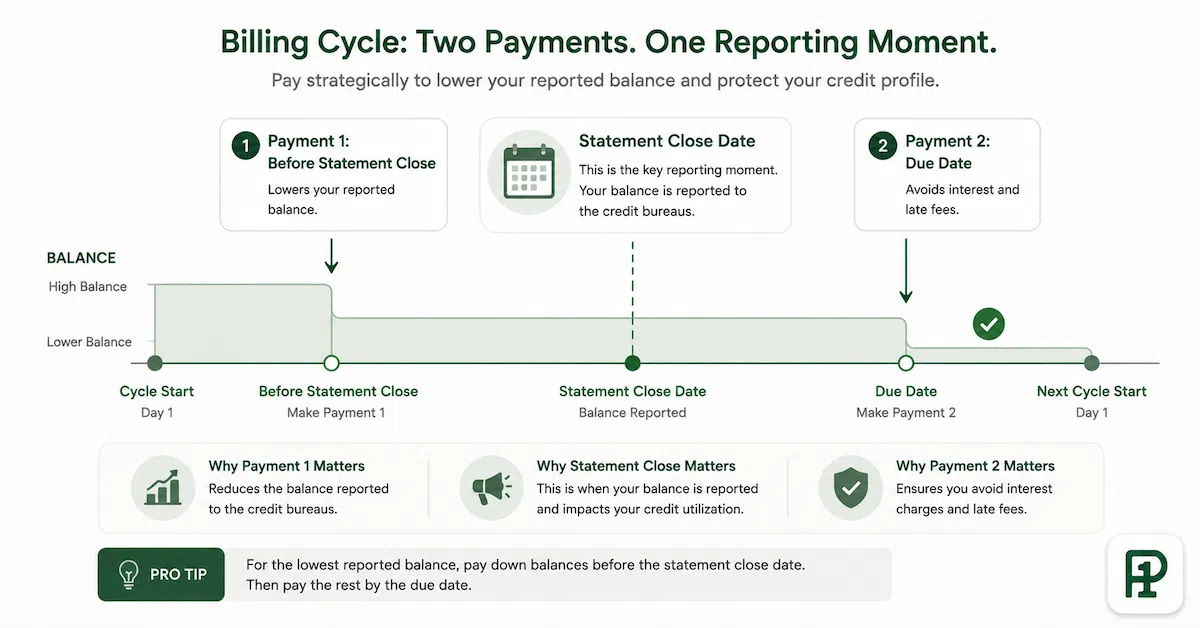
— Payment one — before statement close — controls your reported utilization. Payment two — on or before the due date — protects your payment history. Each payment has a distinct job.
— Paying twice a month does not earn bonus credit score points for frequency. The score only responds to what gets reported at statement close. Timing is everything.
— This strategy works whether you carry a balance or pay in full every month — the mechanics are the same. The goal is always to control what balance is reported, not just what balance you carry.
— For people with high spending months, this strategy is the difference between a utilization spike that tanks their score and a clean report that reflects their actual financial behavior.
The two-payment-per-month strategy is one of the most searched credit tactics on the internet — and one of the most misunderstood. Most articles confirm it works, explain the 15/3 rule, and move on. What they don't explain is the one thing that makes the strategy make sense: your credit score doesn't care how often you pay. It only cares what balance is reported on your statement close date.
Once you understand that, everything simplifies. You're not trying to pay twice because frequency is good. You're paying twice because paying once — on the due date — often means your full month of spending got reported to the bureaus before you paid any of it. The statement closed with a high balance, your utilization spiked, and your score reflected that spike even though you paid in full that same month. The two-payment strategy is the fix for that specific problem. This article covers exactly how it works, how to set it up, and when it matters most.
The Only Date That Matters to Your Credit Score
Most people manage their credit cards around one date: the payment due date. Pay by that date, avoid late fees, stay in good standing. That logic is correct for protecting your payment history — but it has nothing to do with your credit utilization, which is the factor the two-payment strategy is designed to control.
Your credit card issuer reports your balance to the credit bureaus once per month, and that report happens on your statement close date — the last day of your billing cycle, when your statement is generated. Whatever balance appears on your account at that moment is what gets sent to Equifax, Experian, and TransUnion. That reported balance, divided by your credit limit, is your utilization ratio for that card.
The due date — the date your payment is actually required — typically falls 21 to 25 days after the statement close date. If you wait until the due date to pay, your full month of spending has already been reported. The bureaus received your high balance. Your utilization was calculated from that high balance. Your score reflected it — and it won't reflect the payment you made until next month's statement closes with the lower balance.
This is the gap the two-payment strategy closes. Understanding exactly how credit card payments are reported to the bureaus — the full reporting pipeline from your account to the bureau to your score — makes this mechanic completely clear and prevents the confusion that comes from doing everything right and still watching your score fluctuate unexpectedly.
How the Two-Payment Strategy Actually Works
The strategy has two payments with two completely different purposes. Understanding the job of each payment is what makes the system reliable rather than a guessing game about timing.
Payment One — Before statement close. Purpose: control your reported utilization. This payment happens a few days before your statement closing date. Its only job is to bring your balance down to the level you want reported. If your credit limit is $5,000 and you've spent $1,800 during the billing cycle, Payment One brings that balance below $500 — ideally below 10% of your limit — before the statement closes and that balance gets sent to the bureaus. This is the payment that moves your credit score. The timing relative to the statement close date is what matters, not the amount relative to what you owe.
Payment Two — On or before the due date. Purpose: protect your payment history. This payment covers whatever remaining balance is due after Payment One. Its job is to ensure you never have a missed or late payment recorded on your account. Payment history is 35% of your FICO score — protecting it is non-negotiable. If you paid the full balance in Payment One, Payment Two may be minimal or zero. If you paid down a partial balance in Payment One, Payment Two covers the rest or at least the minimum required to avoid a late payment notation.
The two payments are not interchangeable. Payment One is a utilization management tool. Payment Two is a payment history protection tool. Running both means your score sees both a low reported balance and a perfect payment record — which is the optimal outcome from a single billing cycle.
Finding Your Statement Close Date and Setting the System Up
The statement close date is the foundational piece of information you need to implement this strategy. Without it, you're guessing at timing and the strategy becomes unreliable. Every credit card issuer publishes your statement close date — it appears on your monthly statement, in your online account dashboard, and in the account settings of your card's app. It is not the same as your due date, though both dates should be visible in the same place.
Once you have your statement close date, the implementation is straightforward. Set a recurring calendar reminder three to five days before the statement close date. That's your window for Payment One. Three to five days gives you enough buffer for the payment to fully process and post to your account before the statement generates. Same-day or next-day processing is common with most issuers for ACH payments from a linked checking account, but a small buffer eliminates any risk of processing delays.
For multiple cards: Each card has its own statement close date. You manage each one independently. The strategy doesn't require all cards to close on the same date — it requires you to know each card's close date and set a pre-close payment reminder for each. Many people find it useful to list their cards with their close dates and due dates in a simple notes document or spreadsheet so the calendar reminders are easy to set up and verify.
If your close date is inconvenient: Most credit card issuers will change your statement close date upon request. If your current close date falls at a time when your checking account balance is typically low — right before payday, for example — you can call the number on the back of your card and ask to move the close date to a more convenient point in the month. This small adjustment can make the pre-close payment much easier to execute consistently. The connection between your pay schedule and your payment timing is covered in depth in the article on how paycheck timing affects your credit utilization — a factor that makes a bigger difference than most people realize in how reliably this strategy works month to month.
What I've Seen
The most common version of this mistake I see: someone pays their card in full every single month, never carries a balance, considers themselves responsible — and then wonders why their utilization is showing 40% or 50% on their credit report. They paid in full. They just paid on the due date, three weeks after the statement closed with a high balance. The bureaus already had the high number by the time the payment cleared. Switching to a pre-close payment — just moving the payment date earlier in the month — produces a score improvement within one billing cycle without changing anything else about their behavior. Same amount paid, completely different result.
When This Strategy Matters Most
The two-payment strategy produces the most measurable score impact in specific situations. Understanding which situations those are helps you prioritize where to apply it first if you have multiple cards.
High-spending months. If you put a large purchase on a credit card — a vacation, a home repair, a medical bill — your utilization for that card can spike dramatically in a single month. Without a pre-close payment, that spike gets reported and your score drops temporarily even though you planned to pay it. A pre-close payment that brings the balance back below your target utilization threshold before the statement closes prevents the spike from ever appearing on your report.
Cards you use heavily for rewards. Many people put nearly all their monthly spending on one rewards card to maximize points or cashback. High spending on a single card means high utilization on that card — even if your total available credit across all cards is large. Individual card utilization matters, not just overall utilization. A pre-close payment on your primary spending card keeps that card's individual ratio in check even while you maximize rewards spending.
The 90-day window before a major credit application. In the three months before applying for a mortgage, auto loan, or any significant credit product, your utilization at statement close is the number that will appear on your report when the lender pulls it. Managing every statement close date in that window with a pre-close payment ensures the lender sees your score at its best, not mid-cycle after a high-spending period. The article on why your credit score drops even when you pay on time covers the full range of utilization-related score fluctuations — many of which the two-payment strategy directly addresses.
When you're actively building or rebuilding credit. For someone with a $500 or $1,000 secured card limit, even a $200 purchase represents 20% to 40% utilization. At low credit limits, every dollar of reported balance has an outsized impact on the utilization ratio. The pre-close payment strategy is more important at low credit limits than at high ones — the math is more sensitive. A $200 payment before statement close on a $500 limit card is worth far more in score terms than the same payment on a $10,000 limit card.
What Utilization Target to Aim For at Statement Close
The purpose of Payment One is to bring your balance to a specific target before the statement closes. Knowing what that target should be is what makes the payment purposeful rather than arbitrary.
The standard guidance is to keep utilization below 30% — both overall and on each individual card. That threshold is accurate as a minimum standard. But 30% is not the optimal target for someone actively working to maximize their score. The score improvement curve is not linear — utilization below 10% per card produces meaningfully better scores than utilization in the 20% to 30% range, and utilization below 10% on every card simultaneously is where the strongest score readings live.
The practical target for Payment One: bring each card to a reported balance of under 10% of its limit. For a $2,000 limit card, that means a reported balance of under $200. For a $5,000 limit card, under $500. If you cannot get to under 10% on a given month due to cash flow constraints, the next best target is under 30%. Getting a card from 70% utilization to 25% still produces a score improvement — it's not all-or-nothing. But under 10% is the threshold where the score responds most favorably.
The full breakdown of why specific utilization thresholds produce the score results they do — and why the commonly cited 30% guideline understates what's actually optimal — is covered in the article on the best credit utilization ratio for your score. Understanding the threshold mechanics helps you set Payment One at the right amount rather than guessing at a round number.
Combining the Two-Payment Strategy With a Bills System
The two-payment strategy works reliably when it's automated — not when it depends on remembering to log in and make a manual payment at the right time every month. The most durable implementation connects the pre-close payment to a structured bills system where payment triggers are set in advance rather than executed reactively.
The foundational structure for this is a dedicated bills account — a checking account where your fixed obligations and pre-close credit card payments originate — separate from the account where variable spending happens. When the pre-close payment comes out of a dedicated bills account rather than your primary spending account, there's no risk of the payment being unavailable because you spent the money on groceries that week. The article on the bills system that helps prevent missed payments covers the full account structure that makes this automation reliable rather than aspirational.
If full automation isn't immediately available — some issuers don't allow recurring custom payment amounts outside of the minimum or statement balance — a calendar reminder set three to five days before each card's statement close date is the manual equivalent. The reminder prompts the payment, which takes two minutes to execute through your bank's app. Over time, as the habit becomes automatic, the calendar reminder becomes a confirmation step rather than a prompt.
Build the Complete Utilization System
Payment timing is one piece. The Credit Utilization & Payment Strategy cluster covers every utilization lever — limit increases, multi-card management, paycheck timing, and the reporting mechanics that determine what your score actually sees.
Explore the Full StrategyGovernment Resources
CFPB — What Is a Credit Utilization Rate? — Official guidance on how utilization is calculated and how it affects your credit score.
CFPB — Credit Reports and Scores — How credit reporting works and your rights as a consumer.
FTC — Understanding Credit Scores — Federal Trade Commission overview of how scores are calculated and used by lenders.
Return to the full credit building and protection guide for a complete overview of every credit strategy covered on PersonalOne.
Frequently Asked Questions
Does paying your credit card twice a month actually improve your credit score?
Yes — but only if the first payment happens before your statement closing date. Paying twice a month with both payments after the statement closes does nothing for your score. The score improvement comes entirely from having a lower balance reported at statement close. If Payment One lands before the statement closes and brings your balance below your target utilization threshold, that lower balance is what gets reported to the bureaus and your score reflects it. The frequency of payments is irrelevant. The timing relative to the statement close date is everything.
What is the 15/3 rule and does it work?
The 15/3 rule is a specific version of the two-payment strategy: pay 15 days before your due date and again 3 days before your due date. It's widely shared and technically valid as a payment schedule. The limitation is that it's framed around the due date rather than the statement close date — which is the date that actually matters to your score. A more reliable version of the same strategy: pay a few days before your statement close date (to control what gets reported) and again on or before the due date (to protect payment history). This approach is directly tied to the mechanism that moves your score rather than working backward from the due date.
What if I can't afford to pay down the balance before the statement closes?
Pay whatever you can before statement close, even if it doesn't bring the balance to your ideal target. Getting a $2,000 balance on a $3,000 limit card down to $1,500 before the statement closes moves utilization from 67% to 50% — that improvement shows in your score even if it's not the full reduction you wanted. Every dollar of balance reduction before statement close produces a scoring benefit. The strategy doesn't require a full payoff to be useful. If cash flow constraints are the limiting factor, the goal is to bring the balance as low as possible before close and cover the minimum required by the due date, then work toward having sufficient buffer to execute the full pre-close payment in future months.
Does this strategy work if I pay my card in full every month?
Yes — and this is one of the most important points to understand. Paying in full by the due date does not mean your reported utilization was low. If your statement closed with a $2,000 balance on a $3,000 limit card and you paid the full $2,000 three weeks later by the due date, the bureaus already received the $2,000 balance. Your utilization was calculated as 67% for that cycle. The full payment you made came too late to affect what was reported. Paying in full before the statement closes — so the statement generates with a low balance — is the version that produces low reported utilization regardless of whether you're paying in full or carrying a partial balance.
How do I find my statement close date?
Log into your credit card account online or through the issuer's app. Your statement close date appears on your current statement, in your account summary, or in your account settings under billing cycle information. It is not the same as your due date — the due date is typically 21 to 25 days after the close date. If you cannot locate the close date in your account, call the number on the back of your card and ask the representative to confirm both your statement close date and your payment due date. Also ask whether the close date can be changed if the current date is inconvenient relative to your pay schedule.
Should I set up autopay for the pre-close payment?
If your card issuer allows it, yes. Some issuers offer autopay options for custom amounts or for the current balance — either of these can be set to trigger a few days before statement close. Check your card's autopay settings for available options. If a fully automated pre-close payment isn't available through your issuer, a recurring calendar reminder set three to five days before your statement close date is the reliable manual alternative. The due-date autopay — set to pay the statement balance or minimum — should remain in place as the safety net for Payment Two regardless of how Payment One is managed.
This article is for educational purposes only and does not constitute financial or credit advice. Credit score outcomes vary based on individual credit profiles, scoring models, and financial circumstances. Always verify statement close dates and payment processing times directly with your card issuer. PersonalOne is a free financial education platform.