July 2026
Home › Credit Building & Protection › Credit Score Building Strategies › The Biggest Credit Score Myths That Won't Die
What You Need to Know
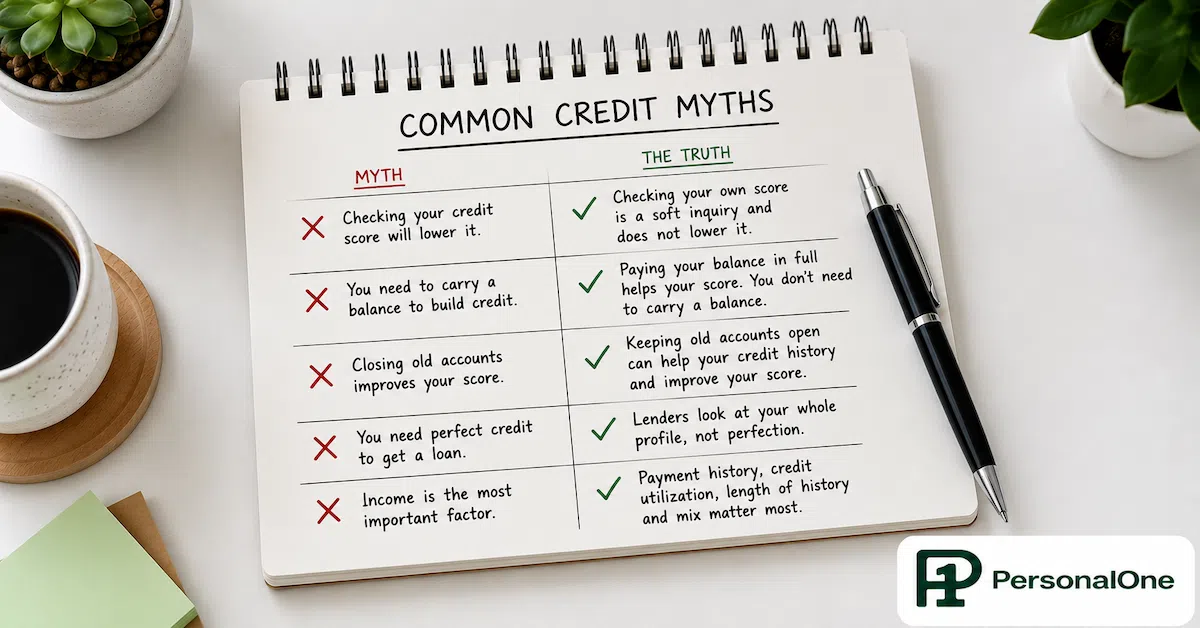
— Most credit score myths persist because they sound logical. The carrying-a-balance myth, the checking-hurts-your-score myth, the closing-old-cards myth — each one has a plausible-sounding reason behind it that makes the false belief sticky.
— Acting on these myths costs real money. The carrying-a-balance myth alone costs the average believer hundreds of dollars per year in unnecessary interest charges while producing zero score benefit.
— Several new myths have emerged in 2026 around VantageScore 4.0, BNPL payment reporting, and rent payment credit building. Some of these are partially true in specific circumstances, which makes them more dangerous than simple myths.
— Income, employment status, and relationship status have zero effect on a credit score. These are among the most widespread myths and among the most consequential to correct.
— The myths in this article are ranked by the cost of believing them — financial cost, opportunity cost, and behavioral cost. The ones that produce the most damage in practice come first.
Credit score myths are uniquely resilient because they are rarely pure fabrications. Most of them contain a grain of truth that makes the false conclusion feel reasonable. The carrying-a-balance myth exists because credit activity does help build a score — but the activity that matters is on-time payment, not the balance carried and the interest paid on it. The checking-hurts-your-score myth exists because some credit inquiries do lower a score — but hard inquiries from lender applications are categorically different from soft inquiries when you check your own score. The logic behind each myth is partially sound. The conclusion it leads to is wrong.
What makes these myths particularly damaging is that they cause people to either pay more than necessary (carrying balances, paying interest) or avoid actions that would actually help them (checking their score, opening an account with a good payment history opportunity). The myths do not just produce misunderstanding — they produce measurable financial harm.
This article covers the most persistent credit score myths, why each one sounds plausible, what the truth actually is, and the real dollar cost of acting on the wrong information. For the broader framework of what actually does build a score effectively, see Credit Score Building Strategies.
Myth 1: You Need to Carry a Balance to Build Credit
The Myth
Leaving a small balance on your credit card each month signals to the bureaus that you are actively using credit, which helps build your score.
Why it sounds true: Credit activity does help build a score. An account with zero activity over many months can sometimes be closed by the issuer or excluded from the scoring calculation as inactive. That much is accurate.
What is actually true: The credit-building activity that matters is payment history — specifically, having a payment reported as on time each month. That payment can be for a $5 balance or a $500 balance. The size of the remaining balance after the payment is irrelevant to payment history. What the remaining balance does affect is utilization — and higher utilization actively hurts the score. Carrying a $500 balance on a $1,000 limit card is reported as 50% utilization, which is a drag on the score, not a benefit.
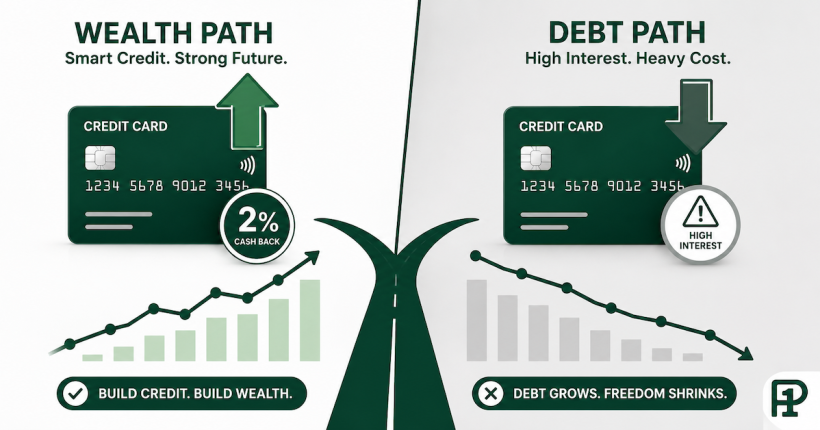
The real cost of this myth: The average credit card APR in 2026 is approximately 22%. A person carrying a $500 balance because they believe it helps their score is paying roughly $110 per year in interest charges for zero score benefit. On a $2,000 carried balance, that is $440 per year in pure unnecessary expense.
What to do instead: Use the card each month — any small purchase keeps the account active. Pay the full statement balance before the due date. The on-time payment is captured in payment history. The zero balance reduces utilization to its minimum. Both outcomes are better than carrying a balance. The full utilization strategy is covered in credit utilization and payment strategy.
Myth 2: Checking Your Credit Score Lowers It
The Myth
Every time you check your credit score, it creates an inquiry that lowers your score.
Why it sounds true: Credit inquiries do affect the score — specifically, hard inquiries from lender applications can lower a score by a few points. The logic seems to extend to any credit check.
What is actually true: There are two categorically different types of credit inquiries. Hard inquiries occur when a lender pulls your credit as part of an application for new credit — a credit card application, a mortgage, an auto loan. These can lower the score by 5–10 points and remain on the report for two years. Soft inquiries include checking your own score, pre-qualification checks, employer background checks, and credit monitoring services. Soft inquiries have zero effect on the score, ever. The bureaus distinguish between the two types at the data level — they are not the same thing with different names.
The real cost of this myth: People who avoid checking their credit score because of this myth miss errors, identity theft, and unauthorized accounts that can lower the score by far more than any hard inquiry. The CFPB estimates that roughly 1 in 5 credit reports contains an error significant enough to affect creditworthiness. Checking the report regularly is the only way to catch these.
What to do instead: Check your credit score monthly through your bank's free credit monitoring tool, Credit Karma, or directly through the bureaus. Pull your full credit report at least once per year at annualcreditreport.com — now available weekly for free from all three bureaus. None of this affects the score. If you want to understand why the score you see changes from month to month even when nothing significant has happened, why your credit score changes every month covers the full mechanics.
Myth 3: Closing Old Credit Cards Improves Your Score
The Myth
Closing unused or old credit cards reduces the amount of available credit, which shows lenders you do not need or rely on a lot of credit, improving your score.
Why it sounds true: The idea that having less available credit makes you look less risky has a surface-level logic. It also appeals to the instinct to simplify finances by eliminating accounts that are not being used.
What is actually true: Closing a card does two things that typically hurt the score. First, it reduces total available credit. If the total credit limit across all cards drops because a card is closed, the utilization ratio on remaining cards goes up for the same spending level — higher utilization, lower score. Second, if the closed card was the oldest account or one of the older accounts, closing it lowers the average account age, which reduces the length-of-credit-history contribution to the score. The account stays on the report for up to ten years after closure, but once it drops off, the age contribution disappears.
The one legitimate reason to close a card: An annual fee that is not justified by the card's benefits. If a card charges $95 per year in fees and provides no meaningful rewards or benefits, closing it is a reasonable financial decision. Accept that it may cause a modest score dip and plan accordingly.
What to do instead: Keep old cards open. Make a small purchase once every few months to keep them active. If the issuer closes the card due to inactivity, it was going to happen anyway — but for cards you control, inactivity that leads to voluntary closure costs more in score impact than the inconvenience of occasional use.
What I've Seen
The carrying-a-balance myth is the one I correct most often — and the one where the correction produces the most immediate and visible relief. The standard response when I explain it is some version of "I've been paying interest for two years thinking it was helping my score." It is not just a misunderstanding about credit mechanics. It is an expensive one. The second most costly myth in practice is the closing-old-cards myth, which I typically encounter right before someone is about to apply for a mortgage. Closing a card in the months before a mortgage application — for any reason — is one of the most reliable ways to produce a score drop at exactly the wrong moment.
Myth 4: Income and Employment Affect Your Credit Score
The Myth
A higher income or stable employment improves your credit score. Losing your job will hurt your credit score.
Why it sounds true: Income and employment are used in lender underwriting decisions — a lender absolutely considers income when deciding how much to lend and at what rate. Since income affects lending decisions, it is natural to assume it also affects the credit score those decisions are partly based on.
What is actually true: Income and employment status do not appear in a credit report and are not factors in any credit score calculation. FICO and VantageScore use only information from the credit report — payment history, balances, account ages, inquiries, and credit types. A person earning $30,000 per year with perfect credit management will have a higher score than a person earning $300,000 who misses payments and carries high balances. Losing a job does not lower the score. Missing a payment because of a lost job does.
The practical implication: Job loss itself is credit-neutral. The downstream financial behaviors that sometimes follow job loss — missed payments, high credit card utilization from cash flow pressure, new collection accounts — affect the score. The distinction matters because it identifies where to focus during a financially difficult period: protecting payment history is the credit priority, not the employment status itself.
Myth 5: You Have One Credit Score
The Myth
Your credit score is a single number that all lenders see.
Why it sounds true: When people talk about "their credit score," the singular framing is nearly universal. Credit monitoring apps typically show one number. The myth is embedded in the standard language around credit.
What is actually true: You have dozens of credit scores. FICO alone has over 40 different scoring models — FICO 8, FICO 9, FICO 10, FICO Auto Score, FICO Bankcard Score, and others. VantageScore has multiple versions. Each model uses a slightly different algorithm and produces a different number for the same person. The same consumer can have scores that differ by 20–40 points between FICO 8 and VantageScore 3.0. A 750 FICO score is "very good." A 750 VantageScore is "good" under a wider tier definition.
The 2026 update: Fannie Mae and Freddie Mac now accept VantageScore 4.0 alongside FICO models for conforming mortgage applications. This is a significant change. A borrower who scores 720 on FICO 8 but 745 on VantageScore 4.0 — potentially because VantageScore 4.0 incorporates on-time rent payments — may qualify for better mortgage terms than a FICO-only evaluation would suggest.
What to do instead: Know which model the specific lender uses for the specific product. For mortgages, ask which scoring model is being used. For credit cards, most major issuers use FICO 8 or FICO Bankcard Score 8. For auto loans, FICO Auto Score versions are common. The score that matters is the one the lender uses — not the score your banking app shows. The full breakdown of what each score range means across FICO and VantageScore is in what is a good credit score in 2026.
Myth 6: Paying Off a Collection Account Removes It From Your Report
The Myth
Once you pay off a collection account, it disappears from your credit report and stops affecting your score.
Why it sounds true: Paying a debt resolves the obligation. It seems logical that a resolved obligation would be treated as if it never happened.
What is actually true: Paying a collection account does not remove it from the credit report. The account stays on the report for seven years from the original delinquency date, regardless of whether it is paid or unpaid. What changes when it is paid is the status — from "unpaid collection" to "paid collection." Under FICO 9 and VantageScore 4.0, a paid collection has less scoring impact than an unpaid one. Under the older FICO 8 model (still widely used), a paid collection is treated similarly to an unpaid one in terms of score impact.
The 2026 update: Medical collections under $500 were removed from credit reports by the three major bureaus in 2023. Medical collections under $500 that have been paid are no longer reported at all. Unpaid medical collections over $500 still appear but carry less weight under newer scoring models.
What to do instead: When negotiating with a collection agency, ask for a "pay for delete" agreement in writing before paying — where the collector agrees to remove the tradeline from the report as a condition of payment. Not all collectors will agree, and the practice is technically against credit bureau agreements with collectors, but it sometimes works. If pay for delete is not available, paying the collection is still the right move for debt resolution, but expect the account to remain on the report for the full seven-year period. For the specific remediation sequence that produces the fastest score recovery after a derogatory item, see how to increase your credit score quickly.
The 2026 Myths: Newer Beliefs That Are Partially Wrong
Several newer credit beliefs have emerged around recent changes to scoring models and reporting practices. These are more nuanced than simple myths because they contain elements of truth that make them harder to correct cleanly.
"Rent payments always build credit now." Partially true. Rent payments can be reported to the credit bureaus through services like Experian RentBureau, RentTrack, and others. VantageScore 4.0 and FICO 10T incorporate this data when it is available. But traditional FICO 8 — still the most widely used model by lenders — does not use rent payment data. Whether rent payments help your score depends entirely on which scoring model the specific lender uses. It is not automatic and it is not universal.
"BNPL payments now build credit." Partially true. Some BNPL providers now report to the bureaus. Affirm began reporting to Experian in 2022. Klarna and others have followed. But the impact varies by scoring model. FICO 9 and VantageScore 4.0 include BNPL data. FICO 8 does not. Missed BNPL payments are more likely to be reported than on-time payments, meaning BNPL represents more credit risk than credit building opportunity for most people.
"Paying bills on time builds your credit score." Only if those bills are reported to the credit bureaus. Rent, utilities, phone, and internet payments are not automatically reported. Credit card payments, loan payments, and mortgage payments are. The confusion between "paying bills" and "building credit history" is one of the most consequential misunderstandings for people starting with thin credit files.
Knowing What Does Not Work Clears the Path to What Does.
The complete system for building credit correctly — payment strategy, utilization management, account structure, and derogatory item resolution — is in Credit Score Building Strategies. For the fastest available improvement tactics, see how to increase your credit score quickly.
Frequently Asked Questions
Does getting married or divorced affect my credit score?
No. Marital status does not appear in a credit report and has no effect on a credit score. Credit files remain individual after marriage — there is no joint credit file created by getting married. What can affect both partners' scores is co-signing for debt together or opening joint accounts: any late payments or derogatory events on jointly held accounts appear on both credit reports. Divorce does not automatically affect the score either, but financial decisions that are consequences of divorce — a missed payment during a chaotic period, a joint account going delinquent while ownership is disputed — can produce real score damage.
Does being rejected for credit hurt my credit score?
The rejection itself has no effect. The hard inquiry from the application that led to the rejection does — typically 5–10 points temporarily. The inquiry and the score impact are identical whether the application is approved or declined. The practical lesson: apply for credit products you are likely to qualify for, and space applications out rather than submitting multiple applications in a short window. Multiple hard inquiries within a short period compound the temporary score reduction.
Does a debit card build credit?
No. Debit card transactions are not reported to any credit bureau. Debit card usage, even responsible and consistent usage, produces no credit history whatsoever. A person who has used only a debit card for ten years has an identical credit file to someone who has never used any card — both have no credit history from card usage. Building credit requires products that are reported to the bureaus: credit cards, credit-builder loans, authorized user status on a reported account, or a secured card.
Does your employer check your credit score?
Employers do not see your credit score. Some employers in financial services, government, and security-sensitive roles conduct credit checks as part of background screening — but they see a modified version of your credit report, not your score. The report they access omits certain information including account numbers and date of birth. Employers must get written consent before pulling a credit report. The pull is a soft inquiry and has no effect on the score.
Does settling a debt for less than the full amount hurt your credit more than paying in full?
Yes — a settled account is reported as "settled" rather than "paid in full" and is treated as a derogatory item by most scoring models. Both a paid collection and a settled account remain on the report for seven years. A "paid in full" status produces the best outcome. "Settled for less than full balance" produces a negative mark that persists even after the settlement is complete. When negotiating debt resolution, paying the full amount — or negotiating a pay-for-delete agreement — produces a better credit outcome than settling for a reduced amount, even when the reduced settlement seems financially attractive.
Official Sources
myFICO — What's in Your Credit Score (official factor breakdown)
CFPB — Credit Reports and Scores Consumer Tools
AnnualCreditReport.com — Free Weekly Credit Reports
FTC — Fair Credit Reporting Act (consumer rights on credit reports)
More From This Cluster
Return to Credit Score Building Strategies for the complete framework. Related articles built in this cluster: Why Your Credit Score Changes Every Month — why monthly fluctuation is normal and what drives it. What Is a Good Credit Score in 2026? — the score ranges and what each tier actually unlocks. How to Increase Your Credit Score Quickly — the highest-leverage actions available. For the credit-utilization mechanics behind Myth 1, see credit utilization and payment strategy. For the full system, see Credit Building & Protection.
PersonalOne Money System
This content is researched, written, and owned by PersonalOne — a free financial education platform built to help Millennials and Gen Z build real financial systems.
Disclaimer: This content is for educational purposes only and does not constitute financial or legal advice. Credit scoring model behaviors, bureau reporting practices, and lender policies change over time. Always verify current information directly with your credit card issuer, loan servicer, or the relevant credit bureau. PersonalOne is not a licensed financial advisor.