Home › Credit Building & Protection › Credit Utilization & Payment Strategy › How to Lower Your Credit Utilization Without Paying Off Your Balance
What You Need to Know
— You can lower your reported credit utilization without paying off your full balance by requesting a credit limit increase, redistributing balances, or timing payments strategically before your statement closes.
— A credit limit increase lowers utilization instantly — the same balance on a higher limit reports a lower percentage.
— These are scoring strategies, not debt elimination strategies. They improve your score while you work toward payoff — they do not replace it.
— The fastest and most reliable approach remains paying down the balance before the statement closes — but when cash is limited, these strategies create real score movement.
Lowering your credit utilization is one of the fastest ways to improve your credit score — but not everyone has the cash available to pay balances down significantly right now. The good news is that utilization is a ratio, and a ratio can be improved by changing either side of the equation. You can lower your reported utilization by reducing balances, by increasing your available credit, or by changing when and how balances are reported — without necessarily paying off everything first. This is central to the credit utilization and payment strategy system that the cluster hub covers in full.
This guide covers every lever available for lowering credit utilization, what each one actually does to the score, and how to sequence them when resources are limited.
Strategy 1: Request a Credit Limit Increase
The most direct way to lower utilization without paying down debt is to increase your available credit. If your credit limit goes up while your balance stays the same, your utilization percentage drops automatically. A $2,000 balance on a $5,000 limit is 40% utilization. The same $2,000 balance on an $8,000 limit is 25%. The full step-by-step process — including which issuers use soft versus hard inquiries, the timing window for the best approval odds, and how much to request — is covered in the article on how to request a credit limit increase to lower your utilization.
Most card issuers will consider a credit limit increase request after six to twelve months of on-time payment history with no recent delinquencies. The process is straightforward: call the number on the back of the card or submit a request through the issuer's online portal. Some issuers offer automatic increases; others require a request. Some requests trigger a hard inquiry — ask the issuer whether the review will be a hard or soft pull before submitting.
The critical discipline is holding spending constant when the limit increases. A higher limit that gets filled with new charges produces no utilization benefit. The goal is widening the gap between balance and limit — not providing room for more spending.
Strategy 2: Redistribute Balances Across Cards
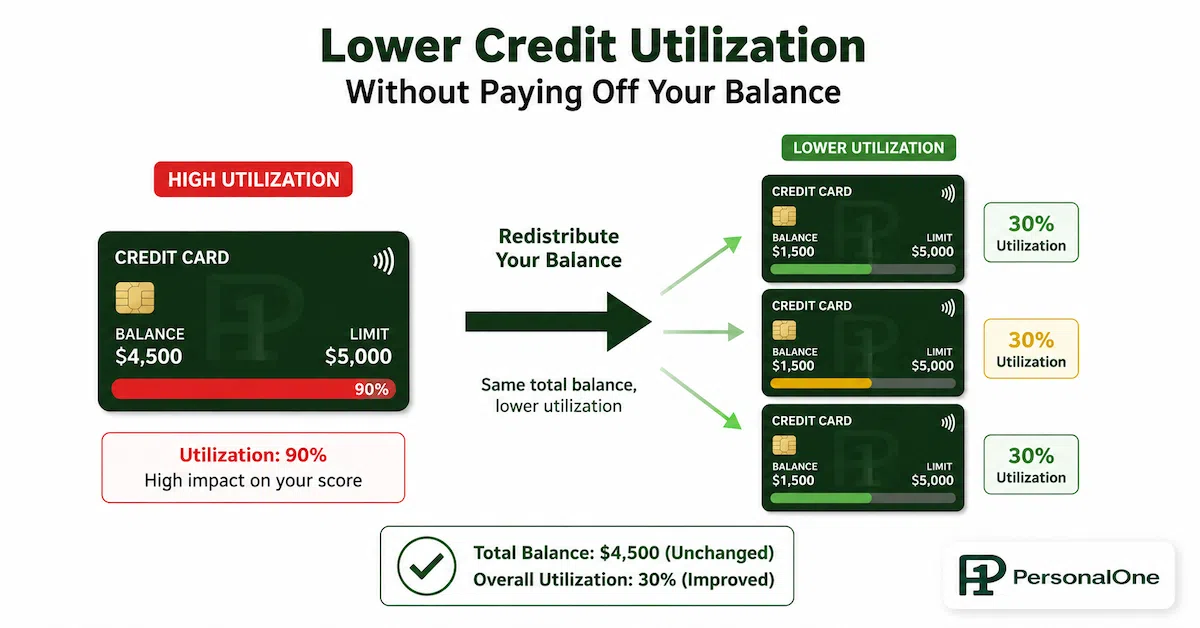
FICO calculates utilization both in aggregate and on each individual card. A single card at high utilization creates a per-card penalty even when overall utilization is moderate. Redistributing balances to bring each card below 30% — ideally below 10% — can improve the score even when total debt stays the same.
If you have one card at 85% and two cards at 5%, redistributing the balance so all three cards sit at roughly 30% removes the per-card penalty on the maxed-out card. The total dollars owed are identical — the scoring impact is meaningfully better. This is a tactic, not a solution — it improves the score while you work toward actual payoff, which is always the financial priority.
One practical option for redistribution is a balance transfer to a card with available credit and a lower balance. If one card has significant available capacity, moving a portion of the high-utilization card's balance there can bring both cards into a more favorable utilization range. Watch for balance transfer fees — typically 3 to 5% — and ensure the receiving card does not get pushed into high utilization as a result. The full framework for managing balances and utilization targets across multiple cards simultaneously is covered in the article on how to manage credit utilization across multiple cards.
What I've Seen
One of the biggest misconceptions I see is people assuming they need to pay off their entire balance before their score can improve. In reality, most score movement comes from how the balance is reported — not whether it's fully eliminated.
In one case, someone was carrying roughly $5,000 across two cards and didn't have the cash to pay it off quickly. One card was sitting above 80% utilization while the other was under 20%. They felt stuck because full payoff wasn't realistic in the short term.
Instead of focusing on payoff first, the strategy shifted to redistribution and timing. Part of the balance was moved to the lower-utilization card, and a partial payment was made before the statement closing date to bring both cards under 30% — with the goal of eventually getting closer to 10%.
The total debt didn't change meaningfully in that first cycle, but what was reported did. Within one billing cycle, the score increased by over 40 points — not because the debt disappeared, but because the utilization profile improved.
The takeaway: paying off debt is the long-term goal, but credit scoring responds to ratios. When cash is limited, changing how balances are distributed and when they're reported can create real score movement before the balance is fully paid down.
Strategy 3: Make a Partial Payment Before the Statement Closes
You do not need to pay a balance to zero to lower your reported utilization. Any payment that reduces the balance before your statement closing date lowers what gets reported. If your card closes on the 15th and you are currently at 60% utilization, a payment three to five days before the 15th that brings you to 25% is what the bureaus will see — not the 60%.
This is the most accessible strategy for people who have some cash available but cannot clear the full balance. Even a partial paydown timed correctly produces a better reported number than a full paydown timed incorrectly. A payment made the day after the statement closes does nothing for that cycle's reported utilization — it affects the following month. The complete timing mechanics — including how to find your statement close date, how much buffer to allow for processing, and how to set up the system so it runs automatically — are in the guide on paying your credit card twice a month to protect your score.
To implement: find your statement closing date on any previous statement or call the issuer. Set a calendar reminder three to five days before that date each month. On that date, make the largest payment you can manage. Let the statement close with the reduced balance. Pay any remaining amount by the due date. The three-to-five day buffer accounts for payment processing time — a payment initiated the day before closing may not post before the balance is calculated.
Strategy 4: Become an Authorized User on a Low-Utilization Account
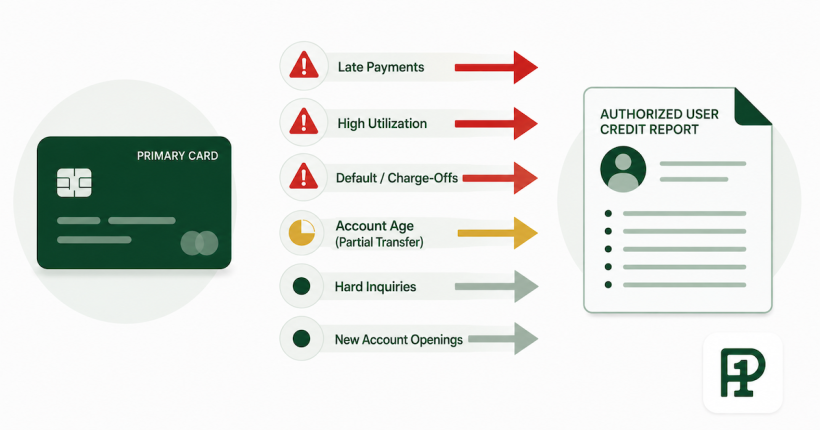
If a family member or trusted contact has a credit card with a high limit, low balance, and long payment history, being added as an authorized user brings that account's profile onto your credit report. The account's available credit increases your total available credit, which lowers your overall utilization ratio even if your own balances stay the same.
For this to work in your favor, the account being added must have low utilization. Being added to an account with high balances and a high utilization rate can make your utilization worse, not better. Verify the account's current balance and limit before agreeing to be added. You do not need to use the card — the credit profile benefit comes from the account appearing on your report, not from spending on it.
Strategy 5: Open a New Credit Account Strategically
Opening a new credit card increases your total available credit, which lowers your aggregate utilization ratio if your existing balances stay the same. This is a real effect — but it comes with meaningful trade-offs. A new account generates a hard inquiry — typically 5 to 10 points of temporary score reduction — and lowers your average account age, both of which work against your score in the short term.
This strategy makes sense only when the utilization improvement outweighs the inquiry and age cost, and when you are not planning a major credit application within the next six to twelve months. For most people already carrying high balances, the other strategies on this list produce better results with fewer trade-offs. Opening new credit to manage utilization is a last resort, not a first move. The full picture of how new accounts, inquiries, and utilization interact across all five FICO factors is covered in the article on what actually moves your credit score.
What These Strategies Do Not Do
Every strategy on this list improves your reported utilization and therefore your credit score. None of them reduces the amount you owe. A credit limit increase that lowers your utilization from 60% to 30% does not eliminate any debt — it changes the ratio while the balance stays the same. Interest continues accruing on the full balance.
These strategies are most valuable in two specific situations: when a score improvement is needed ahead of a time-sensitive application, and when someone is actively paying down debt and wants the score to reflect their progress faster. If your score has been dropping despite responsible behavior, the article on why your credit score drops even when you pay on time identifies whether a utilization timing issue or another factor is the cause.
For clarity on what the real optimal targets are — and why the 30% guideline understates where scores are actually maximized — the article on what credit utilization is and why the 30% rule is a myth covers the utilization bands you are actually working toward.
For the broader credit improvement picture — how utilization reduction fits alongside payment history, account age, and the other FICO factors — the article on how to increase your credit score quickly covers the full multi-factor sequence for the fastest compound score improvement.
Build the Complete Utilization System
Lowering utilization is the fastest-moving lever in credit scoring. The Credit Utilization & Payment Strategy cluster covers every tool — payment timing, limit increases, multi-card management, and the reporting mechanics that determine what your score sees each month.
Explore the Full StrategyGovernment Resources
CFPB — What Is a Credit Utilization Rate? — Federal explanation of how utilization is calculated and its role in credit scoring.
AnnualCreditReport.com — Pull your free weekly credit reports to verify current reported balances and limits across all accounts.
Return to the full credit building and protection guide for a complete overview of every credit strategy covered on PersonalOne.
Frequently Asked Questions
Can I lower my credit utilization without paying off debt?
Yes. Requesting a credit limit increase lowers your utilization ratio without changing your balance. Redistributing balances across cards can remove per-card penalties. Making a partial payment before your statement closes reduces the balance that gets reported. Each approach improves the reported ratio without requiring full payoff.
Does requesting a credit limit increase hurt my score?
It depends on the issuer. Some process limit increase requests with a soft inquiry, which has no scoring impact. Others use a hard inquiry, which typically costs 5 to 10 points temporarily. Ask the issuer before submitting whether the review will be a hard or soft pull. In most cases, even if a hard inquiry is required, the utilization improvement from the higher limit outweighs the inquiry cost within a billing cycle or two.
How fast will my score improve after lowering utilization?
The improvement appears within one to two weeks of your next statement closing with the lower reported balance. The full cycle from action to visible score change is typically 30 to 45 days. Because utilization has no historical component, the score can recover substantially in a single billing cycle once balances or limits change and the new numbers are reported.
Does opening a new card lower utilization?
Yes, in aggregate — it increases total available credit, which lowers the utilization percentage if balances stay the same. But it also triggers a hard inquiry and lowers average account age, both of which temporarily reduce the score. This trade-off usually only makes sense if the utilization improvement is large and no major credit applications are planned in the next year.
Is it better to pay down one card fully or spread payments across cards?
It depends on the distribution of your balances. If one card is significantly above 30% while others are low, targeting that card first removes the per-card penalty faster. If multiple cards are above 30%, spreading payments to bring all of them below that threshold produces better immediate score improvement than zeroing out one card while leaving others above it. Use the utilization ranges as your guide — getting each card below 30% is the first priority, then below 10% as resources allow.
This content is for educational purposes only and does not constitute financial or credit advice. Credit score calculations vary by scoring model and individual credit profile. PersonalOne is a free financial education platform.