August 2026
Home › Credit Building & Protection › Authorized User Credit Strategy › Can Being an Authorized User Hurt Your Credit Score?
What You Need to Know
— Yes, authorized user status can hurt your credit score — in five specific ways. Most guides cover two. Understanding all five is what makes the risk assessment complete.
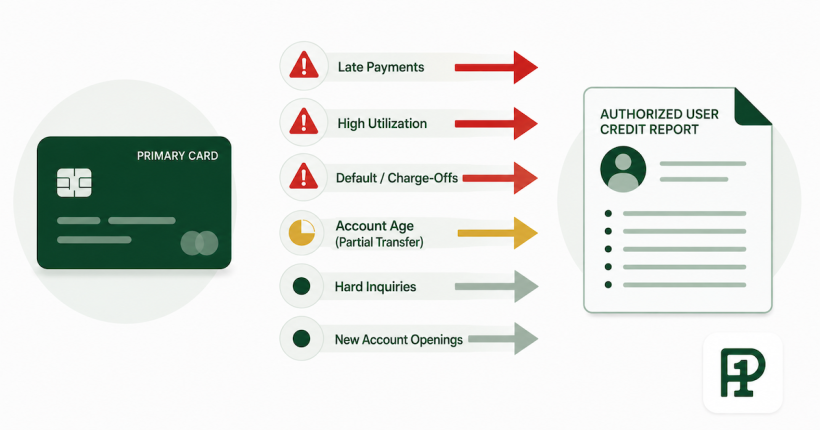
— High utilization on the primary account transfers to your utilization calculation immediately. A card at 80% utilization suppresses your score whether you own the card or are just an authorized user on it.
— Late payments transfer differently depending on the bureau. Experian excludes negative payment history for authorized users. Equifax and TransUnion include it. This bureau asymmetry is the most important risk factor most people never learn.
— When AU status ends — by choice or by the primary cardholder closing the account — your score can drop back to close to where it started if you haven't built independent credit during the AU period.
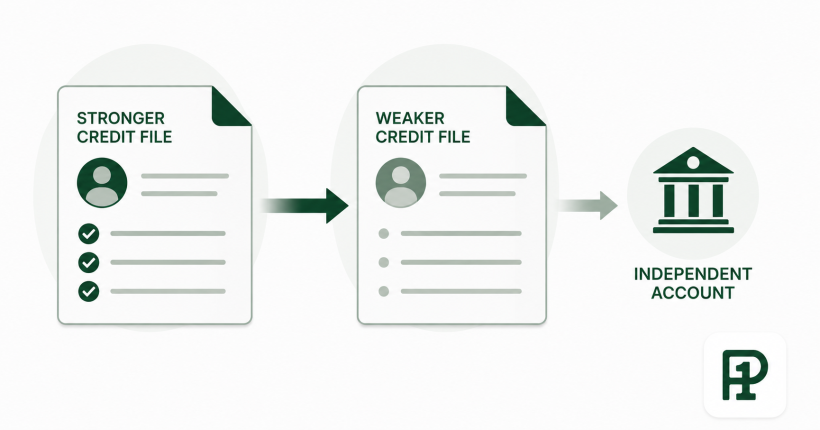
— The fix for every risk on this list is the same: evaluate the primary account before agreeing to be added, and use the score improvement period to open your own independent accounts.
The most common answer to "can authorized user hurt credit" is a cautious yes with two examples — late payments and high utilization. That answer is accurate but incomplete. There are five specific ways authorized user status can damage your credit score, and three of them get almost no coverage in standard financial guides. The late payment risk, for example, is more nuanced than a simple yes — because the three major credit bureaus don't treat authorized user negative history the same way, and that bureau-level asymmetry changes the risk calculation in a way that matters for anyone deciding whether to accept AU status on a specific account.
This guide covers every scenario where being an authorized user produces a score that is lower than it would have been without the AU account — and gives you the pre-addition checklist that makes the risk assessment clear before you agree to be added to anyone's card.
Risk 1 — High Utilization on the Primary Account
Credit utilization is calculated across every revolving account associated with your credit file — including authorized user accounts. When you're added to a card that carries a high balance relative to its credit limit, that card's utilization contributes to your overall utilization ratio and creates a per-card utilization penalty, exactly as if you owned the card yourself.
A primary cardholder with a $10,000 limit card carrying an $8,000 balance is reporting 80% per-card utilization. When you're added as an authorized user on that account, 80% per-card utilization now appears in your credit file. If your other accounts are low-utilization, your overall utilization ratio may still be manageable — but the per-card penalty on the AU account suppresses your score regardless of how your own accounts look. The scoring model evaluates per-card utilization independently from overall utilization, and a card above 50% creates a meaningful score penalty whether you own it or not.
This risk is invisible until you look at the actual numbers. Before agreeing to be added to any account, ask the primary cardholder for the current balance and credit limit. Calculate the per-card utilization yourself. Any account above 30% utilization delivers a smaller net benefit than the same account at under 10% — and any account above 50% may actively harm your score rather than help it. The full breakdown of how utilization thresholds affect your score at each band is covered in the article on what credit utilization is and why the 30% rule is a myth.
What I've Seen
The most common version of AU-related score damage I see isn't from late payments — it's from utilization that nobody checked before the addition. Someone gets added to a parent's card to help build credit. The parent has a $5,000 limit card that typically carries $3,500 to $4,000 because they use it heavily for rewards. That's 70% to 80% per-card utilization reporting in the authorized user's credit file every month. Their score isn't improving — it's suppressed by the AU account they thought was helping them. The fix is straightforward: have the parent pay down the card before the next statement close, or use a different card with lower utilization. But nobody checked the numbers first, so the damage ran for months before anyone understood why the strategy wasn't working.
Risk 2 — Late Payments and the Bureau Asymmetry
Late payments on the primary account can transfer to your credit report as an authorized user — but the way this works is not uniform across the three bureaus, and this asymmetry is the most important risk factor most people never learn before agreeing to AU status.
Experian's policy: Experian generally does not include negative payment history in an authorized user's credit report. If the primary cardholder misses a payment, that late payment notation typically does not appear on the authorized user's Experian file. This makes Experian the bureau where AU status carries the lowest risk of payment history damage from the primary cardholder's behavior.
Equifax and TransUnion's policy: Equifax and TransUnion include both positive and negative payment history from authorized user accounts. A 30-day late payment on the primary card can appear on your Equifax and TransUnion credit reports with the same weight as if you missed your own payment. Since many lenders pull FICO scores calculated from Equifax or TransUnion data — not just Experian — the late payment can affect your score for the applications that matter most.
The practical implication is direct: if you're added as an authorized user on a card with a history of late payments — even a single 30-day late from two years ago — that late payment appears in your Equifax and TransUnion files. Your score at those bureaus reflects that history. Your score at Experian may not. A lender who pulls all three bureaus and takes the middle score sees the damage. This is why verifying the full payment history of any account before agreeing to be added is non-negotiable. The mechanics of how payment history is reported at each bureau — and how to read your credit report to find these entries — is covered in the article on what happens to your credit when you're added to someone else's card.
Risk 3 — Score Reversal When AU Status Ends
Authorized user status is not permanent, and neither is the score improvement it produces. When you're removed from the account — voluntarily or because the primary cardholder closes the card, misses too many payments, or decides to remove you — the account's history typically disappears from your credit report within one to two billing cycles. Every score benefit that came from the AU account reverses.
The score reversal can be sharp when the AU account was doing significant heavy lifting in your credit profile. If the primary card was your oldest account on file, removing it shortens your average account age. If it was your highest-limit account, removing it raises your overall utilization ratio. If it was contributing payment history to your record, that history disappears. The net effect can return your score to close to where it started — which is a problem if you've made financial decisions based on the improved score without building independent credit history to sustain it.
The score reversal risk is why AU status should always be treated as a bridge — use the score improvement while it's active to open your own independent accounts. A credit card application approved at 690 because of an AU account gives you an account that builds history independently, so your score doesn't collapse when the AU relationship ends. The full process for removing yourself and understanding the exact consequences for your credit file is covered in the article on how to remove yourself as an authorized user and what happens next.
Risk 4 — Being Added to the Wrong Account Type
Not all authorized user accounts are equal in terms of what they contribute to your credit profile — and some account types create more risk than benefit depending on your specific situation.
Accounts with a short history. A credit card opened six months ago has minimal positive account age to contribute. The available credit lowers your utilization ratio, which helps — but the account age benefit is minimal. If the primary cardholder makes a mistake on this new account, the relative damage from the negative history is proportionally larger because the account hasn't accumulated years of positive history to offset it.
Accounts with a high balance relative to the limit. As covered in Risk 1, any account above 30% per-card utilization delivers a reduced benefit — and above 50% can actively damage your score. The utilization risk is independent of the payment history quality. A card with a perfect 10-year payment history and 75% utilization is not a good AU candidate despite its strong payment record.
Store credit cards with low limits. Retail credit cards typically have lower credit limits — $500 to $2,000 — which means even moderate spending creates high per-card utilization. A $400 balance on a $600 limit store card is 67% per-card utilization. Being added to a store card doesn't add meaningful available credit to your overall ratio while creating a per-card utilization liability. Major bank credit cards with high limits and low utilization are consistently stronger AU candidates than retail cards.
The full picture of how to evaluate a specific card before agreeing to be added — account age, limit, utilization, and payment history — is covered in the article on being an authorized user when the primary cardholder has bad credit, which addresses the most extreme version of this risk in detail.
Risk 5 — Reduced Incentive to Build Independent Credit
This is the subtlest risk on the list and the one that produces the most long-term damage. When authorized user status produces a meaningful score improvement, it's tempting to rely on that improvement rather than building the independent credit history that produces durable, self-sustaining scores. If the AU account is doing the heavy lifting, the urgency to open your own accounts, build your own payment history, and establish your own utilization management system diminishes.
The result: someone who maintains AU status for two or three years without building independent credit exits the arrangement with a score that collapses as soon as the AU account disappears. They've spent years at a higher score without developing the credit foundation that would sustain it independently. The score improvement was real — but it was borrowed, not built.
The correct use of AU status treats it as a starting point, not a destination. The score improvement provides access to credit products that build independent history — a credit card in your own name, a secured card, a credit-builder loan. Each of those products contributes payment history and account age that belongs to you permanently, regardless of what happens to the AU account. The complete framework for building credit from scratch using AU status as an entry point — including the specific timeline for when to open your own accounts — is covered in the article on how being an authorized user actually builds credit.
The Pre-Addition Checklist: Evaluating an Account Before You Agree
Every risk on this list is identifiable before you're added to an account. Running through this checklist before agreeing to AU status takes less than ten minutes and tells you whether the account is likely to help, likely to be neutral, or likely to hurt.
Check the current utilization. Ask the primary cardholder for the current balance and credit limit. Divide balance by limit. Any card above 30% delivers reduced benefit — above 50% is a risk. Ideal: under 10% per-card utilization at statement close consistently.
Check the full payment history. Ask the primary cardholder to pull their credit report and show you the payment history for the specific account. Look for any late payment notations in the last three to five years. Even a single 30-day late from two years ago will appear on your Equifax and TransUnion files. If there's any negative payment history on the account, the Equifax and TransUnion risk applies immediately.
Check the account age. Accounts open for five or more years contribute meaningfully to account age calculations. Accounts open less than two years contribute minimally. Ask when the account was opened — this information is on the primary cardholder's credit report.
Verify the issuer reports AU status. Not all issuers report authorized user accounts to all three bureaus. The primary cardholder should call their issuer and ask: "Do you report authorized user accounts to all three credit bureaus — Equifax, Experian, and TransUnion — and do you include the full account history including the original open date?" If the answer to either part is no, the account produces no score benefit. How long the reporting takes once the issuer does report — and how to verify it appeared — is covered in the article on how long authorized user status takes to affect your credit score.
Assess the relationship stability. AU status depends entirely on the primary cardholder's continued responsible management of the account. If the relationship between you and the primary cardholder is unstable — or if the primary cardholder's financial situation is precarious — the account that helps your credit today can become the account that damages it tomorrow. This risk is not financial — it's relational. For the complete analysis of when adding someone to your card creates unacceptable risk for the primary cardholder, the article on when you should never add someone to your credit card covers every scenario where the primary cardholder's credit is put at risk.
Build a Complete Authorized User Strategy
Risk awareness is one piece. The Authorized User Credit Strategy cluster covers every dimension — who to add, when it backfires, how to evaluate accounts, how to remove yourself, and how to use AU status as a bridge to independent credit.
Explore the Full StrategyGovernment Resources
CFPB — Credit Reports and Scores — Official guidance on how authorized user accounts appear on credit reports and your rights as a consumer.
AnnualCreditReport.com — Free weekly reports from all three bureaus — the only way to verify what an authorized user account is contributing to your credit file at each bureau.
FTC — Understanding Your Credit — Federal overview of credit reporting, how account history transfers, and your rights regarding disputes.
Return to the full credit building and protection guide for a complete overview of every credit strategy covered on PersonalOne.
Frequently Asked Questions
Can being an authorized user hurt your credit score?
Yes — in five specific ways. High utilization on the primary account transfers to your utilization calculation. Late payments from the primary account appear on your Equifax and TransUnion files (though not typically on Experian). Score reversal occurs when AU status ends without independent credit to sustain the improvement. Being added to the wrong account type — short history, low limit, high utilization — can produce no benefit or active harm. And over-reliance on AU status without building independent credit creates long-term vulnerability. Each of these risks is identifiable before you're added to an account.
Does the primary cardholder's late payment hurt the authorized user's credit?
It depends on the bureau. Experian generally excludes negative payment history from authorized user accounts — a late payment on the primary card typically does not appear on the authorized user's Experian file. Equifax and TransUnion include both positive and negative payment history from AU accounts. A 30-day late payment from the primary account can appear on your Equifax and TransUnion files with the same weight as if you missed your own payment. Many lenders pull scores from all three bureaus — so even if your Experian score is unaffected, a score pulled from Equifax or TransUnion reflects the late payment.
Does high utilization on the primary account affect the authorized user?
Yes — directly and immediately. Authorized user accounts factor into your utilization calculation the same way your own accounts do. A card at 80% utilization suppresses your per-card utilization score whether you own the card or are an authorized user on it. Before agreeing to be added to any account, calculate the current per-card utilization by dividing the current balance by the credit limit. Any card consistently above 30% per-card utilization delivers reduced benefit — and consistently above 50% may actively damage your score.
What happens to my score when I'm removed as an authorized user?
The account disappears from your credit report within one to two billing cycles after removal. Every score contribution from that account — available credit, account age, payment history — reverses. If you haven't built independent credit accounts during the AU period, your score can return close to where it started. This is why AU status should always be used as a bridge — the improved score period should be used to open your own credit accounts so your score doesn't collapse when the AU relationship ends.
How do I check whether an authorized user account is hurting my credit?
Pull your full credit reports from all three bureaus at AnnualCreditReport.com and locate the authorized user account. Check three things: the current balance and credit limit (to calculate per-card utilization), the payment history section (look for any late payment notations), and whether the account appears at all three bureaus or only some. If the account shows high utilization or late payment notations at any bureau, that account is suppressing rather than improving your score at that bureau. The remedy is either to have the primary cardholder address the issue — pay down the balance, establish a clean payment streak — or to remove yourself from the account.
This article is for educational purposes only and does not constitute financial or credit advice. Bureau policies on authorized user accounts and how negative history is reported may change. Verify current policies directly with each bureau and your card issuer. PersonalOne is a free financial education platform.