September 2026
Home › Credit Building & Protection › Authorized User Credit Strategy › What Happens to Your Credit When You're Added to Someone Else's Card?
What You Need to Know
— When you are added as an authorized user, seven specific data fields from the primary account transfer to your credit report — including the account's open date, credit limit, balance, and full payment history going back to the account's origin, not just from when you were added.
— The primary card's balance affects your credit utilization ratio in two ways simultaneously: it reduces your available credit utilization overall, and it creates a per-card utilization calculation on the AU account specifically.
— FICO 8 — the most widely used scoring model — treats authorized user accounts nearly identically to accounts you own. FICO 2, 4, and 5 — the mortgage scoring models — weight AU accounts differently. Industry-specific models vary further.
— Experian generally excludes negative payment history from AU credit reports. Equifax and TransUnion include both positive and negative history. This bureau asymmetry means the same late payment can affect your score differently depending on which bureau a lender pulls.
— Two people added to the same card on the same day can see completely different score outcomes because five variables determine the result: their existing credit profile, the primary account's quality, the issuer's reporting policy, which bureau processes the data, and which FICO model calculates their score.
Most guides answer the question "does being an authorized user help your credit" with a confident yes — and then stop before explaining how. What actually changes on your credit report when you're added to someone else's card? Which specific fields transfer? How does the primary card's balance interact with your utilization calculation? Why does FICO 8 treat your AU account differently than the model your mortgage lender will pull? And why do two people added to identical accounts sometimes see outcomes 40 points apart?
Understanding what happens to credit when added as authorized user requires mapping the complete data pipeline — from the moment the primary cardholder adds your name through the moment a new score calculates. This article covers that pipeline in full: the seven data fields that transfer, the exact mechanics of how each one affects your credit score, the FICO model variations that change the outcome, and the five variables that determine whether your result lands at the high end or low end of the expected range.
Stage 1: What Gets Added to Your Credit Report
When a primary cardholder adds you as an authorized user and the card issuer reports AU status to the credit bureaus, a new tradeline appears on your credit report. A tradeline is simply the credit bureau's record of a credit account — the complete data file the bureau maintains for that account under your name. The AU tradeline contains the same data fields as any other tradeline on your report, populated with the primary account's information.
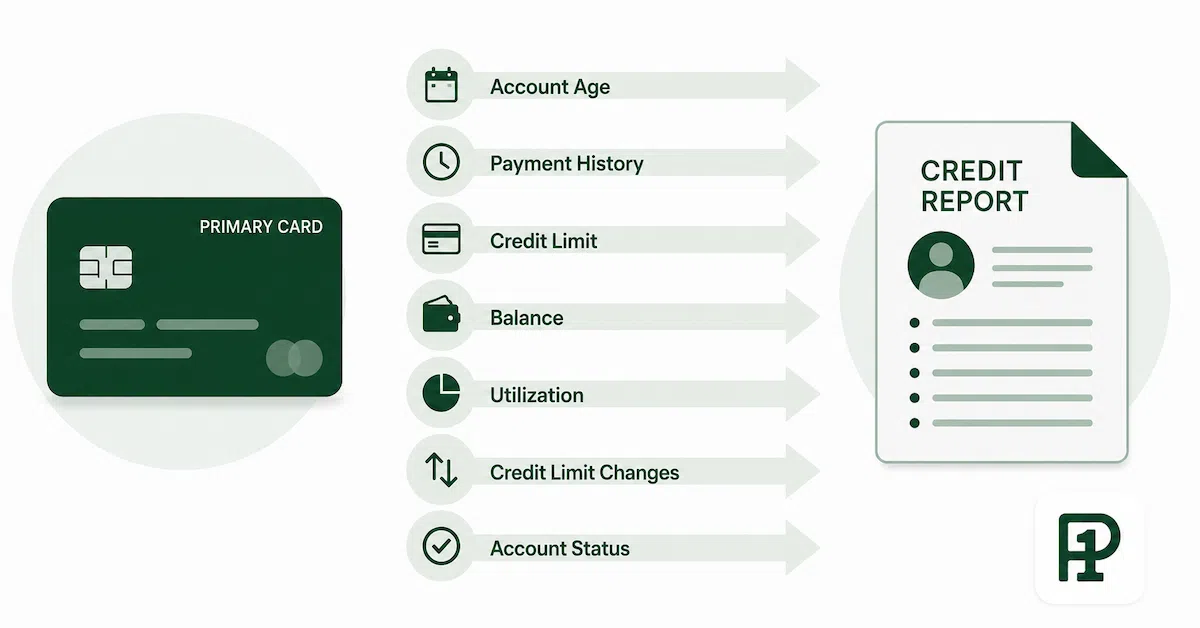
The Seven Data Fields That Transfer
1. Account open date. The date the primary cardholder opened the account — not the date you were added as an authorized user. If the primary account has been open for nine years and you were added last month, your credit report shows a nine-year-old account. This is the mechanism that makes AU strategy so effective for building account age: you inherit the full account history from its origin, not from your addition date.
2. Credit limit. The full credit limit on the primary account transfers to your utilization calculation. If the primary account has a $12,000 credit limit, $12,000 of available revolving credit appears in your credit file. This additional available credit directly reduces your overall utilization ratio.
3. Current balance. Whatever balance the primary account reports at statement close transfers to your credit file as a balance on the AU account. This is the most consequential field for utilization: a $9,000 balance on a $12,000 limit card is 75% per-card utilization in your credit file, regardless of whether you personally charged any of that balance.
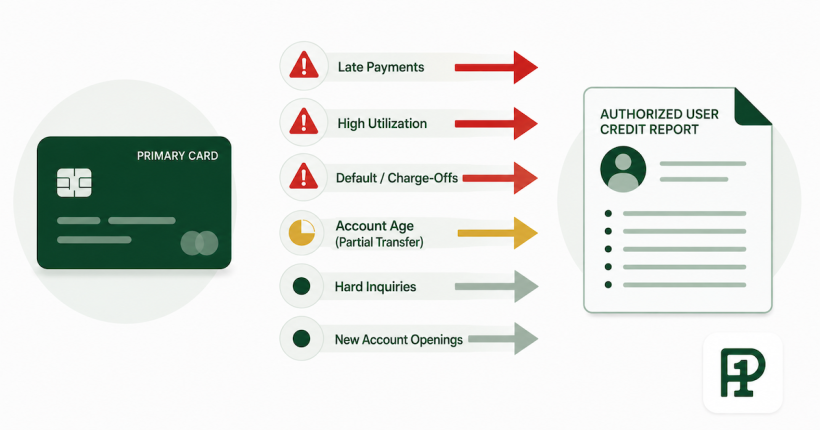
4. Payment history. Every payment the primary cardholder has ever made on the account — going back to the account's open date — transfers to your payment history field. Years of on-time payments appear as your payment history. This is the retroactive history transfer that no other credit-building tool provides. A late payment from three years ago also transfers at Equifax and TransUnion — though Experian generally excludes negative payment history from AU tradelines.
5. Account status. Whether the account is current, in collections, charged off, or closed transfers to your credit file. An account in good standing shows as current. An account with problems shows those problems.
6. Account type. The account is coded as a revolving credit card account — the same type as accounts you own. The AU designation is noted in the tradeline, but the account type classification is the same as any other revolving account.
7. Issuer name and account identifier. The card issuer's name and an account identifier appear on your report, allowing the bureau to distinguish the account and link it to the primary cardholder's reporting. This is how the bureau knows whose data to update when the issuer sends monthly account updates.
What I've Seen
The data field that surprises people most consistently is the payment history transfer going back to the account's origin. Someone is added to a parent's card that was opened in 2015. They assume the benefit is the current available credit and perhaps the recent payment history. When they pull their credit report, they see eleven years of perfect payment history on the AU account — every month back to 2015 marked paid on time. That history populates their payment history field as if they had been a responsible credit user for eleven years, which is exactly what the scoring model reads. The full account history is what makes the strategy work. The current balance is what makes it backfire when the primary account has high utilization.
Stage 2: How the Transferred Data Affects Your Credit Score
Each of the seven transferred data fields feeds into specific inputs in the credit scoring calculation. Understanding which field affects which scoring factor is what allows you to predict the outcome of AU addition before it happens — and diagnose why a specific AU account produced an unexpected result.
Payment History Impact (35% of FICO 8 Score)
Payment history is the largest single factor in most credit scoring models, accounting for approximately 35 percent of a FICO 8 score. The AU account's complete payment history — every on-time payment going back to the account's origin — populates your payment history field. For someone with a thin credit file or limited payment history, inheriting years of perfect payments from a well-managed primary account can produce substantial score improvements. The payment history transfer is retroactive to the account's open date, not to your addition date — which is why an older primary account with a clean history delivers significantly more benefit than a newer account with an equally clean history.
Utilization Impact (30% of FICO 8 Score)
Credit utilization — the ratio of your revolving balances to your revolving credit limits — is the second largest scoring factor and the most immediately affected by AU addition. The mechanics operate at two levels simultaneously.
Overall utilization: The AU account's credit limit adds to your total available revolving credit. If you currently have $5,000 in available credit with a $1,500 balance (30% overall utilization) and you're added to a $12,000 limit card with a $1,000 balance, your new totals are $17,000 available credit and $2,500 in balances — 14.7% overall utilization. The improvement is significant and immediate.
Per-card utilization: FICO models also evaluate utilization on a per-card basis, not just overall. The AU account's balance-to-limit ratio creates a separate per-card utilization calculation. A $9,000 balance on a $12,000 limit AU card is 75% per-card utilization — a penalty that suppresses your score even if your overall utilization looks reasonable. This is why the primary account's balance at the time of your addition — and its ongoing balance — matters as much as the credit limit it adds. The complete explanation of how utilization thresholds affect your score at each level — and why the 30% rule is an oversimplification — is covered in the article on what credit utilization is and why the 30% rule is a myth.
Account Age Impact (15% of FICO 8 Score)
The AU account's open date enters your average account age calculation. FICO scores evaluate two age-related factors: the age of your oldest account and the average age of all accounts. A primary account opened nine years ago raises both figures when it appears in your credit file. For someone whose credit file contains only recent accounts, an older AU account can meaningfully improve their average account age score factor. For someone with an established file and already-old accounts, the impact on account age is smaller.
Credit Mix Impact (10% of FICO 8 Score)
Credit mix evaluates the variety of account types in your credit file — revolving accounts, installment loans, mortgage accounts. If your existing credit file has only installment loans and no revolving credit, the addition of a revolving credit card AU account can improve your credit mix score factor. If you already have revolving accounts, the impact on credit mix is minimal because the factor is already being addressed.
Stage 3: FICO Model Variations — Why the Same Account Produces Different Scores
There is no single "credit score." There are dozens of FICO model versions, each calculating slightly differently, and the treatment of authorized user accounts varies meaningfully across them. The score you see in a free monitoring app is almost certainly not the score a lender will use when you apply for credit.
FICO 8 — The Most Widely Used Model
FICO 8 is used by the majority of lenders for most credit decisions — credit cards, auto loans, personal loans. It includes authorized user accounts and treats them similarly to accounts you own. The full payment history, utilization, and account age benefits apply. FICO 8 does contain a safeguard against "credit piggybacking" schemes — it is designed to reduce the benefit of AU accounts where the relationship between the AU and primary cardholder appears to be purely transactional rather than a genuine relationship. For legitimate family and relationship AU arrangements, FICO 8 applies the full benefit.
FICO 2, 4, and 5 — The Mortgage Scoring Models
Mortgage lenders use older FICO model versions — specifically FICO 2 (from Experian), FICO 4 (from TransUnion), and FICO 5 (from Equifax). These models were developed before the modern AU piggybacking concern became widespread, and their treatment of AU accounts is less standardized. Some studies suggest these models weight AU account history less heavily than FICO 8, though the mechanics are not publicly documented in full detail by FICO. What this means practically: the score improvement you see from an AU addition in your FICO 8 score — which your credit monitoring app may display — may not translate identically to the mortgage score a lender pulls during a home purchase application. This is why the complete picture of timing AU strategy around a major credit application — including understanding which score model a lender will use — matters for any major financial decision. The timing framework for protecting your score when AU status ends and its relationship to mortgage applications is covered in the article on how long authorized user status takes to affect your credit score.
FICO 9 and FICO 10 — Newer Models with Limited Adoption
FICO 9 and FICO 10 include AU accounts and maintain the same general treatment as FICO 8. FICO 9 introduced changes in how paid collections and medical debt are weighted, but the AU account treatment is consistent with FICO 8. FICO 10 and 10T are the most recent versions as of 2026, but lender adoption remains limited — most lenders continue using FICO 8 for most decisions.
VantageScore — The Free Monitoring Score
VantageScore is a different scoring model entirely — developed by the three bureaus as an alternative to FICO. Most free credit monitoring apps and services (Credit Karma, Credit Sesame, many bank portals) show VantageScore rather than FICO. VantageScore includes AU accounts, but its weighting differs from FICO 8. The practical implication: a significant score improvement in your VantageScore from AU addition may not translate to the same improvement in your FICO 8 score — and the FICO 8 is what most lenders will actually use.
Stage 4: The Bureau Asymmetry — Why the Same Account Shows Differently at Each Bureau
The three major credit bureaus — Experian, Equifax, and TransUnion — each maintain independent credit files and receive independent data transmissions from issuers. The same AU account can appear differently at each bureau, and the differences are not random — they follow consistent bureau-specific policies.
Experian's AU Policy
Experian generally excludes negative payment history from authorized user tradelines. If the primary cardholder has a late payment, that late payment typically does not appear on the authorized user's Experian credit report. The AU account appears with the positive history intact but without the negative marks. This makes Experian the most favorable bureau for AU credit reports when the primary account has any negative history. The complete analysis of how the bureau asymmetry on negative payment history changes the risk calculation of AU status is covered in the article on can being an authorized user hurt your credit score.
Equifax and TransUnion's AU Policy
Equifax and TransUnion include both positive and negative payment history from authorized user accounts. A late payment on the primary account will appear on your Equifax and TransUnion credit reports with the same notation as if you had made the late payment yourself. A derogatory mark — a collection, a charge-off, a judgment — also transfers through these bureaus. Because many lenders pull scores from Equifax or TransUnion rather than exclusively from Experian, the negative history can affect the scores that lenders actually see even when your Experian score appears unaffected.
Why the Bureau Asymmetry Matters for Score Pulls
Many lenders pull scores from all three bureaus and use the middle score for credit decisions. If your Experian score (without the negative AU history) is 720, your TransUnion score (with the negative AU history) is 690, and your Equifax score is 705, a lender using the middle score sees 705 — not 720. The bureau that excludes the negative history doesn't determine your outcome when the lender takes the middle value from all three. The full pipeline from how payment history is reported at each bureau through how to read your credit report to identify which fields are present is covered in the article on how credit card payments are reported to the bureaus.
The Five Variables That Determine Your Specific Outcome
The same AU account added on the same day can produce outcomes 40 or more points apart for two different people. The five variables that determine your specific outcome explain why — and understanding them is what makes the strategy predictable rather than mysterious.
Variable 1 — Your Existing Credit Profile
AU strategy produces the most dramatic results for people with thin credit files — no accounts, limited history, or only recently opened accounts. For someone with an established credit file and a strong existing payment history, the same AU account produces a more modest improvement because the factors the AU account affects are already partially addressed by their existing accounts. The weaker your existing credit profile relative to the primary account's quality, the larger the likely improvement.
Variable 2 — The Primary Account's Quality
The primary account's age, credit limit, utilization at statement close, and payment history all determine the quality of what transfers to your credit file. An account opened fifteen years ago, with a $20,000 limit, clean payment history, and 5% utilization delivers maximum benefit across all scoring factors simultaneously. An account opened two years ago, with a $3,000 limit, two late payments, and 60% utilization can suppress your score on arrival. Evaluating the primary account before agreeing to be added — the specific checklist for doing this — is covered in the article on being an authorized user when the primary cardholder has bad credit.
Variable 3 — The Issuer's Reporting Policy
If the issuer does not report AU accounts to the credit bureaus, no tradeline appears and no score change occurs — regardless of account quality or your existing profile. Some issuers do not report AU status at all. Some report to only two of the three bureaus. The first verification step before agreeing to AU status on any account is confirming the issuer's reporting policy directly by calling the number on the back of the card.
Variable 4 — Which Bureau Processes the Data First
Experian typically processes new account data faster than Equifax and TransUnion. The AU account may appear at Experian and affect your Experian-based scores before it appears at the other two bureaus. If you're monitoring your score through an app that pulls from TransUnion, you may see no change while your Experian score has already reflected the improvement. Pulling all three bureau reports from AnnualCreditReport.com approximately 45 days after AU addition verifies which bureaus have received and processed the account.
Variable 5 — Which FICO Model Calculates Your Score
As covered in Section 3, the FICO model version determines how the AU account is weighted. FICO 8 delivers the fullest benefit for most credit applications. Mortgage-specific models (FICO 2, 4, 5) may weight the AU contribution differently. The free monitoring score you see (usually VantageScore) may show different improvement than the FICO 8 score that matters for credit applications. Knowing which score model applies to your specific goal — a credit card application, an auto loan, a mortgage — tells you which score to monitor and which model's treatment of AU accounts to understand.
Understand the Complete Authorized User System
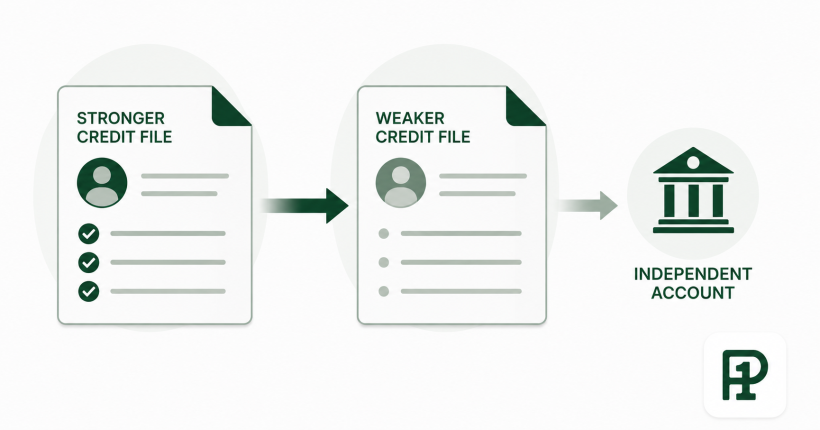
The mechanics are one piece. The Authorized User Credit Strategy cluster covers the complete picture — how to evaluate accounts before agreeing to be added, the risk scenarios, the timeline, and how to use AU status as a bridge to independent credit.
Explore the Full StrategyGovernment Resources
CFPB — Credit Reports and Scores — Official guidance on how authorized user accounts appear on credit reports, how to dispute inaccuracies, and your rights under the Fair Credit Reporting Act.
AnnualCreditReport.com — Free weekly credit reports from all three bureaus — the only way to verify that an AU account has appeared, which bureaus received it, and what data fields populated.
FTC — Understanding Your Credit — Federal overview of credit reporting mechanics, including how tradelines are created, updated, and disputed.
Return to the full credit building and protection guide for the complete framework covering every credit strategy on PersonalOne.
Frequently Asked Questions
What shows up on my credit report when I'm added as an authorized user?
A new tradeline appears on your credit report containing seven data fields from the primary account: the account open date, the credit limit, the current balance, the complete payment history going back to the account's origin, the current account status, the account type, and the issuer's name. Critically, the payment history transfers retroactively — if the primary account was opened in 2014 and you were added in 2026, twelve years of payment history appears on your report, not just recent activity.
How does being an authorized user affect my credit utilization?
It affects utilization at two levels. First, the primary account's credit limit adds to your total available revolving credit, which reduces your overall utilization ratio. Second, the primary account's balance creates a per-card utilization calculation on the AU account specifically. A high balance on the primary card — even one you did not create — can produce a high per-card utilization penalty in your credit file. This is why the primary account's balance at statement close, not just its credit limit, determines whether AU addition helps or harms your utilization score factor.
Does the primary cardholder's late payment appear on my credit report?
It depends on the bureau. Experian generally excludes negative payment history from authorized user tradelines — a late payment typically does not appear on your Experian report. Equifax and TransUnion include both positive and negative payment history from AU accounts. A late payment on the primary account can appear on your Equifax and TransUnion reports with the same notation as if you had made the late payment yourself, which can affect scores calculated from those bureaus.
Does FICO treat authorized user accounts the same as accounts I own?
In FICO 8 — the most widely used scoring model — authorized user accounts are treated nearly identically to accounts you own for the purposes of payment history, utilization, account age, and credit mix calculations. Older FICO models used for mortgage scoring (FICO 2, 4, and 5) may weight AU accounts differently, though the exact treatment is not publicly documented in full detail. VantageScore — which most free monitoring apps display — includes AU accounts but calculates their impact differently than FICO 8.
Why do some people see bigger score improvements from being added as an authorized user than others?
Five variables determine the outcome: your existing credit profile (thin files see more improvement), the primary account's quality (older accounts with high limits, low balances, and clean history deliver more benefit), the issuer's reporting policy (some don't report at all), which bureau processes the data first (Experian typically processes fastest), and which FICO model calculates the score being monitored (FICO 8 vs mortgage models vs VantageScore produce different results from the same AU addition).
What happens if I'm added to an account with a high balance?
The primary account's balance transfers to your utilization calculation immediately at the next statement close reporting. If the account carries 70% per-card utilization, that 70% penalty appears in your credit file and suppresses your score even though you did not charge the balance. The overall utilization benefit of the added available credit may partially offset the per-card penalty, but the net result is less improvement — or no improvement — than an equivalent account with low utilization would produce. This is why verifying the primary account's current balance before being added is a non-negotiable step in AU strategy evaluation.
This article is for educational purposes only and does not constitute financial or credit advice. Credit scoring models, bureau reporting policies, and issuer practices change over time. Verify current policies directly with credit bureaus and card issuers. PersonalOne is a free financial education platform.