June, 2026
Home › Debt Relief & Credit Repair › Debt Settlement Options › How Debt Settlement Affects Your Credit Score
Part of the debt settlement options cluster — the honest comparison between settling and the path you're already on.
About the Author
Don Briscoe has spent 20 years in banking and finance, the last 12+ of which have been focused on helping Millennials and Gen Z build income and financial stability. He founded PersonalOne to provide the financial education he wished existed — structured, honest, and free.
What You Need to Know
— The credit damage from settlement starts at the first missed payment, not at the settlement itself — by the time you settle, the report already carries several negative marks
— The real comparison isn't settlement versus a clean record — it's settlement versus continuing to miss payments, which is the alternative most settlement candidates are actually facing
— A higher starting credit score loses more points from the same negative event, since FICO scoring isn't linear
— The seven-year reporting clock starts at your first missed payment, not at the date you settle — settling sooner doesn't extend how long the mark stays on your report
— Settlement stops the bleeding and starts a recovery clock; continued delinquency keeps adding damage with no resolution date in sight
If you're asking how debt settlement affects your credit score, the honest answer depends on a question almost nobody asks directly: affects it compared to what? Every guide on this topic explains that settlement causes a score drop, usually 100 points or more, and that the "settled for less than full balance" notation stays on your report for years. That's true, but it treats settlement as if it's being compared to a clean credit file — when for most people actually considering settlement, the real alternative isn't a clean file at all. It's continuing to miss payments on debt they already can't pay in full. The question that actually matters is whether settlement does more damage than the path you're already on, and that requires looking at both trajectories side by side, not settlement in isolation. If you haven't yet covered the basics of how settlement actually works, debt settlement explained is the right starting point before this comparison.
The Damage Timeline Nobody Draws
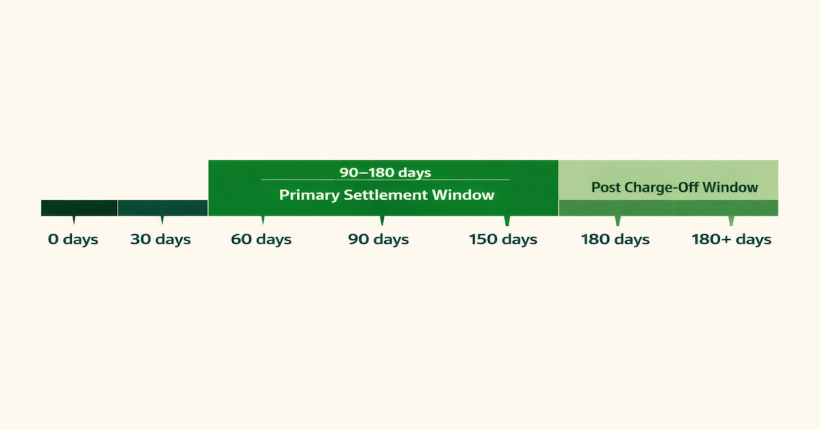
Settlement isn't where the credit damage begins. It's where a longer chain of damage usually ends. Most creditors won't even consider negotiating a settlement until an account is seriously delinquent, which means the credit damage from a settled account typically follows a sequence that's already well underway by the time settlement happens, often over a period of several months:
- A 30-day late payment appears on the account
- A 60-day late payment follows if the account isn't brought current
- A 90-day late payment appears, which is often the point where creditors become willing to discuss settlement
- The account may be charged off by the original creditor
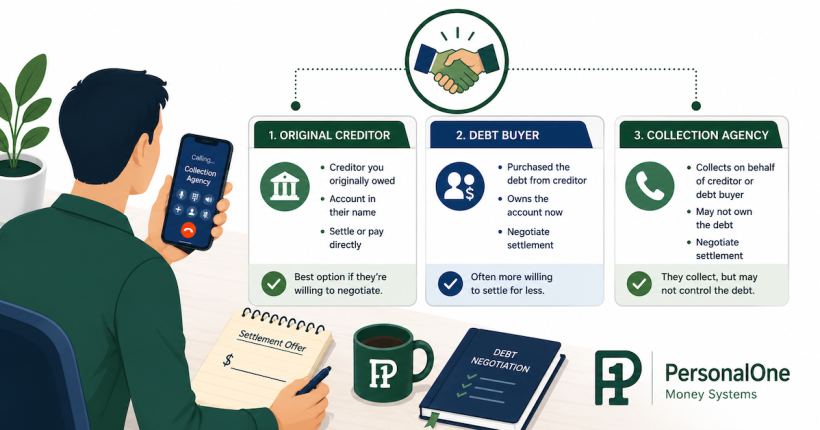
- Collection activity begins, sometimes with the debt sold to a third-party collector
- Settlement is negotiated and an agreement is reached
- The account reports as "settled for less than full balance"
By the time that final settlement notation appears, the report has usually already absorbed three to five significant negative marks from the stages before it. The settlement entry is the last line in a chain of damage, not the cause of the damage itself. This matters enormously for how you should think about the decision, because the score drop people fear when researching settlement has, in most cases, already substantially happened before settlement is even on the table — which means the fear itself is often pointed at the wrong moment in the timeline.
The Real Comparison: Settle vs. Keep Missing Payments
Here's the comparison almost no article actually runs. Picture two people at the exact same starting point: both are 90 days delinquent on a $10,000 credit card balance, and both have already taken the same damage up to that point from the missed payments leading up to this moment. From here, their paths diverge.
Path one: settlement. The account is negotiated and settled, reporting as "settled for less than full balance." The debt is resolved. No further missed payments accrue on this account. From this point forward, the recovery clock starts — every on-time payment on other accounts, every month of low utilization, every account in good standing begins rebuilding the file.
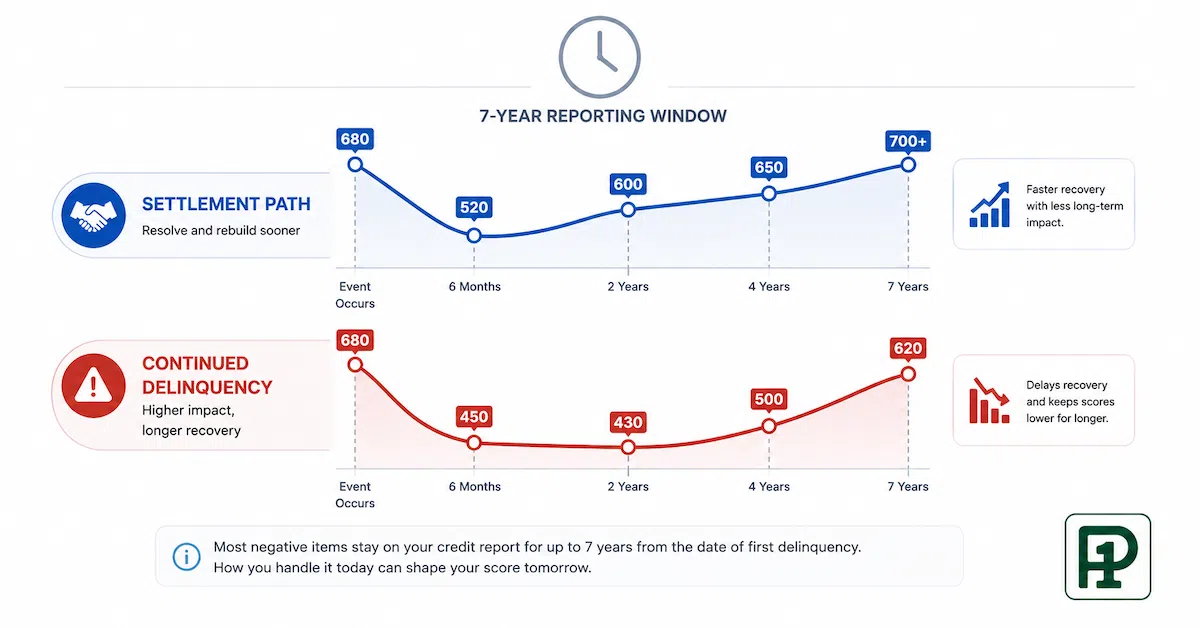
Path two: continued delinquency. The account isn't resolved. It may sit in collections indefinitely, accrue additional fees and interest where applicable, potentially result in a lawsuit and judgment depending on the creditor and state, and continue generating negative marks with no defined endpoint. At month 12, path two often looks worse than path one, not better, because the damage hasn't stopped accumulating — it's simply continued without resolution. At month 24 and month 36, the gap typically widens further, since path one has had a full recovery clock running while path two has had none.
If your account is already with a collector or has been charged off, how to recover from charge-offs and collections walks through that specific trajectory in more depth, since the recovery path looks somewhat different once a debt has moved past the original creditor.
What I've Seen
A client once delayed settling a collections account for nearly a year, hoping their financial situation would improve enough to pay it in full. It didn't, and during that year the account accumulated additional negative reporting, a judgment was filed, and their score sat well below where it would have landed had they settled at month two. When we finally negotiated the settlement, the score barely moved compared to where it already was — because most of the damage from waiting had already happened, and the settlement itself was almost a formality at that point.
The takeaway: the fear of "what settlement will do to my score" often causes people to delay a decision that would actually stop further damage. Waiting rarely protects the score — it usually just delays the recovery clock from starting.
Why Your Starting Score Changes the Credit Score Impact
FICO scoring isn't a straight line, and this has a direct, often-overlooked consequence for anyone weighing settlement: the same negative event costs dramatically more in points for someone with a high starting score than for someone with a low one.
A reader with a 780 score who settles one account can lose significantly more points than a reader with a 580 score settling the exact same type of debt. This isn't a flaw in the system — it reflects how much further there is to fall from a strong position, and how little additional information a single new negative mark adds to a file that's already carrying significant damage. This creates two genuinely different readers facing this decision, and they deserve different framing:
To put rough numbers on this: a borrower starting at 780 who settles a single account might see their score fall to somewhere in the 620 to 660 range, a drop of well over 100 points, because the scoring model is reacting to a sharp, unexpected change in an otherwise pristine file. A borrower starting at 580 who settles a comparable account often sees a much smaller drop, sometimes 20 to 40 points, because the file already reflects significant existing risk and the new mark doesn't change the overall risk picture nearly as much. The dollar amount of debt being settled can be identical in both cases — the point loss has far more to do with where you started than what you're settling.
The reader already deep in delinquency. For this person, settlement is damage control on a file that's already taken most of the hit. The marginal cost of the settlement notation itself is relatively small compared to what's already happened, and the benefit of stopping the bleeding and starting recovery is large.
The reader who is still current but considering settlement proactively. This person — someone weighing whether to stop paying an account specifically in order to qualify for settlement — is in a fundamentally different position. Their starting score is higher, which means the damage from the delinquency required to reach settlement eligibility costs them more, and they're voluntarily creating the very delinquency that triggers it. For this reader, the math is far less favorable, and alternatives like a debt management plan or aggressive payoff plan deserve serious consideration before deliberately damaging a still-healthy file.
The Seven-Year Rule: Why Settlement Timing Doesn't Change Your Report Date
This is the most commonly misunderstood mechanic in this entire topic, and getting it wrong leads people to make worse decisions about timing. The seven-year reporting window for a settled account is measured from the date of first delinquency on the original account — not from the date the settlement agreement is reached.
A reader who first fell behind in January 2023 and settles the account in January 2025 will see that negative mark fall off their report in January 2030, regardless of when the settlement itself happened. Settling earlier doesn't extend the seven-year window, and settling later doesn't shorten it — the clock is already running from the first missed payment, independent of the settlement date. The practical implication is significant: settling sooner doesn't cost you any additional time on your report. It only stops new damage from accumulating and starts your score recovering sooner. There's no credit-reporting-timeline reason to delay a settlement once you've decided it's the right move for your situation.
The Credit Damage Comparison Timeline
Putting the pieces above together, here's roughly how the two trajectories compare for someone starting at 90 days delinquent on a meaningful balance, assuming a moderate starting credit profile:
- Month 0 (90 days delinquent): Both paths share identical damage to this point — the 30, 60, and 90-day lates are already on the report regardless of what happens next.
- Month 3: Settlement path: account settles, "settled for less than full balance" reports, no further missed payments on this account. Continued delinquency path: account may charge off, collection activity likely begins.
- Month 12: Settlement path: roughly nine months of recovery time on other accounts, no new negative marks from this debt. Continued delinquency path: collection account still unresolved, possible additional fees, lawsuit risk depending on jurisdiction and creditor.
- Month 24: Settlement path: meaningful score recovery typically underway if other accounts are managed well. Continued delinquency path: judgment risk has often materialized in many states, with potential wage garnishment or bank levy depending on local law, and no resolution date in sight.
- Month 36: Settlement path: often substantially recovered, especially if no other negative marks have occurred. Continued delinquency path: still carrying unresolved collection activity, with the seven-year clock running the same as the settlement path's would have, but with ongoing active damage layered on top instead of a stopped, aging mark.
The two paths start identically and diverge sharply from the moment one stops and the other continues. This is the comparison worth running for your own situation before deciding — not "will settlement hurt my score," but "which of these two trajectories am I actually choosing between."
Once a settlement is complete, the work shifts from managing damage to actively rebuilding. Rebuilding after debt relief picks up exactly where this article leaves off, covering the specific steps that move your file from recovering to genuinely strong.
One Reporting Detail Worth Negotiating
Not every aspect of how a settlement reports is fixed once you've agreed to settle. While the seven-year clock itself isn't negotiable, how the account is described can sometimes be, and it's worth asking about before signing.
Some creditors will agree, as part of the settlement negotiation, to report the account as "paid" or "paid as agreed" rather than "settled for less than full balance," particularly if you're able to pay a larger lump sum upfront. This isn't always available, and not every creditor will agree to it, but it costs nothing to ask before the agreement is finalized. A "paid" notation is generally viewed somewhat more favorably than a "settled" notation by some scoring models and manual underwriting reviews, even though both indicate the original balance wasn't paid in full. Get any reporting agreement in writing before you send payment — a verbal promise about how an account will report is not enforceable if the creditor doesn't follow through.
Government Resources
CFPB: What Is Debt Settlement? — Federal consumer guidance on how debt settlement works and what to watch for.
CFPB: Credit Reports and Scores — Federal resources on how negative information is reported and how long it remains.
For the complete picture on resolving unmanageable debt, visit the debt relief and credit repair guide.
Frequently Asked Questions
How many points does debt settlement typically drop your credit score?
Commonly cited figures suggest 100 points or more, but this varies widely depending on your starting score and how much damage already occurred from missed payments leading up to settlement. For someone already deep in delinquency, the settlement notation itself often adds relatively little additional drop.
Is debt settlement worse for my credit than bankruptcy?
Generally, a settled account is viewed less severely than a bankruptcy filing, and bankruptcy can affect every account on your file rather than the one debt being settled. The right choice depends heavily on your full financial picture, not credit score impact alone.
Does settling a debt sooner reduce how long it stays on my report?
No. The seven-year reporting window is measured from your first missed payment on the original account, not from the settlement date. Settling sooner stops new damage from accumulating, but it doesn't shorten or extend the reporting timeline itself.
Will my score recover faster after settlement than if I never settled?
Usually, yes, if the alternative is continued missed payments. Settlement stops new negative marks from accumulating on that account and starts a recovery period. Continuing to miss payments adds compounding damage with no resolution date, which generally produces a worse trajectory over time, not a better one.
Should I settle a debt while I'm still current on payments to get a better deal?
This is generally not advisable. Most creditors won't negotiate a settlement until an account is significantly delinquent, which means deliberately missing payments to qualify for settlement creates damage on a file that may not need it yet. If you're still current, explore alternatives like a debt management plan or an aggressive payoff strategy before considering settlement.
Can I negotiate how the settlement is reported to the credit bureaus?
Sometimes. Some creditors will agree to report the account as "paid" rather than "settled for less than full balance" as part of the negotiation, particularly with a larger upfront payment. This isn't guaranteed and varies by creditor, but it's worth asking about and getting in writing before finalizing the agreement.
Disclaimer: This content is for educational purposes only and does not constitute financial advice. PersonalOne is not a licensed financial advisor, broker, or investment professional. Individual financial situations vary — consult a qualified financial professional for personalized guidance.