Updated: April 02, 2026
Home › Investing & wealth growth › Index fund investing › Index funds vs ETFs
Index funds vs ETFs: what's better for your portfolio?
— Index funds and ETFs are both passive tools designed to track the market, not beat it.
— ETFs offer flexibility and tax efficiency. Index funds offer automation and simplicity.
— Expense ratios are low for both. Your behavior matters more than tiny fee differences.
— The best choice depends on how you invest, not just what you invest in.
Most people think this decision is about performance. It's not. Index funds and ETFs often deliver nearly identical returns because they track the same markets. The real difference comes down to how you interact with them — how you buy, hold, automate, and stay consistent over time.
Understanding that distinction is one of the most important steps in building a portfolio that actually works. This guide breaks it down so you can choose the structure that fits your strategy.
What are index funds and ETFs?
Both are designed for passive investing. Instead of trying to beat the market, they track it — giving you exposure to hundreds or thousands of companies at once through broad indexes like the S&P 500 or the total stock market.
This approach is powerful because it removes complexity. You don't need to guess which stocks will win. You rely on long-term market growth, which has historically trended upward. That's why passive investing is considered one of the most reliable strategies for building wealth.
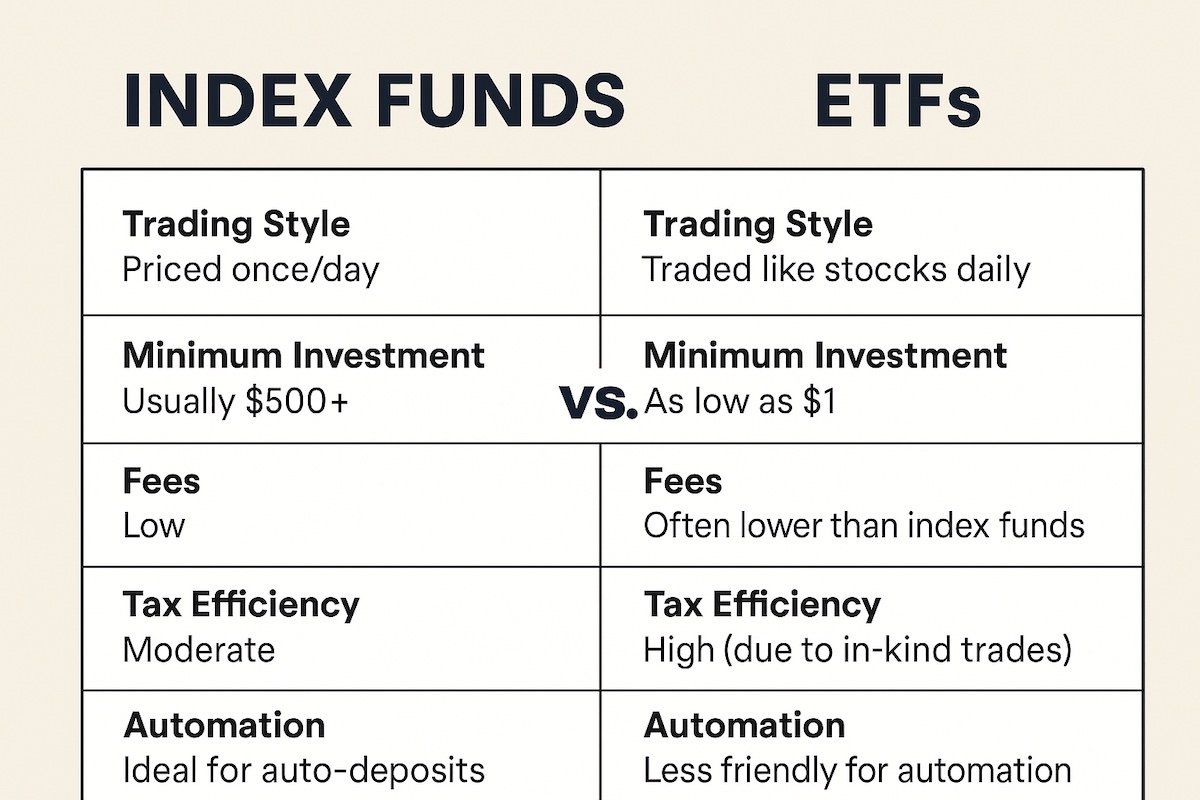
The key structural difference: index funds are mutual funds priced once per day, while ETFs trade like stocks throughout the day. That difference affects behavior, flexibility, and system design — but not the core investment itself.
Key differences that actually matter
The difference comes down to execution, not philosophy. Both follow the same passive investing principles, but they operate differently in practice.
Index funds prioritize simplicity. You invest money, and it executes at the end-of-day price. That structure removes the temptation to time the market and makes consistent contributions almost automatic.
ETFs introduce flexibility. You can buy and sell anytime during market hours — which can be useful, but also dangerous if it invites emotional decisions. That flexibility can either help or hurt depending on how disciplined you are.
This is why the decision isn't just technical — it's behavioral. The best option is the one that keeps you consistent, not the one that gives you the most control.
Cost comparison: expense ratios and hidden fees
Low expense ratios are one of the biggest advantages of both structures. Most funds today are extremely cheap — especially options like Vanguard's broad market offerings, which often fall below 0.05% annually. That's dramatically lower than actively managed funds.
The difference between index fund fees and ETF fees is usually minimal. Both typically come in under 0.10% per year.
ETFs may add small trading-related costs like bid-ask spreads. These are usually negligible, but they can add up if you trade frequently. Index funds avoid this entirely because they don't trade intraday.
Costs matter over time — but behavior matters more. Poor investing habits will do far more damage than a slightly higher expense ratio.
How expense ratios compound over 30 years
Here's a concrete illustration. Two investors each start with $50,000 and invest for 30 years at a 7% annual return.
The market provided the same returns for both. Fees determined how much each investor kept. That's why choosing low-cost funds is one of the highest-leverage decisions you can make early on.
Trading flexibility: feature or trap?
ETFs can be bought and sold throughout the day, just like stocks. Index funds execute once per day at the closing price.
At first glance, this makes ETFs seem superior. More flexibility should mean better control, right? In practice, this flexibility works against most investors. The ability to react to price movements often leads to overtrading, emotional decisions, and market-timing attempts — all of which consistently reduce returns.
Index funds remove that temptation entirely. By limiting trades to end-of-day pricing, they reinforce the behavior that actually builds wealth: invest consistently, ignore daily noise, let compounding do the work.
Tax efficiency: where ETFs have a real edge
Due to how they're structured, ETFs are less likely to generate capital gains distributions. Fewer distributions means fewer taxable events — which matters most in taxable brokerage accounts.
Index funds can still be tax-efficient, but depending on how the fund is managed, they may distribute gains more frequently.
In retirement accounts like a Roth IRA or 401(k), this difference is mostly irrelevant — gains aren't taxed until withdrawal anyway. In a taxable brokerage account, ETFs earn their edge.
Minimum investment: getting started
Many index funds require an initial investment of $1,000 to $3,000, depending on the provider. That's a real barrier for new investors.
ETFs remove it. You can buy a single share — or even a fraction of one — which means you can start with whatever you have. That accessibility matters.
But accessibility and effectiveness aren't the same thing. Index funds tend to integrate more seamlessly with automated contribution systems, which makes them more powerful for building wealth over time despite the higher entry point. Starting is easy with ETFs. Staying consistent is easier with index funds.
Dividend reinvestment: the friction you don't notice until it costs you
Dividends are a quiet but powerful part of a long-term portfolio. Reinvesting them buys more shares, which generate more dividends, which buy more shares. That's how compounding snowballs.
Index funds usually make this frictionless. Most mutual-fund-based index funds reinvest dividends automatically by default — you set it once and never think about it again. Less friction between receiving a dividend and putting it back to work means more consistent compounding.
ETFs can also reinvest dividends, but whether they do depends on your brokerage. Some let you enroll in an automatic reinvestment plan. Others require you to toggle settings manually, account by account. That may sound minor, but extra steps create extra chances for cash to sit idle.
Idle cash doesn't compound. It just sits there. If you're using ETFs, confirm your dividend reinvestment is actually turned on and working the way you expect.
Common myths, cleared up
ETFs always outperform index funds. Usually false. If an ETF and an index fund track the same benchmark, their returns will be extremely close. The differences come from structure, fees, tax handling, and investor behavior — not some hidden performance advantage in the ticker symbol.
Index funds are for beginners; ETFs are for serious investors. Mostly branding noise. Both are used by experienced investors, retirement savers, and people building large portfolios. A millionaire can hold index funds. A beginner can buy ETFs. The better question is which one matches your account type and habits.
ETFs are always cheaper. Sometimes, but the gap is often tiny. If one option charges 0.03% and another charges 0.04%, that's not what decides whether your portfolio succeeds. High-fee products, overtrading, and inconsistent contributions will do far more damage than a basis point.
You have to choose one and commit forever. You don't. Many investors use index funds in retirement accounts for automation and ETFs in taxable accounts for tax efficiency. The goal isn't ideological purity — it's building a portfolio that supports broad market exposure, low costs, and long-term consistency.
How to choose: a simple decision framework
Choose index funds when...
- You want automated contributions
- You invest mostly in retirement accounts
- You want dividends reinvested without thinking
- Behavior control matters more than flexibility
Choose ETFs when...
- You invest in taxable brokerage accounts
- You want to start with a small amount
- Tax efficiency and portability matter
- You already have a disciplined brokerage workflow
In both cases, the real win comes from choosing low-cost funds, staying diversified, and keeping contributions consistent.
So what's better for your portfolio? Usually, it's whichever option helps you keep investing through boring months, chaotic markets, and the rest of life. If a product keeps costs low and helps you stay committed to your plan — it's doing its job. Everything else is detail.
Index funds and ETFs are tools — but your system determines your results.
Explore index fund investing →