

January 24, 2026
February 19, 2026
Home > Banking Systems > Multi-Account Budgeting System
About the Author: Don Briscoe is a financial systems coach with 12+ years helping Millennials and Gen Z escape paycheck-to-paycheck cycles. He's worked with hundreds of people to build emergency funds, eliminate debt, and start investing using framework-first strategies that require less willpower and more infrastructure. He founded PersonalOne to provide the financial education he wished existed—structured, honest, and free.
TL;DR — What This Guide Covers
Separating money into multiple accounts creates clear boundaries between spending, saving, and bills—transforming money management from constant stress into autopilot simplicity.
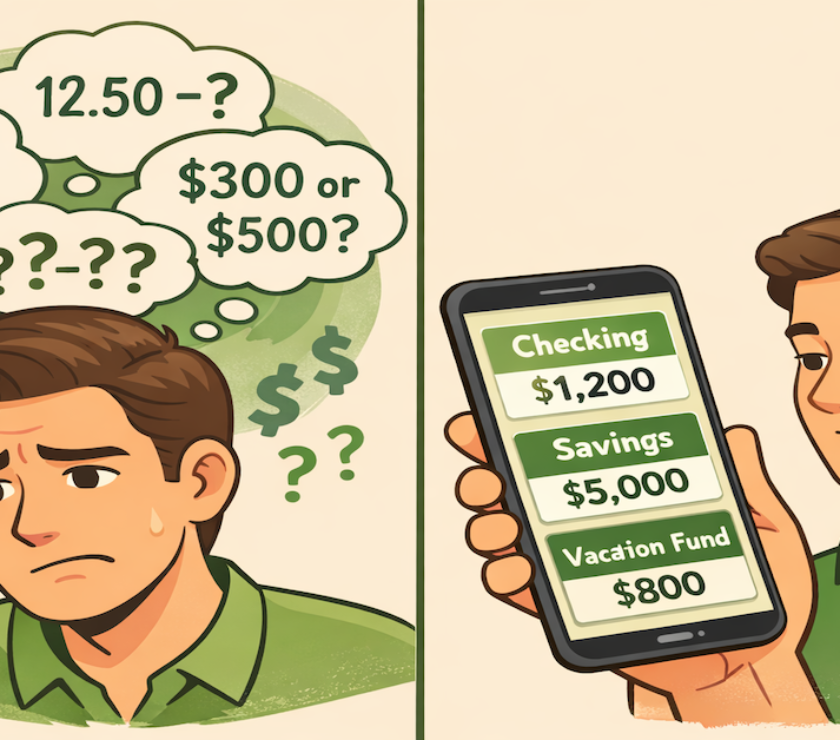
The core principle: Physical account separation removes the mental burden of tracking categories. When your spending account shows $300, that's genuinely available money—not "$300 but I should probably save some and remember rent is due."
What you'll learn:
- Why physical separation works when mental accounting fails
- The three-account foundation most people need
- How to calculate and automate transfers for each account
- Advanced strategies once the basics are mastered
- Common challenges and how to solve them
Ever wondered why your checking account balance always seems lower than you expected? Or why saving money feels impossible even though you swear you're being careful with spending?
The problem isn't your willpower—it's your account structure.
When everything lives in one account—your rent payment, grocery money, emergency fund, and fun spending—it becomes nearly impossible to track where your money actually goes. You're constantly doing mental math, trying to remember which bills are coming up, and second-guessing whether you can afford that coffee.
The multi-account system solves this by creating physical boundaries that match financial reality.
Part of Your Complete Banking Structure
The multi-account strategy you're learning here is one piece of a larger framework for organizing your financial life. This approach sits within complete banking systems architecture that enables everything from bill automation to long-term wealth building.
Understanding where account separation fits in the bigger picture helps you see why this isn't just about having more accounts—it's about building financial infrastructure that removes daily stress.
Why the Multiple Account System Works
Your brain processes money differently when it's physically separated. When all your money sits in one place, every dollar feels available to spend. But when you create boundaries between spending, saving, and bill money, you make it psychologically easier to stick to your financial plan.
Think of it like meal prepping. When you portion out your meals for the week, you're less likely to overeat because the boundaries are clear. The same principle applies to money—when you allocate funds to specific purposes, you naturally spend more intentionally.
The key insight: You're not relying on willpower or discipline to avoid spending bill money. It's literally in a different account. The structure enforces the boundary, not your self-control.
The Three-Account Foundation
Most people benefit from starting with three core accounts:
Account #1: Bills Account
Purpose: For fixed monthly expenses like rent, utilities, insurance, and subscriptions
Why it works: When bills are separated, your spending account balance becomes perfectly accurate. What you see is what you can actually spend.
Account #2: Spending Account
Purpose: For variable daily expenses like groceries, gas, dining out, and entertainment
Why it works: Once you know bills and savings are handled, you can spend what's in this account guilt-free. No more "should I really buy this?" paralysis.
Account #3: Savings Account
Purpose: For emergency fund, short-term goals, and long-term savings
Why it works: Money that's out of sight stays out of mind. A separate savings account makes "not spending" the default.
Setting Up Your Bills Account
Your bills account serves one purpose: covering your fixed monthly expenses. This should be a separate checking account dedicated exclusively to recurring bills.
How to Calculate Your Bills Account Amount
Start by listing every fixed expense that hits your account each month. Include rent or mortgage, utilities, phone bill, insurance premiums, car payments, minimum debt payments, and subscription services. Add these up to get your total monthly bill amount.
Then add a 10-15% buffer. If your bills total $2,000 per month, keep $2,200-2,300 in this account. This cushion protects you from unexpected bill increases or forgotten subscriptions.
Automating Your Bills Account
Set up automatic transfers from your primary income account to your bills account on payday. If you're paid bi-weekly, transfer half your monthly bill amount with each paycheck. This ensures the money is always there when bills are due.
Then set every possible bill to autopay from this account. This eliminates late fees, reduces mental load, and ensures your essential expenses are always covered first.
Bills Account Best Practices
- Review bank statements monthly to catch any billing errors or unwanted subscriptions
- Never use your bills account debit card for purchases
- Set up low-balance alerts to warn you if funds dip too low
- Update your buffer amount annually as bills change
Creating Your Spending Account
Your spending account holds money for everything that isn't a fixed bill or designated savings. This includes groceries, gas, restaurants, entertainment, clothing, and personal care.
The beauty of a dedicated spending account is psychological freedom. Once you know your bills and savings are handled, you can spend what's in this account guilt-free.
Determining Your Spending Budget
After accounting for bills and savings goals, whatever remains is your spending money. If you earn $4,000 monthly, pay $2,000 in bills, and save $600, you have $1,400 for spending.
Divide this amount across your pay periods. If you're paid twice monthly, transfer $700 to your spending account with each paycheck. This prevents the "flush on payday, broke before next payday" cycle.
Managing Your Spending Account
Check your spending account balance before making purchases. When the balance gets low, you know it's time to cut back until the next payday. No complicated budgeting required—just spend what's there and stop when it's gone.
Some people prefer to withdraw their spending money as cash for even tighter control. Others use their debit card but check the balance daily. Find what works for your spending personality.
Building Your Savings Account
Your savings account shouldn't be an afterthought—it should be funded first, right alongside your bills. The "pay yourself first" principle means treating savings like a non-negotiable bill.
Choosing the Right Savings Account
Don't keep savings in your regular bank's standard savings account. Those typically earn 0.01% interest, meaning your money loses value to inflation.
Instead, open a high-yield savings account at an online bank. These accounts currently offer 4-5% interest, meaning your money actually grows while sitting there. Popular options include Ally Bank, Marcus by Goldman Sachs, and American Express Personal Savings.
The key feature to look for is no monthly fees and no minimum balance requirements. Your savings should work for you, not cost you money.
How Much to Save
Start with whatever you can—even $25 per paycheck adds up to $650 annually. As your income increases or expenses decrease, increase your savings allocation.
Work toward these savings milestones:
- $1,000 starter emergency fund: Covers minor emergencies without derailing your finances
- One month of expenses: Provides breathing room if income is disrupted
- 3-6 months of expenses: Full emergency fund for job loss or major unexpected costs
Automating Savings Transfers
Set up automatic transfers from your main checking account to your savings account on payday. This "set it and forget it" approach removes willpower from the equation.
Start conservative if needed. It's better to automatically save $50 per paycheck consistently than to manually transfer $200 once and then never again.
The Complete System in Action
Let's walk through how this system works with a real example:
Sarah earns $3,500 per month paid bi-weekly ($1,750 per paycheck).
Her monthly expenses break down as:
- Fixed bills: $1,800
- Savings goal: $400
- Discretionary spending: $1,300
Every payday, Sarah's money automatically flows:
- $1,750 deposits into her main checking account
- $900 transfers to her bills account (half of monthly bills)
- $200 transfers to her high-yield savings account
- $650 transfers to her spending account
All her bills autopay from the bills account throughout the month. She spends freely from her spending account knowing everything else is handled. Her savings grow automatically without requiring any additional decisions.
This system removes 90% of the financial decisions Sarah used to make daily. She's no longer wondering if she can afford something or worrying about upcoming bills—the system handles it automatically.
Common Challenges and Solutions
Challenge: Irregular Income
If your income varies month to month, base your system on your lowest typical income month. During higher-income months, the extra funds can boost savings or cover irregular expenses.
Calculate your average monthly income over the past six months. Use the lowest month to set your bills and spending allocations. Treat anything above that as extra.
Challenge: Too Many Accounts to Track
Start with just the three core accounts. You can always add more specialized accounts later, but beginning with a simple system increases your likelihood of success.
Use a financial app like Mint or YNAB to view all accounts in one dashboard. This gives you the benefits of multiple accounts without constantly logging into different banks.
Challenge: Overdraft Fears
Link your accounts for overdraft protection. If your bills account runs low, your bank can transfer money from your main account instead of charging overdraft fees.
Alternatively, keep a small buffer in each account. Having an extra $100 in your bills account means a surprise subscription renewal won't cause problems.
Challenge: Overspending in One Category
If you consistently overspend from your spending account, the problem isn't the system—it's the allocation. Either increase your spending allocation (and decrease savings temporarily) or identify where you're overspending and make adjustments.
Track your spending for one month to see where money actually goes. You might discover you're spending $400 on restaurants when you thought it was $200. Awareness enables better allocation.
Taking Your System to the Next Level
Once you've mastered the three-account system, consider adding specialized accounts for specific goals:
Advanced Account Options
- Irregular expenses account: For annual bills like car registration, holiday gifts, or insurance premiums paid yearly
- Investment account: For retirement contributions beyond workplace plans
- Vacation fund: Building travel savings without raiding your emergency fund
- Home maintenance fund: For homeowners to save for repairs and upgrades
- Car replacement fund: Saving gradually for your next vehicle purchase
The principle remains the same: give every dollar a job by putting it in an account designated for a specific purpose.
The Mental Game: Why Separation Works
Money management isn't just math—it's psychology. When you see $5,000 in your account, your brain registers "I have money to spend," even if $3,000 is earmarked for next month's rent.
Physical separation creates mental accounting barriers. When your spending account shows $300, you know that's truly available money. You're not doing mental calculations about upcoming bills or wondering if you should be saving instead.
This clarity reduces decision fatigue. Instead of questioning every purchase, you make decisions based on simple account balances. If the money's there, you can spend it guilt-free. If it's not, you wait until the next transfer.
The system also creates positive feedback loops. Watching your savings account grow motivates continued saving behavior. Consistently paying bills on time from a dedicated account builds financial confidence.
Deep Dive: Multi-Account System Topics
The following guides provide detailed implementation strategies for mastering the multi-account system:
The Psychology of Account Separation
Why physical boundaries work when mental accounting fails. Understand the cognitive science behind account separation and how to leverage it for automatic financial discipline.
Coming soon
Common Multi-Account Setup Mistakes
The five critical errors people make when implementing multi-account systems—and how to avoid them from day one. Learn from others' missteps to build your system correctly the first time.
Coming soon
How Many Bank Accounts Should You Really Have?
Move beyond the three-account foundation. Discover when to add specialized accounts, when simplicity beats complexity, and how to scale your system as finances grow more sophisticated.
The 4-Bucket Money Management Method
Advanced multi-account strategy that separates money into four distinct buckets: Obligations, Necessities, Goals, and Wants. Complete implementation guide for this proven system.
Coming soon
Why You Need a Separate Account for Bills
Master the single most important account separation: bills versus spending. Why this distinction matters more than any other, how to maintain the boundary, and troubleshooting when they blur together.
Ready to Build Your Complete Banking Structure?
You've learned how multi-account separation works. Now discover how this fits into complete banking systems architecture that makes your entire financial life run on autopilot.
Explore Banking Systems ArchitectureFrequently Asked Questions
How many accounts do I really need?
Three accounts—bills checking, spending checking, and high-yield savings—provide the foundation. Most people find this sufficient. Add more only if you have specific goals requiring dedicated funds.
Will multiple accounts hurt my credit score?
No, bank accounts don't appear on credit reports. Opening checking or savings accounts has zero impact on your credit score. Only credit accounts like loans and credit cards affect your score.
What if I can't save much right now?
Start with any amount you can manage consistently. Even $10 per paycheck builds the savings habit. You can increase the amount later as your income grows or expenses decrease. The habit matters more than the initial amount.
Should I use separate banks or keep everything at one bank?
Both approaches work. Using one bank simplifies management but might limit your options. Using multiple banks lets you optimize each account type—traditional bank for bills, online bank for savings interest. Choose based on your comfort level and which banks offer the best features for each purpose.
How do I handle irregular expenses like car repairs?
Build a buffer into your spending account, create a separate irregular expenses account, or use your emergency fund for truly unexpected costs. As you track spending over several months, you'll identify which irregular expenses happen frequently enough to budget for specifically.
What if I overdraft one account but have money in another?
Link your accounts for overdraft protection so your bank automatically transfers money instead of charging fees. Alternatively, keep small buffers in each account and review balances weekly to catch potential issues before they cause problems.
Can I use credit cards in this system?
Absolutely. If you pay your credit card in full monthly, treat it like a bill that autopays from your bills account. If you use credit cards for rewards, pay them from your spending account since that's where the purchases were budgeted.
How often should I review and adjust my system?
Check account balances weekly to stay aware of your financial position. Do a thorough system review monthly to identify any adjustments needed in your allocations. Annually, reassess the entire structure as your income, expenses, and goals evolve.
What's the biggest mistake people make with multiple accounts?
Making the system too complicated. Start simple with three accounts and only add more if you have a clear need. Also, failing to automate transfers—if you rely on manual transfers, you'll eventually skip them and the system breaks down.
How long until I see results from this system?
You'll feel less financial stress within the first month as bills start autopaying and spending becomes clearer. Measurable savings results appear within 2-3 months. The system becomes fully automatic and habitual after 3-6 months of consistent use.
Related Resources
- Banking Systems: How to Structure Accounts for Control, Growth, and Automation — The complete framework for account architecture
- Where Your Paycheck Should Go First: Designing Your Money Flow — How to route income to make this system work automatically
- How to Set Up a 3-Account Money Flow System That Actually Works — Step-by-step implementation guide
- Direct Deposit Splitting: The Smart Way to Control Cash Flow — Automate funding for your multi-account system
- Financial Automation: How to Run Your Money on Autopilot — Next step after structure is built
- The Ultimate Guide to Modern Banking & FinTech — Choose the right banks and tools for your system
Educational Content Disclaimer: This guide provides general educational information about multi-account banking systems and personal finance strategies. It is not personalized financial advice. Your optimal account structure depends on your income patterns, expense stability, financial goals, existing accounts, and personal preferences. Before making significant changes to your banking setup, consider your complete financial situation and consult with qualified financial professionals if needed. PersonalOne provides educational content and does not offer personalized financial planning services. Banking products and account features vary by institution; verify specific terms and conditions with your financial institution before implementation.