

February 11, 2026
February 20, 2026
Home > Banking Systems > Banking for Irregular Income > Personal vs Business Bank Accounts: What Freelancers Need to Know
About the Author: Ally M. Scott is a personal finance advisor with over 22 years of experience guiding everyday people through smarter financial decisions. She writes on banking systems, self-employment finances, and practical money management for freelancers and independent workers.
TL;DR — Personal vs Business Bank Accounts for Freelancers
- Separate accounts aren't legally required for most freelancers — but they solve practical problems that single-account systems can't.
- The real issue is cash flow chaos, not compliance — mixing personal and business money makes it impossible to know what you can actually spend.
- Business accounts create forced structure — payments go in, expenses come out, what's left transfers to personal spending on a schedule.
- You don't need an LLC to open a business account — sole proprietors can open one with a DBA or EIN in most cases.
- Tax season becomes manageable — all business transactions in one account means no more reconstructing a year of mixed statements.
- The decision point is clarity, not income level — if you can't tell business money from personal money at a glance, it's time to separate.
You've been freelancing for six months. Client payments hit your personal checking account. Business expenses come out of the same account. Groceries, rent, software subscriptions, client invoices, coffee with a friend, domain renewals — it's all one swirl of money moving in and out. You think you're profitable. You're pretty sure. But you're not certain because the numbers are tangled.
Then tax season arrives. You need to separate business income from personal income, business expenses from personal expenses. You spend hours combing through bank statements trying to remember: Was that dinner a business meeting or just dinner? Was that Amazon order business supplies or personal? The chaos you've been living with all year becomes a crisis.
This isn't about being disorganized. It's about trying to run two financial lives — personal and business — through one structure that wasn't built for both. The question isn't whether you're capable of tracking everything mentally. The question is whether the mental load and error risk are worth avoiding a second account.
Most freelancers eventually realize they're not. This guide covers when separation makes sense, what actually changes when you separate accounts, and how to structure your money so freelancing doesn't feel like financial chaos with occasional income.
Why Mixing Personal and Business Money Creates Chaos
The problem with a single account isn't that it's illegal — it usually isn't. The problem is cognitive. When all your money lives in one place, you lose the ability to answer basic questions quickly: How much did I actually make from freelancing this month? How much can I safely spend on personal expenses right now? What's my effective hourly rate after business expenses? Am I actually profitable or just busy?
You can answer these questions with a single account — but only with constant mental accounting, detailed tracking, and perfect categorization discipline. Most people don't have that. More importantly, most people don't want to spend mental energy on that when a structural solution exists.
The Illusion of Available Money
A client pays you $2,000. Your checking account shows $3,000 total. Rent is $1,500. You "have enough money." Except you don't. $500 of that $3,000 was already there for personal spending. The $2,000 from the client needs to cover business expenses you haven't paid yet — software, contractor payments, equipment, estimated taxes.
But the account just shows $3,000. You see $3,000 minus $1,500 rent equals $1,500 left. That math feels safe. Then business expenses hit and suddenly you're closer to the edge than you realized. This isn't bad budgeting — it's bad structure. Separating accounts solves this immediately: when you look at your personal account balance, that number is real. It's actually yours to spend. No mental math required.
When You Actually Need Separate Accounts
There's no universal income threshold or client count that triggers the need for separation. The trigger is simpler: when you can no longer easily distinguish business transactions from personal transactions at a glance.
Separate now if:
- You regularly can't recall whether a transaction was business or personal without checking receipts
- You've missed deducting business expenses at tax time because you forgot they happened
- You've accidentally spent money earmarked for taxes or business expenses on personal items
- You're spending more than 15 minutes per week tracking and categorizing transactions
- You've formed an LLC or other business entity (legally required in most cases)
- You have business partners or investors (required for legal separation)
You can probably wait if:
- You have fewer than five business transactions per month
- All business income comes from one or two clients who pay predictably
- Business expenses are minimal and clearly distinct from personal spending
- You're genuinely comfortable with the current tracking workload
The decision isn't about following rules. It's about whether your current structure serves you or adds friction. Separate accounts are a tool, not a moral obligation. Use them when they solve a problem you actually have.
What Actually Changes When You Separate Accounts
Opening a business account isn't just about having two accounts — it's about creating a boundary that forces clarity. With one account, money is just money. With two accounts, money has a job.
Business account flow:
- Client payments deposit here
- Business expenses pay from here — software, supplies, contractors, fees
- Quarterly estimated taxes transfer from here to a dedicated tax savings account
- What's left is your owner's draw — your actual income
- Owner's draw transfers to personal account on a set schedule (weekly, biweekly, or monthly)
Personal account flow:
- Owner's draw deposits here
- Personal expenses pay from here — rent, groceries, entertainment, everything non-business
- This account balance is your real, spendable money
This separation creates forced clarity. You can't accidentally spend business money on personal items because business money doesn't live in your personal account. Transfers are intentional, not accidental.
Tax preparation simplifies considerably as well. Instead of combing through twelve months of mixed transactions, your business account statement is your complete business financial record. Every deposit is income. Every withdrawal is a potential deduction. At tax time, you hand your accountant — or yourself — one clean statement.
Personal vs Business Accounts: The Real Differences
Business checking accounts aren't fundamentally different from personal ones. They're checking accounts with slightly different terms and sometimes different fees. Here's what actually differs:
| Feature | Personal Account | Business Account |
|---|---|---|
| Monthly Fees | Often $0–5 | Often $10–30 (sometimes waived with minimum balance) |
| Transaction Limits | Unlimited in most cases | May cap free transactions (e.g., 100/month, then fees) |
| Deposit Methods | Mobile, ATM, branch | Same, sometimes higher mobile deposit limits |
| Debit Card | Personal name | Business name (more professional with clients) |
| Tax Reporting | Not designed for business separation | Statements organized for business tax purposes |
| Legal Protection | None (mixing can pierce LLC veil) | Maintains legal separation for LLCs and corporations |
The functional differences are small. The psychological and organizational differences are significant. Business accounts create a mental and practical boundary that personal accounts don't.
How to Set This Up: The Logistics
Opening a business account as a freelancer is straightforward, though requirements vary by bank.
If you're a sole proprietor (no LLC): Personal identification, Social Security Number, and either a DBA ("Doing Business As") registration if you use a business name other than your legal name, or a free EIN (Employer Identification Number) from the IRS — takes about five minutes at irs.gov.
If you have an LLC or corporation: Formation documents (Articles of Organization or Incorporation), EIN (required for multi-member LLCs), personal identification, and business address.
Step 1 — Get an EIN. Even as a sole proprietor, an EIN lets you open accounts without using your Social Security Number everywhere, reducing identity theft exposure. It also signals legitimacy to banks. Free, instant at irs.gov.
Step 2 — Choose a bank. Look for business checking with low or no monthly fees. Many online banks offer free business checking. Credit unions often have better terms than large banks.
Step 3 — Open the account. Most banks allow online applications. You'll provide business information, upload identification, and make an initial deposit (typically $25–$100).
Step 4 — Transition payments. Update invoices with business account details. If you use Stripe, PayPal, or Venmo for Business, update deposit routing to the business account. Do this incrementally as new payments come in — no need to switch everything at once.
Step 5 — Set an owner's draw schedule. Decide how often you'll transfer from business to personal (weekly, biweekly, or monthly) and treat it as your paycheck. Moving money on a schedule instead of whenever you feel like it is what makes the separation functional rather than cosmetic.
The Practical Reality: Three Accounts, Not Two
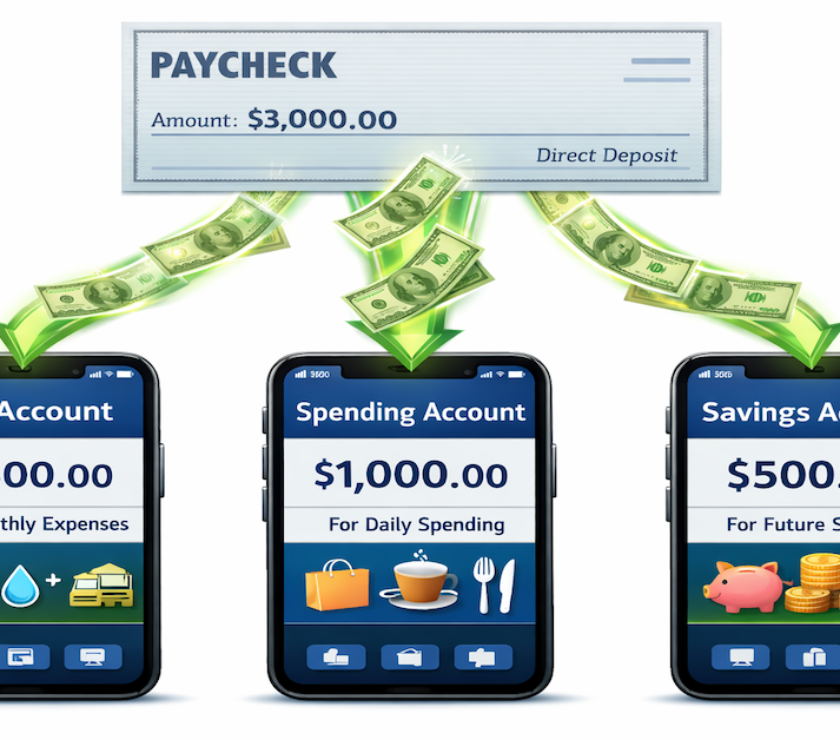
Most freelancers who get this right don't stop at separating personal and business — they use three accounts:
Account 1 — Business Checking: Client payments in, business expenses out. Your operating account. Everything business-related runs through here.
Account 2 — Personal Checking: Owner's draw deposits here. Personal expenses pay from here. This is your salary — the number that reflects what your freelance work actually nets you personally.
Account 3 — Tax Savings: Transfer 25–30% of every client payment here immediately. Don't touch it until quarterly estimated payments or annual filing. This account is a firewall — tax money goes in, gets ignored, comes out only for taxes.
This three-account structure applies the same principle as a multi-account budgeting system for personal finances — using physical separation to create clarity and prevent money from being spent on the wrong things.
The tax account is not optional for most freelancers. Those who skip it often spend what should be tax reserves, then face a cash crisis when quarterly payments come due. The separate account makes that structurally harder to do accidentally.
Common Mistakes That Break the Separation
Moving money randomly instead of on a schedule. If you transfer from business to personal whenever you "feel like it" or "need money," you've created two accounts with the same chaos as one. Pay yourself on a fixed schedule — weekly, biweekly, or monthly. The schedule is the structure.
Paying personal expenses from the business account "just this once." Every crossover muddies the record. If you need personal money, transfer it to personal first, then spend it. The extra step is intentional — it's the friction that keeps categories clean.
Leaving all money in the business account indefinitely. Some freelancers only move money when they "need" it, which means they never actually know their income. Pay yourself on a schedule. The amount can vary with business income, but the timing shouldn't.
Skipping the tax account. Separation doesn't solve tax planning. Without a dedicated tax reserve account, you'll have clean financial separation but still face a cash crisis at quarterly payment time. Twenty-five to thirty percent of gross income set aside from every deposit prevents this entirely.
When Separate Accounts Aren't Enough
Account separation solves cash flow chaos and simplifies tax preparation. It doesn't solve everything. If you're still struggling financially after separating accounts, the issue is structural at a deeper level.
Profitability problems: If business expenses consistently consume most of your revenue, separate accounts make the problem more visible — not smaller. The fix is raising rates, reducing costs, or questioning the business model.
Irregular income stress: Separate accounts don't smooth feast-famine cycles. You still need an income buffer, emergency fund, and systems designed for variable income. That's a separate layer from account separation.
Operational gaps: If you're not tracking profitability, haven't set clear pricing, or aren't managing invoicing systematically, separate accounts clarify that those problems exist — they don't fix them. Account separation is infrastructure. Necessary, but not sufficient on its own.
What This Looks Like in Practice
A typical month for a freelancer running the three-account system:
Week 1: Client A pays $1,500 into business checking. Immediately transfer 30% ($450) to tax savings. $1,050 stays in business checking.
Week 2: Pay business expenses — $100 software, $300 contractor payment. Business checking: $650. Transfer $500 owner's draw to personal checking.
Week 3: Client B pays $1,000. Transfer $300 (30%) to tax savings. $700 stays in business checking. Running balance: $850.
Week 4: Light expense week. Transfer another $500 owner's draw to personal. Business checking: $350 operating buffer.
End of Month Snapshot
Business checking: $350 — operating buffer for next month
Tax savings: $750 — reserved from this month's income
Personal checking: $1,000 — actual take-home pay
Gross income: $2,500. Taxes reserved: $750. Business expenses: $400. Personal income: $1,000. You know exactly where you stand — no guessing, no mental math.
Account Separation Is the Foundation. Irregular Income Needs a Bigger System.
Separating personal vs business bank accounts for freelancers solves cash flow chaos and simplifies taxes. But freelancers also need systems for smoothing variable income, sizing an income buffer, knowing when to increase an owner's draw, and building stability when paychecks don't arrive on schedule. The Banking for Irregular Income hub covers the complete framework.
Build a System for Irregular Income →Frequently Asked Questions
Do I need an LLC to open a business bank account?
No. Sole proprietors can open business accounts, though requirements vary by bank. Some want a DBA registration or an EIN — both are straightforward to obtain. An EIN is free from irs.gov and takes about five minutes. Check your target bank's specific requirements for sole proprietors before applying.
Will having a business account affect my personal credit?
Opening a business checking account doesn't impact personal credit. Business credit cards and loans can affect personal credit if you personally guarantee them — which most freelancers do initially — but basic business checking and savings accounts don't report to personal credit bureaus.
What if I can't afford business account fees right now?
Look for free business checking first — many online banks and credit unions offer it with no minimum balance requirement. If fees are genuinely prohibitive in the short term, a second personal account used exclusively for business is a workable interim step. It's not ideal structurally but beats running everything through one account. Transition to a proper business account once income stabilizes.
How much should I keep in my business checking as a buffer?
Aim for one month of typical business expenses plus a small cushion — roughly $500–$1,000 depending on your expense patterns. This prevents overdrafts and gives flexibility when client payments run late. The exact amount depends on your specific expense volume and income predictability.
Should I use the same bank for business and personal accounts?
It's convenient — same login, easy internal transfers — but some people prefer different banks to create stronger separation and reduce the temptation to move money impulsively. Either approach works if you maintain clear rules about when and why transfers happen. What matters is the schedule and discipline, not the specific institution.
Resources
- Banking for Irregular Income — PersonalOne Hub
- Multi-Account Budgeting System — PersonalOne
- IRS Small Business and Self-Employed Tax Center
- IRS — Apply for an EIN Online (Free)
- SBA — How to Open a Business Bank Account
- FDIC — Consumer Protection and Deposit Insurance
Disclaimer: This article provides educational information about banking account structures for freelancers and self-employed individuals. It does not constitute financial, tax, or legal advice. Banking requirements, business structures, and tax obligations vary by location and individual circumstances. Consult a qualified accountant, tax professional, or business attorney for guidance specific to your situation. Always verify that accounts are FDIC-insured before opening them.