Updated: September 12, 2026
Home › Banking Systems › Multi-Account Budgeting System › Separate Bills Account
What You Need to Know
— A separate bills account keeps money for rent, utilities, insurance, loan payments, and other fixed obligations away from everyday spending.
— Once bills are separated, the balance in your spending account becomes much easier to trust because bill money is no longer mixed into it.
— Fund the bills account automatically on payday and have recurring obligations autopay from it.
— Add a buffer above your expected monthly bills so small increases, forgotten subscriptions, or timing differences do not cause missed payments.
— The goal is not to create more accounts for the sake of complexity. It is to give each dollar a clear job before you spend it.
Picture this: it is Thursday and your checking account shows $1,200. You are deciding whether to spend $70 at the grocery store, replace something you need for the house, or go out for dinner.
But before you make the purchase, the mental calculations start.
Is rent coming out tomorrow or next week? Has the car insurance already cleared? What about the phone bill? Did the electric bill increase this month? Which subscriptions are still pending?
The account may show $1,200, but you do not actually know how much of that money is available to spend.
That uncertainty is the problem a separate bills account is designed to solve.
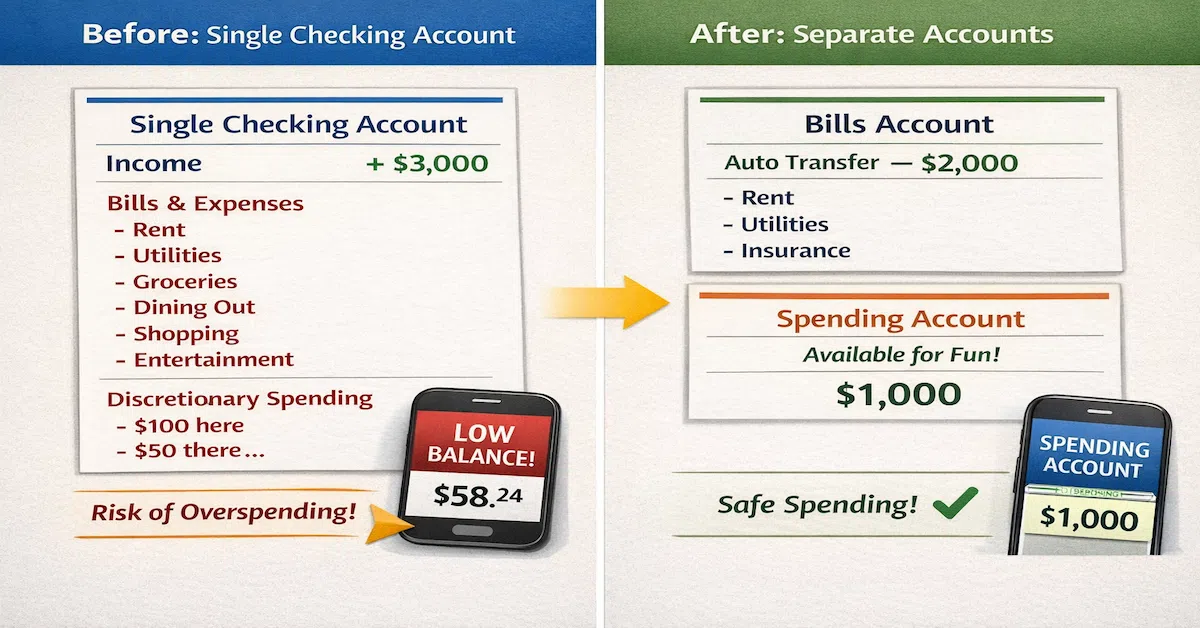
When fixed obligations live in one account and everyday spending lives in another, your money becomes easier to read. Bill money is protected. Spending money is visible. And you no longer have to mentally subtract future obligations every time you check your balance.
What a Separate Bills Account Actually Does
A bills account is a checking account dedicated to fixed and recurring obligations. Its job is simple: receive the money needed for bills and pay those bills when they are due.
You do not use it for groceries, restaurants, gas, clothing, entertainment, or everyday purchases. Those transactions belong in a separate spending account.
This separation creates three important benefits.
1. Bill Money Cannot Be Accidentally Spent
If rent money is sitting in the same account you use for groceries and entertainment, it is easy to spend part of it without realizing what happened. The bank balance may look healthy even though much of the money is already committed.
A separate bills account removes that risk. The money for obligations is physically separated from the money available for discretionary spending.
2. Your Spending Account Becomes Easier to Trust
When fixed obligations are removed, the spending account balance becomes a much cleaner number.
If the spending account shows $600, you do not have to mentally subtract rent, insurance, internet, and the car payment. Those obligations are already funded somewhere else.
The question becomes much simpler: does the spending account have enough for the purchase you are considering?
3. Bills Can Run Automatically
Once the account is properly funded, recurring bills can autopay from it without requiring constant intervention.
The bills account becomes financial infrastructure. Income arrives, the correct amount moves into the account, bills are paid, and you monitor the system rather than manually rebuilding it every month.
PersonalOne Principle
Do not rely on your memory to protect bill money. Build the separation into the banking structure so the correct behavior happens automatically.
What Happens When Bills and Spending Share One Account
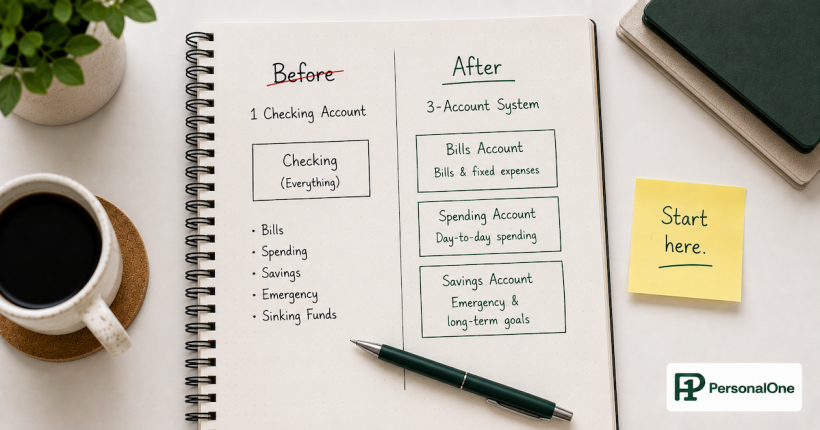
Most people begin with one checking account. Income lands there. Bills come out of it. Groceries come out of it. Entertainment comes out of it. Debt payments come out of it.
The account may work technically, but it forces you to perform accounting in your head every time you spend.
Suppose you are paid $2,500 and that amount appears in checking. Your brain sees $2,500.
But $1,200 is for rent, $150 is for insurance, $100 is for utilities, $70 is for internet, $60 is for subscriptions, and $200 is committed to debt payments.
Your bank shows $2,500. Your actual flexible money is far less.
Failure Mode 1: Constant Mental Math
Every purchase requires a calculation. You are not simply deciding whether you want to spend $40. You are trying to remember what has cleared, what has not cleared, and what is still due.
That turns ordinary purchases into repeated financial decisions.
Failure Mode 2: Accidental Overspending
You may see $1,500 in checking, spend $80 on groceries, $50 on gas, and $40 on dinner, only to realize later that part of that balance was reserved for an upcoming bill.
You did not consciously decide to spend bill money. The system simply failed to distinguish committed money from available money.
Failure Mode 3: Bill Anxiety
Even when you never miss a payment, you may still check balances repeatedly before due dates because you do not trust the number in the account.
The problem is not always insufficient income. Sometimes the problem is that the account does not tell you which dollars are still available and which dollars already belong to future obligations.
What Belongs in a Bills Account
A bills account should hold expenses that are recurring, necessary, and predictable enough to plan for in advance.
Bills Account: What Belongs Here
Rent or mortgage — Car payment — Auto insurance — Renters or homeowners insurance — Utilities — Internet — Phone bill — Minimum student loan payments — Personal loan payments — Childcare or tuition — Essential recurring subscriptions
Bills Account: What Usually Does Not Belong Here
Groceries — Gas — Dining out — Entertainment — Clothing — Personal care — Hobbies — Everyday discretionary purchases
A useful test is to ask whether the expense is a recurring obligation or an everyday spending decision.
If the expense is something you must pay regardless of how much discretionary spending you do that month, it probably belongs in the bills account.
How to Calculate Your Bills Account Amount
Before setting up automation, calculate how much the account must receive each month.
Step 1: List Every Recurring Bill
Write down rent or mortgage, insurance, utilities, internet, phone service, loan payments, subscriptions, childcare, and other recurring commitments.
For bills that change slightly, such as electricity or gas, use a reasonable recent average.
Step 2: Add the Monthly Total
Example Monthly Bills
Rent: $1,200
Car payment: $350
Insurance: $220
Utilities: $180
Phone: $85
Internet: $70
Student loan minimum: $45
Total monthly bills: $2,150
Step 3: Add a Buffer
Bills are not perfectly static. Utilities change. Insurance premiums increase. A subscription may renew that you forgot to include.
Adding approximately 10 to 15 percent gives the account room to absorb small changes without immediately creating a shortfall.
Using the $2,150 example, a 15 percent buffer creates a target of about $2,473. Rounding that to $2,500 makes the system easier to manage.
Step 4: Convert the Monthly Number Into a Payday Transfer
Once you know the monthly amount, divide the funding across the paychecks that normally cover that month's bills.
If you are paid twice monthly, half can move after each paycheck. If you are paid weekly or on another schedule, structure the transfers so the account remains funded before obligations come due.
The exact timing matters less than one rule: the bill money should arrive before the bills need it.
How to Set Up a Separate Bills Account Step by Step
Step 1: Open a Dedicated Checking Account
Use a checking account with no unnecessary monthly maintenance fee and easy online transfer capability.
Name it something obvious such as Bills Account so there is no confusion about its purpose.
If you do not need a debit card for the account, you may choose not to use one. The fewer ways money can leave outside the bill-payment system, the cleaner the structure remains.
Step 2: Seed the Account Before Moving Bills
This is an important step that is easy to skip.
When the account is brand new, recurring transfers have not yet had enough time to create a working balance. Move enough money into the account to cover bills that will come due before your normal transfer cycle is established.
Do not switch every autopay first and hope the funding catches up later.
Step 3: Move Recurring Bills to the New Account
Log into each biller and change the payment account.
Typical obligations include rent or mortgage if electronic payment is available, utilities, phone service, internet, insurance, loan payments, subscriptions, and other predictable recurring bills.
Confirm that each change was accepted before assuming the migration is complete.
Step 4: Automate Funding on Payday
Set automatic transfers so money moves into the bills account shortly after income arrives.
If your employer supports split direct deposit, you may also be able to route part of each paycheck directly into the bills account.
The objective is the same either way: bill funding should not depend on remembering to make a manual transfer.
The larger payday-routing strategy is explained in Where Your Paycheck Should Go First: Designing Your Money Flow.
Step 5: Turn On Autopay Where Appropriate
Once the funding is stable, recurring obligations can autopay from the bills account according to their normal due dates.
Automation reduces the chance that a bill is forgotten, but it does not remove the need to monitor the account. Autopay works best when the funding system beneath it is reliable.
Step 6: Monitor the First Two to Three Months
During the first few billing cycles, review the account regularly.
If the balance repeatedly falls too low, increase the transfer amount. If the balance grows much faster than expected, you may be overfunding it. If the account remains comfortably above the minimum needed for upcoming bills, the system is working.
Once the account is calibrated, maintenance becomes much lighter.
In My Experience
One of the biggest changes people notice after separating bills is not that they suddenly have more money. It is that the numbers become easier to understand. A checking balance that used to contain rent, insurance, groceries, subscriptions, and spending money all at once becomes two much clearer numbers: money reserved for obligations and money available for daily life. The financial position may be the same, but the uncertainty is lower because the structure shows what each dollar is supposed to do.
What the System Looks Like After Setup
Consider Maria, who receives $3,200 during a typical month and has approximately $1,900 in recurring bills.
Instead of allowing every dollar to remain in one checking account, she routes the amount needed for fixed obligations into her bills account and leaves the remainder in her spending account.
Rent, insurance, utilities, internet, and loan payments come from the bills account. Groceries, gas, dining, and daily purchases come from the spending account.
If Maria checks her spending account and sees $240, she does not have to mentally subtract rent or wonder whether the insurance payment has cleared. Those obligations have already been isolated.
That is the real benefit of the system: the account structure does part of the budgeting work for you.
The Spending Account Effect
The biggest benefit of a bills account may actually show up somewhere else: in your spending account.
When fixed obligations are separated, your spending balance becomes much easier to interpret.
Instead of seeing $1,100 and wondering how much is really available, you may see $380 and know that $380 represents the money designated for everyday expenses.
This can reduce the need to constantly track dozens of transactions simply to determine whether money is still safe to spend.
The full approach is covered in How to Set Spending Limits by Account Without a Budget App.
How to Handle Irregular and Annual Bills
Not every obligation arrives monthly.
Car registration, annual insurance premiums, membership renewals, holiday spending, property-related expenses, and other irregular costs can still disrupt an otherwise well-designed bills system if they are ignored.
One approach is to total predictable annual obligations and divide them across the year.
For example, if you expect $600 in annual registration and maintenance costs plus another $600 in annual renewals, that is $1,200 for the year.
Dividing $1,200 by 12 means setting aside approximately $100 per month.
That money can remain in the bills structure or move into a separate sinking-fund account, depending on how detailed you want the system to become.
The important point is that irregular does not have to mean unexpected.
Bills Account Best Practices
Rules That Keep the System Working
Do not use the account for everyday purchases. Mixing discretionary spending back into the account defeats the separation.
Set low-balance alerts. Alerts provide an early warning if the account drops below the level you expect.
Review the statement monthly. Check for unexpected charges, increases, duplicate payments, or subscriptions that should be canceled.
Recalculate the funding amount periodically. Insurance, utilities, subscriptions, and loan payments change over time.
Keep the buffer intact. The cushion is part of the system, not extra spending money.
The most common mistakes in multi-account systems are covered in Multi-Account Banking Mistakes That Sabotage Your Money.
Common Challenges and How to Handle Them
My Income Changes From Month to Month
Variable income requires a slightly different funding rhythm, but the account separation still works.
Instead of assuming every paycheck is identical, prioritize the bills account when income arrives. Cover the next required obligations first, then allocate the remainder to spending, savings, and other goals.
The account structure remains the same. The transfer timing becomes more flexible.
A Bill Is Due Before My Next Paycheck
This is usually a timing problem rather than a failure of the overall system.
You can build a larger buffer or ask the biller whether the due date can be changed to better align with your income cycle.
The goal is to stop depending on perfect timing between every paycheck and every bill.
My Bank Charges Fees for Additional Checking Accounts
A bills account should not create unnecessary ongoing costs.
If your institution charges maintenance fees simply for maintaining the structure you need, compare other banks or credit unions with lower-cost checking options.
Managing More Than One Account Feels Complicated
The setup requires more work than using a single account.
The maintenance should require less.
Once transfers and autopay are working, the system should reduce repeated decision-making rather than increase it.
The Bills Account Inside the Full Three-Account System
A separate bills account works especially well as part of a simple three-account structure:
Landing Zone: Income arrives here before being routed.
Bills Account: Fixed obligations and recurring payments are funded here.
Spending Account: Groceries, gas, dining, entertainment, and everyday purchases come from here.
Savings can then be layered into the system through automatic transfers to a dedicated savings account or high-yield savings account.
The larger goal is not to accumulate accounts. It is to separate money by purpose so that each balance tells you something useful.
For the complete account structure, see How to Set Up a 3-Account Money Flow System That Actually Works.
A separate bills account is one piece of a larger banking system.
See how account structure, paycheck routing, spending control, and automation work together inside the PersonalOne Banking Systems framework.
Explore Banking Systems →Government Resources
CFPB — Bank Accounts — Consumer guidance on checking accounts, account management, fees, and banking choices.
FDIC — Consumer Resources — Federal information about bank accounts, deposit protection, and managing money safely.
FDIC — Deposit Insurance — How eligible deposits are insured at FDIC-insured institutions.
Return to the Multi-Account Budgeting System cluster for the complete framework.
Frequently Asked Questions
Should my bills account be at the same bank as my spending account?
It can be. Keeping both checking accounts at the same institution may make transfers easier and faster. The important issue is that the accounts remain clearly separated by purpose.
How much extra money should I keep in the bills account?
A buffer above expected monthly obligations helps absorb small bill changes and timing differences. The exact amount depends on your bills and income pattern, but the goal is to avoid running the account down to exactly zero.
Should I get a debit card for the bills account?
You do not need to use one for everyday spending. The account is designed primarily for incoming transfers and recurring bill payments. Limiting spending access can help preserve the separation.
Can I use a separate bills account with irregular income?
Yes. Prioritize upcoming bills whenever income arrives rather than relying on identical paycheck transfers. The structural separation still works even when the timing and amount of income change.
What if one of my bills increases?
Use the account buffer to absorb the immediate change, then update the recurring transfer amount so future funding reflects the new cost.
Can I pay credit cards from the bills account?
You can if that fits your system and the account is funded to cover the payment. The important point is consistency. Know which account is responsible for the payment and make sure the money is there before autopay occurs.
What happens after I pay off a loan?
Recalculate your monthly bill requirement. Instead of allowing the freed-up money to disappear into general spending, consider redirecting some or all of it toward savings, investing, emergency reserves, or another financial goal.
How long does it take for the system to feel automatic?
The account can be set up in a day, but it usually takes several billing cycles to calibrate the transfer amount, buffer, and autopay timing. Once those pieces are working reliably, the ongoing maintenance should be minimal.
Disclaimer: This content is for educational purposes only and does not constitute financial advice. Individual financial situations vary. Banking products, account features, transfer timing, overdraft policies, fees, and account requirements vary by institution and may change over time. Always verify current terms directly with your bank or credit union before changing your banking structure. PersonalOne provides financial education and does not provide personalized financial planning services.