January 7, 2026
January 7, 2026
Home › Banking Systems › The 3-Account System Explained › Traditional Banks vs Online Banks: Which One Actually Fits Your Life?
About the Author: Don Briscoe is a financial systems coach with 12+ years helping Millennials and Gen Z escape paycheck-to-paycheck cycles. He founded PersonalOne to provide the financial education he wished existed — structured, honest, and free.
TL;DR — Quick Summary
— Traditional banks still make sense for in-person services, cash deposits, and complex lending needs.
— Online banks win on fees, speed, savings rates, and digital tools in 2026.
— Most online banks are FDIC-insured — the difference is access and experience, not safety.
— The best setup for most people isn't one or the other — it's knowing which job each institution does best.
If you're deciding between a traditional bank and an online bank, you're asking the right question — but not the full one.
The real issue isn't which type of bank is "better." It's which one fits how you earn, spend, save, and manage money in 2026.
Part of the 3-Account System
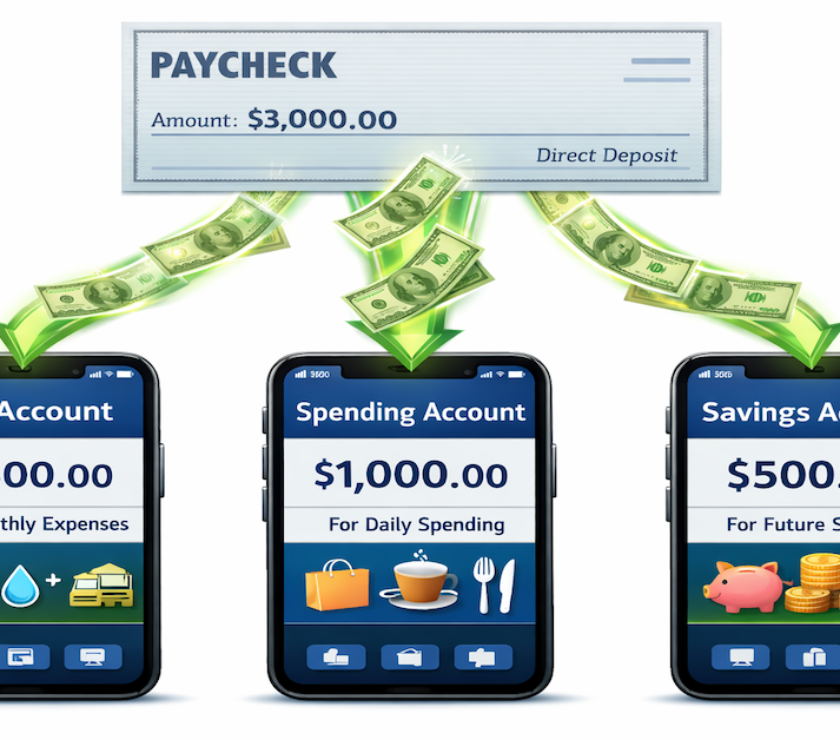
This comparison covers institution types. For the complete framework on how to structure accounts across any institution — bills, spending, and savings — see the PersonalOne guide to the three-account money system.
This comparison breaks down the differences so you can make a clear choice — or combine both — as part of a smarter banking setup.
What Counts as a Traditional Bank vs an Online Bank?
Traditional banks are institutions with physical branches, long operating histories, and full-service offerings like checking, savings, loans, and mortgages. They operate on relationship banking — in-person interactions, local presence, and a broad product suite under one roof.
Online banks operate primarily through apps and websites. They skip branches, reduce overhead, and focus on digital speed, automation, and lower fees. Many are backed by or partner with FDIC-insured institutions.
Important: Most online banks are FDIC-insured. The difference between traditional and online banking is access and experience — not safety.
Where Traditional Banks Still Make Sense
Traditional banks aren't obsolete. They still work well in specific situations:
— In-person support for complex or high-dollar transactions
— Services like cashier's checks, safe deposit boxes, or business lending
— A long-standing relationship with a local institution
— Frequent cash deposits that require branch or ATM access
If you deposit cash regularly or need branch access for specific services, a traditional bank may still play a role in your setup — particularly as the institution that holds loans or handles in-person financial needs.
Where Online Banks Clearly Win in 2026
This is where the gap between traditional and online banking has widened significantly over the past five years.
— No monthly maintenance fees or minimum balance requirements
— Early direct deposit and faster ACH transfers
— Meaningfully higher savings rates through high-yield savings accounts
— Built-in automation tools for recurring transfers and savings goals
— Real-time transaction notifications and spending visibility
For freelancers, side hustlers, and anyone managing irregular income, online-first setups typically outperform branch-based banking. The lower overhead of online institutions gets passed to account holders as higher interest rates and fewer fees — not as a trade-off for security, but as a structural advantage of not paying for physical branches.
The Most Common Mistake: Choosing One When You Need Both
In 2026, most efficient money systems are hybrid.
The framing of "traditional vs online" assumes you have to pick one. Most people who have built functional banking systems don't make that choice — they assign each institution a specific job:
— A traditional bank or credit union for loans, mortgages, and services that require a physical presence
— An online bank for daily spending, savings, and fee-free everyday transactions
— A high-yield savings account at a separate online institution to hold the emergency fund
This approach cuts fees, increases interest earnings, and creates the structural separation between spending money and savings that makes financial consistency easier to maintain. Each institution does what it does best — and nothing else.
How to Evaluate Any Bank Before Opening an Account
Whether you're evaluating a traditional bank or an online bank, the same checklist applies:
— FDIC or NCUA insured? Non-negotiable. Verify at FDIC.gov before depositing.
— Monthly fees? Any fee that isn't waivable unconditionally is a cost you'll pay eventually.
— Minimum balance requirements? Requirements you can't always meet become fees.
— Overdraft policy? How does the bank handle transactions that exceed your balance?
— Transfer speed? Slow transfers between institutions create cash flow problems in a multi-account system.
— Does it fit its assigned role? A checking account should move money efficiently. A savings account should earn competitive interest. Evaluate each account for the specific job it needs to do.
The Institution Is One Decision. The Structure Is the System.
Choosing between traditional and online banking is one input. The larger question is how to structure accounts so money moves correctly, savings grow automatically, and bills never create overdrafts. For the complete framework, see the PersonalOne banking systems account structure guide.
Frequently Asked Questions
Are online banks as safe as traditional banks?
Yes, provided they are FDIC-insured or NCUA-insured. FDIC insurance covers up to $250,000 per depositor per institution regardless of whether the bank has physical branches. You can verify any institution's insurance status through the FDIC BankFind tool at FDIC.gov before opening an account.
Do online banks offer loans and mortgages?
Some do, but the product range varies significantly. Most online banks specialize in deposit accounts — checking and savings — rather than full lending services. If you anticipate needing a mortgage, auto loan, or personal loan, a traditional bank or credit union typically offers more competitive rates and a more comprehensive lending process.
Can I deposit cash with an online bank?
Cash deposits are the most significant limitation of online-only banking. Some online banks partner with retail networks like Green Dot locations to accept cash deposits, but the process is less convenient than walking into a branch. If you regularly handle cash — tips, in-person sales, or cash-based income — maintaining a traditional bank account for that purpose makes practical sense.
What happens if I have a problem with an online bank?
Online banks handle support through app chat, phone, and email rather than in-person service. Response quality varies by institution. Before opening, check customer service reviews and verify what dispute resolution options exist. For complex account issues, the CFPB's complaint portal at consumerfinance.gov is available for any federally regulated institution.
Is it worth having accounts at both a traditional bank and an online bank?
For most people, yes. The added management overhead is minimal — checking two apps instead of one — and the financial benefits are concrete: higher savings rates, lower fees, and structural separation between account types. The most common setup is an online bank for daily spending and savings, paired with a traditional bank or credit union for loans and services that require physical access.
Resources
FDIC — Verify Bank Insurance Status and Consumer Resources
CFPB — Bank Account Consumer Tools and Complaint Filing
Federal Reserve — National Deposit Rate Averages
NCUA — Credit Union Insurance and Consumer Protection
Disclaimer: This article is for educational purposes only and does not constitute financial advice. Account features, fees, and interest rates vary by institution and are subject to change. Always verify FDIC or NCUA insurance status and review current account terms directly with the institution before opening an account.