Updated: June 1, 2026
Home › Credit Building & Protection › Credit Score Building Strategies › What Actually Moves Your Credit Score
What You Need to Know
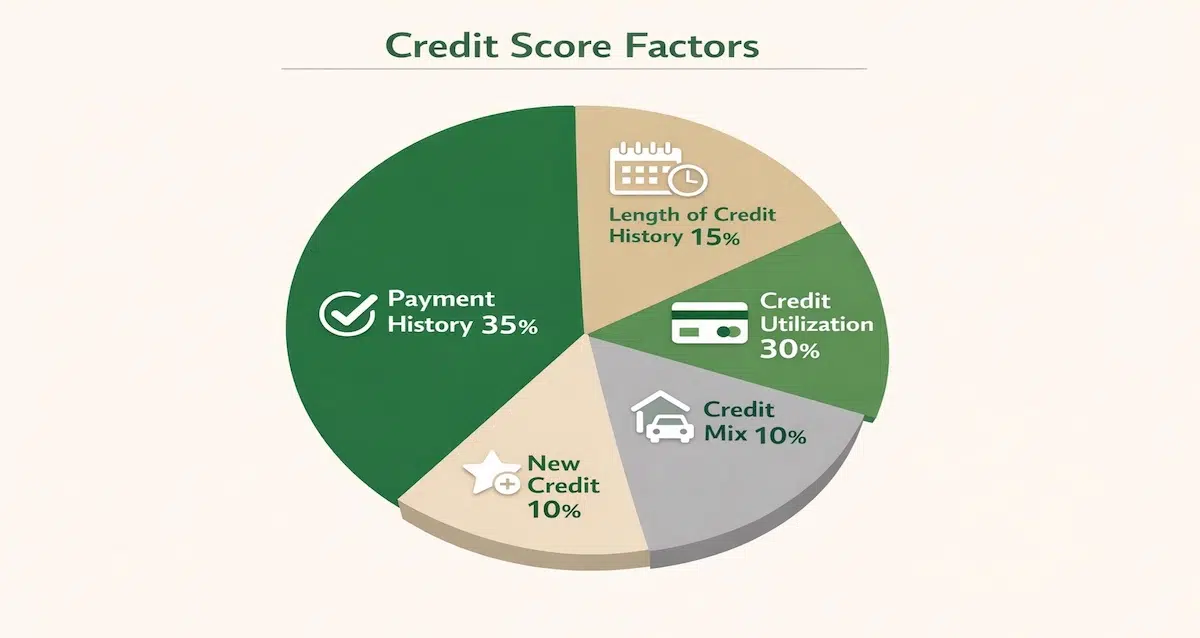
— Five factors control your credit score: payment history (35%), credit utilization (30%), length of credit history (15%), credit mix (10%), and new credit inquiries (10%).
— What doesn't affect your score: income, bank balances, debit card use, age, employment status, marital status, or checking your own credit.
— Payment history dominates: one 30-day late payment can drop your score 60–110 points and stay on your report for seven years.
— Credit utilization is the fastest lever: keeping balances below 30% — ideally under 10% — can improve your score within weeks.
— New in 2026: FICO 10T and VantageScore 4.0 now use trended data, rent and utility payments can count, medical debts under $500 have been removed, and BNPL activity now reports to bureaus.
What Actually Moves Your Credit Score — And What Doesn't
Your credit score affects more of your financial life than almost any other three-digit number you'll encounter. It determines whether you get approved for mortgages, auto loans, and credit cards. It controls the interest rates you pay. It influences apartment applications, insurance premiums, and occasionally job opportunities in certain industries. Despite how much weight it carries, misinformation about what actually moves your credit score runs rampant — people obsess over factors that don't matter while ignoring the behaviors that do.
The reality is that five specific, documented factors drive nearly everything. Once you understand what those factors are and how much weight each carries, your score stops feeling mysterious and starts functioning like a system you can manage. The full credit score building strategies framework starts here — with the mechanics that make the score move.
This guide covers exactly which factors control your score and how much weight each one carries, what common behaviors have zero impact despite popular belief, and what's changed in 2026 with new scoring models and updated reporting rules.
The 5 Factors That Actually Control Your Credit Score
FICO scores — used by roughly 90% of lenders — and VantageScore models both rely on five core factors. While the exact algorithms remain proprietary, the credit bureaus have been transparent about what matters and how much weight each factor carries. Understanding how your credit score works at the component level is what separates deliberate builders from people who hope passively and wonder why their number isn't moving.
1. Payment History — 35% of Your Score
Payment history is the single most important factor in your credit score: do you pay your bills on time? This includes credit cards, auto loans, mortgages, student loans, personal loans, and even certain utility accounts if they're reported to the bureaus.
What gets evaluated: Whether you've made payments by the due date (most creditors report after 30 days past due); how many accounts have late payments and how late those payments were — 30 days, 60 days, and 90+ days each progressively worse; how recently late payments occurred; and the presence of collections, charge-offs, foreclosures, bankruptcies, or tax liens.
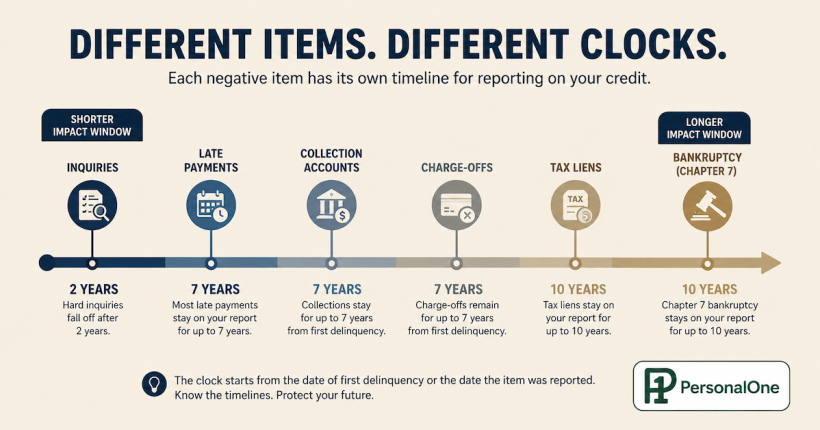
The damage from late payments: A single 30-day late payment can drop your score by 60–110 points depending on your starting score and overall credit profile. Late payments remain on your credit report for seven years, though their impact diminishes over time as you build positive payment history on top of them.
The fix: Set up automatic minimum payments on every credit account. Even if you plan to pay more later in the month, autopay ensures you never accidentally miss a due date. If you do miss a payment, contact the creditor immediately — some will remove the late payment notation if you have an otherwise clean history and can demonstrate it was a one-time error.
2. Credit Utilization — 30% of Your Score
Credit utilization is the ratio of your current credit card balances to your total available credit limits. If you have $10,000 in total credit limits across all cards and you're carrying $3,000 in balances, your utilization is 30%.
The benchmarks: Below 30% is generally acceptable and won't significantly hurt your score. Below 10% is the optimal range where you'll see the best score benefits. Above 30% starts negatively impacting your score. Above 50% causes significant damage. Maxed out at 90% or higher is a major red flag to lenders and produces substantial score reduction.
Both overall and per-card utilization matter: Scoring models look at your total utilization across all cards and the utilization on each individual card. Having one card maxed out at 95% will hurt your score even if your overall utilization is low because you have multiple cards with zero balances.
The fastest score boost: Credit utilization is one of the quickest levers available. Pay down high balances and you could see score improvements within 30–60 days once the lower balances are reported. Requesting credit limit increases without increasing spending automatically lowers your utilization ratio. For the complete breakdown of timing, thresholds, and payment strategies, the dedicated article on credit utilization covers every mechanic in detail.
When you pay matters: Credit card companies report your balance to the bureaus on your statement closing date — not your payment due date. This means you could pay your card in full every month and still show high utilization if you're carrying large balances when the statement closes. Making payments before the statement closing date, not just before the due date, keeps your reported balance low.
3. Length of Credit History — 15% of Your Score
Credit scoring models reward longevity. A longer credit history provides more data about your borrowing patterns and demonstrates sustained responsible behavior over time. What gets evaluated: the age of your oldest credit account, the average age of all your accounts combined, and how long specific types of accounts have been open.
Common mistake: Closing old credit cards — especially your oldest one — can shorten your credit history and hurt your score. Even if you're not actively using an old card, keeping it open (assuming it has no annual fee) preserves that history and maintains your average account age.
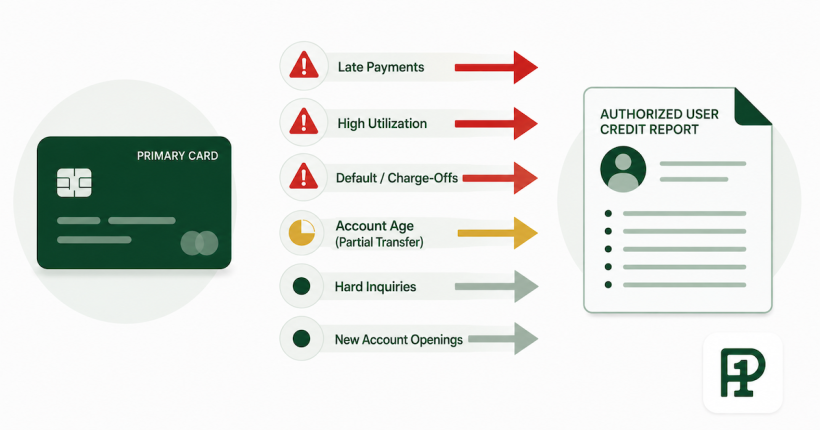
For those building credit: This is the one factor you can't rush. Time is the only solution. Focus on maintaining perfect payment history and low utilization while your accounts age naturally. If you're starting from zero, becoming an authorized user on an established account with excellent payment history is one of the most efficient accelerators available — you can inherit the age of that account on your credit report immediately. The full mechanics of authorized user strategy are worth understanding before using it.
4. Credit Mix — 10% of Your Score
Credit mix refers to the variety of credit types in your portfolio. Lenders like to see that you can responsibly manage different kinds of credit simultaneously. Types considered include revolving credit (credit cards, retail store cards, lines of credit), installment loans (auto loans, mortgages, student loans, personal loans), and as of 2026, BNPL accounts being reported by major providers.
The reality check: Credit mix is the smallest traditional factor at only 10%. Don't take out loans you don't need just to diversify your credit types. If you only have credit cards right now and manage them well, you'll still build a strong score. When you do need an installment loan, it will naturally add to your mix over time.
5. New Credit and Inquiries — 10% of Your Score
This factor tracks how often you're applying for new credit and how many new accounts you've recently opened. Opening multiple accounts in a short timeframe can signal financial distress or irresponsible credit seeking to scoring models.
Hard inquiries: When you apply for credit, the lender requests your credit report, creating a hard inquiry. Each hard inquiry typically reduces your score by 2–5 points and remains on your report for two years, though it only impacts your score for about twelve months.
The rate-shopping exception: If you're applying for mortgages, auto loans, or student loans, multiple inquiries within a 14–45 day window — depending on the scoring model — are typically counted as a single inquiry. This allows you to compare offers without being penalized repeatedly.
What doesn't count against you: Soft inquiries — when you check your own credit, when creditors check for pre-approval offers, or when employers check your credit with permission — do not affect your score at all.
What I've Seen
The most common pattern I see in clients who feel like their score is "stuck" despite doing everything right: they're managing payment history perfectly but carrying one card at 70–80% utilization. That single card suppresses the score 30–50 points on its own — and masks all the positive work happening everywhere else. Utilization is the factor people underestimate most. It's also the fastest to fix. Paying that card below 10% before the statement close date produces visible movement within one billing cycle, every time.
What Doesn't Affect Your Credit Score
Just as important as knowing what does affect your score is understanding what doesn't. These common misconceptions cause real damage — people avoid useful behaviors or fixate on irrelevant ones while the actual limiting factors go unaddressed. The complete credit building and protection guide covers the full framework, but these myths are worth resolving directly.
Your income or net worth. Credit scoring models do not consider how much money you make or how much wealth you've accumulated. Someone earning $40,000 per year who manages debt responsibly can have an excellent score, while someone earning $400,000 who mismanages credit can have a poor one. Lenders do consider income when making lending decisions — it affects your debt-to-income ratio — but income doesn't feed into the score calculation itself.
Checking or savings account balances. The money in your bank accounts is invisible to credit scoring models. Having $50,000 in savings doesn't boost your score, and having $100 doesn't hurt it. Bank account activity isn't reported to credit bureaus — unless you overdraft and the account goes to collections, which would hurt your score.
Debit card usage. Using a debit card — whether run as "debit" or "credit" at the point of sale — has zero impact on your credit score. Debit cards pull money directly from your checking account and don't involve any form of credit. Building credit requires an actual credit account.
Age, race, gender, marital status, or employment status. The Equal Credit Opportunity Act explicitly prohibits credit scoring models from considering these demographic factors. Your credit report doesn't track any of them. The only thing that matters is how you manage credit accounts.
Checking your own credit score or report. This is perhaps the most persistent myth. Checking your own credit is a soft inquiry with absolutely zero impact on your score. The myth persists because people confuse soft inquiries with hard inquiries from lenders. Only hard inquiries affect your score — and even then, only modestly.
Carrying a balance on credit cards. You do not need to carry a balance month-to-month or pay interest to build credit. This is one of the costliest myths. Paying your card in full every month demonstrates excellent credit management and keeps utilization low — both positive for your score. Carrying a balance costs you interest with no scoring benefit.
Getting married. When you get married, your credit reports remain completely separate. There is no joint credit report or household score. Each person maintains their individual credit history. If you apply for joint credit, lenders review both profiles separately.
Closing paid-off installment loans. Paying off an installment loan closes the account naturally, and this is positive for your credit. The paid-off loan remains on your credit report for up to ten years, continuing to demonstrate successful repayment history.
What's Changed in 2026: New Scoring Models and Reporting Rules
FICO 10T and VantageScore 4.0: Trended Data. Traditional credit scores looked at a snapshot of your credit at a single point in time. The newest models now analyze your credit behavior over time — typically reviewing patterns from the past 24 months. If you consistently pay down balances each month, the models recognize this positive trend and may reward you with a higher score. Conversely, if you're steadily increasing balances or frequently carrying high utilization, the models flag this as elevated risk regardless of your current snapshot balance.
Rent and utility payments now count. VantageScore 4.0 and some newer FICO models can now incorporate rent payments, utility bills, and telecom payments into credit scores — if these are being reported to the bureaus. This is particularly beneficial for people with thin credit files. Services like Experian Boost, RentTrack, and Esusu allow voluntary reporting of these payments. If you've been paying rent and utilities on time for years, adding this data can boost your score by 10–30+ points immediately.
Medical debt under $500 removed. As of 2026, all three major credit bureaus have removed paid medical collections from credit reports entirely, and medical debts under $500 no longer appear even if unpaid. For medical debts above $500, they'll still report if they go to collections, but only after a 12-month waiting period — giving you more time to resolve them before credit damage occurs.
BNPL reporting. Services like Affirm, Klarna, Afterpay, and PayPal Pay in 4 are increasingly reporting payment activity to credit bureaus. On-time BNPL payments can now build positive credit history. Missed payments can hurt your score. Treat BNPL accounts with the same seriousness as credit cards and set up automatic payments to ensure you never miss a due date.
Faster dispute resolution. Updates to the Fair Credit Reporting Act have accelerated dispute timelines and require credit bureaus to provide better documentation when investigating errors. If you find inaccuracies on your credit report, the resolution process is faster and more transparent than in previous years.
Practical Strategies: Controlling What Actually Matters
Payment history (35%): Automate everything. Set up automatic minimum payments on every single credit account. Use calendar reminders as backup. If you're struggling to track multiple due dates, ask creditors to move them to the same day each month. Even if you plan to pay more than the minimum — and you should — autopay protects you from accidental late payments that could set back months of progress in a single cycle.
Credit utilization (30%): Manage the timing, not just the balance. Pay down balances aggressively, focusing on cards with the highest utilization first. Request credit limit increases if you have good payment history — this instantly lowers your ratio without requiring you to pay down balances. Make payments before your statement closing date, not just before the due date, to ensure the lower balance is what gets reported to the bureaus. For anyone who wants to go deeper on exactly how and when to time these payments, the article on how to increase your credit score quickly covers the full tactical approach.
Credit history length (15%): Preserve old accounts. Keep your oldest credit cards open and occasionally use them for small purchases to prevent closure due to inactivity. If an old card has an annual fee you don't want to pay, call the issuer and ask to product-change to a no-fee version — this preserves your account history without the ongoing cost.
Credit mix (10%): Let it develop naturally. Don't take out loans you don't need just to diversify your credit types. When you organically need an auto loan, mortgage, or other installment loan, it will naturally add to your mix. If you're building from scratch and want to add mix deliberately, a credit builder loan through a credit union is the lowest-risk option.
New credit (10%): Be strategic about applications. Space out credit applications by at least three to six months when possible. If you're shopping for mortgages or auto loans, compress all applications into a 14-day window to take advantage of inquiry deduplication. Before applying for new credit, ask yourself if you genuinely need it or if you're chasing rewards or promotional offers. Applying strategically is part of building good credit wisely — every new account temporarily lowers your average account age and adds an inquiry, so each one should serve a clear purpose.
Understanding the mechanics of how long it takes to build a 700 credit score puts all five factors in context — it's not just about which behaviors to adopt but about how quickly each factor responds to behavioral change and what your realistic timeline looks like given your starting point.
Build the Full Credit System
Understanding what moves your score is the foundation. The Credit Score Building Strategies hub maps every factor, every lever, and every action — organized as a system you can actually follow.
Explore the Full StrategyGovernment Resources
CFPB — Credit Reports and Scores — Government resource on credit rights, scoring, and dispute processes.
AnnualCreditReport.com — The only federally authorized source for free weekly credit reports from all three bureaus.
FTC — Fair Credit Reporting Act — Consumer rights around credit reporting and dispute processes.
CFPB — What Is a Credit Score? — Plain-language breakdown of scoring models and how lenders use them.
Return to the full credit building and protection guide for a complete overview of every credit strategy covered on PersonalOne.
Frequently Asked Questions
How long does it take to build good credit from scratch?
Building a solid credit score from zero typically takes 12 to 18 months of consistent positive activity. FICO requires at least one account open for six months and reporting to the bureaus before it will generate a score — so the first six months are foundation-building even before a number appears. Reaching a good score in the 670–739 FICO range usually takes another six to twelve months of perfect behavior on top of that. Becoming an authorized user on an established account with a long, clean history can compress this timeline by adding account age to your file immediately.
Can I have a perfect credit score if I've never had debt?
No. While avoiding debt is generally sound personal finance, you cannot build a credit score without using credit. Credit scores measure how well you manage debt and credit obligations — no credit history means no score. You don't need to carry debt or pay interest. You can achieve an excellent credit score by using credit cards for normal purchases and paying them off in full every month. The score measures behavior, not balance.
Does closing a credit card always hurt your credit score?
Closing a credit card typically hurts your score, but the degree varies. Your total available credit decreases — raising utilization — and your average account age may decrease. The impact is usually minimal if you have multiple other cards, low utilization, and are closing a relatively new card. The impact is substantial — potentially 30–50+ points — if you're closing your oldest card or if your remaining cards have high utilization. Best practice: keep old cards open unless they carry annual fees that aren't justified. If you must close one, call first and ask to product-change to a no-fee version to preserve the account history.
How much does one late payment actually hurt my credit score?
A single late payment can drop your credit score by 60–110 points, with the exact damage depending on your starting score. The higher your score before the miss, the bigger the drop — a 780 takes a harder hit than a 620. Late payments remain on your credit report for seven years, though their impact diminishes significantly over time. Critical note: most creditors don't report late payments until you're 30 days past due, so if you realize you missed a payment that's only five to ten days late, pay immediately — you may avoid credit damage entirely.
Should I pay off collections or let them age off my credit report?
It depends on your timeline. Collection accounts remain on your report for seven years from the original delinquency date, regardless of whether you pay them. If the collection is recent — under two years old — paying it typically helps your score with newer scoring models like FICO 9 and VantageScore 4.0, which ignore paid collections entirely. If the collection is old — five to seven years — it's already having minimal impact. If you need to improve your score quickly for a major purchase, negotiate a pay-for-delete agreement in writing before paying. Medical collections under $500 no longer appear on credit reports as of 2026 — check whether yours qualifies for automatic removal.
Do I need to use all my credit cards to maintain my credit score?
You don't need to use all your cards regularly, but you should use them at least occasionally to prevent closure due to inactivity. Most credit card issuers will close accounts that show no activity for 12 to 24 months. The best practice is to set small recurring charges on cards you don't actively use and set up autopay to handle them automatically. This keeps the accounts active, preserves the credit limit and account age, and requires zero ongoing effort.
Can my employer check my credit score as part of a background check?
Employers can request your credit report — with your written permission — as part of pre-employment screening, but they cannot see your actual credit score. What they receive is a modified version of your credit report showing payment history, outstanding debts, and public records like bankruptcies, without your score number or account numbers. This practice is most common in industries involving financial responsibility: banking, accounting, government, and defense contracting. Many states have passed laws limiting when and how employers can use credit reports in hiring decisions.
This article is for educational purposes only and does not constitute financial or credit repair advice. Credit scoring is complex and varies based on individual circumstances, which scoring model is used, and how different lenders interpret credit data. For personalized guidance on credit repair, dispute processes, or major financial decisions, consult a qualified financial advisor or certified credit counselor.