Updated: May 26, 2026
Home › Financial Stability › Expense Compression Strategy
What You Need to Know
— Expense compression is not cutting everything. It is a structured audit that identifies where money is leaking without purpose, eliminates the leaks, and redirects the freed margin toward stability and wealth building — without dismantling the lifestyle you have built.
— Most households have 15–25% of their income going to expenses that deliver no meaningful return in quality of life. The compression audit surfaces that number with specificity.
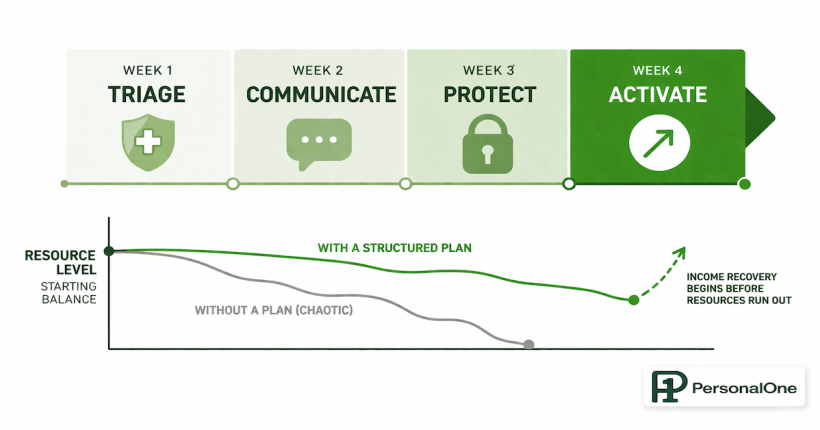
— The framework has four phases: audit (find the leaks), eliminate (cut fixed costs permanently), capture (redirect freed margin), and sequence (use captured margin to build stability in the right order).
— Expense compression is not a permanent lifestyle. It is a temporary sprint that creates the margin your financial system needs to function — and then it ends, with the financial gains it created remaining permanently.
— The wealth-building sequence from a compressed expense base is specific: emergency fund first, then high-interest debt, then investment contributions. Skipping the sequence is why most compression efforts fail to produce lasting results.
When money is tight, the standard advice is to spend less. That advice is technically correct and almost completely useless — it tells you the direction without giving you the map, the tools, or the sequence that actually gets you from financial pressure to financial stability. Telling someone whose budget is already stretched to "spend less" is like telling someone who is lost to "go somewhere else."
An expense compression strategy is different. It is a structured, systematic approach to identifying where your money is going, eliminating the spending that delivers no return in quality of life, capturing the freed margin, and deploying it in the specific sequence that converts temporary sacrifice into permanent financial progress. It is not a lifestyle. It is a sprint with a defined endpoint and a defined reward.
This cluster hub covers the complete expense compression framework — the audit, the fixed cost elimination process, the margin capture mechanism, and the wealth-building sequence that uses compressed expenses as a launchpad. For the complete financial stability system this cluster sits within, the Financial Stability hub maps all six layers from emergency fund to long-term resilience.
Why Most Budgeting Fails and What Expense Compression Does Differently
Standard budgeting approaches ask you to divide your income into categories and stay within them. The problem is that budgets built this way are reactive — they describe how money has been flowing, and they ask you to maintain that flow with more discipline. They rarely identify the structural spending that is quietly draining margin every month without delivering any measurable benefit in return.
Expense compression starts differently. Instead of dividing what you earn, it begins by auditing what you spend — not to describe the spending, but to evaluate it. Every expense gets a simple test: does this dollar deliver meaningful value in my life right now, or is it a habit, a forgotten subscription, a fixed cost I could restructure, or a lifestyle decision I made at a higher income level and never revisited?
The answers to that audit are almost always surprising. Most households discover 15–25% of their income flowing to expenses that would not survive a deliberate review — not because they are irresponsible, but because spending tends to expand automatically as income grows, and contracts only when something forces a deliberate look. The compression audit is that deliberate look, structured to surface specific dollars rather than produce general guilt.
Phase 1 — The Compression Audit: Finding Where the Money Actually Goes
The compression audit is a 30-day exercise with a specific output: a complete, categorized picture of every dollar that left your accounts last month, organized by whether that spending is fixed or variable, essential or discretionary, and delivering real value or running on autopilot.
The Four-Category Audit Framework
Category 1 — Fixed Essentials: Rent or mortgage, insurance premiums, minimum debt payments, utilities. These are non-negotiable obligations. They cannot be cut immediately. They can sometimes be restructured — refinanced, renegotiated, or reduced — but that happens in Phase 2. In Phase 1, you simply identify the total and verify the amounts are accurate.
Category 2 — Variable Essentials: Groceries, transportation, healthcare, phone. These are genuinely necessary but flexible in amount. A $600 monthly grocery bill can often be compressed to $350–$400 without meaningful sacrifice. A $120 phone plan can often become $50. The dollar amount is not fixed — only the category is essential.
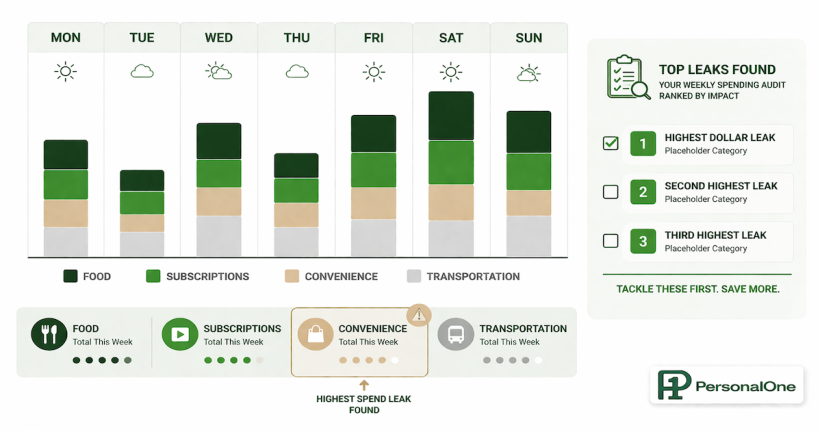
Category 3 — Fixed Discretionary: Subscriptions, memberships, recurring services, streaming platforms, software. These are charged automatically whether you use them or not. This is typically the highest-density leak category — the average household carries $200–$400 in active subscriptions, and a significant portion are used rarely or not at all. List every single one. The 7-day spending audit in the cluster covers exactly this category in granular detail.
Category 4 — Variable Discretionary: Dining out, entertainment, shopping, personal spending, impulse purchases. This is the category most budgets focus on — and it is rarely where the largest sustained savings come from. Variable discretionary spending is the most visible, but fixed discretionary and variable essential are where the permanent structural gains live.
After 30 days, total each category. Then apply the value test to every line item in Categories 3 and 4: if this expense disappeared tomorrow, would I notice within 30 days? If the honest answer is no or probably not, it is a compression candidate.
The output of the audit is not a judgment about your spending decisions — it is a map of where structural compression is available. Most people find $200–$600 per month in this map on the first pass. Some find significantly more. The number is the starting point for Phase 2.
Phase 2 — Fixed Cost Elimination: The Permanent Compression Moves
Cutting variable discretionary spending produces temporary gains that erode as habits return. Eliminating or restructuring fixed costs produces permanent gains that persist even when spending discipline lapses. Phase 2 focuses on the structural changes — the moves that stay made.
Subscription and Membership Elimination
Every subscription that does not survive the value test gets cancelled. Not paused — cancelled. Paused subscriptions resume automatically and the cost returns. The test is simple: in the last 30 days, did I use this service enough that its absence would create a genuine gap in my daily or weekly life? If not, cancel.
For streaming services specifically: most households have three to five active streaming subscriptions. One or two deliver the vast majority of actual watching hours. Compress to the one or two that get used and revisit the rest in six months. The content will still exist if you decide to return.
For gym memberships, software subscriptions, club memberships, and similar recurring charges: apply the same 30-day usage test without exception. A $50/month gym membership you use twice a month is a $25-per-visit habit. That number, made visible, usually produces its own decision.
Insurance and Service Renegotiation
Auto insurance, renter's insurance, internet service, and phone plans are all negotiable or shoppable. Most households have not renegotiated any of these in two or more years. In that time, better rates have become available and their current providers have raised prices quietly through small incremental increases.
Call each provider. State that you are reviewing your expenses and considering switching. Ask what retention offers are available. The majority of service providers have unpublished retention rates they will offer before losing a customer. If no offer is made, get a competing quote and either switch or use it as leverage in a second call.
Internet and phone plan audits alone regularly produce $30–$80 per month in permanent savings per household. Auto insurance shopping every 12–18 months routinely produces $100–$200 in annual savings. These are one-time actions that produce permanent results.
Variable Essential Compression
Groceries, personal care, and household supplies can almost always be compressed 20–35% without meaningful lifestyle impact. The primary mechanism is not buying less — it is buying differently. Store-brand equivalents, meal planning that reduces waste, buying staples in bulk, and reducing dining-adjacent grocery spending (prepared foods, premium convenience items) produce the bulk of the savings.
Transportation costs are compressible through route consolidation, carpooling where available, and eliminating convenience-driven driving patterns. For households with two vehicles and genuinely overlapping schedules, the math on a single-vehicle household is worth running explicitly. The savings in insurance, registration, maintenance, and fuel are often $400–$600 per month — one of the highest-impact single compression moves available.
Phase 3 — Margin Capture: Making Sure the Freed Money Actually Goes Somewhere
This is where most compression efforts fail. The audit surfaces the leaks. Phase 2 eliminates them. And then the freed margin — $200, $400, $600 per month — quietly gets absorbed back into spending over the following weeks because no structural mechanism existed to capture it.
Margin capture is structural, not willpower-dependent. On the day you cancel a subscription or reduce a bill, set up an automatic transfer for that exact dollar amount to a designated savings or debt payoff account. The transfer fires on the same day the expense used to — so the cash flow pattern is identical, but the destination changes from an expense to an asset.
If your phone bill drops from $120 to $55, the $65 difference gets redirected to your emergency fund via automatic transfer immediately — not "when you remember to save it." If three subscriptions totaling $87 get cancelled, $87 moves automatically to the debt payoff account. The timing matters because the behavioral window is shortest immediately after the compression action. A transfer set up two weeks later will face more friction and is less likely to stick.
The captured margin account — wherever it is directed — should be separate from the checking account your daily spending comes from. Physical and psychological separation is what prevents the freed margin from getting reabsorbed into lifestyle spending before it can do structural work.
Phase 4 — The Wealth-Building Sequence: Deploying Compressed Margin Correctly
Captured margin deployed in the wrong sequence produces suboptimal results. The most common mistake is routing freed expense money directly into investments while carrying high-interest debt and no emergency fund — a setup where one bad month reverses everything the compression effort built.
The correct sequence is specific and non-negotiable:
The Wealth-Building Sequence From a Compressed Base
Step 1 — $1,000 emergency starter fund: Every dollar of captured margin goes here first until you have $1,000 set aside in a separate account. This single step stops the debt spiral — the pattern where every small unexpected expense becomes a credit card charge because there is no buffer. With $1,000 protected, the most common financial emergencies (car repairs, urgent care, appliance failures) stop producing debt.
Step 2 — High-interest debt elimination: Any debt at 15% APR or above is producing a guaranteed negative return that no investment can reliably outperform. Once the starter emergency fund is in place, all captured margin redirects to the highest-interest debt using an avalanche approach — highest rate first, minimum payments on everything else, every available dollar attacking the top-rate balance until it is gone, then moving to the next.
Step 3 — Full emergency fund: With high-interest debt cleared, captured margin rebuilds the emergency fund to the three to six month target. This is the protection layer that makes investing safe — without it, a job loss or major expense forces asset liquidation at the worst possible time.
Step 4 — Investment contributions: With a funded emergency buffer and no high-interest debt, captured margin begins flowing into investment accounts. Employer-matched 401(k) contributions come first — the match is a guaranteed immediate return. Roth IRA contributions follow. After these are established, the question of where additional compressed margin should go depends on individual goals, timeline, and tax situation.
The sequence works because each step removes a structural vulnerability before building the next layer. Emergency fund prevents debt spiral. Debt elimination removes guaranteed negative returns. Full emergency fund makes investing resilient. The wealth-building sequence does not shorten the compression period — it ensures the compression period produces permanent results rather than a temporary feel-good followed by a return to the same position six months later.
When Compression Ends: What a Sustainably Lean Budget Looks Like
Expense compression is not meant to be permanent. The sprint ends when the structural goals are achieved — specifically, when the emergency fund is funded and high-interest debt is eliminated. At that point, the spending that was cut can be selectively restored based on genuine value, not habit or unconscious inflation.
The distinction between sustainable lean and artificially restricted is important. A sustainably lean budget is one where every expense either delivers real value or serves a structural financial purpose. Subscriptions that were genuinely missed get restored. Restaurants and social spending that contribute to quality of life get a meaningful budget allocation. But the expenses that the audit revealed were running on autopilot without delivering value — those do not come back. The compression made their absence visible. Keeping them gone is not sacrifice. It is the result of a more deliberate relationship with spending.
The marker of a complete compression cycle is a budget where every dollar has a deliberate assignment, the emergency fund is funded, and investment contributions are automated. That budget runs with less effort and more financial progress than the pre-compression version — not because you earn more, but because the structural leaks have been permanently sealed.
Compress Expenses. Capture the Margin. Build From There.
Expense compression is one cluster in the complete financial stability framework. Emergency funds, buffer accounts, income volatility planning, and long-term resilience all build on the margin this cluster creates. See the full system at the Financial Stability hub.
Go Deeper: Expense Compression Guides
This hub covered the complete framework. The articles below go deep on the specific tools, tactics, and scenarios the framework surfaces.
How to Compress Your Expenses Fast Without Destroying Your Lifestyle
The fast-track compression approach for people who need margin immediately — which cuts produce the most savings per dollar of lifestyle impact, and how to execute the compression sprint without burning out in the first week.
The 7-Day Spending Audit: Find the Leaks in Your Budget
The complete audit process compressed into seven days — how to surface every active subscription, identify the spending that runs on autopilot, and produce a specific compression candidate list with exact dollar amounts attached.
How to Cut $500 From Your Budget Without Touching Necessities — Coming Soon
The specific moves that reliably produce $500 or more in monthly savings from the fixed discretionary and variable essential categories — without affecting housing, food quality, transportation, or healthcare.
Needs vs Wants: A Framework That Actually Works Under Pressure — Coming Soon
The practical needs vs wants framework for compression decisions — why the standard definition breaks under real financial pressure and how to apply a more useful test that produces clear decisions without guilt.
How to Build Wealth When Money is Tight
The wealth-building sequence from a compressed expense base — why the order of emergency fund, debt elimination, and investment contributions matters more than the amounts, and how to follow it starting from zero margin.
Resources
Official Sources
CFPB — Budget and Spending Tools
CFPB — Building Emergency Savings
FDIC — Consumer Financial Education Resources
Related PersonalOne Guides
Financial Stability Hub — The complete stability framework across all six clusters
Emergency Fund Strategy — Where compressed margin goes first — the protection layer that makes everything else stable
Financial Shock Absorption — How expense compression creates immediate breathing room during a financial shock
Buffer Account Systems — The account structure that holds captured compression margin and prevents it from being reabsorbed
Frequently Asked Questions
How long does an expense compression sprint typically last?
Most households complete the audit and execute the primary compression moves within 30 days. The full sprint — audit, eliminate, capture, and reach the first milestone in the wealth-building sequence ($1,000 emergency fund) — typically takes 60–90 days depending on starting position. The sprint ends when the structural goals are achieved, not at an arbitrary calendar date. Some households complete it faster using windfalls or high-income months to accelerate. The goal is to make it as short as possible by executing all compression moves immediately rather than spacing them out.
What if my budget is genuinely bare-bones and there is nothing to compress?
Run the audit before concluding this. Almost every household that believes it has no compression room finds at least $50–$150 per month in the audit that was not visible before the exercise. That said, households at the genuine income floor — where every dollar is covering a non-negotiable essential — may need to focus simultaneously on income expansion. Expense compression and income growth are not mutually exclusive strategies. The compression audit still helps because it confirms exactly how much additional income is needed and what margin that income needs to produce before the wealth-building sequence becomes viable.
Should I compress expenses before or after addressing high-interest debt?
The compression audit happens first because it surfaces the margin you need to address the debt. You cannot accelerate debt payoff with money that is currently leaking through unused subscriptions and unreviewd fixed costs. Run the audit, execute the compression moves, capture the margin, and then deploy it against high-interest debt as Step 2 of the wealth-building sequence. The compression creates the fuel. The sequence determines where that fuel goes.
How do I stop the compressed spending from creeping back up over time?
Three mechanisms prevent rebound. First, execute the elimination moves permanently — cancel, not pause; switch providers, do not negotiate a temporary discount. Second, set up automatic transfers immediately so the freed margin is captured before it gets spent. Third, schedule a quarterly expense audit going forward — 30 minutes every three months to review the expense list for new subscriptions, rate changes, and spending that has quietly expanded. The original sprint is a one-time intensive effort. The maintenance is minimal.
Is it worth compressing expenses aggressively if I also have investment opportunities I want to pursue?
The sequence matters. Investing while carrying high-interest debt and no emergency fund produces worse outcomes than the alternative almost every time — because a single unexpected expense forces debt accumulation or investment liquidation that erases the investment gains. Complete the compression sprint, execute Steps 1 through 3 of the wealth-building sequence, and then invest from a position of structural stability. The delay is weeks or months. The difference in long-term outcomes is significant.
PersonalOne Money System
This content is researched, written, and owned by PersonalOne — a free financial education platform built to help Millennials and Gen Z build real financial systems.
Disclaimer: This content is for educational purposes only and does not constitute financial advice. Individual financial situations vary — consult a qualified financial professional before making significant changes to your spending, savings, or investment approach.