August, 2026
Home › Financial Automation › Banking Infrastructure for Automation › Where Your Paycheck Should Land First
TL;DR
— The income landing account is the account that receives your paycheck first — every automated transfer in your system originates from this account, so choosing it correctly determines whether everything else works.
— For most people the spending account should be the income landing account — income arrives, transfers to bills and savings execute automatically, and what remains is the genuine spending balance.
— Schedule all outgoing transfers for one business day after the expected deposit date, not the same day — same-day transfers fail when deposits post late.
— Direct deposit splitting — sending portions of each paycheck directly to separate accounts at the employer level — is the cleanest implementation because money arrives already distributed.
— Variable income earners need an income buffer account as the landing zone rather than the spending account directly.
In a multi-account automated system, where your paycheck lands first is not a minor logistical detail. It is the foundational decision that determines whether every subsequent transfer executes correctly or creates a cascade of failures.
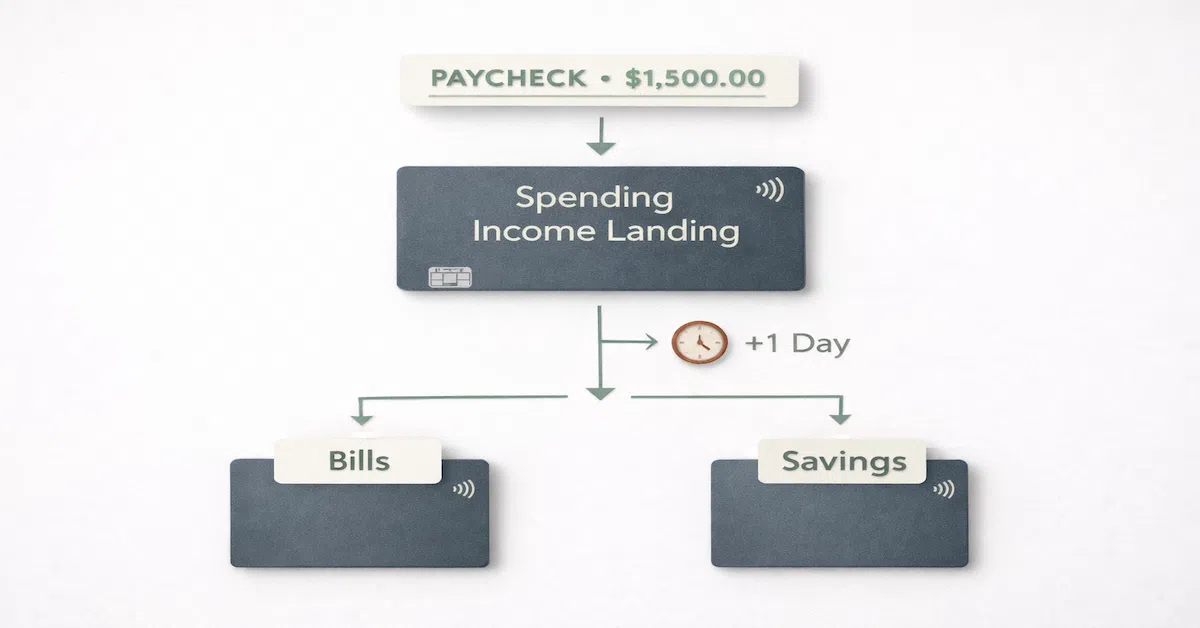
The income landing account is the origin point for all automated outflows. Bills transfer out of it to the bills account. Savings transfer out of it to the savings account. What remains is the spending balance. If the wrong account receives income first — or if the right account receives it but the transfer timing is wrong — the whole system misfires. Transfers draw on balances that are not yet there. Overdrafts trigger. The automation that was supposed to simplify money management starts requiring more attention than no system at all.
Getting where your paycheck should land right is one of the three most important infrastructure decisions in any automated system. Here is the complete framework for making it correctly.
The Two Options: Spending Account vs Dedicated Landing Account
There are two valid configurations for the income landing account. Which one is right depends on how predictable and consistent your income is.
Option 1 — Spending account as income landing account. This is the right choice for salaried earners with predictable, consistent paychecks. Income deposits directly into the spending account. Automated transfers to the bills account and savings account execute one business day later. What remains in the spending account after those transfers is the genuine spending allocation. Clean, simple, and requires no extra accounts.
Option 2 — Dedicated income buffer as landing account. This is the right choice for freelancers, commission earners, gig workers, and anyone with variable income. Income from all sources deposits into a dedicated buffer account. On a consistent schedule — the 1st and 15th, or every Monday — a fixed "salary" amount transfers from the buffer to the spending account, and bills and savings transfers also execute. The buffer absorbs income variability so the spending account always receives a consistent amount regardless of when or how much clients pay.
Which Option Is Right for You?
Salaried with consistent biweekly or monthly pay: Option 1. Spending account receives paycheck directly. Transfers execute day after deposit.
Freelance, commission, gig, or variable income: Option 2. All income lands in a buffer account. Consistent salary-style transfers from buffer to spending on a fixed schedule.
Multiple income streams (salary plus side income): Hybrid. Primary salary lands in spending account. Side income lands in buffer account and feeds into the system separately on a percentage basis.
The One-Day Rule: Why Transfer Timing Matters
The single most common cause of automation failure is transfers scheduled for the same day as the deposit. When a transfer fires the instant a deposit is expected, it frequently beats the deposit. The transfer attempts to draw funds that have not posted yet. The transfer fails. If overdraft protection is enabled, the failed transfer triggers a fee. If it is not, the transfer is simply rejected and the intended flow — bills funded, savings funded, spending balance accurate — does not happen.
The fix is straightforward: schedule all automated transfers for one business day after the expected deposit date. If you are paid on Friday the 1st, transfers execute Monday the 4th. If you are paid on Wednesday the 15th, transfers execute Thursday the 16th. The one-day buffer absorbs processing delays without creating any meaningful disruption to the system's rhythm.
For direct deposit specifically, most employers release funds the night before the official pay date, which means same-day transfers often work in practice. But "often" is not "always," and one failure in twenty-four months produces an overdraft cascade that negates months of smooth operation. The one-day buffer is cheap insurance against that failure.
Direct Deposit Splitting: The Cleanest Landing Configuration
Direct deposit splitting allows you to instruct your employer's payroll department to divide each paycheck across multiple accounts at the source. Instead of a full paycheck landing in one account and then being distributed via bank transfers, the distribution happens before the money even arrives in any account you control.
This is the cleanest implementation of income landing for automation because it removes the transfer step entirely. The bills account receives its allocation directly. The savings account receives its contribution directly. The spending account receives the remainder. By the time you check your accounts after payday, everything is already where it belongs. There are no transfers to monitor, no timing failures to watch for, no reconciliation needed.
To set up direct deposit splitting: contact your payroll department or access the employee self-service portal. Specify the routing and account numbers for each destination. Most payroll systems allow two to four destination accounts. Specify either fixed dollar amounts for bills and savings allocations with the remainder going to spending, or specify percentages if you prefer proportional splitting.
If your employer does not offer direct deposit splitting, automated bank transfers scheduled for the day after deposit accomplish the same result. The outcome is identical — money in the right accounts before spending decisions happen. The only difference is the mechanism.
The Variable Income Landing Account: Buffer Architecture
Freelancers, commission earners, and gig workers face a specific challenge that salaried earners do not: income arrives in irregular amounts at irregular intervals. A fixed automated transfer schedule — bills on the 2nd, savings on the 2nd, spending allocation funded on the 2nd — assumes the income to support those transfers is always there on the 1st. For variable earners, it frequently is not.
The buffer account solves this by decoupling income arrival from money distribution. All variable income lands in the buffer account as it arrives throughout the month. The buffer accumulates. On a consistent schedule, a fixed salary-style amount transfers from the buffer to the spending account and a fixed savings amount transfers to the savings institution. The spending account receives the same amount every period regardless of what clients paid or when. The system operates consistently even when income does not.
The buffer should contain one to two months of essential expenses at all times. During strong income months, the buffer grows. During lean months, it draws down. As long as it maintains a positive balance, the automated transfers continue executing and the spending account receives its consistent allocation. Build the buffer before running any automated transfer schedule — launching automation without a buffer in place creates exactly the failure mode the buffer is designed to prevent.
Verifying Your Landing Account Is Working
After the first two automated pay cycles, verify four things. First, that income landed in the intended account on the expected date. Second, that the bills transfer executed the following business day for the correct amount. Third, that the savings transfer executed the following business day for the correct amount. Fourth, that the spending account balance after both transfers reflects the expected allocation — not more, not less.
If any of these four checks fails, identify the failure point before the next cycle. Common failure causes include a transfer amount that exceeds the account balance when transfers fire before deposit posts (fix: add one more day to the transfer timing), a transfer that did not execute because of a bank processing error (fix: verify the transfer was scheduled correctly and contact the bank if it was), and a balance discrepancy because a bill autopayed from the wrong account (fix: verify all autopay updated correctly to the bills account during setup).
Income landing is the starting point. Financial Automation is the complete system.
Once income is landing in the right place, every other automation layer — budget, savings, debt, investing — connects naturally on top of this infrastructure.
Explore the Financial Automation Hub →Resources
CFPB — Bank Account Consumer Tools and Resources
FDIC — Consumer Protection and Deposit Insurance
FDIC — Deposit Insurance: How Your Accounts Are Protected
This article is part of the Financial Automation hub on PersonalOne — a complete framework for building financial systems that run without daily decisions.
Frequently Asked Questions
What if my employer only allows one direct deposit account?
Automated bank transfers scheduled for one business day after deposit accomplish the same result as direct deposit splitting. The full paycheck lands in your spending account and transfers to bills and savings execute the next day. Some payroll platforms allow splitting even if the HR system appears to restrict it — worth confirming directly with payroll before assuming it is unavailable.
Should I have a separate account just for income landing?
For salaried earners, no. The spending account doubles as the income landing account cleanly. A dedicated income landing account adds complexity without meaningful benefit when income is predictable. For variable income earners, a dedicated buffer account as the landing zone is the correct configuration because it decouples income arrival from spending account funding and smooths variability.
How do I handle income that arrives on different days each month?
Set automated transfers to fire on a consistent day of the month rather than tied to specific deposit dates. Fund the income buffer first to a level that covers at least one full month of outgoing transfers. The buffer absorbs the timing variability and the transfer schedule runs on its own clock regardless of when any specific payment arrived.
Can I switch my direct deposit without disrupting my current automation?
Yes, but allow an overlap period. Submit the new direct deposit instructions to payroll and maintain your existing bank account open for at least two to three pay cycles while the change processes. Payroll changes sometimes take one to two pay periods to take effect. Running both accounts in parallel during the transition prevents a missed paycheck from disrupting your automated transfer schedule.
Disclaimer: This content is for educational purposes only and does not constitute financial advice. Banking features, direct deposit capabilities, and transfer timing vary by institution and employer. Always verify current terms with your bank and payroll provider before making changes to your income routing setup.