May, 2026
Home › Financial Stability › Long-Term Resilience › How to Recession-Proof Your Finances
What You Need to Know
— Recession-proofing your finances is about building structural protections before economic conditions deteriorate — not reacting after a recession has already started
— The six specific actions that reduce recession vulnerability: expand cash reserves, eliminate high-interest debt, reduce fixed expense obligations, diversify income, maintain essential coverage, and avoid new major financial commitments
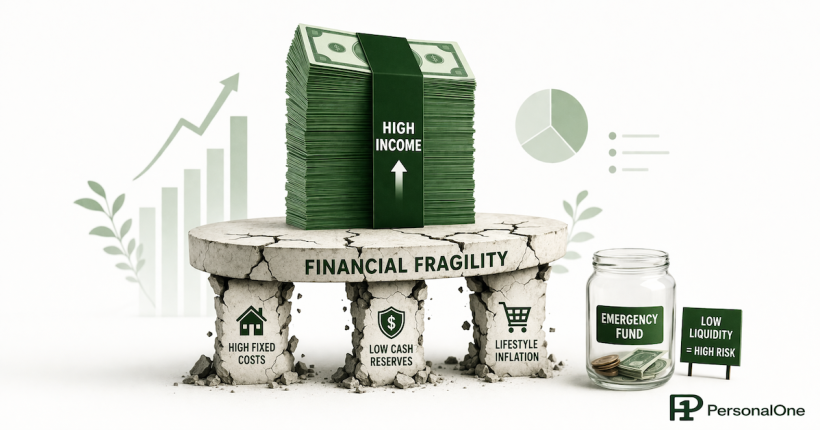
— The single most valuable recession preparation move is expanding your emergency fund — aim for 6 months minimum, not the standard 3–6 range
— Job security in a recession is not guaranteed regardless of performance — recession preparation assumes your income could be disrupted and builds accordingly
— Recession preparation is not pessimism — it is the same structural thinking that makes your finances stronger in any economic environment
The question of how to recession-proof your finances comes up most urgently when economic warning signs appear — rising unemployment, slowing GDP growth, tightening credit conditions. But the honest answer is that recession preparation done after economic deterioration begins is significantly less effective than recession preparation done before. Most of the structural moves that protect your finances in a recession take months to implement fully, which means they need to start well before the recession arrives. The long-term financial resilience framework this preparation is part of is in the Long-Term Resilience guide.
Recession preparation is not a prediction that a recession is coming — it is a structural upgrade to your financial system that makes it more durable in any economic environment. The same moves that protect you in a recession also improve your financial position in a strong economy: more cash, less debt, lower fixed obligations, and diversified income all produce better financial outcomes regardless of macroeconomic conditions. The complete financial stability system this recession preparation fits within is in the financial stability guide.
Move 1: Expand Your Emergency Fund to 6 Months Minimum
The standard emergency fund guidance of 3–6 months is calibrated for individual disruptions — a job loss, a medical expense, a car repair. A recession creates the possibility of extended income disruption in an environment where finding new employment takes longer than normal. During the 2008–2009 recession, the average duration of unemployment for workers who lost jobs exceeded 25 weeks. During peak pandemic unemployment in 2020, millions of workers experienced gaps of 6 months or more.
For recession preparation specifically, the 6-month floor is the target — not the ceiling. If your employment is in a recession-sensitive industry (hospitality, retail, construction, financial services, media), a 9–12 month emergency fund is appropriate recession preparation. Keep the expanded fund in a high-yield savings account at a separate FDIC-insured institution. The Emergency Fund Strategy guide covers exactly how to build and size your reserves for your specific situation.
Move 2: Eliminate High-Interest Debt Now
High-interest debt is a fixed monthly obligation that does not pause during a recession. Credit card debt at 22% APR, personal loans, and buy-now-pay-later balances all require payments regardless of your income situation. Every dollar of high-interest debt you eliminate before a recession reduces your minimum monthly obligation and increases your ability to survive on reduced income. Eliminating a $10,000 credit card balance removes approximately $200–$300 in monthly minimum payments — payments that would otherwise consume a significant portion of unemployment benefits or reduced income during a downturn. The complete debt elimination framework is in the Debt Relief and Credit Repair guide.
Move 3: Reduce Your Fixed Expense Ratio
Your fixed expense ratio is the percentage of your take-home income committed to non-negotiable monthly obligations — rent, mortgage, car payments, insurance, minimum debt payments. The higher this ratio, the less flexibility you have to survive income reduction. A household spending 70% of income on fixed obligations and losing 40% of income has an immediate shortfall. A household spending 45% of income on fixed obligations losing the same 40% has room to manage.
Recession preparation means evaluating whether upcoming fixed obligation decisions — housing upgrades, new vehicle purchases, major purchases financed over time — are appropriate given the economic environment. Keeping your fixed expense ratio below 50% of take-home income provides the flexibility to survive significant income reduction without immediate crisis. The Budgeting and Savings guide covers the specific frameworks for managing your expense ratio as income and circumstances change.
Move 4: Diversify Your Income Before You Need To
Building a secondary income source before a recession is significantly more effective than trying to build one during one. In a recession, competition for freelance work, side income opportunities, and part-time positions increases at exactly the moment your primary income may be at risk. Developing a marketable secondary skill, building a client base for freelance work, or establishing a small online income stream during a strong economy means those resources are available and functioning when economic conditions tighten.
Even modest secondary income — $500–$1,000/month from a developed side skill — meaningfully extends financial runway during primary income disruption. It also keeps skills current and professional networks active during periods when employment searches are more competitive. The Side Hustles and Entrepreneurship guide covers the specific frameworks for building income streams that can be scaled up or down based on need.
Move 5: Protect Your Credit Score Now
A strong credit score before a recession provides access to better financial tools during one — lower-cost emergency credit if needed, better terms on refinancing opportunities, and more options for hardship programs from lenders. Credit score improvement takes time: consistent on-time payments, reduced utilization, and cleared negative marks all require months to years to fully reflect. Building your credit score before economic conditions tighten ensures you have maximum flexibility if you need to access credit during a difficult period. The Credit Building and Protection guide covers the complete system for improving and protecting your score.
Move 6: Maintain Essential Coverage and Avoid New Major Commitments
Recession preparation includes both protecting what you have and avoiding new vulnerabilities. Maintaining adequate health, disability, and life insurance coverage ensures that a health crisis in a difficult economic environment does not compound into a financial catastrophe. Avoiding major new financial commitments — large mortgage upgrades, new vehicle financing, significant investment in illiquid assets — during periods of economic uncertainty preserves your flexibility and liquidity.
The best time to recession-proof your finances is before the recession starts.
The complete Long-Term Resilience framework covers every structural move for building a financial system that holds through economic uncertainty.
Explore Long-Term Resilience →Resources
Official Sources
Federal Reserve — Report on Economic Well-Being of U.S. Households — Annual data on household financial vulnerability, emergency savings capacity, and recession readiness across income levels.
BLS — Unemployment Duration Data — Bureau of Labor Statistics data on unemployment duration by industry and demographic, relevant for calibrating emergency fund targets for recession preparation.
Return to the financial stability guide for the complete system this cluster is part of.
Frequently Asked Questions
Should I stop investing during a recession?
Generally no — stopping regular investment contributions during a recession means missing the lower prices that recessions create. Dollar-cost averaging through a recession — investing the same fixed amount regardless of market conditions — produces strong long-term returns because more shares are purchased at lower prices. The exception: if your emergency fund is not fully funded, prioritize completing it before maintaining investment contributions above your employer match.
Is it too late to recession-proof my finances if one has already started?
It is never too late to improve your financial position — but the moves available to you change once a recession is underway. Building income diversification and expanding your emergency fund are harder during a recession because employment is less stable and savings require income surplus. Focus on what is immediately actionable: cut non-essential expenses, contact creditors proactively about hardship options, and stabilize your current income position before addressing longer-term structural improvements.
How much cash is too much during a recession?
There is no upper limit on cash reserves during economic uncertainty within the context of a total financial plan. However, cash in excess of 12–18 months of expenses held long-term in savings rather than invested has an opportunity cost — it earns savings account rates rather than long-term investment returns. A 6–12 month cash reserve that matches your recession risk profile is appropriate for most households. Beyond that, continuing to invest in diversified low-cost index funds through the uncertainty is generally the stronger long-term decision.
Disclaimer: This article is for informational and educational purposes only. Economic conditions, employment markets, and financial product terms change. This content does not constitute financial or investment advice.