May, 2026
Home › Financial Stability › Financial Shock Absorption › How to Prepare Financially Before You Quit a Job
What You Need to Know
— Quitting without a financial runway is one of the most common and most preventable causes of financial setback for Millennials and Gen Z
— The minimum safe runway before quitting is 6 months of bare-bones expenses — 12 months is the target for career pivots or entrepreneurship
— Health insurance is the most overlooked cost in a voluntary departure — COBRA and marketplace replacement costs must be calculated before you give notice
— Vesting schedules, deferred compensation, and equity grants have hard deadlines that a resignation date can eliminate permanently
— Voluntary resignation typically disqualifies you from unemployment insurance — your financial plan must account for zero benefits income
Quitting a job is one of the most consequential financial decisions most people make — and one of the least systematically prepared for. The focus is usually on the next opportunity, the relief from a bad situation, or the excitement of a new direction. The financial preparation gets compressed into a rough guess about how long savings will last. That guess is usually wrong, in the wrong direction.
This guide covers the complete financial preparation checklist for a voluntary departure. Not the career or emotional considerations — those are real and valid, but they are separate from the financial readiness calculation. This is about the financial resilience system you need to build before your last day, so that the transition works financially regardless of how long it takes.
The Minimum Financial Readiness Threshold
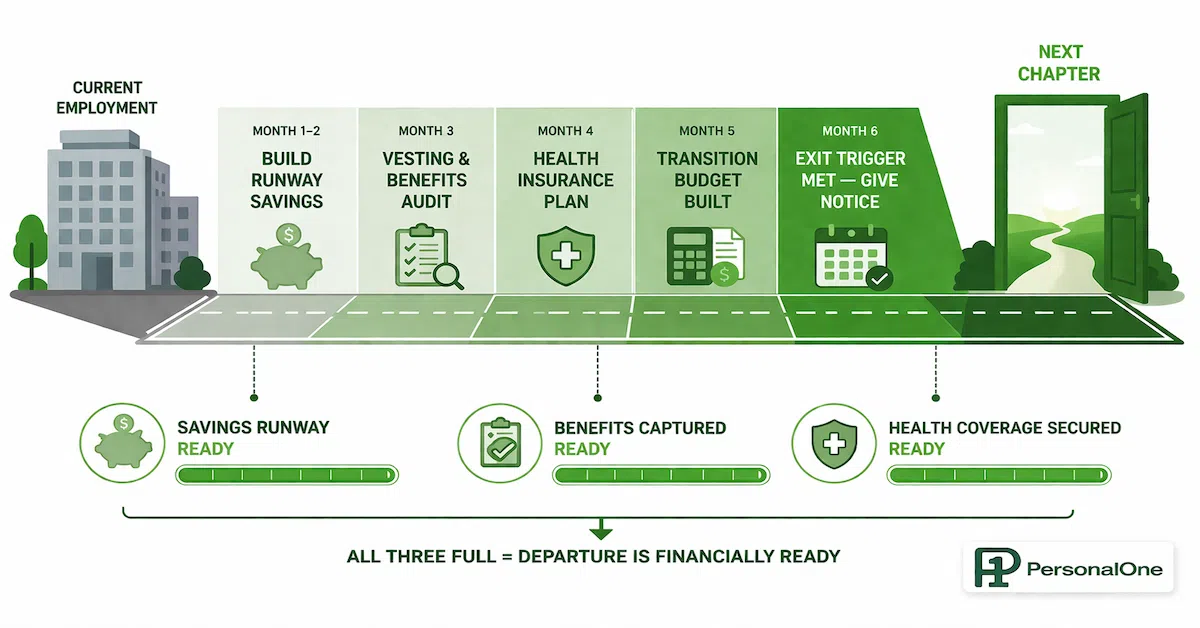
Before giving notice, three conditions should be met. Not two of three. All three.
Condition 1: Six months of bare-bones expenses in liquid savings. Not six months of your current lifestyle. Six months of your bare-bones survival budget — the minimum required to maintain housing, utilities, food, transportation, and debt minimums. Calculate your bare-bones number first, then confirm your savings cover six months of it. If you are making a career pivot or moving into entrepreneurship, the target is 12 months, not 6. The framework for calculating your bare-bones monthly number — the same one used in any income disruption scenario — is in the worst-case scenario budget guide.
Condition 2: Health insurance replacement identified and budgeted. Most people have no idea what their employer-sponsored health insurance actually costs until they have to replace it. An employer may be paying $600 to $900 per month toward your coverage. That cost becomes yours the moment you leave. Before giving notice, get a COBRA quote from your HR department and a marketplace quote from healthcare.gov. Include the actual replacement cost in your bare-bones budget calculation — not as an afterthought, but as a line item that changes your runway math.
Condition 3: All near-term vesting events captured or consciously forfeited. If your employer offers equity, retirement matching, or deferred compensation with vesting schedules, know exactly what vests and when. Resigning two weeks before a major equity vest or losing unvested employer 401(k) matching contributions are avoidable losses that require only a calendar check to prevent. The financial preparation process for quitting must include a complete review of your total compensation package and its vesting timeline. This document review — including where to find and how to organize these records — is covered in the guide on organizing your key financial documents.
Calculate Your True Bare-Bones Monthly Number
Your bare-bones monthly number is the foundation of every calculation in this guide. It is not your current monthly spending. It is the minimum required to cover housing, utilities, groceries, transportation, health insurance at replacement cost, and minimum debt payments. Nothing else is included in the bare-bones number.
To calculate it: open your last three months of statements, identify every recurring charge, and classify each as either essential survival or non-essential. Essential survival is the bare-bones list above. Everything else — subscriptions, dining, entertainment, gym, clothing, non-essential insurance riders — is non-essential and excluded from the calculation.
Add your health insurance replacement cost to the bare-bones total. This is the step most people miss. If your employer was covering $700 per month toward health insurance and your COBRA or marketplace replacement is $550 per month, that $550 belongs in your bare-bones number as a real cash expense starting on your first day without employer coverage.
The bare-bones number is your monthly burn rate in the transition. Your runway in months equals your liquid savings divided by this number. If the runway is less than 6 months, you are not financially ready to quit regardless of how prepared you feel in other ways. The financial stability strategy is built around the principle that runway length is the primary variable in any voluntary income disruption.
The Vesting and Benefits Audit
Before setting a resignation date, complete a full audit of every employer benefit that has a vesting component or a forfeiture risk. This audit takes one to two hours and can recover thousands of dollars in compensation you have already earned but not yet received.
Employer 401(k) match vesting. Many employers vest their matching contributions over a schedule — cliff vesting (fully vested at a specific date) or graded vesting (a percentage vests each year). If you leave before full vesting, you forfeit the unvested portion of employer contributions. Pull your plan documents or contact your plan administrator to confirm your vesting percentage and the next vesting date. If a significant vesting event is within 30 to 90 days, adjusting your resignation date accordingly may recover thousands of dollars of already-earned compensation.
Equity and stock grants. RSUs, stock options, and performance share units each have their own vesting schedules. Unvested equity is forfeited when you leave. For RSUs specifically, check whether any grants are scheduled to vest within the next quarter. For stock options, confirm the post-termination exercise window — the period after your last day during which you can exercise vested options. Missing this window forfeits them permanently.
Accrued PTO payout. Many employers pay out unused PTO at termination. Confirm your employer's PTO payout policy and calculate the dollar value of any accrued balance. In states where accrued PTO is classified as earned wages, this payout is legally required regardless of employer policy.
Deferred compensation and bonuses. If your compensation structure includes an annual bonus, confirm whether a departure before the payment date forfeits the bonus for the year in which you worked. For deferred compensation plans, forfeiture rules can be complex — review your plan documents or consult with HR before finalizing your departure date.
Health Insurance: The Most Expensive Line Item in Your Transition
Health insurance is the most commonly underestimated cost in a voluntary departure and the one that most frequently collapses financial plans that looked solid on paper. This is a calculation that must happen before you give notice, not after.
COBRA coverage. COBRA allows you to continue your current employer-sponsored health insurance for up to 18 months after departure. The cost is your full premium — both your contribution and your employer's contribution — plus a 2% administrative fee. For most people, this is significantly more expensive than they expect because they have only been paying the employee portion. Contact your HR department before your last day to get the exact COBRA premium for your current coverage level.
Marketplace alternatives. Job loss including voluntary resignation in most states qualifies as a Special Enrollment Period for marketplace health insurance plans. You have 60 days from your last day of employer coverage to enroll. Marketplace plans may be significantly cheaper than COBRA for equivalent coverage, particularly if your income during the transition qualifies for premium tax credits. Compare both options before defaulting to COBRA.
Coverage gap risk. Going uninsured during a career transition to save money is a high-risk decision. A single emergency room visit or unexpected diagnosis during an uninsured period can produce medical bills that eliminate an entire emergency fund and create debt that extends financial recovery by years. Budget for continuous coverage. The transition to building your next income source through a side hustle or freelance work is covered in the Side Hustles and Entrepreneurship hub, which addresses income replacement specifically for people in career transition.
Building the Transition Budget Before Day One
The transition budget is a modified version of your bare-bones budget that accounts for the specific costs and savings that change when employment ends. It is not your current budget minus your savings contributions. It is a rebuilt budget that reflects actual post-employment expenses.
Items that increase in the transition budget: health insurance at full replacement cost, transportation if you previously used an employer commuter benefit, and any professional services such as tax preparation that become more complex with self-employment or consulting income.
Items that may decrease: commuting costs if you will not be commuting, work clothing if the new role involves no dress code requirement, and work-related expenses your employer was reimbursing. Map the transition budget line by line before your last day so that your runway calculation uses the correct number, not an approximation. Connect this budget structure to the broader budgeting for wealth growth system so that the transition period flows into a full financial structure rather than a temporary holding pattern.
Leave ready. Not hopeful.
Financial preparation before quitting is one part of the complete Financial Shock Absorption system. The full framework for managing income transitions — voluntary and involuntary — is in the cluster hub.
Financial Shock Absorption → Financial Stability Hub →The Pre-Resignation Financial Checklist
Runway confirmed at 6 months minimum of bare-bones expenses. Not estimated. Confirmed with an exact number from your liquid savings balance divided by your calculated bare-bones monthly total including health insurance replacement.
Vesting schedule reviewed and resignation date optimized. All employer match vesting, equity vesting, and deferred compensation reviewed. Resignation date set to capture near-term vesting events or forfeiture amounts consciously acknowledged.
Health insurance replacement identified and budgeted. COBRA quote obtained from HR. Marketplace alternatives compared on healthcare.gov. Monthly cost included in bare-bones budget and runway calculation.
PTO balance confirmed and payout policy verified. Accrued PTO dollar value calculated. State law on PTO payout confirmed. Amount included in departure resource total if applicable.
Tax obligations assessed for the transition period. If moving into self-employment or consulting income, quarterly estimated tax payment obligations begin immediately. Confirm whether you need to make a Q1 or Q2 estimated payment in the month of departure. The IRS self-employment tax center is the authoritative reference for this calculation.
401(k) rollover plan established. Confirm your rollover options: leave the balance with the former employer's plan if allowed, roll it to your new employer's plan, or roll it to an IRA. Do not take a cash distribution — this triggers immediate income tax plus a 10% early withdrawal penalty in most cases. Understand the options before your last day so you are not making a high-stakes financial decision under time pressure. If the departure becomes an unplanned disruption rather than a prepared exit, the day-by-day response framework is in the 30-day income disruption plan.
Resources
Official Sources
Healthcare.gov: Special Enrollment Periods — Official guidance on health insurance enrollment windows triggered by job loss, including voluntary departure in most states.
DOL: COBRA Continuation Coverage — Department of Labor official guidance on COBRA eligibility, election periods, cost, and coverage duration.
IRS: Estimated Taxes — Official IRS guidance on quarterly estimated tax payment requirements for self-employed individuals.
DOL: Retirement Benefits and Life Changes — Department of Labor guidance on 401(k) rollover options, vesting rules, and retirement plan decisions at job departure.
Continue Building Your Shock Absorption System
The Worst-Case Scenario Budget — Calculate your bare-bones monthly number — the foundation of every runway calculation in this guide.
The 30-Day Income Disruption Plan — If the transition becomes involuntary or harder than planned, this is the day-by-day response framework.
The full Financial Stability framework is in the Financial Stability guide.
Frequently Asked Questions
Do I qualify for unemployment if I quit voluntarily?
In most states, voluntary resignation disqualifies you from unemployment insurance. There are exceptions — quitting due to constructive dismissal, intolerable working conditions, or following a spouse to a new location may qualify in some states. Do not plan your finances assuming unemployment benefits will be available after a voluntary departure. Plan as if they will not be, and treat any benefits as upside.
How do I calculate how much I need before quitting for entrepreneurship?
Use 12 months of bare-bones expenses as the target, not 6. Entrepreneurship timelines consistently take longer than projected. Revenue ramp-up is slower. Unexpected costs appear. Your first 6 months of savings covers the launch period. The second 6 months covers the inevitable slower-than-expected ramp. If your business generates meaningful income before month 12, you are ahead of plan.
What if I absolutely cannot wait 6 months to quit?
Calculate your actual runway, identify what short-term income you can activate immediately after leaving, and adjust your transition plan around what you have rather than what the ideal target is. A 3-month runway with an immediate freelance or contract income source is a different calculation than a 3-month runway with no income replacement plan.
Should I tell my employer I am leaving before I have the finances ready?
No. Giving notice before financial readiness is established creates an external timeline that your financial preparation now has to match. The resignation date should be determined by your financial readiness and vesting calendar, not by how ready you feel emotionally or how uncomfortable you are in the current role.
What happens to my HSA when I leave?
Your Health Savings Account balance is yours and portable. You can continue using it for qualified medical expenses after departure. You can no longer make new contributions once you are no longer enrolled in a qualifying high-deductible health plan. If you elect a marketplace plan that is not HDHP-eligible, your HSA balance remains usable but new contributions stop until you re-enroll in an eligible plan.
Disclaimer: This article is for informational and educational purposes only and does not constitute financial, legal, or tax advice. Unemployment eligibility, vesting rules, COBRA costs, and tax obligations vary significantly by state, employer plan, and individual circumstance. Consult qualified professionals for guidance specific to your situation. PersonalOne is not a licensed financial advisor.