June 13, 2026
Home › Banking Systems › Banking for Irregular Income › How to Build a Buffer Account That Survives Your Slow Months
What You Need to Know
— A buffer account absorbs the gap between irregular income and consistent monthly expenses — it is the structural fix for freelance cash flow problems.
— Size your buffer at one to two months of essential expenses, not total income — that is the number that keeps the lights on when payments stall.
— All client income lands in the buffer first — you pay yourself a fixed monthly transfer from there, not directly from whatever just arrived.
— High months build the buffer. Slow months draw from it. Your personal spending never changes, which eliminates the feast-or-famine cycle.
— A buffer account is a business banking tool, not a savings account — it lives separately from your emergency fund and personal goals.
— The buffer fails if you treat it as spending money during good months — protect it by automating the transfer out to personal before anything else.
The freelance financial calendar is predictable in one way: it is unpredictable. January is slow. March is chaotic. A client pays late in June. A project gets cancelled in September. Your income does not arrive on a schedule, but your rent, utilities, and groceries do not care.
The standard advice — “save more during good months” — fails because it relies on discipline during the exact moments when you feel flush and spending feels justified. The better solution is structural: a buffer account that absorbs the timing mismatch between irregular income and consistent expenses, so your personal spending never depends on which clients happened to pay this week.
A buffer account is not an emergency fund. It is not a savings account. It is a cash flow management tool that sits between your business income and your personal life — and it is the single most effective structural change most freelancers can make to their financial system. Once the buffer is built and functioning, you can move to the bigger picture of how to pay yourself a consistent salary as a freelancer — which the buffer makes possible in the first place.
Why Freelance Cash Flow Breaks Without a Buffer
Most freelancers manage money reactively. A big payment arrives and they feel financially comfortable. They cover bills, spend normally, maybe even catch up on things that have been deferred. Three weeks later, nothing has come in, two invoices are past due, and the checking account is uncomfortably low. The cycle repeats every few months, generating chronic financial anxiety regardless of how much the freelancer earned over the year.
The problem is not income. It is timing. A freelancer who earns $72,000 annually — $6,000 per month on average — may receive $14,000 in one month and $1,200 in another. If personal spending is calibrated to the average and income is deposited directly to personal accounts, good months trigger overspending and bad months trigger shortfalls. The checking account becomes a barometer of anxiety rather than a functional tool.
A buffer account breaks this cycle by decoupling when money arrives from when you spend it. Income accumulates in the buffer. You transfer a fixed amount to personal spending on the same date every month. The buffer’s job is to absorb the peaks and valleys so your personal account never experiences them.
The Cash Flow Problem Visualized
Without a buffer: Client pays $8,000 → deposits to personal → spends more than usual → nothing arrives next month → scrambles to cover rent → stress, late payments, or credit card use.
With a buffer: Client pays $8,000 → lands in buffer account → $4,500 transfers to personal on the 1st (as always) → $3,500 stays in buffer → next slow month buffer covers the same $4,500 transfer → personal spending never changes.
What a Buffer Account Is (and Is Not)
Terminology matters here because conflating the buffer with other account types leads to misuse.
A buffer account is: A business or business-adjacent checking account that holds incoming client income temporarily before it is distributed to personal spending and business expenses. Its job is timing management, not growth or long-term storage. Money should not sit here indefinitely — it flows in, it flows out on a fixed schedule.
A buffer account is not: Your emergency fund. Emergency funds cover catastrophic events — medical crises, long-term inability to work. The buffer covers routine income variability. They serve different purposes and should live in different accounts.
A buffer account is not: A savings account. You are not growing this money. High APY is irrelevant. What matters is low friction, fast transfers, and clarity about the running balance at all times.
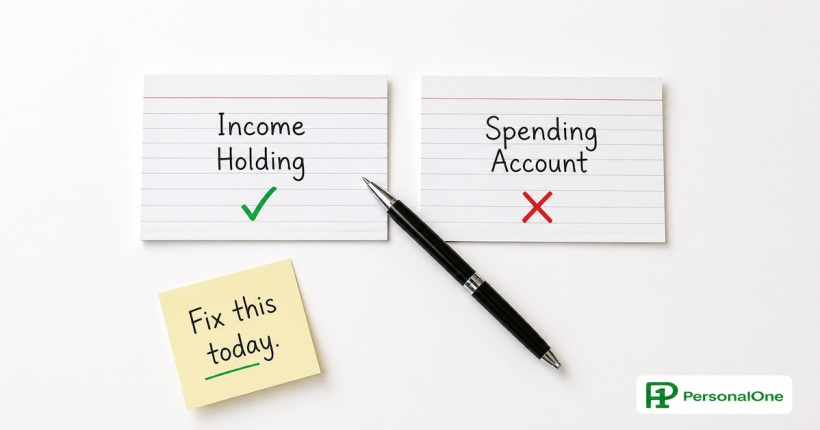
A buffer account is not: Your personal spending account. The buffer is a business-side account. Personal spending happens downstream of it, after the fixed transfer occurs. Mixing them destroys the cash flow separation that makes the buffer work.
How to Size Your Buffer
The buffer size question has a specific answer: one to two months of your total monthly essential expenses. Not one to two months of income. Expenses.
The distinction matters because income-based sizing overcomplicates the calculation and sets the target too high for most people to reach before they need the buffer to work. The buffer’s job is to ensure that your fixed monthly transfer to personal happens even when income is low or delayed. To do that, it needs enough to cover one or two transfer cycles while you wait for the next client payment.
Buffer Sizing Formula
Step 1: Calculate your monthly personal transfer amount — the fixed amount you will pay yourself each month for personal bills and spending.
Step 2: Add your monthly business operating expenses — software subscriptions, professional fees, contractor payments if any.
Step 3: Multiply the total by 1.5 (for a 6-week buffer) or 2 (for a full 2-month buffer).
Example: Personal transfer $4,200 + business expenses $800 = $5,000/month total outflow. Buffer target: $7,500 (1.5x) to $10,000 (2x).
Start with a 1x target — one month of total outflows — and operate on it immediately rather than waiting until you reach the full two-month target. A functioning one-month buffer is dramatically better than no buffer while you accumulate toward two months. Upgrade the buffer over time as income allows.
For seasonal freelancers — those with predictable slow seasons of three months or more — size the buffer at three months of outflows. A single bad month is timing friction. A predictable three-month slow season is a known expense that should be funded in advance.
Where the Buffer Account Should Live
The buffer account works best as a business checking account at an online bank with no monthly fees, no minimum balance requirements, fast ACH transfer capability, and a clear interface for tracking the running balance.
Keeping the buffer at a separate institution from your personal accounts adds a small layer of friction that protects it. When it takes 1–2 business days to move money from the buffer to personal, the transfer becomes a deliberate act rather than an impulse. This is the same principle that makes keeping an emergency fund at a separate institution effective — friction is protection.
The buffer should not be at the same bank as your personal checking. When all accounts share an interface, the combined balance is psychologically available for spending. A freelancer who sees $18,000 across both accounts will spend against $18,000, not against the $4,500 that is actually available for personal use this month.
For freelancers who have already separated business and personal banking — or who are evaluating whether to do so — the question of account structure is covered in the guide on personal vs business bank accounts for freelancers. If you have not yet made that separation, the buffer account setup is a natural moment to do it. And if you are still choosing which institution to use for the buffer, the best banks for freelancers guide covers the 2026 options built for irregular income earners.
How the Buffer System Actually Works: The Flow
The mechanics are simple once the accounts are in place. The rule is: all client income lands in the buffer first. No exceptions.
The Monthly Buffer Flow
Income arrives: All client payments, platform deposits, retainer fees — everything — deposits to the buffer account. This is where freelance income lives, not personal checking.
Business expenses paid: Software, tools, professional memberships, and any business operating costs autopay directly from the buffer account. These never touch personal accounts.
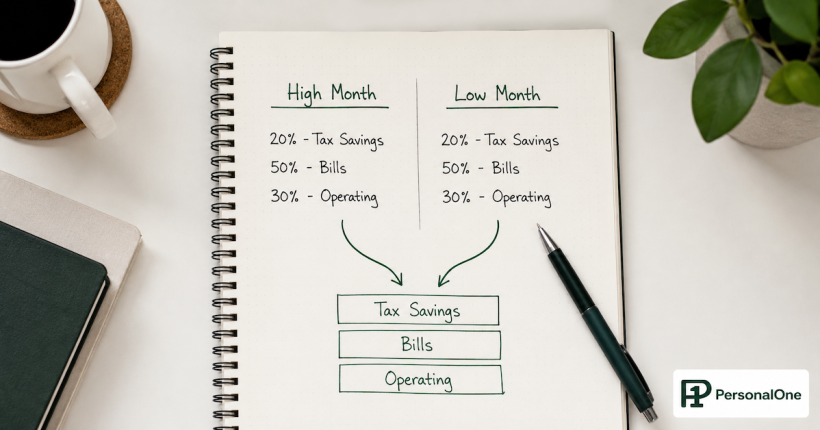
Tax reserve set aside: A percentage of every deposit (typically 25–30%) moves to a dedicated tax savings account each time income arrives. This happens before the personal transfer.
Fixed personal transfer executes: On the same date every month (e.g., the 1st), a fixed amount transfers automatically from the buffer to personal checking. This is your salary. It does not change based on how much arrived this month.
Buffer balance adjusts: Good months leave more in the buffer. Slow months draw it down. As long as the buffer stays above zero, your personal life runs normally.
The key discipline is treating the fixed personal transfer as non-negotiable. It goes on the 1st whether the buffer is full or thin. If the buffer is thin, that is information — either the target needs to be rebuilt in upcoming high months, or the personal transfer amount is set too high and needs to be recalibrated.
Setting the Right Personal Transfer Amount
The fixed monthly transfer is the number you pay yourself. It should cover your actual personal monthly expenses — not your average monthly income, not a round number you hope works. The transfer amount should be calculated from your real expense baseline.
How to Calculate Your Personal Transfer Amount
Add up your monthly fixed personal expenses: Rent or mortgage, utilities, insurance, loan minimums, subscriptions. These are non-negotiable regardless of income.
Add your average monthly variable personal expenses: Groceries, gas, dining, personal care. Use a three-month average from your statements.
Add a personal savings contribution: Emergency fund, goals, investments. This should be a fixed monthly amount, not whatever is left.
Total = your personal transfer amount. This is what transfers on the 1st regardless of what the buffer holds above it.
If you are setting this number for the first time and are uncertain, set it conservatively. A transfer amount that is slightly lower than actual spending is better than one that drains the buffer in slow months. You can adjust upward once the buffer is established and you have two to three months of data on how it behaves.
Do not set the transfer based on what you want to earn. Set it based on what you actually need to cover your life. The transfer is the floor. Anything the buffer holds above the floor after covering the transfer is excess that belongs to the buffer reserve, not to discretionary spending.
Building the Buffer From Zero
If you are starting with no buffer, the path from zero to funded looks like this:
Phase 1 — Open the account and route income immediately
Open your buffer account — a business or dedicated income-holding account at a separate institution. Update all client payment instructions, platform payout settings, and invoice details to deposit to this account. The routing change happens now, before the buffer is funded. Every payment that arrives from this point goes there.
Phase 2 — Operate on reduced personal transfer while building
During the build phase, set your personal transfer at 70–80% of your full calculated amount. The remaining 20–30% stays in the buffer each month to build the reserve. This means tighter personal spending during the build period — but it funds the buffer faster than waiting for a windfall to do it all at once.
Phase 3 — Use high-income months to accelerate
When an unusually high payment arrives, do not adjust the personal transfer upward. Let the full surplus stay in the buffer. This is the fastest path to full capitalization. The buffer is not a profit-sharing mechanism during build — it is an account you are filling as quickly as possible so the system can start protecting you.
Phase 4 — Activate full transfer once minimum buffer is reached
Once the buffer holds your 1x minimum target, increase the personal transfer to its full calculated amount. The buffer is now operational. Continue building toward the 2x target during subsequent high months by leaving surplus in the buffer rather than increasing the transfer.
The Tax Reserve: Non-Negotiable Before the Personal Transfer
Before the personal transfer executes, one other allocation must happen: the tax reserve.
Freelancers are responsible for self-employment tax plus income tax on all earnings. Without employer withholding, the tax liability accumulates silently throughout the year and arrives as a lump sum at filing time. If the buffer has been operating without a tax reserve, there is nothing set aside for the bill.
The fix is a separate tax savings account — typically a high-yield savings account — that receives a percentage of every client payment that lands in the buffer. The percentage varies by income level and deductions, but 25 to 30 percent of gross receipts is a conservative starting point for most self-employed freelancers in the U.S. A tax professional can give you a more precise number based on your specific bracket and deductible expenses.
The tax account sits outside the buffer system. It should be at a separate institution, earning competitive interest while it accumulates, and treated as untouchable until quarterly estimated tax payments are due or the annual filing is complete. This account is not emergency savings. It is not buffer backup. It has one job: covering the tax bill.
Five Ways Freelancers Undermine Their Buffer
Mistake 1 — Treating buffer surplus as discretionary income
When the buffer holds $15,000 and the personal transfer is $4,500, the visible surplus is not $10,500 of available money. It is reserve capital protecting future slow months. Spending the surplus because it is visible is the most common way buffers get destroyed in good months.
Mistake 2 — Increasing the personal transfer when income is high
The personal transfer is a fixed amount, not a variable one. Increasing it during good months because you can defeats the entire purpose of the system. The transfer stays fixed. Good months rebuild the buffer. Only recalibrate the transfer annually based on actual expense changes, not income changes.
Mistake 3 — Setting the buffer at the same bank as personal accounts
When all accounts live in one app, the psychological separation disappears. The combined balance looks like available money. One institution, zero friction between accounts, and the buffer gets treated as overflow personal checking within a few months.
Mistake 4 — Skipping the tax reserve
Operating the buffer without a parallel tax reserve creates a specific failure mode: the buffer looks healthy until April, at which point a large tax bill depletes it completely, leaving the freelancer operating without protection entering what is often a slow post-tax season.
Mistake 5 — Letting the buffer fund lifestyle expansion
After six months of smooth operation, freelancers sometimes recalibrate their personal transfer upward based on what the buffer can sustain in good months, not what it can sustain across the full year including slow periods. The transfer should be set to what average income supports, not peak income supports.
What the Buffer Enables: The Full Freelance System
A functioning buffer account is not the end goal. It is the enabling infrastructure for a complete freelance financial system.
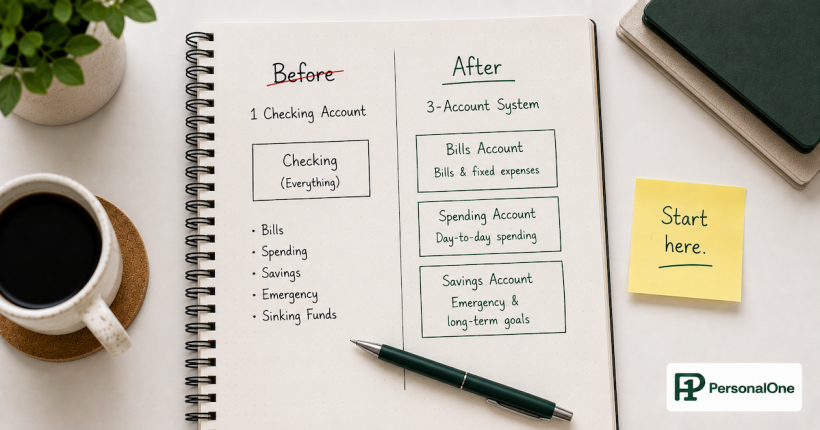
Once the buffer is operational and the personal transfer is running reliably, you have effectively given yourself a salary. That salary can then support the same account structure that any salaried employee would build: separate bills, spending, emergency fund, and goals accounts on the personal side, all funded by a predictable monthly income stream. The irregular nature of your income becomes invisible to your personal financial system. The buffer absorbs all of it upstream.
The buffer also makes tax planning manageable, business investment decisions clearer, and slow-month anxiety structurally impossible. You cannot be blindsided by a slow February if February’s personal expenses were already covered by the January buffer balance.
For a complete guide to structuring the personal salary side — how much to pay yourself, how to calibrate the number across seasons, and what to do with buffer surplus in strong years — the next step is the consistent freelancer salary guide — how to calculate the number, automate the transfer, and calibrate it across seasons in a way the system enforces automatically.
The buffer is one piece of a complete banking architecture for irregular income.
How the buffer connects to your tax account, personal salary structure, business account separation, and long-term goal saving — that is the full system. The Banking Systems hub covers the complete architecture for freelancers and variable-income earners.
Explore the Banking Systems Hub →Resources
IRS — Self-Employed Individuals Tax Center
CFPB — Bank Account Tools and Consumer Resources
FDIC — Deposit Insurance: How Your Accounts Are Protected
This article is part of the Banking Systems hub on PersonalOne — a complete framework for building the account structure and cash flow infrastructure that controls your financial outcomes automatically.
Frequently Asked Questions
How is a buffer account different from an emergency fund?
An emergency fund covers catastrophic, unpredictable events — sudden job loss, major medical events, essential home repairs. A buffer account covers routine income variability — the normal peaks and troughs of freelance cash flow. Both are necessary, but they serve different purposes and should live in separate accounts. The buffer is a cash flow tool. The emergency fund is insurance. Depleting the emergency fund to cover a slow month is a sign the buffer was either too small or never built.
How long does it take to build a functional buffer from scratch?
Most freelancers with reasonably consistent income can fund a one-month buffer within three to five months by reducing the personal transfer to 70–80% of its full target amount during the build period. The buffer becomes partially functional almost immediately — even $2,000 in the buffer is better than zero when a payment is a week late. Full capitalization at two months of outflows typically takes six to twelve months depending on income level and how aggressively surplus from high months is retained.
What if my income is genuinely too low to build a buffer right now?
If current income barely covers essential expenses, the buffer is still the right structural goal — but the immediate priority is increasing income or reducing expenses until there is enough margin to begin building it. Operating at the exact edge of your income with no reserve is a structural problem that the buffer cannot solve until there is something to put into it. That said, even $100 per month routed to a separate account starts creating the habit and the infrastructure before the amounts become meaningful.
Should the buffer be a checking or savings account?
Checking, for most freelancers. The buffer needs frequent incoming deposits (client payments) and a regular outgoing transfer (personal salary). Many savings accounts have transaction limits that complicate this flow. A business checking account with no monthly fees and fast ACH transfer capability works best. Interest rate is secondary — the money should not sit here long enough for APY to matter significantly.
What should I do when the buffer gets very large?
Once the buffer exceeds your two-month target consistently, the surplus is available to redirect — to your emergency fund if that is not yet fully funded, to investment contributions, or to a planned business investment. Do not raise the personal transfer as a first response to a large buffer. Transfer the surplus to a purpose-assigned account instead. The buffer’s size should be managed, not spent through the personal transfer.
Disclaimer: This content is for educational purposes only and does not constitute financial or tax advice. Self-employment tax obligations vary based on income, deductions, business structure, and jurisdiction. Consult a qualified tax professional for guidance specific to your situation. FDIC insurance covers up to $250,000 per depositor per institution — verify coverage directly with the FDIC before opening accounts.