June, 2026
What You Need to Know
- A large irregular payment is a routing event first — not a spending event.
- This article shows how to immediately apply your percentage system when money hits
- Do not change your lifestyle based on a single large payment. Wait for a sustained income pattern before adjusting your salary.
- Any surplus after the standard routing goes to savings or a defined purpose — not to discretionary spending by default.
- The system works because large payments often precede slow periods. Your routing system accounts for this automatically.
Knowing how to handle a large freelance payment correctly is one of the highest-leverage financial skills a variable-income earner can develop. A $15,000 project payment that gets routed correctly builds your tax reserve, tops off your buffer, funds your salary for months, and accelerates your savings goals. The same payment handled without a system can be gone in 60 days with nothing structural to show for it. The entire premise of banking for irregular income is that large deposits and small ones get treated with the same systematic discipline — because your routing structure does not have a "big check" exception.
Large irregular payments are the moments when a complete banking system for money management proves its worth most clearly. Without a defined structure, a large deposit feels like permission to spend. With a defined structure, it is a system event — predictable, processable, and protected.
Why Large Payments Are High-Risk for Freelancers
Large payments create two specific failure modes that smaller, consistent payments rarely trigger. The first is lifestyle inflation: a single large deposit makes your account balance look healthy enough to justify spending that your average monthly income cannot sustain. A $12,000 payment in March does not mean you have $12,000 available to spend — it means you received several months of income compressed into one event, and it needs to cover the obligations of those future months too.
The second failure mode is the post-project cash gap. Large project payments frequently arrive at the end of a major engagement. Once that project closes, the pipeline often needs time to refill. Freelancers who spend the large payment as if it were ordinary income commonly find themselves in a genuine cash crisis 60–90 days later when the next project has not started and the bank account reflects the spending habits of a flush period. The routing system closes both vulnerabilities before the money ever touches your operating balance.
The Routing Protocol for a Large Payment
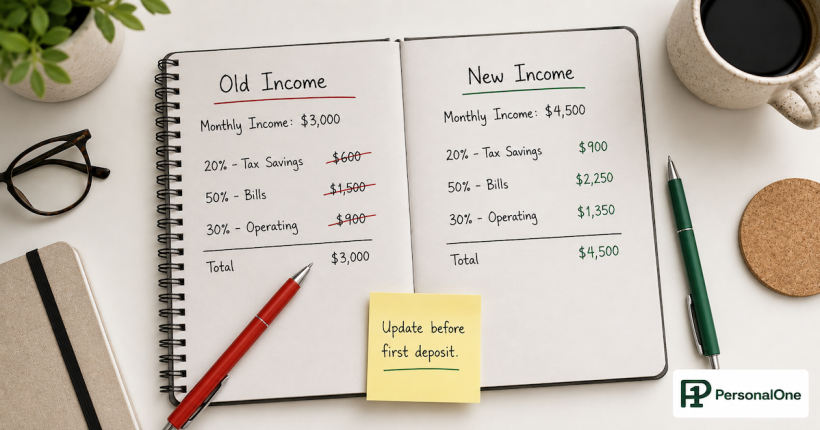
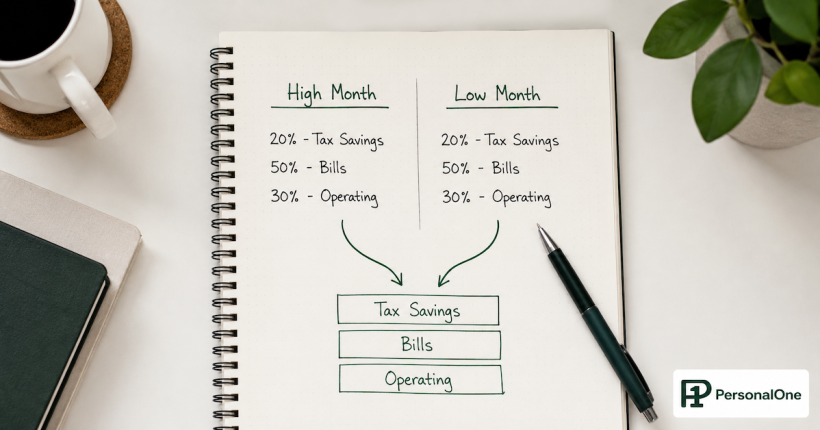
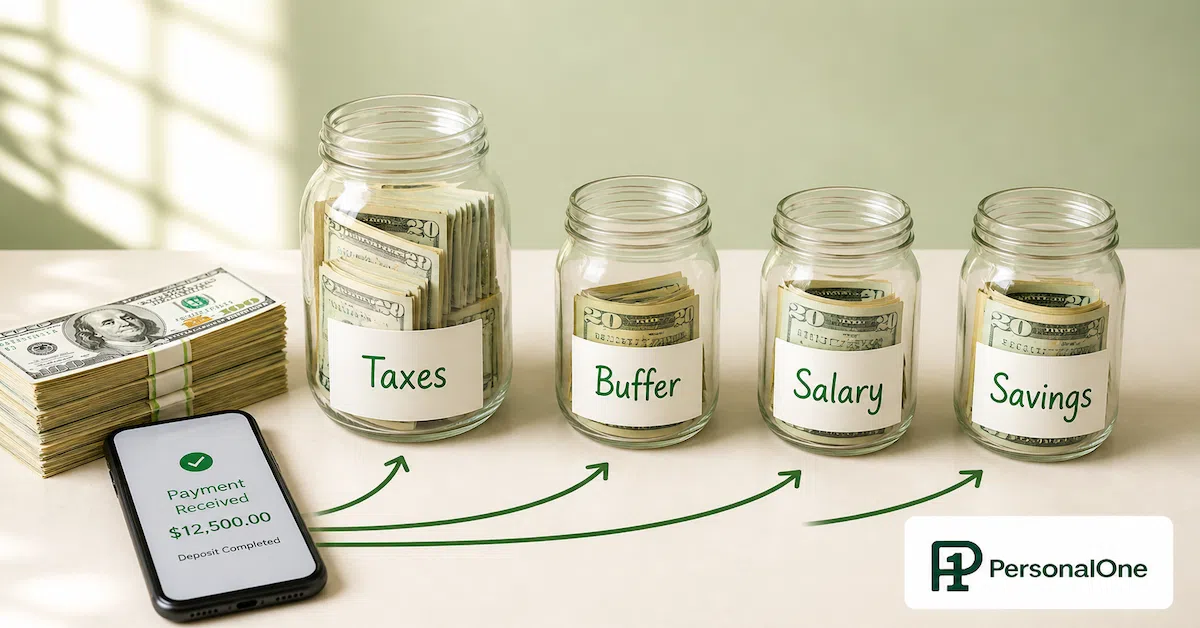
When a large irregular payment clears your business operating account, execute your standard routing immediately — within 24 hours if possible. Do not let the full balance sit undivided. The larger the deposit, the more urgent the routing.
Step 1 — Taxes first. Transfer 25% to your dedicated tax savings account. A $10,000 payment generates a $2,500 tax transfer. This is non-negotiable regardless of payment size. Large payments produce large tax liabilities. The IRS does not offer a discount because the income was irregular.
Step 2 — Buffer next. If your buffer is below its target, direct 10% of the post-tax remainder toward it. A fully funded buffer means this 10% redirects to savings instead. Either way, the percentage runs. The discipline of allocating large irregular income the same way you allocate small income is what separates a system from a good intention.
Step 3 — Salary transfer on schedule. Your salary transfer runs on its normal date at its normal amount. A large payment does not trigger an early salary transfer or a larger one. The salary is fixed. If the payment arrived mid-month, the operating account holds the balance until your next scheduled salary date. The money is not sitting idle — it is waiting to be allocated correctly.
Step 4 — Surplus allocation. After taxes, buffer, and salary are handled, assess what remains. This surplus goes to savings goals in a defined order: emergency fund if not yet fully funded, retirement contributions if applicable, then a future income gap reserve for the slow period that may follow this project's completion.
How Much of the Surplus Can You Actually Spend?
After executing the full routing protocol, some surplus will remain in your business operating account above your normal operating reserve. That remainder — and only that remainder — is discretionary. Not the full payment. Not the balance after just taxes. What is left after every routing bucket has been funded.
On a $10,000 payment with $3,000 in monthly fixed business expenses already covered, $2,500 routed to taxes, $500 to a partially depleted buffer, and a $2,200 monthly salary already transferred, the discretionary remainder might be $1,800. Possibly less if savings goals are a priority that month. This is not a disappointing number — it is an accurate one. And it is the amount you can spend without creating a future problem.
The Post-Project Gap: Why Large Payments Often Precede Slow Months
One of the most consistent patterns in freelance income is the post-project gap. A large payment signals the completion of a significant engagement. Once that engagement closes, the pipeline deprioritized during the project needs time to produce new revenue. The gap between project completion and the next project's first payment can be 30–90 days depending on your sales cycle and project duration.
Your routing system accounts for this automatically. The tax savings built from the large payment covers your estimated quarterly payment. The buffer contribution preserves your fixed expense coverage during the pipeline gap. Your salary continues uninterrupted from the operating account, which now holds a reserve funded by the large payment's post-routing surplus. If the gap extends beyond 45 days, the protect finances during income drops protocol activates — but when it does, the system has already pre-positioned the resources to handle it.
Build the System That Handles Every Payment Size
The Banking Systems hub covers the complete account structure, routing strategy, and income management framework for every freelancer income scenario.
Explore the Banking Systems HubWhen to Adjust Your Salary After a Large Payment Period
A single large payment is not a salary adjustment trigger. Your personal salary adjusts only when your income floor has been sustainably higher for three or more consecutive months. One large project does not establish a new floor — it establishes one good month. Treat it as such and let the routing handle the allocation. If large payments become a regular pattern over multiple quarters, that pattern justifies revisiting your routing percentages and salary target together.
The one area where a large payment should directly influence your ongoing financial behavior is savings acceleration. If your emergency fund is not yet fully funded, a large payment is the moment to close that gap. If it is funded, direct the surplus toward retirement contributions or a dedicated business investment reserve. The what to do with a big freelance payment decision is always simpler when the routing system has already answered the first four questions before you even open your banking app.
Handling Advance Payments and Deposits
Many large freelance projects include a partial advance payment — 25%, 33%, or 50% of the total — paid before work begins. Advance payments follow the same routing protocol as any other deposit. The fact that the work is not yet complete does not change the tax liability or the buffer logic. Route the advance the same day it clears.
One specific consideration with advance payments: if the project falls through or requires a refund, you will need that money available. Until the project is fully delivered and the client relationship is stable, keep a portion of the advance in your operating account as a project reserve rather than fully distributing it to savings. A conservative approach is to hold 20–25% of any advance as a project reserve until delivery is confirmed, then release it into the standard routing flow.
The Mental Shift: Income Is Not the Same as Available Cash
The most important reframe for handling large freelance payments is this: the number that hits your account is gross income, not available cash. Available cash is what remains after taxes, buffer, and salary obligations are met. Until you run the routing, you do not know what you actually have to work with. This reframe is not pessimistic — it is accurate. And accuracy is what lets you make spending decisions from a position of real information rather than balance-sheet optimism.
Freelancers who internalize this distinction stop experiencing the feast-and-famine emotional cycle that plagues variable income earners. The feast months get routed. The famine months get covered. The system runs the same way regardless of deposit size, and that consistency is what turns irregular income into a reliable financial life.
Resources
Official sources used to inform this guide:
- IRS: Estimated Taxes for Self-Employed Individuals
- IRS: Self-Employed Individuals Tax Center
- SBA: Managing Business Finances and Accounting
- CFPB: Consumer Savings Tools and Resources
For the complete banking framework, return to the banking systems and account structure guide.
Frequently Asked Questions
What qualifies as a "large" payment that needs special handling?
Any payment that is more than 1.5× your average monthly income qualifies as large enough to route with extra intentionality. The routing protocol is the same regardless of size — but payments above that threshold carry greater risk of triggering lifestyle inflation and deserve a conscious allocation review before any discretionary spending occurs.
Should I pay off debt with a large freelance payment?
Only after taxes, buffer, and salary obligations are met. High-interest consumer debt — credit cards above 15% APR — can be targeted with surplus after the standard routing runs. Do not skip the tax routing to accelerate debt payoff. The IRS penalty and interest rate on underpaid estimated taxes often exceeds the interest rate on the debt you are trying to eliminate.
Can I increase my salary temporarily after a large payment?
A one-time personal bonus — a fixed dollar amount taken from the post-routing surplus — is a more structurally sound approach than raising your salary. A salary increase implies permanence. A bonus is clearly defined as a single event tied to a specific payment. Take the bonus, enjoy it, and leave your salary baseline unchanged until income confirms a new sustainable floor over multiple months.
What if the large payment was for a multi-month project? Should I spread the routing over time?
Route it all at once when it lands. The routing percentages already account for multi-month project income because they are calibrated to your annual income patterns. Spreading the routing manually across months adds complexity without adding protection. Route it in full, let the savings and buffer accounts hold the allocated portions, and draw from them on schedule as needed.
I received a large payment and already spent most of it before reading this. What now?
Calculate your remaining tax liability from that payment and set aside what you still owe the IRS from whatever is left in your account. That is the most critical recovery step. Then assess whether your buffer was depleted and prioritize rebuilding it from your next few deposits before returning to normal allocation. Going forward, execute the routing immediately on every future payment before spending anything.
Disclaimer: This content is for educational purposes only and does not constitute financial, legal, or tax advice. PersonalOne is a free financial education platform. Individual financial situations vary. Consult a qualified financial professional for advice specific to your circumstances.