July 2026
Home › Credit Building & Protection › Credit Monitoring & Protection › How to Freeze Your Credit and Protect Yourself From Identity Theft
What You Need to Know
— A credit freeze is the single most effective free tool for preventing new account identity theft. It blocks lenders from accessing your credit file entirely, making it nearly impossible to open fraudulent accounts in your name.
— Freezing is free at all three bureaus under federal law, takes five to ten minutes per bureau online, and has zero effect on your credit score.
— You must freeze all three bureaus separately — Equifax, Experian, and TransUnion. A freeze at one does not carry over to the others.
— A freeze prevents new account fraud. It does not protect existing accounts, prevent tax identity theft, or stop medical identity fraud — each requires a separate defensive layer.
— The correct order of operations: freeze first, then add monitoring. Monitoring tells you after something went wrong. A freeze prevents it from going wrong in the first place.
A credit freeze — also called a security freeze — is the strongest single action you can take to prevent identity theft from damaging your credit. It is free, reversible, takes about ten minutes per bureau to set up online, and has no impact on your credit score. Despite all of that, most people have never done it. The reason is usually some combination of not knowing it exists, assuming it's complicated, or believing a credit monitoring service already handles it. None of those are true — and the cost of not having a freeze in place is real.
This guide covers exactly what a credit freeze does, how to place one at each of the three major bureaus, how to lift it when you need to apply for credit, what a freeze doesn't protect against and what does, and how the freeze fits into the complete identity protection system alongside monitoring, fraud alerts, and dispute processes.
What a Credit Freeze Actually Does
When you place a credit freeze, you are restricting access to your credit file at that bureau. Any lender or creditor who attempts to pull your credit report as part of a new account application receives a block signal — your file is inaccessible. Because virtually all lenders require a credit report pull before approving a new account, the freeze makes it nearly impossible for an identity thief to successfully open a credit card, take out a loan, or establish a new line of credit in your name.
The freeze does not close your existing accounts, affect your credit score, or prevent your current creditors from accessing your file for account management purposes. It does not show up as a negative item on your credit report. It does not affect pre-approval offers that use soft pulls. Your score continues to be calculated normally. The freeze is purely a restriction on new hard-pull access — the kind of pull that happens when someone applies for new credit.
The legal basis: Credit freezes are governed by federal law — specifically Section 301 of the Economic Growth, Regulatory Relief, and Consumer Protection Act of 2018. Under that law, all three major bureaus are required to provide free credit freezes to all consumers, and to lift them for free within one business day of a request. There is no fee at any stage of the process. Any bureau that charges for a freeze is violating federal law.
Freeze vs. credit lock: Some bureaus offer a "credit lock" as an alternative — a bureau-proprietary feature that accomplishes the same thing as a freeze but is governed by the bureau's terms of service rather than federal law. A freeze has stronger legal protections and guaranteed pricing. A lock is more convenient (usually toggle-based in an app) but doesn't carry the same statutory guarantee. Both prevent new account fraud equally well. The freeze is the better choice for long-term protection.
How to Place a Credit Freeze at All Three Bureaus
Each bureau has its own freeze process. All three must be frozen separately for complete protection — a freeze at Equifax does not notify TransUnion or Experian. The online process at each bureau takes five to ten minutes and requires standard identity verification: your name, address, Social Security number, date of birth, and sometimes answers to identity questions based on your credit history.
After placing each freeze, save your account credentials securely. You will need them to lift the freeze temporarily when you apply for credit. Losing access to your bureau accounts doesn't make the freeze permanent — you can still lift it by verifying your identity — but account access makes the process faster.
Equifax
Online: equifax.com/personal/credit-report-services/credit-freeze. Create a myEquifax account if you don't have one. Select "Add a Security Freeze." Verify your identity. Equifax confirms the freeze by email. You can manage the freeze — place, lift, or remove — through your myEquifax account at any time. By phone: (888) 298-0045.
Experian
Online: experian.com/freeze/center. Create an account or log in. Select "Add a Security Freeze." Verify your identity. Experian sends a confirmation. Freeze management — including temporary lifts — is handled through the same portal. By phone: (888) 397-3742.
TransUnion
Online: transunion.com/credit-freeze. Create a TransUnion Service Center account. Add the freeze and verify your identity. TransUnion confirms by email. Lifts and removals are managed through the Service Center portal. By phone: (888) 909-8872.
By Mail (if online isn't an option)
Send a written request to each bureau including your full name, current address, Social Security number, date of birth, and a copy of a government-issued ID plus a utility bill or bank statement showing your address. Allow up to three business days for processing by mail versus the immediate online process. The CFPB resource listed in the government resources section below includes the mailing addresses for all three bureaus.
Additional Specialty Bureaus Worth Freezing
The three major bureaus cover the majority of lenders, but several specialty consumer reporting agencies are also used for specific types of accounts. ChexSystems is used by banks when opening checking and savings accounts. NCTUE (National Consumer Telecom and Utilities Exchange) is used by utility and telecom companies. Innovis is a fourth credit reporting agency used by some lenders. Freezing these specialty bureaus provides more complete identity protection, particularly for banking and utility fraud. CFPB provides guidance on accessing and freezing specialty bureau files — link in the resources section below.
What I've Seen
The most common situation I see is people who set up a paid credit monitoring service and consider themselves protected — without ever placing a freeze. The monitoring service alerts them when a new fraudulent account has already been opened. The account was opened, the damage is done, and now they're spending weeks disputing it. The freeze would have stopped the application before it was approved. Monitoring and a freeze are not the same thing and one doesn't replace the other. The freeze is prevention. Monitoring is detection. You need both, and the freeze takes fifteen minutes and costs nothing.
How to Lift a Credit Freeze When You Need to Apply for Credit
A credit freeze is not permanent in any limiting sense. Whenever you need to apply for new credit — a credit card, auto loan, mortgage, apartment — you can lift the freeze temporarily at the bureau the lender will pull, allow the application to proceed, and refreeze when the process is complete. The lift is free, takes effect online within minutes, and can be set for a specific time window — one day, one week — after which the freeze automatically reinstates.
How to lift efficiently: Before applying for credit, ask the lender which bureau they pull. Most will tell you — it's a routine question. Lift only that bureau's freeze for the duration of the application process. This minimizes the window of exposure while still letting the application move forward. If the lender pulls all three — as mortgage lenders typically do — lift all three for the same time window.
Managing lifts online: All three bureaus allow you to set temporary lifts with a specific end date through their online portals. Log into the bureau account you created when placing the freeze, navigate to freeze management, and select "Temporarily Lift" with the start and end dates. The freeze reinstates automatically on the end date — you don't need to remember to refreeze manually.
If you're rate-shopping: For mortgage and auto loan applications where you're submitting to multiple lenders simultaneously, lift the relevant bureaus for the duration of your shopping window — typically 14 to 45 days — rather than managing individual lifts per application. FICO's rate-shopping deduplication logic treats multiple inquiries for the same loan type within that window as a single inquiry, so the exposure window is the same regardless of how many lenders you apply to.
What a Credit Freeze Doesn't Protect — and What Does
A credit freeze is the strongest tool for preventing new account fraud. It is not a comprehensive identity protection system on its own. Understanding what it doesn't cover — and what the correct defensive layer is for each gap — is what separates a complete protection system from a partially secure one.
Existing account fraud. A freeze does not protect your existing credit cards, bank accounts, or loans. If your card number is stolen and used for fraudulent purchases, your credit freeze doesn't prevent that — it only blocks new accounts. Your existing card issuers and banks provide account-level fraud protection through their own systems, including real-time transaction alerts and zero-liability policies. Enable transaction alerts on every existing account.
Tax identity theft. An identity thief with your Social Security number can file a fraudulent tax return claiming a refund before you file yours. The IRS does not use credit bureau data, so a credit freeze has no effect on this. The IRS Identity Protection PIN (IP PIN) program is the correct tool — it assigns a six-digit PIN required to file your return, making fraudulent filings impossible without it. Enrollment is free at IRS.gov.
Medical identity theft. A thief using your identity to obtain medical services or prescriptions operates entirely outside the credit system. Medical identity theft appears in your Explanation of Benefits statements from your insurer — review them regularly. If your insurer provides a fraud alert option for your member account, activate it.
Data breach exposure. A freeze prevents fraudulent use of your information, but it doesn't prevent your information from being exposed in a breach in the first place. Dark web monitoring — available through paid credit monitoring services and some free tools — alerts you when your information appears in known breach databases. For the full breakdown of what monitoring adds on top of a freeze and when the paid tier is worth the cost, the article on free vs paid credit monitoring covers that decision framework in detail.
Fraud on existing credit lines. A freeze does not prevent someone who already has access to your account credentials from using them. Account security — strong unique passwords, two-factor authentication, and account alerts — is the correct layer for this. Credit monitoring alerts you to unauthorized changes in account status; a freeze does not.
Freeze vs. Fraud Alert: Understanding the Difference
A credit freeze and a fraud alert are both defensive tools, but they work differently and serve different situations. They are not interchangeable — each has specific use cases where it's the stronger choice.
A credit freeze completely blocks lender access to your credit file. No one can pull your report for a new account without you first lifting the freeze. This is the stronger tool for ongoing, proactive protection — appropriate for everyone, not just identity theft victims.
A fraud alert is a flag on your credit file that asks — but does not require — lenders to take additional verification steps before approving credit in your name. It is less restrictive than a freeze. Unlike a freeze, a fraud alert at one bureau automatically notifies the other two — you only need to contact one. Initial fraud alerts last one year. Extended fraud alerts for confirmed identity theft victims last seven years and require a copy of an identity theft report. For the full mechanics of how a fraud alert works and when to use one instead of or alongside a freeze, the article on how a fraud alert protects your credit file covers the complete comparison.
For most people, the correct setup is a freeze plus ongoing credit monitoring — not a fraud alert as a standalone tool. A fraud alert's "ask creditors to verify" approach is weaker than the freeze's hard block on file access. The fraud alert is most useful in active identity theft situations where you want the extended seven-year flag on your file and the automatic three-bureau notification from a single contact.
The Complete Identity Protection System: Freeze Plus Monitoring
A credit freeze handles prevention. Credit monitoring handles detection. The two tools are complementary, not redundant, and together they cover the great majority of identity theft scenarios that affect your credit file.
The freeze prevents new fraudulent accounts from being opened. Monitoring watches your credit reports for changes — new inquiries, new accounts, changes to existing accounts, new derogatory marks — and alerts you when something unexpected appears. If an error or fraud slips through on an existing account, monitoring is what catches it and gives you the information you need to act quickly.
Building a complete protection system means: freeze at all three bureaus (free, done once), a free monitoring tool for ongoing alerts, regular credit report reviews to catch what monitoring misses, and knowing the dispute process before you need it. The monitoring side of this system is often where people have the most questions about which tool to use. The full breakdown of whether Credit Karma is worth using for credit monitoring covers where its two-bureau VantageScore data is reliable for tracking purposes and where it falls short of what a lender will actually see.
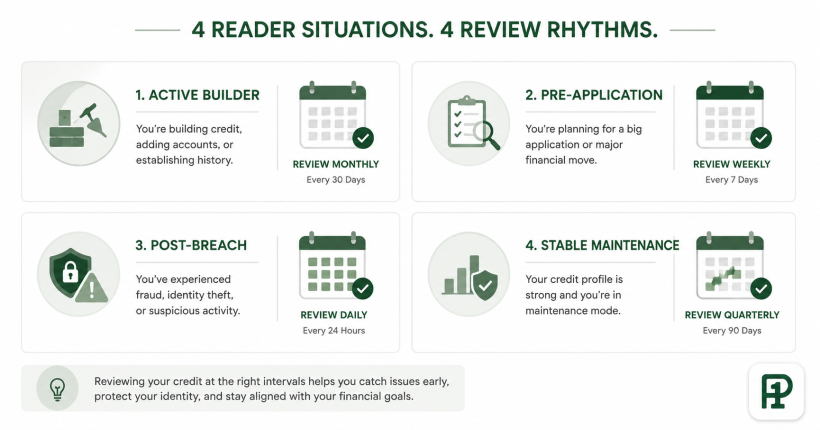
Equally important is cadence — how frequently you review your actual credit reports versus relying on monitoring alerts alone. Knowing how often you should check your credit report gives you the review schedule that catches what automated monitoring misses, particularly errors that appear gradually rather than as a sudden change.
When something appears on your report that shouldn't be there — an error, a fraudulent account, or an item you believe was resolved — the right starting point is a structured review of your full file. A thorough credit report checkup to identify and document errors establishes exactly what needs to be disputed and from which bureau, before you contact anyone.
Once you've identified the specific inaccuracy and documented it, the formal dispute process moves quickly when approached correctly. The step-by-step guide on how to dispute a credit report error with the bureaus walks through the submission method, what to include, the legal timeline the bureaus must follow, and how to escalate if the initial dispute is not resolved.
Protecting Your Children's Credit
Children are increasingly targeted for identity theft because their Social Security numbers have no existing credit history and the fraud often goes undetected for years — sometimes until the child tries to open their first credit account or apply for college financial aid. Placing a credit freeze on your child's credit file is free, has no downside, and takes about the same time as freezing your own.
Children don't have credit files by default. To freeze a minor's credit, you contact each bureau and request that a file be created and immediately frozen. The process requires documentation of your identity and your relationship to the child — typically a birth certificate and your own government-issued ID. Each bureau has a specific process for minor freezes, linked in the government resources section below.
Since children don't need credit until they're at least 16 to 18, there is no practical downside to freezing their files immediately. The freeze can be lifted when they're ready to begin building credit. In the meantime, it prevents one of the most difficult types of fraud to detect and resolve.
Build Your Complete Credit Defense Layer
A credit freeze is the foundation. The Credit Monitoring & Protection cluster covers fraud alerts, monitoring tools, dispute processes, and identity theft recovery — the complete system for protecting your credit profile at every stage.
Explore the Full Protection SystemGovernment Resources
FTC — Credit Freezes and Fraud Alerts — Official guidance on how freezes and fraud alerts work, when to use each, and how to place them.
CFPB — How to Freeze Your Credit — Step-by-step guidance including bureau contact information, mailing addresses, and minor freeze processes.
IdentityTheft.gov (FTC) — The federal resource for reporting identity theft and generating a personalized recovery plan.
AnnualCreditReport.com — Free weekly reports from all three bureaus. Pull and review reports before and after any freeze activity.
IRS — Identity Protection PIN — Free enrollment in the IP PIN program to prevent fraudulent tax filings using your SSN.
Return to the full credit building and protection guide for a complete overview of every credit strategy covered on PersonalOne.
Frequently Asked Questions
Does a credit freeze hurt your credit score?
No. A credit freeze has zero effect on your credit score. It does not appear as a negative item on your report. It does not affect your existing accounts. It does not change how your score is calculated. The freeze simply restricts new lenders from pulling your file for new account applications — your existing creditors can still access your file for account management purposes and your score is calculated normally throughout.
How long does a credit freeze last?
Indefinitely, until you lift or remove it. There is no expiration date on a credit freeze under federal law. It stays in place until you take action to lift it temporarily or remove it permanently. This is by design — the protection should be ongoing, not require periodic renewal. Fraud alerts, by contrast, do expire: initial fraud alerts last one year, and extended fraud alerts for confirmed identity theft victims last seven years.
Can I still use my existing credit cards while my credit is frozen?
Yes. A credit freeze has no effect on your existing accounts. You can continue using all your current credit cards, loans, and lines of credit normally. The freeze only affects new lenders attempting to access your file for a new account application. Your current creditors already have a relationship with you and can continue to access your file for account management purposes regardless of the freeze status.
Do I need to freeze all three bureaus, or just one?
All three, separately. A freeze at Equifax does not notify TransUnion or Experian. Each bureau maintains its own independent file and each must be frozen independently for complete protection. If you freeze only one or two bureaus, a lender or identity thief can simply pull from an unfrozen bureau. The online process at each bureau takes five to ten minutes. For truly complete protection, specialty bureaus like ChexSystems, Innovis, and NCTUE are also worth freezing — particularly for banking and utility account fraud.
What happens if I forget to refreeze after lifting?
If you set a temporary lift with an end date through the bureau's online portal, the freeze reinstates automatically — you don't need to remember to refreeze. If you lifted the freeze indefinitely rather than for a specific window, it remains lifted until you manually refreeze. Log back into the bureau portal and replace the freeze as soon as your credit application is complete. The entire process takes about two minutes.
Is a credit freeze the same as credit monitoring?
No, and this distinction matters. A credit freeze is prevention — it stops new fraudulent accounts from being opened. Credit monitoring is detection — it alerts you when changes appear on your credit reports. A freeze cannot tell you that an error appeared on your report. Monitoring cannot stop a fraudulent account from being approved. You need both tools functioning simultaneously for a complete defensive layer. The freeze is the higher priority if you have to choose one, but the two together take the same fifteen minutes to set up and cost nothing for the free monitoring setup.
This article is for educational purposes only and does not constitute legal, financial, or identity theft recovery advice. Bureau processes, contact information, and specialty bureau freeze procedures may change — verify current instructions directly with each bureau. PersonalOne is a free financial education platform and does not offer identity protection services.