August 2026
Home › Credit Building & Protection › Credit Utilization & Payment Strategy › How Credit Card Payments Are Reported to the Credit Bureaus
What You Need to Know
— Your credit card issuer reports your balance to the bureaus once per month, typically within one to three days after your statement closing date — not your payment due date. These are different dates that do different jobs.
— What gets reported is not your current balance. It is your balance at the moment the statement closed. Everything you've spent since statement close and every payment you've made since then does not appear until next month's report.
— Issuers report independently to each of the three bureaus — Equifax, Experian, and TransUnion. The same card can appear with different balances at different bureaus on the same day because reporting timing varies.
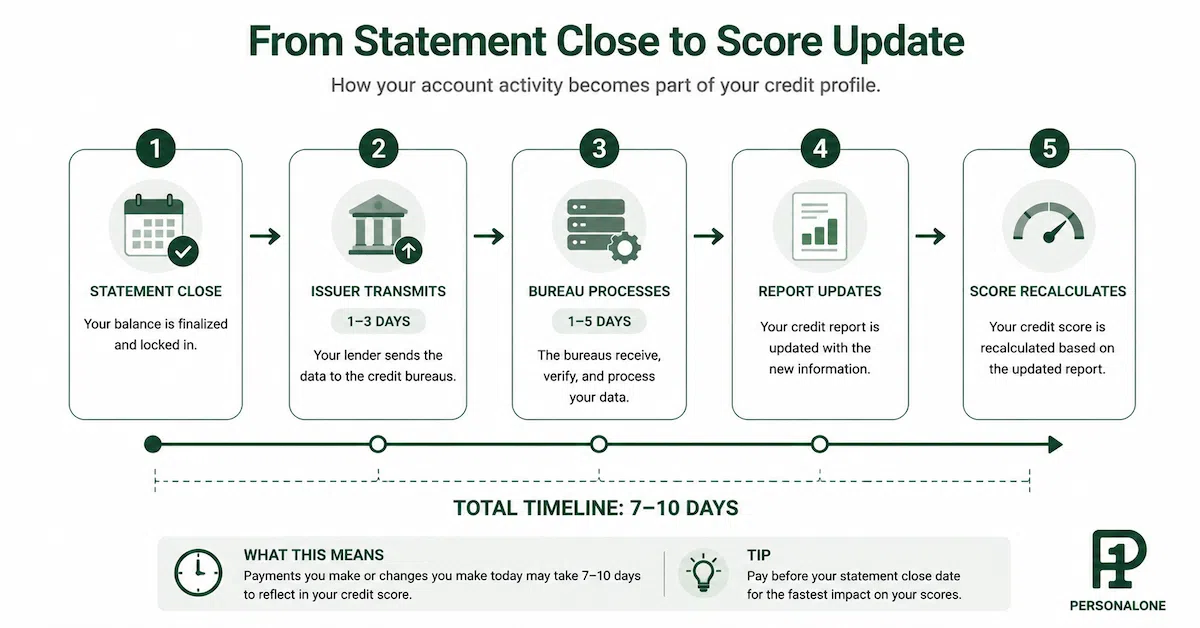
— After the bureau receives your data, it takes one to five business days for your credit report to update. After your report updates, it takes another one to three days for your score to recalculate. The full pipeline from payment to score change takes seven to ten days total.
— Your payment history — on-time or late — is reported separately from your balance. A payment that clears before the due date protects your payment history record regardless of when your balance was reported.
Understanding how credit card payments are reported to the credit bureaus — and how that reporting affects your score — requires understanding the system that connects your card account to your credit report. Most people assume credit happens in real time — that a payment made today shows up on their report tomorrow and improves their score within a day or two. The actual pipeline is more deliberate, more structured, and more predictable than that. It runs on a monthly cycle anchored to your statement closing date, not your payment due date. And once you understand exactly how it works, every tactical decision about when to pay, how much to pay, and which card to prioritize becomes logical rather than approximate.
The reporting pipeline has five distinct stages: your account activity accumulates during the billing cycle, your statement closes and generates a snapshot, your issuer transmits data to the bureaus, the bureaus update your credit report, and your score recalculates from the updated data. Each stage has its own timeline. Each stage determines something specific about what your score sees and when it sees it. This article maps that full pipeline clearly — from the transaction in your account to the score your lender pulls.
Stage 1 — The Billing Cycle: Where Everything Starts
Every credit card operates on a billing cycle — a period of 28 to 31 days during which transactions accumulate. Your billing cycle begins the day after your previous statement closed and ends on your next statement closing date. Every purchase, payment, fee, and interest charge that posts to your account during this window becomes part of the cycle's activity record.
The statement closing date is the last day of the billing cycle — the day your statement generates. It is also the date that determines what gets reported to the credit bureaus. Whatever balance appears on your account at the moment the statement closes is the balance your issuer sends to the bureaus. Not your balance from last week. Not your balance after your upcoming payment. The balance at the exact moment the billing cycle ends.
This is the foundational fact that makes all downstream credit management decisions coherent. Your reported balance is a snapshot taken once per month at a specific moment — not a rolling average, not a current reading, not a reflection of recent payments. A snapshot. Understanding this single fact explains why a payment made three days after statement close doesn't change your reported balance, why a payment made three days before statement close does, and why the payment due date — which arrives 21 to 25 days after statement close — is irrelevant to the utilization calculation on the report that's already been generated.
What I've Seen
The most persistent misconception I encounter is the belief that making a payment immediately after seeing a high balance on a monitoring app will change what's on the report. The statement already closed. The data already went to the bureaus. The payment is real and it reduces what you owe, but it won't appear on your report until next month's statement closes. I've worked with people who made three payments in a single week trying to "fix" a utilization spike they saw in Credit Karma, not realizing that the spike had already been reported and wouldn't change until the next billing cycle. Understanding the pipeline timeline eliminates that frustration entirely — because you know exactly when the change will appear and exactly what you need to do before it does.
Stage 2 — Statement Close: What Gets Sent to the Bureaus
When your statement closes, your card issuer compiles the data that will be transmitted to the credit bureaus. This data package contains several distinct pieces of information — and understanding what each piece is tells you which behaviors affect which parts of your credit report.
Your reported balance. The balance on your account at statement close. This is the number that becomes your reported utilization for that card that month. It does not reflect payments made after statement close, purchases not yet posted, pending transactions, or any other activity that occurs after the billing cycle ends. The reported balance is a static figure — it represents one moment in time and stays on your report as that month's data point until it is replaced by next month's reported balance.
Your credit limit. The credit limit on your account. This is what the bureau uses as the denominator in the utilization calculation. Most issuers report the credit limit consistently each month unless a limit change has been processed. If your limit was recently increased, the new limit may not appear in the report until the cycle following the change — meaning a limit increase approved mid-cycle won't lower your reported utilization until the next statement closes with the new limit on record.
Your payment status. Whether your minimum payment was received by the due date of the previous billing cycle. This is reported as a payment history notation — on-time (typically shown as "OK" or a similar code on your credit report) or late (30 days late, 60 days late, etc.). Payment status is what determines your payment history record — the 35% of your FICO score that comes from whether you've paid on time. This data point reflects the previous cycle's due date, not the current cycle's close date. A payment made before this month's due date protects next month's payment history notation.
Account status information. Whether the account is open or closed, whether it's in good standing or delinquent, the account type, and the account open date. This information is largely static — it changes only when something significant changes about the account itself, not monthly based on spending behavior.
Stage 3 — Transmission: How Data Moves From Issuer to Bureau
After your statement closes, your card issuer transmits the compiled data to the credit bureaus. This transmission typically occurs within one to three days of statement close — not the same day, and not the same timing for every bureau. Most major issuers report to all three bureaus — Equifax, Experian, and TransUnion — but they do so on their own schedule, and the timing for each bureau may differ by one to several days.
This is why you can see different balances for the same card at different bureaus on the same day. If your issuer transmits to Experian on the 15th, to Equifax on the 16th, and to TransUnion on the 17th, and you made a payment on the 16th, your Experian file will show the pre-payment balance and your Equifax and TransUnion files will show the post-payment balance — even though all three bureaus received data from the same issuer about the same account in the same month.
Not all issuers report to all three bureaus. Some smaller issuers, credit builder products, and specialty lenders report to only one or two bureaus. This is why a card that helps build your credit with one bureau may not appear at all on another bureau's file — and why a lender who pulls your report from a bureau your card doesn't report to may not see that card's positive payment history at all. When evaluating a new credit product's credit-building value, asking which bureaus it reports to is a more useful question than asking whether it reports to "the credit bureaus" generically.
The practical implication of multi-bureau reporting with staggered timing: your credit score at any given moment may differ across the three bureaus because each bureau's file reflects a different point in the transmission timeline. A score pulled from Experian today may be five points different from a score pulled from TransUnion today for the same consumer with the same credit history — not because anything is wrong, but because one bureau received an update slightly earlier than the other. The guide on paying your credit card twice a month addresses how to time pre-close payments to control what gets transmitted regardless of which bureau receives the data first.
Stage 4 — Bureau Processing: How Your Report Gets Updated
When the bureau receives your issuer's data transmission, it processes the information and updates your credit report. This processing is not instantaneous — it typically takes one to five business days from receipt of the transmission for the update to appear in your credit report file. The bureau must validate the incoming data, reconcile it against the existing account record, and update the file with the new information.
During this processing window, your credit report may show either the previous month's balance or an update in progress. If you pull your report immediately after your statement closes, you may see the old balance because the transmission hasn't arrived yet or processing hasn't completed. If you pull it five days later, you should see the new balance. This is why checking your credit report on the same date each month — specifically one week after your statement close date — gives you the most consistent view of what's been reported and processed.
When different information appears at different bureaus. Because each bureau processes incoming data independently on its own timeline, your credit report at Equifax, Experian, and TransUnion may show different balances for the same card at any given moment during the processing window. This is normal and expected. It doesn't represent an error at any bureau — it represents the same issuer data arriving and being processed at slightly different times. For most consumers, all three bureaus will show consistent data within a week after statement close.
What triggers a bureau to request new data outside the monthly cycle. Bureaus receive monthly reports from issuers as the primary data source. They also receive data in response to hard inquiries — when you apply for new credit, the lender pulls your report, which may prompt an updated balance check for open accounts. This is one reason your score can appear different the moment a lender pulls it versus what you see in a monitoring app — the inquiry itself may have triggered a data refresh that reflects a balance your monitoring app hasn't received yet.
Stage 5 — Score Recalculation: When Your Score Actually Changes
Your credit score is not a standing number that updates in real time. It is calculated fresh each time it is requested — by a lender pulling your report, by a monitoring service checking for updates, or by you accessing your score through a portal. The score is calculated from whatever data is in your credit report file at the moment of the request. When your credit report updates with new balance data, the next score calculation from that bureau reflects the update.
The practical timeline from statement close to score change: statement closes on day zero, issuer transmits data within one to three days, bureau processes the transmission within one to five business days, and your score recalculates the next time it's accessed after the processing completes. The full pipeline from statement close to a new score reading is typically seven to ten days. If you're monitoring your score daily through a free app, you'll see the change appear within that window after your statement close date each month.
Why your monitoring app score and your lender's score may differ. Free monitoring apps — Credit Karma, Experian's free tier, your bank's score dashboard — typically show VantageScore calculated from one or two bureaus on a specific update schedule. Lenders pulling your score for a credit application use FICO scores calculated from a specific bureau at the moment of the pull. These are different models calculated from potentially different bureau files at different moments in time. The score in your monitoring app is a directional indicator. The score a lender sees is a different calculation. This distinction matters most when you're approaching a major credit application — what your app shows and what the lender pulls may not match. The article on why your credit score drops even when you pay on time covers the timing-driven score fluctuations that monitoring app scores capture — and the pipeline mechanics explained here are what make those fluctuations understandable.
How Payment History Is Reported Separately From Balance
The two most important data points in your credit report — your balance and your payment history — are reported on different schedules and serve different functions. Understanding this distinction prevents one of the most common misconceptions about how credit card payments work.
Your balance is reported at statement close — once per month, as a snapshot of what you owed at that moment. Your payment history notation — on-time or late — reflects whether you paid the minimum required amount by the due date of the previous billing cycle. These are independent data points that can be managed independently.
A payment made between statement close and the due date does two things: it reduces your current balance (which will appear in next month's reported balance) and it satisfies the minimum payment requirement for the current billing cycle (which protects your payment history notation for next month's report). It does not change the balance that was already reported at statement close. This is the foundation of the two-payment strategy — one payment before close controls the reported balance, one payment by the due date protects the payment history notation. Both jobs are necessary and neither payment accomplishes both jobs by itself. The complete framework for executing both payments correctly and understanding what each one does is covered in the article on the best credit utilization ratio for your score — specifically how the threshold-based scoring response makes pre-close payment targeting precise.
The Paycheck Timing Connection — Why the Pipeline Matters for Cash Flow
Understanding the reporting pipeline is what makes the paycheck timing problem visible. If you didn't know that reported balance is determined at statement close rather than at payment time, the connection between your pay schedule and your credit utilization would be invisible. The mechanics explain the problem: your card accumulates spending throughout the billing cycle, your statement closes with whatever balance exists at that moment, and your paycheck may or may not have arrived in time to fund a pre-close payment that would have lowered that balance before the snapshot was taken.
The pipeline also explains the fix. Controlling your reported balance requires intervening before stage 2 — before statement close — not after it. Any action taken after the statement closes affects next month's report, not the current one. Pre-close payments, balance reduction, limit increases — all of these tools produce their effect at the next statement close, not retroactively. This seven to ten day pipeline from close to score change is also why credit score improvement has a predictable timeline: one billing cycle to execute the fix, one to three days for transmission, one to five days for bureau processing, and a score recalculation the next time it's requested. Understanding how paycheck timing affects your credit utilization through the reporting pipeline is the systems-level connection between your cash flow structure and your credit score — one of the most practical insights in personal finance that most credit advice never explains.
Apply the Pipeline to Your Credit System
Understanding how reporting works is the foundation. The Credit Utilization & Payment Strategy cluster covers every tactic built on top of it — pre-close payments, utilization targets, limit increases, multi-card management, and the timing decisions that determine what your score sees each month.
Explore the Full StrategyGovernment Resources
CFPB — Credit Reports and Scores — Official guidance on how credit reports work, what information they contain, and your rights as a consumer.
CFPB — What Is a Credit Utilization Rate? — How utilization is calculated from reported balances and how it affects your credit score.
FTC — Understanding Your Credit — Federal overview of credit score factors, credit reporting, and consumer rights under the Fair Credit Reporting Act.
Return to the full credit building and protection guide for a complete overview of every credit strategy covered on PersonalOne.
Frequently Asked Questions
How long does it take for a credit card payment to show on my credit report?
The payment itself — whether it was on time — shows up in your credit report at the next statement close date, when your issuer transmits your payment status to the bureaus. The balance change from the payment appears in your report when your next statement closes with the lower balance, followed by one to three days for transmission and one to five business days for bureau processing. The full timeline from a payment to a visible score change is typically 30 to 45 days — the time it takes for the next statement cycle to complete and the new lower balance to flow through the pipeline.
Why does my credit score show a different balance than what I actually owe?
Your credit report shows your reported balance — the balance that appeared on your account when your last statement closed. Your actual current balance may be higher (if you've spent since statement close) or lower (if you've made payments since statement close). The difference is everything that happened after the billing cycle ended. Your report doesn't update in real time — it updates once per month when your next statement closes and that new balance is transmitted to the bureaus. The balance on your report always lags behind your current balance by some amount, typically between a few days and a few weeks depending on where you are in the billing cycle.
Do all three credit bureaus show the same credit card information?
Not necessarily, and not always at the same time. Your card issuer transmits data to Equifax, Experian, and TransUnion on separate schedules — often within a day or two of each other but not simultaneously. During the processing window after statement close, different bureaus may show different balances for the same card. Additionally, not all issuers report to all three bureaus — some report to only one or two. Over time, the same account generally shows consistent data at all three bureaus, but a snapshot comparison during the transmission and processing window may reveal differences between bureaus.
If I pay my balance in full before the due date, why does my utilization still show as high?
Because the utilization your score calculated from was determined at statement close — before your payment posted. When your statement closed with a high balance, that balance was transmitted to the bureaus and your utilization was calculated from it. Your payment, arriving 21 to 25 days later on the due date, reduces your current balance but cannot retroactively change the reported balance from the statement that already closed. The next statement close date is when the lower balance will be reported, transmitted, and reflected in your utilization calculation. Payment timing relative to statement close — not payment timing relative to the due date — is what determines reported utilization.
How do I find out when my credit card reports to the bureaus?
Your statement closing date is the anchor point — your issuer typically reports within one to three days after that date. To find your statement closing date, log into your credit card account online or through the app and look for your billing cycle information, account settings, or your most recent statement. The closing date appears there. If it's not visible, call the number on the back of your card and ask for your statement closing date and the approximate reporting date to the bureaus. Once you know your closing date, you know your reporting window — and you can plan pre-close payments accordingly to control what gets transmitted.
Can I make my credit card report a lower balance outside the normal monthly cycle?
Not outside the cycle — but you can control what balance gets reported within it. The only way to change your reported balance is to change what your balance is at statement close. Any payment made before statement close lowers the balance that gets captured in the snapshot and reported to the bureaus. Any payment made after statement close affects the following month's reported balance, not the current one. There is no mechanism for requesting an out-of-cycle balance update from an issuer — the monthly reporting cycle is a regulatory and operational standard that all major issuers follow. The practical strategy is always the same: make payments before statement close to control the snapshot, and make payments by the due date to protect payment history.
This article is for educational purposes only and does not constitute financial or credit advice. Credit reporting timelines, bureau processing schedules, and issuer reporting practices vary and may change. Verify current reporting schedules directly with your card issuer and monitor your credit reports at AnnualCreditReport.com for the most accurate information. PersonalOne is a free financial education platform.