August 2026
Home › Credit Building & Protection › Credit Utilization & Payment Strategy › Should You Close a Credit Card With a Zero Balance?
What You Need to Know
— In most situations, keeping a paid-off card open is the stronger financial decision. It preserves available credit that lowers your utilization ratio and maintains account age that builds your credit history length — both for free.
— Closing a card removes its available credit from your utilization calculation immediately. If you carry balances on other cards, your overall utilization ratio rises the moment the account closes — sometimes significantly.
— A closed account continues to appear on your credit report for up to ten years if the history was positive. The account age benefit doesn't vanish immediately — it fades gradually over a decade.
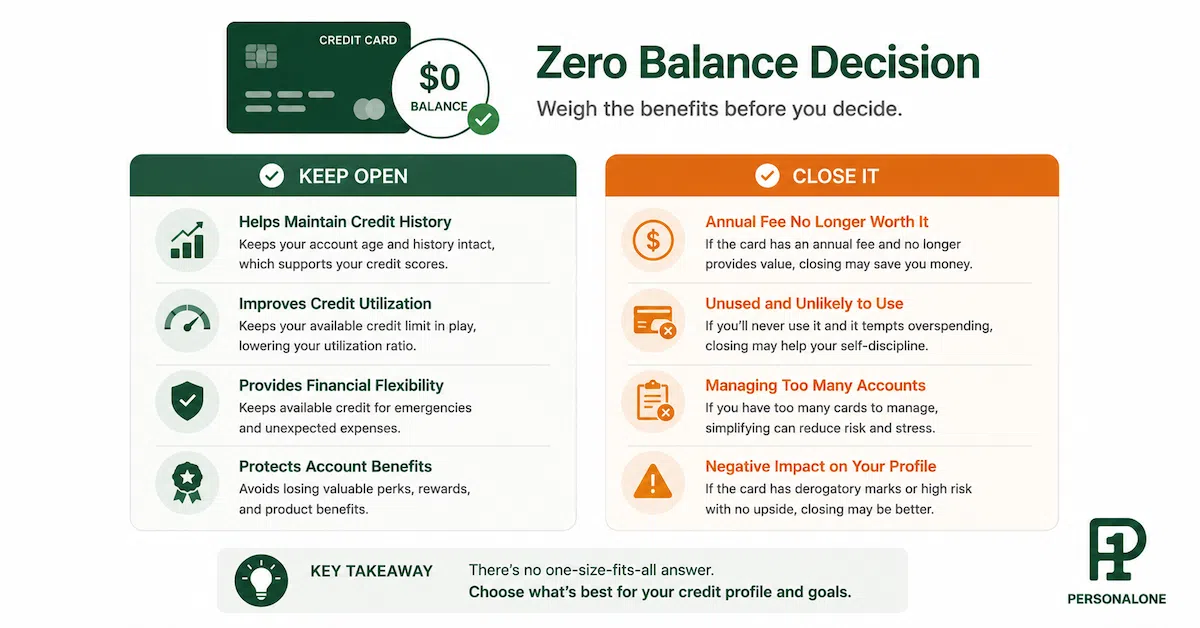
— There are four specific situations where closing the card is the right call despite the scoring impact: high annual fee with no justifying benefits, a joint account ending, active spending control issue, or issuer-required closure to access a better product.
— If you close, timing matters. Close after a major loan application closes, not before. And close higher-limit, newer cards before older ones if you must close multiple accounts.
Paying off a credit card is a genuine financial achievement. After months of focused payments, watching the balance reach zero is the kind of moment that deserves recognition — and it naturally raises the question of whether closing the card is the logical completion of that effort. You paid it off. You don't want to use it again. Why keep a card you're done with?
The honest answer is that closing a paid-off card is almost never the right move from a pure credit score perspective — but that doesn't mean it's always the wrong move for your financial life. The close credit card zero balance decision sits at the intersection of three distinct credit factors — utilization, account age, and credit mix — and it also intersects with practical financial considerations like annual fees, behavioral spending patterns, and joint account situations. This article gives you a specific decision framework rather than a generic "it depends": four conditions where keeping the card open is clearly the right call, four conditions where closing it makes sense despite the scoring impact, and the math that makes each case clear for your specific situation.
What Closing a Card Actually Does to Your Credit Score
Before the decision framework, the mechanics need to be precise. Closing a credit card affects your score through three distinct pathways — and understanding each one is what makes the decision calculation meaningful rather than approximate.
Utilization impact — immediate and direct. The moment a credit card account is closed, its credit limit is removed from your total available credit calculation. If you have other cards with balances, those balances now represent a higher percentage of your reduced available credit. A $3,000 balance across two cards with $15,000 combined limits is 20% utilization. Close the card with a $5,000 limit and zero balance, and the same $3,000 balance now sits against $10,000 in available credit — 30% utilization. The balance didn't change. The limit removal changed the ratio. For a thorough understanding of why specific utilization thresholds produce the scoring responses they do — and what threshold you'd be crossing when the card closes — the article on the best credit utilization ratio for your score maps each band and its score consequences precisely.
Account age impact — delayed and gradual. This is where most guides get the mechanics wrong. A closed account with positive history does not disappear from your credit report immediately. It continues to appear for up to ten years from the date it was closed. During those ten years, the account's age continues to factor into your average account age calculation — at a gradually decreasing weight as the account ages further into the past. The full impact on account age is not immediate. The more immediate concern is that closing a card prevents that account from aging further — a card you close today at three years old stops accumulating age. A card you keep open grows from three years old to ten years old, contributing increasingly to your average account age over time.
Credit mix impact — minor and often overstated. Credit mix — the variety of credit types in your profile — accounts for 10% of your FICO score. Closing a credit card reduces the diversity of your revolving credit portfolio slightly. If you have multiple other revolving accounts open, this impact is minimal. If the card you're closing is your only credit card, the credit mix impact becomes more meaningful. For most consumers with more than one credit card, credit mix is not a decisive factor in the close-or-keep decision.
What I've Seen
The most common version of this mistake I see is someone who paid off their highest-limit card — often a card they'd had for eight or ten years — and immediately closed it as part of the "clean break" feeling that comes with paying off debt. Their score dropped 40 to 60 points within one billing cycle because the limit removal raised their utilization on remaining cards and the account age loss removed their longest-standing positive account. The frustrating part is that the drop was entirely avoidable. The card with a zero balance and ten years of positive history was their single most valuable credit asset. Keeping it open with one small recurring charge costs nothing and preserves both the available credit and the account age. Closing it costs them months of score recovery — exactly when they're trying to use their improved financial position to qualify for something.
Four Conditions Where Keeping the Card Open Is Clearly Right
In each of these four situations, the case for keeping the card open is clear-cut. The scoring benefit of the available credit and account age outweighs any practical inconvenience of maintaining an open account you don't actively use.
Condition 1 — The card has no annual fee. A zero-annual-fee card sitting at zero balance costs you nothing to maintain. It contributes its full credit limit to your available credit calculation every month, lowering your overall utilization ratio at no cost. It ages in your credit history, adding to your average account age every year it stays open. There is no financial argument for closing a no-annual-fee card from a credit perspective. The only reason to close it is behavioral — and behavioral solutions are available that don't require closing the account.
Condition 2 — The card has significant available credit. The higher the credit limit on the paid-off card, the more closing it damages your utilization ratio. A paid-off card with a $10,000 limit that you close removes $10,000 of available credit from your calculation instantly. If you carry $3,000 in balances on other cards and have $20,000 in total available credit before closing, your utilization is 15%. After closing, it's $3,000 against $10,000 — 30%. That single closure moved you from Band 3 to the top of Band 2 in the utilization band framework. The available credit on the card is the single most important variable in the close-or-keep calculation. The larger the limit, the stronger the case for keeping it open.
Condition 3 — The card is among your older accounts. A card you've had for five or more years is contributing meaningfully to your average account age. Closing it removes its age accumulation from your profile permanently — the account's age stops growing at the moment of closure. If the card you paid off is your oldest or second-oldest account, closing it has the most severe account age impact. If it's a newer card in a portfolio with several older accounts, the account age impact is more limited. Check when you opened the card before deciding — the opening date is visible on your credit report and in your account portal. Keeping an older paid-off card open and active is one of the most practical expressions of building good credit wisely — preserving what you've already earned rather than starting the age accumulation over from zero.
Condition 4 — A major credit application is within 12 months. If you're planning to apply for a mortgage, auto loan, or any significant credit product within the next year, this is not the time to close a card. Lenders evaluate your available credit, utilization ratio, and credit history depth as part of the application assessment. A score drop from closing a card in the months before application can move you out of a favorable rate tier — turning a modest financial decision into a significantly expensive one. Keep the card open until after the application closes. The article on how long it takes to build a 700 credit score maps the full timeline of credit building — including why preserving existing account age and available credit in the months before a major application is one of the highest-leverage actions available for score optimization.
Four Conditions Where Closing Makes Sense Despite the Scoring Impact
The standard advice to always keep paid-off cards open is right in most situations — but not all of them. There are four specific conditions where the financial or personal case for closing the card outweighs the scoring cost.
Condition 1 — The card carries a high annual fee with no justifying benefits. An annual fee card that you've paid off but no longer use creates a recurring cost with no corresponding benefit. If the card's rewards rate, travel benefits, or perks don't justify the annual fee given your current spending patterns, the financial case for closing is valid regardless of the scoring impact. Calculate the annual fee as a cost of maintaining the utilization benefit. A $150 annual fee on a card with a $5,000 limit is paying $150 per year to hold $5,000 of available credit. Whether that trade is worth it depends on your current utilization situation — if your other cards keep you comfortably below 10% utilization without the closed card's limit, the annual fee is a real cost with no real benefit.
Condition 2 — The account is joint and the relationship has ended. Joint credit card accounts create shared liability — both account holders are responsible for any balance on the account, and any activity on the account affects both credit files. If a joint account with a former partner, spouse, or co-applicant has been paid to zero, closing the account eliminates the ongoing liability risk that comes from shared account access. The scoring impact is real but secondary to the financial protection concern. Take the scoring hit and close the joint account cleanly.
Condition 3 — The card creates a documented behavioral spending problem. If access to the card consistently leads to spending that undermines financial goals — if having the available credit makes using it feel inevitable — the behavioral case for closing may outweigh the scoring case for keeping. Before closing, exhaust the alternatives: cut up the physical card but keep the account open, remove it from digital wallets, store it somewhere inaccessible. A card you can't use still contributes its credit limit to your utilization calculation. If behavioral controls short of closing don't work, closing may be the right decision for financial system integrity even at a scoring cost.
Condition 4 — The issuer requires it to access a better product. Some card issuers offer product changes — upgrading from a basic card to a premium version — that require closing the existing account and opening a new one rather than converting the existing account. In this specific case, the value of the new product (better rewards rate, higher limit, valuable benefits) may justify the scoring impact of closing and reopening. Evaluate the specific trade carefully: the new account will start with zero age, which replaces the age of the closed account in your profile. If the existing card is your oldest account, this trade has significant account age implications.
The Math: Calculating the Utilization Impact Before You Decide
Before closing any card, run the utilization calculation with and without the card's limit. This takes two minutes and tells you exactly how much your utilization ratio will change — which tells you whether closing creates a scoring problem or a minor inconvenience.
Step 1 — Calculate your current utilization. Add up all your current reported balances across every open card. Add up all your current credit limits across every open card. Divide total balances by total limits. This is your current utilization percentage. Example: $2,400 in total balances, $24,000 in total limits — current utilization 10%.
Step 2 — Calculate utilization after closing. Subtract the paid-off card's credit limit from your total available credit. Keep the balance figure the same. Divide. Example: close a card with a $6,000 limit — total available credit drops to $18,000, same $2,400 in balances — new utilization 13.3%. In this case, utilization moves from 10% to 13.3% — both in Band 3, no threshold crossing, modest impact. Now run the same math on a card with a $15,000 limit — total available credit drops to $9,000, same $2,400 balances — new utilization 26.7%. Still in Band 3, but significantly closer to the 30% threshold where scoring penalties begin to accelerate.
Step 3 — Assess the threshold consequence. If closing the card keeps your utilization in the same band, the scoring impact is modest. If closing the card moves you across a band threshold — from below 10% to above 10%, from below 30% to above 30%, from below 50% to above 50% — the scoring impact is meaningful. The specific band thresholds and their score consequences are covered in the article on what credit utilization is and why the 30% rule is a myth — the foundational piece that maps why these specific thresholds matter and what the scoring model actually responds to.
If You Keep It Open: The Low-Maintenance Strategy
Keeping a paid-off card open doesn't mean using it heavily or thinking about it much. The low-maintenance approach turns a dormant card into a passive credit asset that contributes to your score month after month with minimal effort.
Add one small recurring charge. A subscription service, a streaming platform, a recurring utility — any small predictable monthly charge keeps the account active and prevents issuer-initiated closure for inactivity. Most issuers will close accounts that show no activity for 12 to 24 months. A $10 to $15 monthly charge prevents that outcome. Set the charge on autopay for the full statement balance so it pays itself each month. The card reports a small non-zero balance — which is marginally better than 0% utilization — and then clears to zero before the next statement close. Available credit preserved. Account aging continues. Payment history building. All automatic, all free.
Keep the login credentials somewhere accessible. You'll need them if the issuer changes terms, if a fraud alert triggers, or if you eventually want to request a limit increase that further lowers your overall utilization. A card you've actively managed and maintained in good standing for years is a strong candidate for a limit increase — which adds even more available credit to your utilization calculation. The strategy for requesting a limit increase at the right time and on the right card is covered in the article on how to request a credit limit increase to lower your utilization.
Check it quarterly. Set a calendar reminder to check the account every three months — verify the small charge is posting, confirm autopay is clearing it, check for any account changes or issuer communications. Five minutes every 90 days is the maintenance cost of a credit asset that contributes thousands of dollars of available credit to your utilization calculation every single month at no cost.
If You Close It: How to Minimize the Scoring Impact
If the case for closing outweighs the case for keeping — high annual fee, joint account, documented behavioral issue — the timing and sequence of closure matters. Done correctly, the scoring impact is manageable. Done at the wrong moment, it compounds with other credit events to produce a larger and longer-lasting score drop.
Wait until after any major credit application closes. If a mortgage, auto loan, or significant credit application is in process or planned within 90 days, do not close the card until after the application is complete and funding has occurred. The lender's final credit check happens at or near closing — any score drop from the card closure that occurs before that check affects the application outcome. After the loan closes, the card closure's scoring impact is irrelevant to that transaction.
If closing multiple cards, close newer ones first. Account age impact is smallest on newer cards. If you need to close more than one card simultaneously, prioritize closing the cards with the lowest credit limits and the shortest account history — preserving your oldest, highest-limit accounts protects both account age and available credit most effectively.
Pay down other card balances before closing. If you carry balances on other cards, reducing those balances before closing the paid-off card offsets the utilization impact of the limit removal. Getting your other cards to below 10% utilization before closing the zero-balance card means the limit removal affects a lower numerator — the utilization increase from the closure is smaller in absolute terms. The full strategy for managing utilization across multiple cards simultaneously — including triage sequence and threshold targeting — is covered in the article on how to manage credit utilization across multiple cards.
Build the Complete Utilization System
The close-or-keep decision is one piece. The Credit Utilization & Payment Strategy cluster covers every utilization lever — payment timing, limit increases, multi-card management, and the reporting mechanics that determine what your score sees each month.
Explore the Full StrategyGovernment Resources
CFPB — What Is a Credit Utilization Rate? — Official guidance on how utilization is calculated and how account closures affect the calculation.
CFPB — Credit Reports and Scores — How credit history length, account status, and account closures appear on your credit report.
FTC — Understanding Your Credit — Federal overview of how credit scores are calculated including the role of account age and available credit.
Return to the full credit building and protection guide for a complete overview of every credit strategy covered on PersonalOne.
Frequently Asked Questions
Should I close a credit card with zero balance?
In most situations, no. A paid-off card with no annual fee contributes free available credit to your utilization calculation and continues aging in your credit history — both positive scoring factors that cost nothing to maintain. The case for closing is strongest when the card charges a high annual fee with no justifying benefits, when it's a joint account ending, or when having the card available creates documented spending behavior problems. In all other situations, keeping it open with a small recurring charge and autopay is the higher-scoring choice with no financial downside.
How much will my credit score drop if I close a credit card?
It depends on two variables: how much available credit the card contributes to your utilization calculation, and whether closing it moves your utilization across a scoring threshold. If the card's limit is small relative to your total available credit and your utilization stays in the same scoring band, the impact may be 5 to 15 points. If the card has a large limit and closing it pushes your utilization from below 10% to above 10%, or from below 30% to above 30%, the impact can be 20 to 50 points depending on your overall credit profile. Run the utilization math before closing — calculate your utilization percentage with and without the card's limit to know which scenario applies to your situation.
Does a closed credit card stay on your credit report?
Yes — a closed credit card with positive history remains on your credit report for up to ten years from the date of closure. During that period, the account's positive payment history and its age continue to factor into your credit score at a gradually decreasing weight. A closed account does not disappear from your score immediately. What stops immediately is the account's ability to accumulate more age — a card closed at five years old stays recorded at five years old and does not grow to six, seven, or eight years old as it would if kept open. The ten-year presence on your report is why account age impact from closing is gradual rather than immediate.
Is it better to cut up a credit card or close the account?
Cut it up — or remove it from your digital wallet — and keep the account open. Physically destroying the card makes it impossible to use accidentally or impulsively while the account remains open and continues contributing its available credit and account age to your credit profile. This is the standard recommendation for anyone who wants to stop using a card for behavioral reasons without taking the scoring hit of closure. The card issuer doesn't know or care whether you have a physical card — the account exists at the bureau level regardless of whether a physical card is active. Keep the account open, eliminate the card's accessibility, and set a small recurring autopay charge to keep the account active.
What happens to my credit score immediately after closing a credit card?
The scoring impact appears within one billing cycle after closure — when the account no longer appears as an open account in the next month's credit report update. The utilization impact is immediate: your total available credit drops by the card's limit on the day of closure, and your utilization ratio rises accordingly. The account age impact is gradual: your average account age adjusts based on the ages of your remaining open accounts, and the closed account continues to factor at declining weight for up to ten years. Most consumers see the full scoring impact within 30 to 60 days of closing — after the next credit report update reflects the closure across all three bureaus.
Can I reopen a credit card account after closing it?
Sometimes — but not reliably, and not with the same account history. Some issuers allow account reinstatement within a specific window after closure — typically 30 to 90 days — if you contact them and request it. If reinstated within that window, the account history may be restored. After the window closes, reopening typically means applying for a new account as a new applicant — a new account with a new opening date, no existing history, and a hard inquiry. The original account's history remains on your credit report as a closed account but the new account starts from zero. If you're considering reopening, act quickly and call the issuer within the first month of closure to ask whether reinstatement is possible.
This article is for educational purposes only and does not constitute financial or credit advice. Credit score outcomes from account closures vary significantly based on individual credit profiles, scoring models, and overall account structure. Consult your specific account terms and verify issuer policies before making any account closure decisions. PersonalOne is a free financial education platform.