February 20, 2026
Home > Banking Systems > The 3-Account System > Free Checking Accounts: What to Look For and What to Avoid
TL;DR — Quick Summary
- Your checking account is the operational hub of your entire financial system — income lands here, bills and savings flow out automatically
- Free means zero monthly maintenance fees — not free of all fees. Overdraft and out-of-network ATM fees still apply at most banks
- Five features separate good checking accounts from bad ones — no monthly fee, large ATM network, overdraft protection options, mobile deposit, and direct deposit support
- Online banks and credit unions dominate the free checking landscape — traditional big banks often charge $10–15/month unless you meet minimum balance or direct deposit requirements
- The checking account is one part of a three-account structure — it works best when paired with a dedicated bills account and a high-yield savings account
Most people treat their checking account as a financial catch-all — income goes in, spending comes out, and whatever's left at the end of the month is either saved or spent. That approach works until it doesn't, which is usually right around the time an unexpected bill hits and you realize your "savings" is just whatever happened to survive the month.
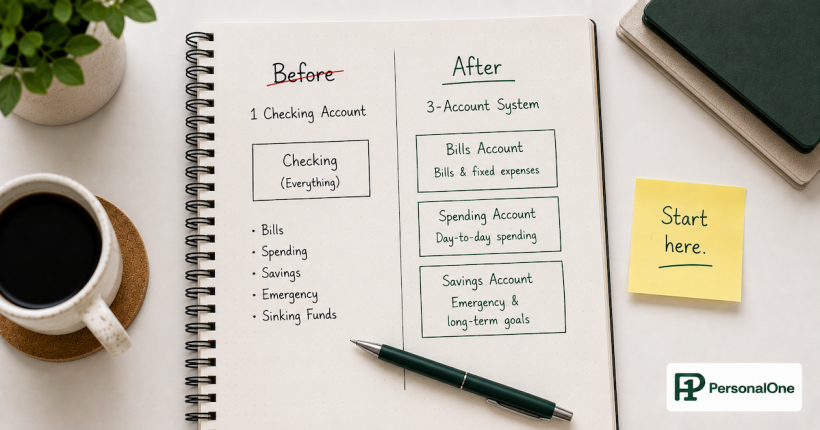
The checking account isn't the problem. The problem is what most people ask it to do: serve as the single account for income, spending, bills, and savings all at once. When everything lives in one place, there's no structure preventing any one category from eating the others.
This guide covers how to choose a free checking account that actually serves its intended role — and what that role should be in the first place. If you're approaching this from a systems perspective, the right checking account is the one that pairs cleanly with a 3-Account System — not the one with the most features or the flashiest app.
But first, let's get clear on what "free" actually means, what fees still apply, and what to look for when choosing.
What "Free Checking" Actually Means
Free checking means no monthly maintenance fee — the flat charge banks used to collect just for the privilege of holding your money. At traditional big banks, that fee runs $10–15/month ($120–180/year) and is typically waived only if you meet minimum daily balance requirements or set up direct deposit. Fail the requirement for even one month, and the fee hits automatically.
Online banks and credit unions mostly dropped the maintenance fee model years ago. Their lower overhead costs — no branch network, fewer employees, less real estate — allow them to offer genuinely fee-free checking to anyone, regardless of balance or direct deposit status.
What "free" doesn't mean: completely free of all fees. Even the best no-fee checking accounts can charge for overdrafts, out-of-network ATM withdrawals, wire transfers, expedited debit card replacement, and paper statements. Knowing which fees you're likely to encounter prevents surprises.
Common Fees Even "Free" Accounts Charge
| Fee Type | Typical Cost | How to Avoid It |
|---|---|---|
| Overdraft fee | $25–35 per incident | Opt out of overdraft coverage, maintain buffer, or choose a bank with no overdraft fees |
| Out-of-network ATM fee | $2–5 per transaction (plus ATM operator fee) | Use in-network ATMs or choose a bank that reimburses ATM fees |
| Wire transfer fee | $15–30 outgoing | Use ACH transfers instead — free and available at all banks |
| Paper statement fee | $1–5/month | Opt into e-statements |
| Expedited debit card replacement | $5–30 | Request standard replacement (usually free, arrives in 7–10 days) |
The Checking Account's Job in a Structured Banking System
Before choosing a specific account, it helps to understand what you're actually choosing it for. In an unstructured banking setup, the checking account does everything: income arrives, spending happens, bills get paid, and savings are whatever's left. That model gives money no clear direction — and money without direction tends to disappear.
In a structured system, the checking account has one defined role: receive income and route it to its destinations. Direct deposit hits. A fixed transfer goes to the bills account. Another fixed transfer funds savings. What remains in checking is your weekly spending money — the only money you're allowed to spend freely, because everything else has already been claimed by its purpose.
What the Checking Account Does in the 3-Account System
Receives income. All direct deposits — payroll, freelance payments, side income — land here first. This account is the single entry point for all incoming money.
Routes automatically. On payday, preset transfers move a fixed amount to the bills account (to cover fixed monthly expenses) and a fixed amount to savings (to build the emergency fund and other goals). These happen before any spending decisions are made.
Funds daily spending. After routing, what remains in checking is your spending money for the period. Groceries, gas, dining, discretionary purchases — all come from this balance. When it's gone, it's gone until next payday.
Does not hold savings. Savings doesn't live in checking. Savings lives in a separate high-yield savings account at a different institution — physically separated so it can't be quietly spent. The checking account holds spending money only.
With that role defined, the criteria for choosing a checking account become much clearer. You don't need the highest interest rate (checking accounts rarely pay meaningful interest anyway). You need operational reliability: no monthly fees, solid direct deposit support, a large ATM network, and a clean mobile experience for day-to-day management.
Five Features That Actually Matter in a Checking Account
Banks market checking accounts on dozens of features — cashback rewards, savings rate bonuses, budgeting tools, early paycheck access. Most of these are noise. Here are the five features that determine whether a checking account actually works for its intended role:
1. Zero Monthly Maintenance Fee
The baseline requirement. Any account charging a monthly fee without clear, easily maintained waiver conditions is disqualified. You're using this account to route money efficiently — paying $10–15/month for that privilege eliminates $120–180 annually from your financial system for no benefit.
What to look for: $0 monthly fee with no minimum balance requirement and no direct deposit condition. Fee should be truly zero, not "waivable if you do X."
2. Large ATM Network or Fee Reimbursement
ATM fees compound quickly. If you withdraw cash twice a week at out-of-network ATMs, you're spending $20–50/month on access fees — more than many monthly maintenance fees. Online banks often solve this by reimbursing ATM fees nationwide, effectively giving you access to any ATM for free.
What to look for: 55,000+ in-network ATMs (Allpoint or MoneyPass network), or unlimited out-of-network ATM fee reimbursement. Confirm the reimbursement policy covers both your bank's fee and the ATM operator's fee.
3. Overdraft Protection Options You Control
Overdraft fees are one of the most predatory fee structures in banking. Traditional banks charge $25–35 per overdraft incident — sometimes multiple times per day — on transactions as small as a $4 coffee. The solution isn't to avoid overdrafting (you should), but to choose a bank whose overdraft policy doesn't punish small mistakes catastrophically.
What to look for: Banks that let you opt out of overdraft coverage entirely (declined transaction, no fee), or that offer small no-fee overdraft buffers ($20–50). Avoid banks that automatically enroll you in paid overdraft protection.
4. Mobile Deposit and Instant Transfers
Your checking account needs to handle income routing quickly and without friction. That means mobile check deposit (for freelance payments, reimbursements, or occasional paper checks), instant transfers to linked accounts for the automatic routing system, and a mobile app that doesn't crash or require a phone call to complete basic transactions.
What to look for: Mobile check deposit with reasonable hold periods (1–2 days for established accounts), same-day or next-day ACH transfers to linked savings, and a mobile app rated 4.5+ stars with recent positive reviews.
5. Direct Deposit Support with Reliable Timing
Direct deposit is how your income enters the system. The checking account needs to accept it reliably and, ideally, make funds available quickly. Many online banks now offer early direct deposit — making funds available 1–2 days before the official paydate — which can significantly improve cash flow timing.
What to look for: Standard ACH direct deposit acceptance, funds availability within 24 hours of deposit, and early deposit option if available. Confirm the account provides a routing and account number for payroll setup.
Where to Find Genuinely Free Checking in 2026
The free checking landscape has two reliable categories: online banks and credit unions. Traditional big banks have largely moved away from truly free checking — most now require minimum balances or direct deposit to waive monthly fees, which means one off month costs you.
Online Banks
Online-first banks are the strongest source of genuinely free checking. With no branches to maintain, their cost structure allows zero-fee accounts that don't require minimum balances or direct deposit conditions. Most partner with major ATM networks (Allpoint, MoneyPass) giving access to 55,000+ fee-free ATMs nationwide.
Representative options:
- Ally Bank: No monthly fee, no minimum balance, Allpoint network, strong mobile app, early direct deposit
- Chime: No monthly fee, SpotMe overdraft protection up to $200, early direct deposit up to 2 days early
- SoFi: No monthly fee, up to $50 overdraft protection with direct deposit, early direct deposit, integrated savings
- Discover Cashback Debit: No monthly fee, 1% cashback on debit purchases, 60,000+ fee-free ATMs
- Axos Bank: No monthly fee, unlimited domestic ATM fee reimbursement, early direct deposit
Credit Unions
Member-owned credit unions frequently offer free checking with no minimum balance requirements, as their nonprofit structure removes the pressure to generate fee revenue. Many participate in shared branching networks and the CO-OP ATM network, giving members access to tens of thousands of fee-free ATMs and some in-person service at locations nationwide.
The main limitation is eligibility — most credit unions require membership based on employer, geography, military affiliation, or other criteria. Some, however, have opened membership through nominal donations to affiliated organizations. If you qualify for a strong credit union, their checking accounts are often among the best available.
Traditional Banks — Use Carefully
Major traditional banks (Chase, Bank of America, Wells Fargo) offer checking accounts that can be fee-free — but usually only with conditions attached. Chase Total Checking, for example, waives its $12 monthly fee with direct deposit or a $500 minimum daily balance. Miss either condition once, and the fee hits automatically.
Traditional banks are worth considering if you have specific needs they uniquely fulfill — extensive branch access for cash deposits, in-person notarization, or relationship-based lending. For pure operational checking in a banking system, online banks or credit unions are more reliable for zero-fee access.
Red Flags When Evaluating Checking Accounts
Beyond what to look for, here's what to watch out for during your evaluation:
- Monthly fees with complicated waiver conditions. If you have to maintain a minimum balance AND set up direct deposit AND make a minimum number of debit transactions to avoid a fee, the account isn't truly free — it's conditionally free and a trap for forgetful months.
- Automatic overdraft enrollment. Banks that automatically enroll you in paid overdraft protection (typically $30+ per incident) without clear opt-out are taking advantage of the default. Look for banks that let you choose overdraft protection terms before you need them.
- Poor app reviews mentioning transaction errors or frozen accounts. Your checking account handles income routing and daily spending. An unreliable app creates operational chaos. Check recent app store reviews — not just the overall rating.
- Limited transfer capabilities. If ACH transfers to external accounts take 3–5 business days or require a phone call to set up, the account will create friction in your automated routing system. Test this before fully committing.
- No FDIC insurance. Some fintech apps that look like banks are not banks — they're payment apps that partner with banks for FDIC coverage. Confirm where FDIC insurance actually applies before depositing income. Check directly at FDIC.gov.
How to Open a Free Checking Account
Once you've chosen an account, the opening process takes 10–15 minutes online for most institutions. Here's what to expect:
- Gather required documents. You'll need a government-issued photo ID (driver's license or passport), your Social Security number, and current address. Some institutions also ask for a second form of ID or proof of address.
- Complete the online application. Most applications take 10–15 minutes. You'll enter your personal information, answer identity verification questions, and agree to account terms. Read the fee schedule before agreeing — this is where overdraft policies and ATM terms are disclosed.
- Fund the account with an initial deposit. Most free checking accounts have no minimum opening deposit, but you'll need to transfer at least a small amount to activate the account and receive your routing and account numbers. A $25–50 initial transfer is typical.
- Set up direct deposit. Log into your employer's payroll portal and update your direct deposit information with your new routing and account numbers. Allow one to two pay cycles for the change to take effect. Keep your old account open during the transition.
- Link your savings and bills accounts. Once direct deposit is confirmed, link your high-yield savings account and your bills account for automatic transfers. Set up the routing transfers that move money to each on payday — this is the automation that makes the system run.
- Close or maintain your old account. Keep your previous checking account open for 60 days after switching to catch any payments or deposits that didn't update. Once confident everything has transitioned, close the old account formally to avoid any fees on a dormant balance.
Your Checking Account Is One Part of a Three-Part System
Picking the right free checking account matters — but a checking account alone doesn't solve the problem of money disappearing before it can be saved or invested. The 3-Account System shows you how to connect your checking account with a dedicated bills account and a high-yield savings account so that income is automatically routed to the right place before spending decisions happen.
See the 3-Account System →Frequently Asked Questions
Is a free checking account really free — or are there hidden fees?
Free checking means no monthly maintenance fee. Other fees — overdraft, out-of-network ATM, wire transfers, paper statements — can still apply. The best free checking accounts are transparent about these fees in their disclosures and make them avoidable through standard behaviors like using in-network ATMs and opting into e-statements. Always read the full fee schedule before opening, not just the headline "no monthly fee" claim.
Are online bank checking accounts as safe as traditional bank accounts?
Yes, provided the bank is FDIC-insured. FDIC insurance protects deposits up to $250,000 per depositor per institution regardless of whether the bank has physical branches. The deposit protection is identical. The difference is that online banks lack branch locations for in-person service, which matters for cash deposits but not for day-to-day digital banking. Verify any institution at FDIC.gov before opening.
What if I need to deposit cash with an online bank?
Online banks handle cash deposits differently depending on the institution. Some partner with retail networks (Green Dot at Walgreens, CVS, etc.) where you can deposit cash directly to your account for a small fee. Others recommend depositing cash at a local ATM or traditional bank, then transferring electronically. If you deposit cash frequently, this is worth evaluating before choosing an online-only bank — it may be more convenient to maintain a local credit union or traditional bank account specifically for cash deposits while keeping your primary checking at an online bank.
Should I use the same bank for checking and savings?
Not necessarily, and often no. Traditional banks offer checking accounts with decent features but poor savings rates. Online banks often offer excellent savings rates. A common setup is keeping a checking account at a bank with a large ATM network and strong mobile experience, while holding savings at a separate online bank offering 4.5%+ APY. Modern instant transfers make cross-institution transfers fast enough that this split rarely causes operational friction — and the rate difference on savings is significant.
Can I have more than one checking account?
Yes, and in a structured banking system it often makes sense. The 3-Account System uses two accounts that function similarly to checking: one primary checking account for income receipt and spending, and a separate bills account (also typically a checking or basic account) that holds only the money earmarked for fixed monthly expenses. Keeping these physically separate prevents the bills budget from being spent and the spending budget from being used for bills — two common patterns that lead to overdrafts and missed payments.
How do I know if my bank's overdraft policy is fair?
Look for three things: the per-incident fee amount, whether you're automatically enrolled or can opt in voluntarily, and whether there's a de minimis threshold below which overdrafts aren't charged. A fair policy charges $0–12 per incident (not $35), requires affirmative opt-in, and doesn't charge if you're only a few dollars over your balance. Banks like Chime, Ally, and SoFi have moved toward no-fee overdraft models. Traditional big banks still typically charge $25–35 per incident and make it harder to opt out.
Resources
- FDIC — Verify Bank Insurance and Find Consumer Resources
- CFPB — Checking Account Tools and Your Rights
- Federal Reserve — Understanding Checking Account Overdraft Programs
Disclaimer: This article provides educational information about checking account options and does not constitute financial advice. Account features, fees, and terms change frequently. Always verify current offerings directly with financial institutions before opening an account. FDIC insurance protects eligible deposits up to $250,000 per depositor, per insured institution, per ownership category.