Updated: February 2026
Home › Investing & Wealth Growth › Crypto & Blockchain: A Systems Approach to Digital Assets › Crypto for Beginners: How to Make Your First Investment
About the Author
Don Briscoe is a financial systems coach with 12+ years helping Millennials and Gen Z escape paycheck-to-paycheck cycles. He founded PersonalOne to provide the financial education he wished existed—structured, honest, and free.
- ✓$100 is enough to start — most exchanges support fractional investing, meaning you can buy a slice of Bitcoin or Ethereum without needing thousands of dollars.
- ✓Foundation first, always — crypto belongs at the end of your financial priority stack, not the beginning. Emergency fund and no high-interest debt come first.
- ✓Start with Bitcoin and Ethereum — the two largest, most established cryptocurrencies. Skip meme coins and anything being promoted in DMs or Telegram groups.
- ✓Security is non-negotiable from day one — two-factor authentication on your exchange, never share your seed phrase, and move significant holdings to a hardware wallet for long-term storage.
- ✓Every trade is a taxable event in the US — keep records from your first transaction. The IRS asks about crypto directly on Form 1040.
I thought crypto was either a scam or something only people with computer science degrees understood. Then I put $100 into it anyway — split between Bitcoin and Ethereum on a regulated exchange — and spent the next week actually learning how it worked.
Seven days later, that $100 was worth $112. A 12% return in a week sounds impressive. It also could have gone the other direction just as easily — that’s the nature of the asset class. What the experience actually taught me wasn’t how to get rich. It was how to participate in something new without losing my footing.
This guide is the practical walkthrough I wish I’d had. Not hype, not promises of 100x returns — just the actual steps to get started safely, understand what you’re buying, and build a framework that holds up when markets get volatile.
This article is part of the Crypto & Blockchain: A Systems Approach to Digital Assets cluster. For the broader investing framework — where crypto fits relative to index funds, retirement accounts, and other asset classes — see the Investing & Wealth Growth hub.
Before You Buy Anything: The Foundation Check
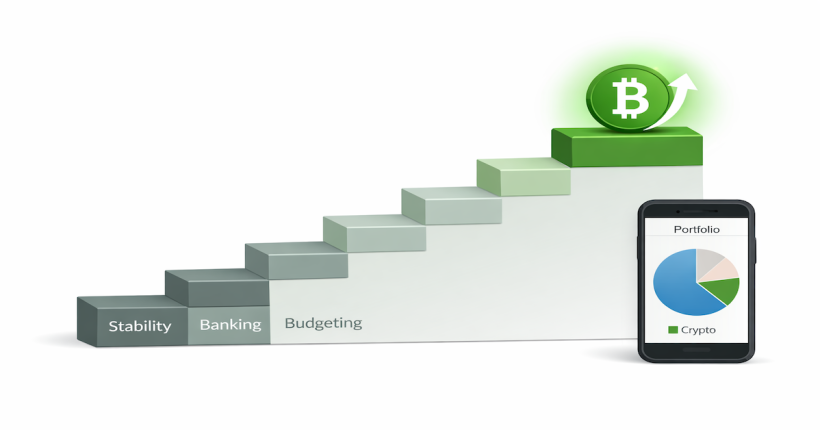
The PersonalOne framework applies to crypto the same way it applies to every financial decision. Infrastructure first. Crypto is a high-risk, speculative asset — it belongs at the end of your priority stack, not the beginning.
Run this checklist before allocating a single dollar to crypto:
- Emergency fund covering 3–6 months of expenses — fully funded
- No high-interest debt (credit cards, payday loans)
- Consistent contribution to retirement accounts (401k, IRA)
- Automated savings system running reliably
If any of these aren’t in place, build them first. Crypto invested on top of an unstable financial foundation doesn’t fix the foundation — it adds volatility to instability.
If your foundation is solid, the general framework is to limit crypto to 1–5% of your total investment portfolio. At that allocation, even a total loss is painful but not devastating. It’s a position size that lets you participate and learn without betting your financial stability on an inherently volatile asset.
What You’re Actually Buying
Cryptocurrency is digital money secured by cryptography and operating on decentralized networks — no bank, no government, no central authority controlling it. Every transaction is recorded on a blockchain: a public, tamper-resistant distributed ledger maintained by thousands of computers simultaneously.
The four categories you need to know as a beginner:
- Bitcoin (BTC): The original cryptocurrency, launched in 2009. Fixed supply of 21 million coins. Primarily functions as a store of value — the closest thing crypto has to digital gold. Longest track record and largest market capitalization of any cryptocurrency.
- Ethereum (ETH): A programmable blockchain platform that enables smart contracts and decentralized applications. More versatile than Bitcoin — it’s the infrastructure layer much of the broader crypto ecosystem is built on. Second-largest by market cap.
- Stablecoins (USDC, USDT): Cryptocurrencies pegged to real-world assets like the US dollar. Designed to eliminate price volatility while retaining crypto’s speed and accessibility. Useful for moving value within crypto ecosystems without exposure to price swings.
- Altcoins: Everything else — Solana, Cardano, Dogecoin, and thousands more. Range from legitimate infrastructure projects to outright scams. Risk profile varies enormously. Not recommended as a starting point for beginners.
For a deeper understanding of how the technology works — blockchain, mining, proof of stake, wallets — the Cryptocurrency 101 guide covers all of it.
How to Make Your First Investment: Step by Step
Step 1: Choose a Regulated Exchange
A cryptocurrency exchange is where you buy, sell, and hold crypto using traditional currency. For beginners, prioritize exchanges that are regulated in the US, have strong security track records, and offer straightforward interfaces. Coinbase, Kraken, and Gemini are the most commonly recommended starting points. Each requires identity verification (government ID) as part of their legal compliance requirements.
Pro tip: Coinbase offers a Learn and Earn feature that pays small amounts of crypto for completing short educational modules. It’s a low-stakes way to get familiar with the interface before committing real capital.
Step 2: Start Simple — Bitcoin and Ethereum Only
When I made my first investment, I split $100 between Bitcoin ($60) and Ethereum ($40). The reasoning was straightforward: both have the longest track records, the deepest liquidity, the clearest use cases, and the most regulatory clarity of any cryptocurrencies. They’re not safe — nothing in crypto is — but they carry substantially lower risk of going to zero than smaller altcoins or anything being promoted on social media.
Fractional investing means you don’t need thousands of dollars to own Bitcoin. $50 buys you a fraction of a coin. Most exchanges support purchases as small as $1–$10.
Step 3: Watch Before You Trade
The instinct when prices move is to react. Resist it. For the first weeks of owning crypto, your job is observation, not action. Track prices on CoinMarketCap. Follow crypto news through CryptoPanic or a mainstream financial outlet. Pay attention to what moves markets — regulatory announcements, major exchange news, macroeconomic data — without making trades based on short-term noise.
Most beginner losses in crypto come not from choosing the wrong asset but from panic selling during dips that subsequently recovered, or chasing gains into assets already at their peak. Building the discipline to observe without reacting is the actual skill that matters.
Security: This Cannot Be an Afterthought
Exchange hacks, phishing attacks, and scams are recurring events in crypto — not edge cases. The decentralized nature of blockchain means there is no fraud department to call, no chargeback to initiate, no FDIC insurance to recover losses. Security infrastructure must be in place before you hold any meaningful amount.
- Enable two-factor authentication (2FA) on your exchange account immediately. Use an authenticator app (Google Authenticator, Authy) rather than SMS-based 2FA, which is vulnerable to SIM-swap attacks.
- Never share your seed phrase with anyone, under any circumstances. Not customer support, not a "crypto advisor," not a friend. Anyone asking for your seed phrase is attempting to steal your funds. This is absolute.
- For significant holdings, use a hardware wallet — an offline device (Ledger, Trezor) that stores your private keys off the internet. Exchange-held assets are exposed to the exchange’s solvency and security. Self-custody removes that counterparty risk.
- Write down your seed phrase on paper and store it somewhere physically secure and offline. Losing your seed phrase means losing access to your holdings permanently. No recovery is possible.
Mistakes to Avoid From Day One
The patterns that consistently hurt beginner crypto investors:
- Panic selling during dips. Crypto is volatile by design. A 20–30% correction is not unusual — it’s a recurring feature of the asset class. Selling during a dip locks in a loss that may have recovered. Establish your position sizing and risk tolerance before you buy, so you’re not making decisions emotionally in the middle of a downturn.
- Responding to unsolicited DMs. No legitimate investment opportunity arrives via Instagram DM, Telegram message, or Discord invite. Anyone promising guaranteed returns, asking you to send crypto to receive more back, or claiming insider knowledge of upcoming price movements is running a scam. This is universal.
- Buying meme coins or unresearched altcoins. High-profile meme coins generate excitement on social media and occasionally produce short-term gains for early holders. They also go to zero regularly. If you cannot explain what problem a cryptocurrency is solving and who is building it, it is speculation, not investment.
- Ignoring tax obligations. Every crypto transaction in the US is a taxable event. Buying and holding is not taxable. Selling, trading one coin for another, or spending crypto on goods or services triggers capital gains tax. Keep records from your first trade — reconstructing transaction history later is painful.
Why Gen Z and Millennials Are Paying Attention
The interest in cryptocurrency among younger generations isn’t primarily about speculation — it’s about the structural problems with traditional financial systems that crypto is attempting to solve. Slow and expensive international transfers. Banks that require minimum balances and charge fees for basic account access. Financial infrastructure that excludes the 1.4 billion adults globally who are unbanked.
Crypto participation among younger investors has grown significantly. The appeal is real: borderless transactions, programmable money, and financial infrastructure that doesn’t require a bank’s permission to access. The risks are equally real: volatility, regulatory uncertainty, and a landscape with no shortage of bad actors.
Understanding both sides clearly — rather than defaulting to either pure enthusiasm or pure skepticism — is what positions you to make informed decisions rather than reactive ones.
Tax Basics: What You Need to Know From the Start
The IRS classifies cryptocurrency as property. This has specific implications that every holder needs to understand:
- Buying and holding is not a taxable event. You owe nothing until you dispose of the asset.
- Selling for dollars, trading one coin for another, or spending crypto on goods or services are all taxable events triggering capital gains.
- Short-term gains (assets held under one year) are taxed as ordinary income — the same rate as your salary.
- Long-term gains (assets held over one year) are taxed at lower capital gains rates (0%, 15%, or 20% depending on income).
- Staking rewards and mining income are typically treated as ordinary income at the time of receipt, valued at the market price when received.
The IRS now asks directly on Form 1040 whether you received, sold, exchanged, or otherwise disposed of digital assets. Major exchanges issue 1099 forms. Consult a tax professional familiar with crypto before your first filing season. For detailed guidance, see the Cryptocurrency Regulation guide.
Ready to go deeper on crypto and investing?
Explore the full systems approach to digital assets — volatility, regulation, blockchain infrastructure, and how it all fits into your investing strategy.
Crypto & Blockchain: Systems Approach →Frequently Asked Questions
Is $100 enough to start investing in crypto?
Yes. Fractional investing means you can buy partial shares of Bitcoin or Ethereum for as little as $10–$25 on most regulated exchanges. $100 is more than enough to get started, learn the interface, understand how transactions work, and experience real market movements without catastrophic downside risk.
Can I lose all my money in crypto?
Yes. Cryptocurrency is a high-risk asset class. Individual coins can and do go to zero. Bitcoin and Ethereum are less likely to disappear entirely given their market depth and institutional adoption, but both have lost 80%+ of their value during market downturns. This is why position sizing matters — only invest what you can genuinely afford to lose without affecting your financial stability.
Do I need a crypto wallet right away?
Not immediately for small test purchases. Exchange accounts function as custodial wallets — the exchange holds your private keys on your behalf. For any significant holdings or long-term storage, a hardware wallet (self-custody) removes your exposure to exchange failure. The FTX collapse in 2022 is the clearest example of why assets held on exchanges carry counterparty risk beyond market price risk.
Which cryptocurrency should a beginner buy first?
Bitcoin and Ethereum are the standard starting point for beginners — longest track records, largest market capitalizations, clearest use cases, and most regulatory clarity. A simple split between the two (60/40 or 50/50) is a reasonable first position. Avoid altcoins, meme coins, and any asset being actively promoted through social media or unsolicited messages until you have a solid understanding of how the market works.
How do I know if a crypto investment is a scam?
Several consistent red flags: guaranteed returns or promised profits (no legitimate investment guarantees returns), unsolicited contact via DM or messaging apps, pressure to act quickly or recruit others, requests to send crypto to receive more back, and anonymous teams with no verifiable identities or track record. When in doubt, don’t invest. The most effective protection is simply refusing to act on anything that wasn’t the result of your own independent research.
Resources & Related Reading
- Investing & Wealth Growth: Authority Hub
- Crypto & Blockchain: A Systems Approach to Digital Assets
- Cryptocurrency 101: Understanding Bitcoin, Ethereum & How It All Works
- The Cryptocurrency Rollercoaster: Understanding Volatility
- Cryptocurrency Regulation: What It Means for Your Money
- IRS — Virtual Currency Tax Guidance
- SEC — Investor Alert: Virtual Currency Risks
Disclaimer: The information provided on PersonalOne is for educational purposes only and does not constitute financial, legal, tax, or investment advice. PersonalOne and its content creators are not licensed financial advisors, attorneys, CPAs, or investment professionals. Cryptocurrency is a highly speculative, volatile asset class. Past performance does not guarantee future results. The experience described in this article reflects one individual’s outcome during a specific short time period and is not representative of typical results. Investments in cryptocurrency involve substantial risk, including the potential loss of your entire investment. Before making any financial decisions involving cryptocurrency, consult with qualified professionals who can assess your specific situation. Tax laws regarding cryptocurrency are complex and evolving — consult a tax professional for guidance specific to your circumstances. PersonalOne may earn a commission from affiliate links in this article, which are clearly marked. This does not influence our editorial content or recommendations.