Updated: April 30, 2026
Home › Banking Systems › Banking for Irregular Income › Best Banks for Freelancers in 2026
What You Need to Know
— No-fee banks eliminate monthly maintenance fees and minimum balance requirements that hit irregular income earners hardest.
— Top picks for 2026: Bluevine, Lili, Found, Novo, and SoFi are all built to handle income that does not arrive on a fixed schedule.
— Look beyond zero fees — direct deposit flexibility, tax features, and payment platform integration matter more for freelancers.
— Pair your bank with a budgeting tool to manage cash flow, track expenses automatically, and stay ahead of quarterly taxes.
Most banks were designed around a simple assumption: income arrives on a predictable schedule in a predictable amount. That assumption does not hold for freelancers. When client payments arrive through Stripe one week, ACH the next, and occasionally a paper check, traditional banking infrastructure creates friction at every turn — and charges fees on top of it.
This guide covers the best no-fee banks for freelancers in 2026, what to look for beyond the absence of monthly fees, and how to pair your banking choice with the broader financial structure that makes irregular income manageable. Choosing the right account is the first structural decision. Understanding how personal vs business bank accounts for freelancers actually differ — and why separation matters even without an LLC — is the context that makes this choice land correctly.
Why Freelancers Need Different Banking
Traditional bank accounts penalize the income patterns freelancers actually have. Monthly maintenance fees become a consistent drain when income is variable. Minimum balance requirements tie up cash that would otherwise serve as operating buffer. Transaction limits create friction for businesses that invoice irregularly and receive payments across multiple platforms.
No-fee banking removes these structural costs. But the more meaningful difference for freelancers is purpose-built features: automatic tax withholding, invoice tracking, integration with payment processors, and account structures that work with irregular cash flow rather than against it.
Top No-Fee Banks for Freelancers in 2026
Bluevine Business Checking
Why it works: No monthly fees, 2.0% APY on balances up to $250K, and free sub-accounts for separating tax reserves from operating funds.
Best for: Solo operators and 1099 workers managing multiple income streams who want built-in balance segmentation.
Lili
Why it works: Built specifically for freelancers with integrated expense tracking, automatic tax categorization, and zero fees on the base plan.
Best for: Creatives, coaches, and independent workers who want tax and expense tools consolidated in one mobile app.
Found
Why it works: Automatically sets aside a percentage of every deposit for taxes, includes invoicing tools, and requires no minimum balance.
Best for: Freelancers who want the tax reserve problem solved structurally rather than through manual discipline.
Novo
Why it works: Direct integrations with Stripe, Shopify, and QuickBooks with no monthly fees and no minimum balance requirements.
Best for: Freelancers who also run online shops or product-based side businesses alongside service income.
SoFi Checking and Savings
Why it works: Up to 4.60% APY with direct deposit, no monthly fees, and built-in overdraft protection — plus a solid savings component for emergency fund separation.
Best for: Part-time freelancers who want strong personal finance infrastructure alongside their variable income.
What to Look For Beyond Zero Fees
No monthly fee is the baseline. These features separate genuinely freelancer-friendly banks from standard accounts that simply waive the maintenance charge:
The Freelancer Banking Checklist
No minimum balance requirements — maintaining a balance floor to avoid fees ties up operating buffer you may need during slow months
Flexible direct deposit — should accept deposits from Stripe, PayPal, ACH, and checks without restrictions on source
Tax withholding tools — automatic percentage-based transfers to a tax reserve account remove a significant source of year-end cash flow surprises
Payment platform integration — seamless connection with the platforms your clients actually use to pay you
Mobile deposit without limits — essential for freelancers who still receive paper checks from certain clients
FDIC insurance — verify before opening; all accounts on this list carry FDIC coverage
For real-time visibility across all accounts — business checking, personal, and tax reserves — a financial aggregation tool like Monarch Money (affiliate) connects all accounts in one dashboard and tracks irregular income across multiple platforms automatically.
Managing Freelance Money Beyond the Bank Account
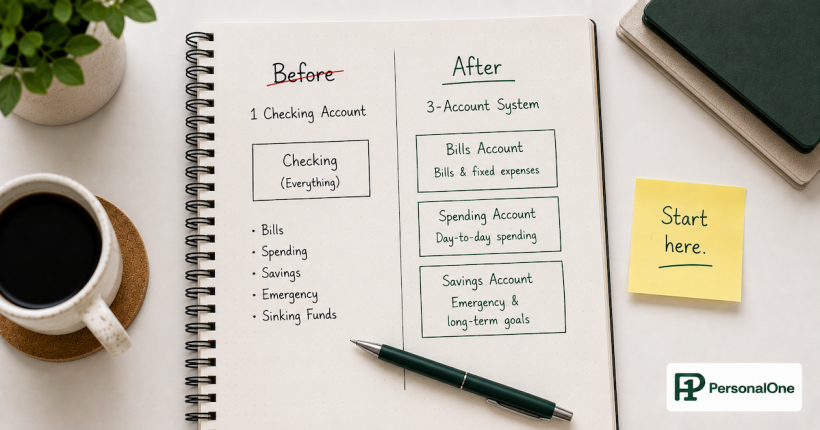
A no-fee bank account solves the cost problem. The cash flow problem requires a broader structure. Freelancers who manage irregular income effectively typically use a three-account system: a business checking account for client payments and operating expenses, a personal checking account that receives a scheduled owner’s draw, and a separate high-yield savings account for tax reserves and emergency buffer.
The business checking account functions as a buffer account for slow months — it absorbs the timing mismatch between when clients pay and when personal expenses are due, so personal spending never depends on whether a particular invoice cleared this week.
Pairing business checking with a high-yield savings account for tax reserves makes a meaningful difference — money set aside for quarterly taxes should be earning 4–5% APY while it sits, not sitting idle in checking.
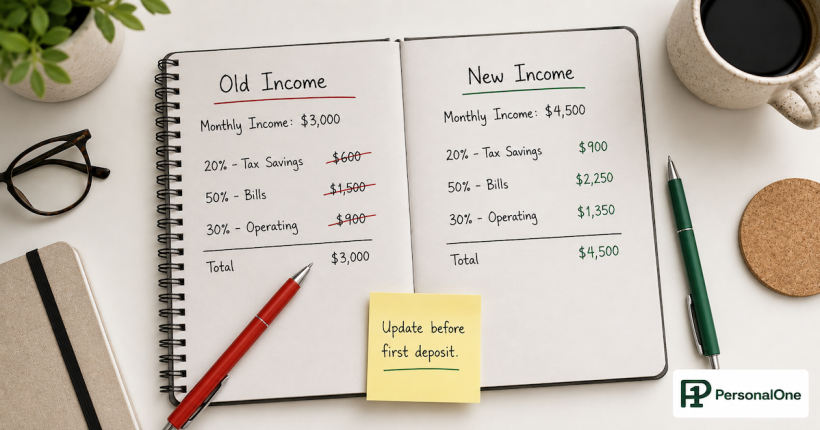
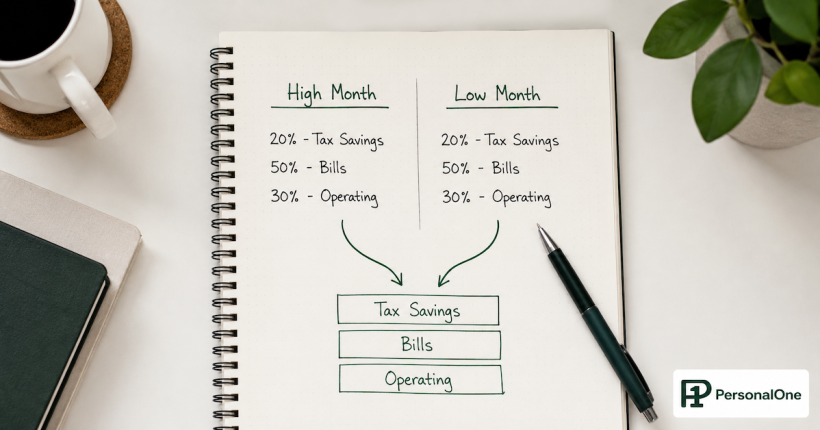
The automation setup that works: on every client payment, immediately transfer 25–30% to tax savings and 10–15% to emergency buffer. What remains in business checking covers operating expenses. From there, a fixed owner’s draw transfers to personal checking on a set schedule — effectively a salary. For the complete framework on calculating that number, automating the transfer, and calibrating it across income seasons, the guide on how to pay yourself a consistent salary as a freelancer covers the full setup.
Banking Mistakes Freelancers Should Avoid
Accounts with minimum balance tiers
Any account that charges maintenance fees when your balance dips below a threshold punishes you during slow income months — the exact times the buffer should be absorbing the gap, not triggering fees.
Limited payment platform compatibility
If the bank does not accept your clients’ preferred payment methods without friction, it adds administrative overhead to every invoice. Verify payment source compatibility before opening.
Restrictive daily transfer or ATM limits
These create problems when you need to move larger amounts between accounts on payday. Check daily ACH limits and any caps on outbound transfers before committing.
Hidden activity or inactivity fees
Read the full fee schedule, not just the headline “no monthly fee” claim. Inactivity fees, excess transaction fees, and wire charges can erode an account that looks free at the headline level.
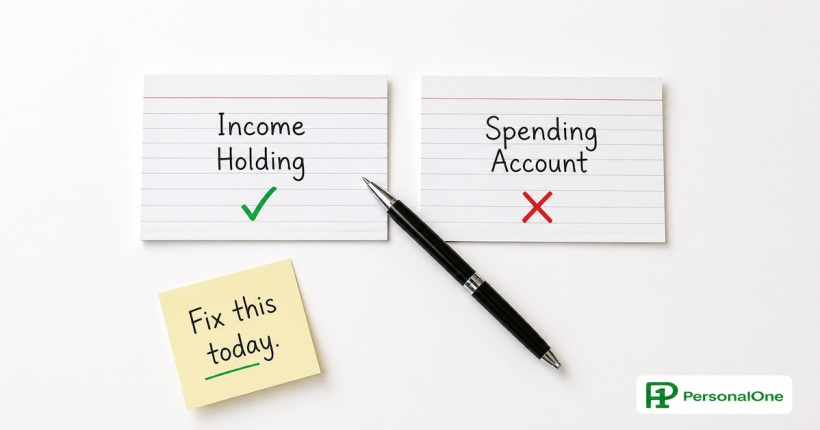
Mixing personal and business finances
A single account for both personal and business transactions makes tax preparation significantly harder and obscures whether the business is actually profitable. The full decision framework on when and how to separate is covered in the guide on personal vs business bank accounts for freelancers.
The right bank is the foundation. Managing irregular income is the system.
Choosing a no-fee bank eliminates unnecessary costs and creates the right infrastructure. The complete Banking for Irregular Income framework covers income buffers, owner’s draw structures, tax reserve sizing, and how to build financial stability when paychecks do not arrive on a schedule.
Build a System for Irregular Income →Frequently Asked Questions
What bank works best for 1099 workers?
Bluevine and Found are strong options for 1099 workers specifically — both offer no-fee accounts with tools built around the realities of self-employment income: tax withholding automation, expense tracking, and invoicing. Lili is also purpose-built for freelancers and consolidates these features in a single mobile app. The best fit depends on whether you prioritize tax automation (Found), balance segmentation (Bluevine), or all-in-one simplicity (Lili).
Should I use a personal or business account as a freelancer?
A business account is the better choice in almost all cases. It separates business income from personal spending, simplifies tax preparation significantly, and — if you operate as an LLC — maintaining separate accounts is required to preserve legal separation. Even as a sole proprietor with modest income, the organizational benefit alone justifies the setup time, especially since most options on this list cost nothing to maintain.
Do these banks work for international clients?
Most domestic no-fee banks handle USD transactions well but have limited multi-currency or international transfer capabilities. If you invoice international clients regularly, a dedicated international payment tool like Wise often pairs well with a domestic no-fee business account — Wise handles the currency conversion and international transfer, while your primary bank handles domestic operations.
How much should I keep in my business checking account?
Target one to two months of typical operating expenses as a working buffer in business checking. This covers the gap between when expenses are due and when the next client payment arrives. Beyond that buffer, excess funds should move to a high-yield savings account or tax reserve rather than sitting idle in checking earning little or nothing.
Can I get a business credit card with these banks?
Some do — Bluevine offers a business credit card alongside its checking product. Others focus exclusively on deposit accounts. If a business credit card is part of your setup, check the bank’s full product lineup before committing. Using a business card for operating expenses while keeping the card balance fully covered by business checking each month is a sound approach for building business credit without carrying debt.
Resources
Banking for Irregular Income — PersonalOne Hub
FDIC BankFind — Compare and Verify Institution Insurance
IRS — Self-Employed Individuals Tax Center
FDIC — Consumer Protection and Deposit Insurance
This article is part of the Banking Systems hub on PersonalOne — a complete framework for building the account structure and cash flow infrastructure that controls your financial outcomes automatically.
Disclaimer: This article provides educational information about banking options for freelancers and self-employed individuals. It does not constitute financial advice. Bank features, APY rates, and fee structures change over time — verify current terms directly with each institution before opening an account. Always confirm FDIC insurance status before depositing funds. Some links on this page are affiliate links marked as such; they do not influence our recommendations.