

March 20, 2026
Home › Financial Automation › Savings Automation
Stage 4 of 7
Automation & Integration — Make money move without constant effort.
View All 7 Stages →
Financial Automation › Cluster Hub
How Automate Your Savings Goals?
Remove willpower from saving entirely — build systems that move money to savings automatically, every pay period, before you can spend it.
Most people intend to save. The problem isn’t desire — it’s system design. When saving requires a conscious decision every month, it competes with every other spending pressure in that moment. Automation removes the decision. Money moves to savings before you see it in your spending account, before a discretionary purchase tempts you, before the month runs out. An automated savings system doesn’t require more discipline — it requires less, because the system does what willpower was supposed to do.
This is Cluster Hub 3 under the Financial Automation authority hub. It covers every dimension of savings automation: split direct deposit, automatic transfers, emergency fund building, sinking funds for planned expenses, and the pay-yourself-first framework that underpins all of it.
What This Cluster Covers
This Cluster Covers
- Split direct deposit for automatic allocation
- Emergency fund automation
- Sinking fund systems
- Pay-yourself-first mechanics
- Savings rate optimization
Covered Elsewhere
- Banking account structure (Banking Systems hub)
- Income routing setup (Cluster 1)
- Budget automation (Cluster 2)
- Investment automation (Cluster 5)
- Emergency fund strategy (Financial Stability hub)
The Savings Automation Framework
Effective savings automation is built on one foundational principle: money saved is money moved before spending can compete for it. Every strategy in this cluster serves that principle through different mechanisms.
Pay Yourself First
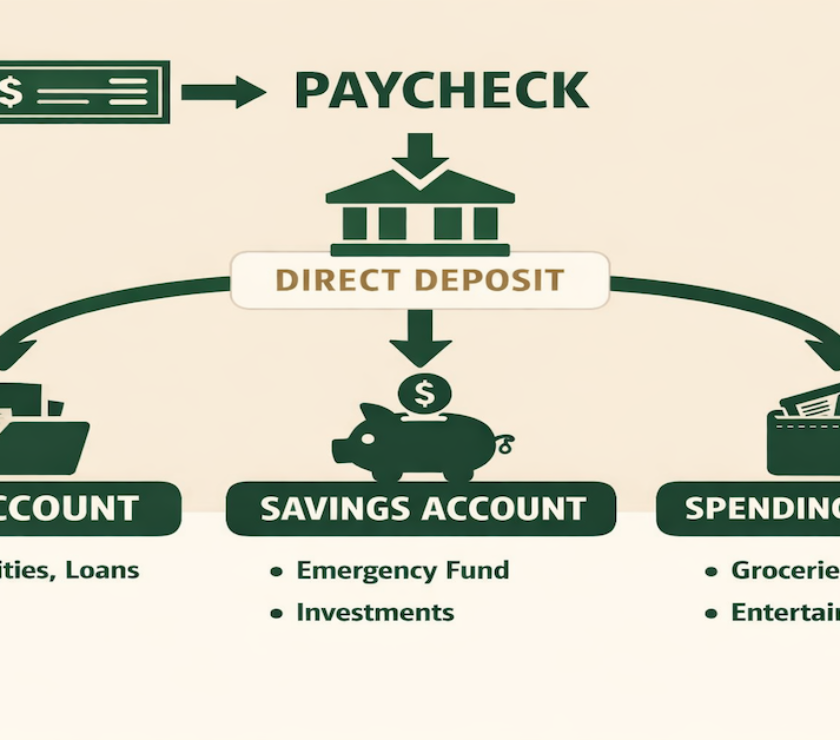
Pay-yourself-first inverts the typical savings approach. Instead of spending first and saving what remains (which is usually nothing), a fixed savings amount moves automatically before spending money becomes available. Whether through split direct deposit or an immediate post-paycheck transfer, savings happens at income arrival — not at month end.
Goal-Based Savings Buckets
Sinking funds automate savings for predictable future expenses: car insurance renewals, annual subscriptions, holiday spending, home repairs. Each bucket receives a fixed monthly contribution calculated by dividing the expected expense by the months until it’s needed. When the expense arrives, the money is already there — no scrambling, no debt, no disruption to other financial plans.
Progressive Rate Increases
Starting with a savings rate you can sustain is more important than starting with a rate that feels ambitious. A 5% automated savings rate maintained consistently outperforms a 20% rate that gets suspended after three months. Many banks and payroll systems allow automatic annual increases — schedule a 1–2% rate increase each year and your savings rate grows passively as income grows.
Articles in This Cluster
Coming Soon
Split Direct Deposit: The Easiest Way to Save Automatically
How to direct a percentage of every paycheck to savings before it touches your spending account — the setup instructions, the math, and which banks make it easiest.
Coming Soon
How to Build an Emergency Fund on Autopilot
A step-by-step automation plan for building 3–6 months of expenses in a dedicated account, with realistic timelines and contribution amounts for different income levels.
Coming Soon
Automating Sinking Funds Without Spreadsheets
How to set up goal-based savings buckets for predictable future expenses — car registration, insurance, holidays, home maintenance — so they never hit your budget as surprises.
Coming Soon
Pay Yourself First — The Automated Way
The foundational savings principle, automated: how to structure accounts, set transfers, and make saving the default behavior rather than the afterthought.
Coming Soon
How to Save 20% Without Feeling It
A progressive savings rate strategy: how to increase your savings rate gradually over 12–24 months so the impact is invisible while the results compound.
Explore the Full Financial Automation System
Savings automation is one layer. The PersonalOne Financial Automation hub covers the complete system — banking infrastructure, budget automation, debt payment automation, and investment automation.
Return to Financial Automation Hub →Other Financial Automation Clusters
Banking Infrastructure Automation
Build the foundation that all other automations depend on.
Explore Banking Infrastructure →Budget Automation
Make your budget run without tracking every dollar manually.
Explore Budget Automation →Debt & Payment Automation
Automate debt payoff without risking your credit score.
Explore Debt Automation →Investment Automation
Build wealth consistently through automated investing.
Explore Investment Automation →