July 2026
Home › Financial Automation › Budget Automation Systems › How to Budget for Irregular Income on Autopilot
What You Need to Know
— A budget for irregular income starts from the lowest reliable monthly income figure — not the average, not the best month — and treats everything above that floor as surplus to be assigned intentionally when it arrives.
— Percentage-based automation rules scale automatically with income fluctuation — when income is high, more goes everywhere proportionally. When income is low, the system still functions within its floor constraints.
— An income smoothing account absorbs the difference between variable actual income and a consistent monthly operating budget — the single most effective structural tool for irregular income earners.
— The surplus protocol — a defined decision sequence for what happens to income above the baseline — prevents high-income months from being absorbed by lifestyle expansion rather than financial progress.
— Freelancers, gig workers, commission earners, and anyone with seasonal income can run a fully automated budget system — the structure is different from a salaried budget but equally systematic.
Budgeting for irregular income is one of the most common financial challenges for Millennials and Gen Z earners — and one of the most poorly served by standard budgeting advice. Most budget frameworks assume a consistent monthly paycheck. They tell you to allocate fixed percentages to fixed categories and automate the transfers. That framework works cleanly when income is predictable. When income varies by $1,000 to $3,000 month to month, the same framework either breaks in low-income months or fails to capture the full potential of high-income months.
Building a budget for irregular income on autopilot requires a different structural approach: a floor-based income model, percentage-based allocation rules that scale with actual income, and an income smoothing mechanism that converts variable deposits into a consistent operating budget. This article covers each component in sequence — the setup that makes a variable income budget as automated and low-maintenance as any salaried budget.
This approach sits within the budget automation systems framework — the same structural principles applied to income that does not arrive in predictable amounts on predictable dates.
Why Standard Budget Automation Fails for Variable Income
Standard budget automation is built around fixed dollar amounts: transfer $800 to savings on the 1st, autopay $1,200 rent on the 5th, transfer $400 to the lifestyle account on the 15th. These fixed amounts work when income is consistent because the account will always have the funds available when the transfer fires. When income varies, fixed-amount automation creates a timing and funding problem.
In a low-income month, fixed automated transfers can overdraw accounts if income falls short of the combined transfer total. In a high-income month, excess income above the fixed transfer amounts sits in the primary account as an unallocated surplus that drifts into discretionary spending rather than savings or debt payoff. The fixed-amount automation system that works for a $4,500 consistent paycheck will either overdraw accounts or fail to capture surplus in months where actual income is $2,800 or $6,200.
The solution is replacing fixed dollar automation with two complementary systems: a floor-based budget that covers essential obligations from a conservative income baseline, and percentage-based rules that determine what happens to every dollar above and below that baseline automatically.
Step 1 — Establish Your Income Floor
The income floor is the most conservative estimate of reliable monthly take-home income — the amount you can count on receiving in any month, including the slowest months of the year. For most variable income earners this is not the average of the past six months. It is the lowest month of the past six to twelve months, possibly adjusted downward slightly to account for seasonal patterns or business cycles that might produce even lower months going forward.
To calculate the income floor: pull the last 12 months of actual take-home deposits. Identify the three lowest months. Average those three months and round down to the nearest $100. That figure is the income floor — the number every fixed budget commitment is built from.
Here is why the floor approach matters. A freelancer who averaged $4,200 per month over the past year but had three months below $2,800 has an income floor around $2,600 to $2,800. Building fixed obligations — rent, insurance, minimum debt payments, automated savings — that total $3,800 per month means three months per year produce overdrafts or missed payments. Building fixed obligations that total $2,400 per month means every month is covered by the floor income, and every dollar above $2,400 becomes surplus to be assigned intentionally.
Income floor calculation example:
Freelance Income — Last 12 Months
Highest month: $6,400 — Lowest month: $1,900
12-month average: $3,850
Three lowest months: $1,900 / $2,300 / $2,600
Average of three lowest: $2,267
Income floor (rounded down): $2,200
Every fixed monthly obligation must be coverable from $2,200. Any month where actual income exceeds $2,200 produces surplus to be assigned by the surplus protocol.
Step 2 — Build the Income Smoothing Account
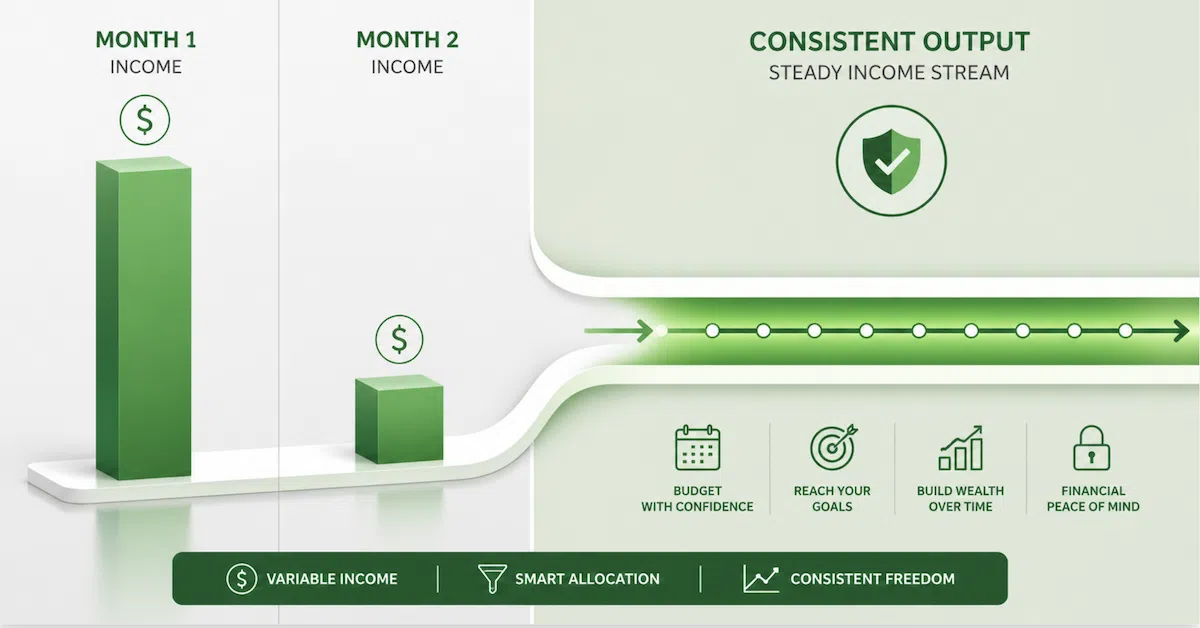
The income smoothing account is the structural tool that converts variable deposits into a consistent operating budget. It functions as a buffer between actual income and the spending system — absorbing excess in high-income months and supplementing the operating budget in low-income months.
The mechanics are straightforward. Every payment received deposits into the income smoothing account rather than directly into the operating accounts. On a fixed date each month — typically the 1st or the 15th — a fixed transfer moves from the smoothing account to the operating accounts. This fixed transfer is set at the income floor amount. The operating budget always receives the same amount regardless of what actual income was that month.
In months where income exceeds the floor, the smoothing account accumulates a growing balance. That surplus sits in the smoothing account — available to supplement the operating budget in lower-income months — rather than flowing directly into spending. In months where income falls below the floor, the accumulated surplus in the smoothing account covers the fixed transfer without any disruption to the operating budget.
Income Smoothing in Practice — $2,200 Floor Budget
Month 1: Actual income $4,800. Smoothing account receives $4,800. Fixed transfer of $2,200 goes to operating accounts. Smoothing account balance: $2,600.
Month 2: Actual income $1,900. Smoothing account receives $1,900. Fixed transfer of $2,200 goes to operating accounts — $300 drawn from accumulated balance. Smoothing account balance: $2,300.
Month 3: Actual income $3,600. Smoothing account receives $3,600. Fixed transfer of $2,200 goes to operating accounts. Smoothing account balance: $3,700.
The operating budget received exactly $2,200 in each of the three months regardless of actual income volatility. The smoothing account absorbed the variation and built a growing buffer that covers future low-income months without any disruption to the fixed obligations the operating budget covers.
The smoothing account should be a separate high-yield savings account — not a checking account used for other purposes. Keeping it separate prevents its balance from being absorbed into general spending and maintains the structural clarity that makes the system work. The budget structure and cash flow framework covers how to set up the multi-account structure that this smoothing mechanism plugs into.
Step 3 — Set Percentage-Based Automation Rules
Once the smoothing account is in place and the operating budget is receiving a consistent monthly transfer, the allocation of that transfer follows percentage-based rules rather than fixed dollar amounts. This is the standard budget automation approach — applied to a consistent income stream rather than a variable one.
For a $2,200 monthly operating transfer, a 50/30/20 percentage allocation produces: $1,100 to essentials (rent, utilities, insurance, minimum debt payments), $660 to lifestyle spending, $440 to savings. These amounts are fixed and predictable because the operating transfer is fixed and predictable — the smoothing account handles the variability before it reaches the allocation layer.
The percentage-based allocation automates the same way as any salaried budget: the operating transfer arrives in the primary account, and sub-transfers move the allocated amounts to the essentials account, the lifestyle account, and the savings account on the same day. All fixed bills autopay from the essentials account. Lifestyle spending draws from the lifestyle account only. Savings build in the dedicated savings account. The multi-account structure runs identically to a salaried budget because from the perspective of that structure, income is now consistent.
Step 4 — Define the Surplus Protocol
The surplus protocol is the decision sequence that determines what happens to income above the floor amount in the smoothing account. Without a defined protocol, surplus accumulates in the smoothing account until it feels available to spend — which is the pattern that prevents high-income months from producing meaningful financial progress.
The surplus protocol triggers when the smoothing account balance exceeds three months of the floor operating budget. At $2,200 per month, that threshold is $6,600. When the smoothing account balance exceeds $6,600, the excess surplus above that buffer is distributed according to a predefined priority sequence.
The priority sequence should be set in advance and followed automatically without renegotiating each time surplus arrives. A well-structured sequence for most variable income earners:
Priority 1 — Emergency fund completion. If the dedicated emergency fund has not reached three months of floor operating expenses ($6,600 in the example above), surplus above the smoothing account threshold goes here first. This is the highest-priority use of surplus because an incomplete emergency fund means the smoothing account is doing double duty as both an income buffer and an emergency reserve.
Priority 2 — High-interest debt payoff. Any debt carrying an interest rate above eight percent produces a guaranteed after-tax return equal to the interest rate when paid off. Surplus directed here produces an immediate, risk-free return that no savings vehicle can reliably match.
Priority 3 — Investment contributions above the automated floor. The floor operating budget includes only the minimum automated savings transfer. Surplus above the threshold is where investment contributions above that minimum should come from.
Priority 4 — Lifestyle enhancement budget. A defined percentage of surplus — 10 to 20 percent is a reasonable starting point — is allocated to discretionary lifestyle spending above the floor budget. This is the mechanism that allows high-income months to produce a meaningfully better quality of life without allowing the entire surplus to flow into lifestyle spending.
Tax Reserves for Self-Employed and Freelance Earners
For variable income earners who receive income without tax withholding — freelancers, independent contractors, sole proprietors, gig economy workers — the automated budget system must include a tax reserve allocation that prevents a large annual tax liability from disrupting the entire structure.
The standard approach is to treat estimated tax as a fixed expense in the floor operating budget. For most self-employed earners, federal and state combined effective tax rates on net self-employment income range from 25 to 35 percent depending on income level and state. Setting aside 25 to 30 percent of every deposit into a dedicated tax reserve account — before the smoothing account receives the remainder — ensures quarterly estimated tax payments are always pre-funded.
The practical implementation: every payment received deposits into a primary account. An automatic transfer immediately moves 25 to 30 percent to the tax reserve account. The remainder moves to the smoothing account. The operating budget is built from after-tax income only. This structure prevents the pattern where a strong income year produces a large unexpected tax bill that the smoothing account and emergency fund cannot absorb without depleting both.
Quarterly estimated tax payments draw automatically from the tax reserve account on the IRS due dates — typically April 15, June 15, September 15, and January 15. The full financial automation framework covers how to connect tax reserve management to the broader automated financial system for self-employed earners.
Variable income. Consistent system. Same results.
The floor-based model and income smoothing structure turn irregular income into a predictable operating budget. The complete Budget Automation Systems framework connects this structure to tracking, bill automation, and savings routing.
Explore Budget Automation Systems →Resources
IRS — Estimated Taxes for Self-Employed Individuals
CFPB — Budget Worksheet and Planning Tools
Continue Learning About Financial Automation
This article covers the floor-based budget and income smoothing system for variable income earners. The complete automated financial system framework is in the Financial Automation authority hub.
Frequently Asked Questions
How do I set the income floor if I just started freelancing?
With less than six months of income history, set the floor conservatively based on the minimum income you need to cover non-negotiable fixed obligations — rent, minimum debt payments, utilities, insurance. This may feel artificially low but it protects the budget from failure during slow early months when income patterns are not yet established. Revisit and recalculate the floor after six months of actual income data is available.
What if two consecutive months fall below the income floor?
The smoothing account buffer is designed to cover this scenario. Three months of floor operating expenses as a smoothing account target means two consecutive below-floor months can be covered without touching the emergency fund. If the smoothing account is depleted and a third below-floor month occurs, the emergency fund supplements the shortfall. This is exactly the situation the emergency fund exists for — not a failure of the system but a demonstration of it working as designed.
Should the floor operating budget include any savings?
Yes — a minimum savings allocation should be part of the floor operating budget even if it is small. Three to five percent of the floor income transferred automatically to the emergency fund until it reaches the three-month target is the appropriate minimum. This ensures savings happen consistently in every month including the lowest-income months rather than only in surplus months. Savings that depend on surplus never accumulate reliably enough to build genuine financial resilience.
How does this system work for commission-based earners who receive a base salary plus variable commission?
The base salary functions as the income floor — it is the consistent, predictable component that the fixed operating budget is built from. Commission income flows into the smoothing account as surplus and is distributed according to the surplus protocol when the smoothing account balance exceeds the buffer threshold. This structure is simpler than pure freelance income because the base salary guarantees the floor transfer without requiring the smoothing account to supplement it in low months.
How often should I recalculate the income floor?
Annually as a minimum and after any significant change in income source, client base, or business structure. A floor calculated from last year's income data may not reflect this year's earning environment. Setting a calendar reminder for January each year to recalculate the floor from the previous 12 months of actual income keeps the budget foundation accurate without requiring ongoing adjustment throughout the year.
Can this system work alongside a weekly money review routine?
Yes — and the combination produces the most resilient variable income financial system. The automated floor structure handles the month-to-month income variability without manual intervention. The weekly review monitors the smoothing account balance, confirms transfers executed correctly, and tracks whether the surplus protocol threshold is being approached. The weekly money review system covers exactly how to structure that check-in for variable income earners specifically.
Disclaimer: This article is for educational purposes only and does not constitute financial or tax advice. Tax obligations for self-employed individuals vary significantly based on income level, business structure, deductions, and state of residence. Consult a qualified tax professional for guidance specific to your situation. PersonalOne is not responsible for decisions made based on this content.