March 2026
Home > Investing & Wealth Growth > Investment Psychology: Avoid Emotional Mistakes
TL;DR – Quick Takeaways
- Investor behavior matters more than strategy – Average investor returns 3-4% while market returns 10%. Gap = emotional mistakes (panic selling, FOMO buying).
- Panic selling locks in losses permanently – Market drops 30%, you sell, miss the recovery. You've destroyed wealth. Crashes always recover historically (3-5 years).
- FOMO buying = buying high, guaranteed losses – "Everyone's buying crypto/meme stocks!" You buy the peak. It crashes. You're down 50-80%. Chase performance = lose money.
- Market timing is impossible – "I'll sell now, buy back after the crash." Problem: You miss the recovery (best days follow worst days). Time IN market beats timing market.
- Loss aversion hurts more than gains feel good – Losing $10K feels 2x worse than gaining $10K feels good. This causes irrational behavior (selling after drops, not buying when cheap).
- Recency bias = "what happened recently will continue" – Market up 3 years? "It'll keep rising!" (wrong). Market down 6 months? "It'll keep falling!" (wrong). Past doesn't predict future.
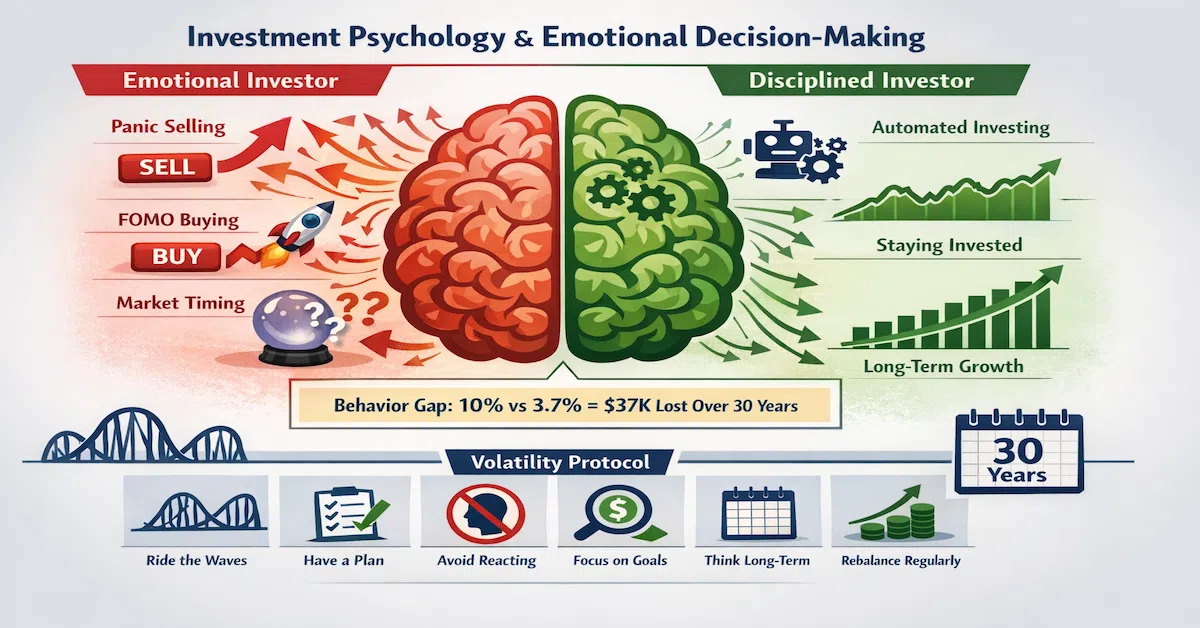
- The behavior gap destroys wealth – S&P 500 returns 10% annually. Average investor returns 3-4%. Difference = buying high, selling low, chasing trends, panic.
- Automation removes emotion from investing – Auto-invest $500/month. Never see it. Never make emotional decisions. Compound for decades. This is the secret.
The Uncomfortable Truth: Psychology Matters More Than Strategy
Here's the data that should terrify you:
S&P 500 annualized return (1993-2023): 10.0%
Your $10,000 investment becomes $67,275 over 30 years.
Average equity investor return (same period): 3.7%
Your $10,000 investment becomes $29,687 over 30 years.
Gap: 6.3% annually = $37,588 in lost wealth.
Same market. Same time period. Different outcomes. Why? Emotional mistakes. Buying high, selling low, panic during crashes, chasing hot stocks, trying to time the market.
The behavioral gap is real, measurable, and devastating. You can have the perfect investment strategy—low-cost index funds, proper diversification, optimal asset allocation. But if you panic sell during a crash or FOMO buy into bubbles, you'll underperform dramatically.
Good news: Investment psychology isn't innate talent. It's learnable skills and systems. This article teaches you the common emotional traps, why they happen, and how to avoid them through automation and discipline.
Emotional Mistake #1: Panic Selling During Market Crashes
The scenario: Market drops 20-30-40%. Headlines scream "RECESSION!" and "MARKET COLLAPSE!" Your $100K portfolio is now $70K. Fear takes over. You sell everything "to stop the bleeding."
What actually happens:
- You lock in losses permanently. That $30K drop was paper loss (you still own the stocks, they'll recover). Selling makes it real loss (you own cash, stocks recover without you).
- You miss the recovery. Market bottoms are impossible to predict. Best market days immediately follow worst days. You're sitting in cash while market rises 20-40% from bottom.
- You buy back higher. Market recovers to $110K. You feel "safe" to re-enter. You buy back at $110K with only $70K cash. You've lost $40K permanently through panic.
Historical reality check:
2008-2009 Financial Crisis:
Market dropped 57% (March 2009 bottom)
Recovery to pre-crash levels: 4 years (March 2013)
New all-time high: 5.5 years (May 2013)
Those who held: Recovered + gained. Those who sold: Lost everything.
2020 COVID Crash:
Market dropped 34% (March 2020 bottom)
Recovery to pre-crash levels: 5 months (August 2020)
New all-time high: 6 months (August 2020)
Fastest recovery in history. Panic sellers locked in massive losses, missed historic gains.
Dot-com Crash (2000-2002):
Market dropped 49% (October 2002 bottom)
Recovery to pre-crash levels: 5 years (October 2007)
Painful, yes. But those who held recovered. Those who sold never did.
Why panic selling happens: Loss aversion. Watching $30K disappear is psychologically unbearable. Selling feels like "taking control" and "doing something." In reality, you're making the worst possible decision at the worst possible time.
How to avoid:
- Stop checking your portfolio daily/weekly. Check quarterly or annually. Can't panic sell what you don't look at.
- Remember: Crashes always recover. 100% historical success rate. Timing varies (1-5 years) but recovery always happens.
- Reframe drops as sales. Market down 30%? Stocks are 30% off. Keep buying through the crash (dollar-cost averaging).
- Automate everything. If contributions happen automatically, you can't stop them during panic. You're forced to buy the dip.
Emotional Mistake #2: FOMO Buying (Chasing Performance)
The scenario: Your coworker made $50K on crypto/Tesla/GameStop/meme stocks. Everyone on social media is getting rich. You're "missing out." You dump $20K into whatever's hot right now.
What actually happens:
- You buy the peak. By the time everyone knows about it, the easy gains are gone. You're the late buyer holding the bag.
- It crashes shortly after. GameStop $400 → $40. Crypto $60K → $20K. Your $20K is now $3K-5K.
- You panic sell at the bottom. "Cut losses!" You sell at $3K. Then it rebounds to $10K without you. You've locked in 85% loss.
Real examples:
Dot-com bubble (1999-2000):
People quit jobs to day trade tech stocks
Pets.com, Webvan, countless others soared then went bankrupt
Result: Average investor lost 50-80% chasing "can't miss" internet stocks
Bitcoin 2017-2018:
Bitcoin rises to $20K (December 2017), media frenzy, everyone buying
Crashes to $3K (December 2018)
Late buyers who FOMO'd in at $15K-20K lost 75-85%
GameStop/AMC (January 2021):
GameStop spikes to $483, everyone rushing in
Drops to $40 within weeks
FOMO buyers at $300-400 lost 80-90%
Why FOMO buying happens: Regret aversion. You see others making money and feel stupid for missing out. Fear of missing the "next big thing" overrides rational analysis.
How to avoid:
- Ignore social media investing noise. People brag about wins, hide losses. You're seeing survivorship bias.
- Stick to your allocation. 80% stocks, 20% bonds? That's your plan. Hot stocks aren't part of it.
- Remember: By the time you hear about it, you're late. Real money is made early. You're hearing about it when it's already peaked.
- If you must speculate, limit to 5% of portfolio. Put 95% in boring index funds. Speculate with 5% if you can't resist. This limits damage.
Emotional Mistake #3: Market Timing (Trying to Predict Tops and Bottoms)
The scenario: "Market is overvalued, I'll sell now and buy back after it crashes." Or: "Market is too volatile, I'll wait for it to stabilize before investing."
What actually happens:
- You sell at all-time high, expecting crash. Market continues up another 20% over 2 years. You're sitting in cash earning 0-4% while missing gains.
- Market finally crashes. "I was right!" But you missed 2 years of gains, so you're still behind.
- You wait for "the bottom." Market drops 20%. You wait for 30%. It rebounds. You missed the bottom entirely.
- Market recovers to new highs. You finally buy back in. You've missed the entire crash buying opportunity AND the recovery.
The math that destroys market timing:
If you invested $10,000 in S&P 500 in 1993 and stayed invested:
Final value (2023): $211,690
Return: 10.5% annually
If you missed the 10 best days (out of 7,500 trading days):
Final value: $103,050
Return: 7.9% annually
Loss: $108,640 (missing just 0.13% of days)
If you missed the 30 best days:
Final value: $44,720
Return: 4.9% annually
Loss: $166,970 (missing just 0.4% of days)
The killer: Best days cluster around worst days. 7 of the 10 best S&P 500 days occurred within 2 weeks of the 10 worst days. If you sell to avoid the crash, you miss the recovery. You can't have one without risking the other.
Why market timing fails: Impossible to predict. Professional fund managers with teams of PhDs and billions in resources can't do it consistently. Neither can you. And even if you predict the crash, you won't predict the bottom or the recovery timing.
How to avoid:
- Accept: Time IN market beats timing market. Every study confirms this. Stay invested.
- Use dollar-cost averaging. Invest same amount monthly regardless of market level. You automatically buy more when it's low, less when high.
- Ignore predictions. CNBC says recession coming? Doesn't matter. Keep investing. They're wrong 50% of the time anyway.
- Reframe volatility as opportunity. Market drops? Great, you're buying stocks on sale with your monthly contribution.
Understanding Key Behavioral Biases
Loss Aversion:
Psychological principle: Losses hurt approximately 2x more than equivalent gains feel good. Losing $10K feels terrible. Gaining $10K feels nice but not equally great.
How it ruins investing: You hold losing stocks too long (refusing to accept loss) and sell winning stocks too early (locking in gain before it "disappears"). Exactly backwards behavior.
Recency Bias:
Believing recent events will continue indefinitely. Market up 3 years? "It'll keep rising!" (wrong—crashes happen unpredictably). Market down 6 months? "It'll keep falling!" (wrong—recoveries begin when pessimism peaks).
How it ruins investing: You buy high (after years of gains, feeling confident) and sell low (after months of drops, feeling terrified). Classic buy-high-sell-low mistake driven by recency bias.
Confirmation Bias:
Seeking information that confirms what you already believe, ignoring contradictory data. You believe Tesla will 10x? You only read bullish articles, dismiss bearish analysis.
How it ruins investing: You double down on losing positions (finding articles to confirm your thesis) instead of objectively reassessing. You ignore warning signs until it's too late.
Overconfidence Bias:
Believing you're smarter than the market. "I can pick winning stocks / time the market / beat the pros." Reality: 80-90% of professionals fail. You won't succeed where they failed.
How it ruins investing: Active trading, stock picking, market timing. All destroy returns through fees, taxes, and bad decisions. Humility (admitting you don't know) leads to better outcomes (index funds, buy-and-hold).
Master the Complete Investing & Wealth Building System
Investment psychology is crucial, but it's just one piece. Learn the complete Stage 7 framework including fundamentals, retirement accounts, index funds, and real estate:
→ Complete Investing & Wealth Growth system
→ Investment fundamentals: Risk, diversification, time horizon
→ What to invest in: Index funds and ETFs
Building Long-Term Discipline: Systems Over Willpower
The problem with willpower: It's finite. You have strong willpower Monday morning. By Friday afternoon after a bad week, your willpower is depleted. Market crashes during weak moment? You'll make emotional mistake.
The solution: Automation removes emotion.
The automated investing system:
- Set up automatic transfers from paycheck to investment accounts. $500/month on payday → Roth IRA. You never see it, can't spend it, can't emotional-decision it.
- Set up automatic investments. That $500 automatically buys index funds every month. No login required. No decisions made.
- Set up automatic dividend reinvestment. Dividends automatically buy more shares. Compounding happens silently in background.
- Delete brokerage app from phone. Can't panic sell what you can't access easily. Make friction = good in this case.
- Check portfolio quarterly (not daily). January, April, July, October. Rebalance if needed. Otherwise, ignore completely.
Why automation works: Removes all decision points where emotions interfere. You're not deciding "should I invest this month?" (already automatic). You're not deciding "should I sell?" (can't easily access account). You're not deciding "what to buy?" (index funds already selected, auto-purchasing).
The result: You invest through market highs (buying expensive but staying invested). You invest through market crashes (buying cheap, dollar-cost averaging). You never panic sell. You never FOMO buy. You compound for 30 years. You get the full 10% market return, not the 3-4% behavior-gap return.
How to Handle Market Crashes: The Volatility Response Protocol
When the next crash happens (it will), follow this protocol:
Step 1: Expect it.
Market crashes 10-20% every 2-3 years. Crashes 30-50% every 5-10 years. This is normal. Price of admission for long-term gains.
Step 2: Do not check your portfolio.
Seeing red numbers triggers panic. Ignorance is strength during crashes. Check in 3 months, after panic subsides.
Step 3: Do not sell. Period.
Selling during crash locks in losses permanently. You will never recover. Hold through downturn, capture recovery.
Step 4: Keep automatic investments running.
Your monthly $500 contribution? Keep it going. You're buying stocks on sale now. This is when wealth is made.
Step 5: If you have extra cash, buy MORE.
Bonus coming? Market down 30%? Buy index funds. This is the opportunity.
Step 6: Remember history.
Every crash in history recovered. 100% success rate. Your job is to hold through the pain, capture the recovery.
Mental reframe for crashes: This isn't your portfolio "losing value." This is stocks going on sale. You're accumulating ownership of great companies at discount prices. When market recovers (it always does), you own more shares bought cheap. That's how wealth compounds.
The Long-Term Mindset: Get Rich Slowly
The truth nobody wants to hear: Investing is boring.
Buy index funds. Hold for decades. Rebalance annually. Ignore daily market noise. Get rich slowly over 30-40 years.
This isn't sexy. It's not exciting. It doesn't make good social media content. But it works.
Compound growth is invisible until it isn't:
Invest $500/month at 10% annual return:
Year 5: $38,600 (you contributed $30K)
Year 10: $102,300 (you contributed $60K)
Year 20: $381,700 (you contributed $120K)
Year 30: $1,130,200 (you contributed $180K)
Years 1-10: Feels slow. $500/month doesn't seem like it's doing much.
Years 20-30: Wealth explodes. Compound growth accelerates. You're a millionaire.
The discipline required: Continuing to invest $500/month when portfolio is $5K (feels pointless). Continuing when portfolio drops 30% (feels scary). Continuing through boring markets (feels tedious). This consistency over decades is what creates millionaires.
Reject get-rich-quick. Day trading, crypto speculation, meme stocks, options, forex—these are gambling, not investing. 99% of participants lose money. The 1% who win get lucky or are pros exploiting amateurs. You're the amateur being exploited.
Embrace get-rich-slow. Boring index funds. Automatic monthly investments. Hold through crashes. Compound for decades. This is how real wealth is built by real people with real jobs.
Frequently Asked Questions
How do I know if I'm making emotional investment decisions?
Red flags: You check portfolio multiple times daily. You feel panic/euphoria based on market moves. You want to sell during drops or buy more of what's already up. You're constantly reading market predictions. You're trading frequently. You're chasing hot stocks you heard about. Solution: Automate everything, check quarterly only, follow your allocation plan regardless of feelings.
What if I genuinely need money during a market crash?
This is why Stage 1 (emergency fund) comes BEFORE Stage 7 (investing). Your 6-month emergency fund handles crises without touching investments. If you don't have emergency fund and must sell during crash, you've violated prerequisites and set yourself up for failure. Never invest money you might need within 5-10 years.
Should I stop investing during market highs and wait for crashes?
No. This is market timing, and it fails. Market at all-time high? It spends 70% of time at all-time highs (that's what growth looks like). Waiting for crash = missing years of gains. If crash comes, you're buying cheap with your monthly contributions. If it doesn't, you're still making gains. Either way, keep investing regardless of market level.
How long do market crashes typically last?
Historical data: Average recovery to previous high takes 1-5 years. 2020 COVID crash: 5 months. 2008-2009 financial crisis: 4 years. Dot-com crash: 5 years. The point: They always recover. Your job is to hold through the 1-5 year pain and capture the subsequent 10-20 years of gains. Panic sellers never recover because they exit during the pain.
What if this time is different and the market doesn't recover?
If U.S. stock market permanently fails, society has collapsed. Money is worthless anyway. Your portfolio isn't your problem—food and safety are. But realistically: U.S. market has recovered from Civil War, two World Wars, Great Depression, multiple recessions, 9/11, 2008 financial crisis, COVID pandemic. "This time is different" is what panic sellers always say. History suggests otherwise.
How do I build emotional discipline if I'm naturally anxious about money?
Automate everything and remove your ability to make emotional decisions. Set up automatic investments, delete brokerage app, check portfolio quarterly only. You can't be anxious about portfolio you're not looking at. Also: Build emergency fund first (Stage 1). Financial anxiety often stems from lack of safety net. Once you have 6-month buffer, investing feels less scary because you know you're protected.
Continue Learning
Related Investment Topics:
- Investment Fundamentals: Risk, Diversification, Time Horizon
- Retirement Accounts: 401(k), IRA, Roth IRA Strategy
- Index Funds and ETFs: What to Actually Invest In
- Why Diversification Matters
- Stay Patient: Investing Is a Long-Term Game
Build the Foundation First:
- Stage 1: Financial Stability (Emergency Fund Prevents Panic Selling)
- Stage 6: Automate Investing (Remove Emotional Decisions)
Behavioral Finance Research:
Disclaimer: The information provided in this article is for educational purposes only and does not constitute financial, investment, or psychological advice. PersonalOne and its content creators are not licensed financial advisors, investment professionals, or mental health professionals. Investment psychology and behavioral finance concepts discussed here are educational frameworks, not personalized psychological guidance. Individual experiences with investing, market volatility, and emotional responses vary significantly based on personal circumstances, risk tolerance, financial situation, and mental health. The historical market data, crash recovery timelines, and return examples cited represent past performance which does not guarantee future results. Market crashes, recoveries, and long-term returns are not predictable and may differ substantially from historical patterns. Automation and systematic investing strategies discussed do not eliminate investment risk or guarantee positive outcomes. Before making investment decisions, consult with qualified professionals including licensed financial advisors who can assess your specific situation, risk tolerance, and emotional capacity for volatility. If you experience severe anxiety, depression, or other mental health challenges related to money or investing, consult a licensed mental health professional. Never invest money you cannot afford to lose, and always maintain appropriate emergency funds before investing.