Updated: May 27, 2026
Home › Banking Systems › Banking for Irregular Income
What You Need to Know
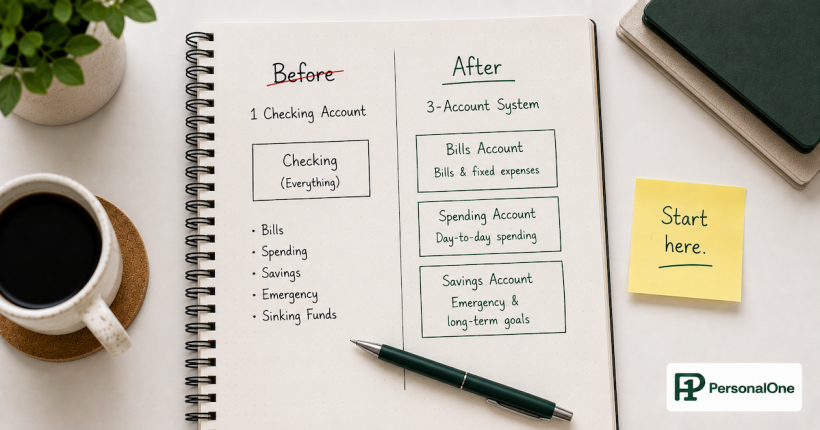
— Standard banking structure fails irregular income. One checking account cannot handle $8,000 one month and $2,000 the next. You need specialized account architecture.
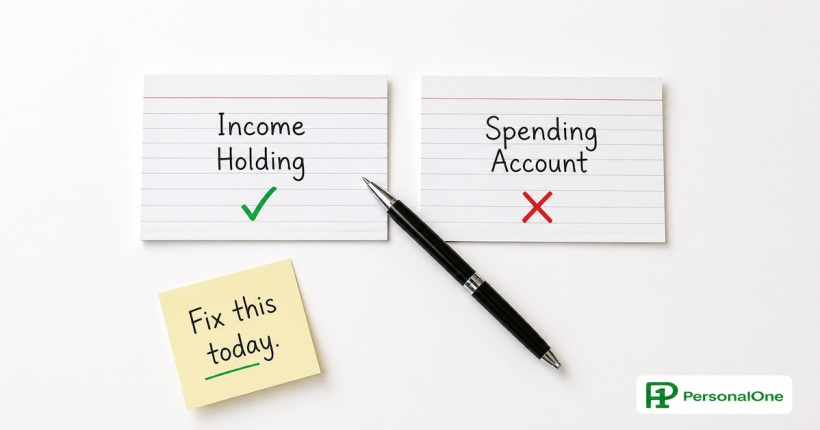
— The Income Holding Account is the foundation — all deposits go here first. Never spend directly from it. It acts as a buffer and smoothing mechanism between income volatility and stable spending.
— The Operating Account receives a fixed monthly transfer — your average budget amount, not actual income. This creates spending stability regardless of what arrived that month.
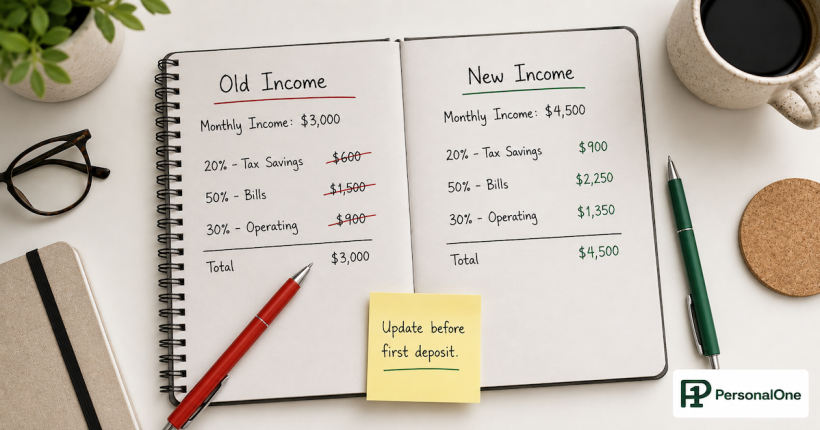
— The Tax Savings Account is non-negotiable for 1099 income. Set aside 25–30% of every deposit immediately into a separate account. Quarterly payments come from there only.
— The buffer builds in high months and cushions low months. Income chaos stays contained in the Holding Account. Operating and Bills accounts see only stable, predictable amounts.
— A minimum two-month buffer in the Income Holding Account is required before the fixed transfer system can function. Build this first.
Banking for irregular income requires a completely different system than traditional paycheck-based budgeting. Most bank account setups are designed around stable biweekly income — not freelance payments, commission checks, seasonal work, or unpredictable cash flow that changes every month.
That is why so many freelancers, self-employed workers, creators, and variable earners constantly feel behind financially even when they earn good money in total. The problem is almost never income. The problem is that standard banking structure cannot absorb income volatility — and without a structure designed for the reality of irregular cash flow, every low month feels like a crisis even when the annual numbers are fine.
This guide covers how to build a banking system for irregular income using buffer accounts, account separation, and cash-flow architecture that stabilizes spending even when monthly income fluctuates dramatically. The full framework connects to the income volatility management cluster, which covers the budgeting and averaging strategies that work alongside this account structure.
Why Standard Banking Fails Irregular Income
Standard advice — keep three to six months of expenses in savings, pay bills from checking — works perfectly if income arrives on a predictable schedule. When income is $8,000 in March, $2,500 in April, $6,200 in May, and $1,800 in June, the same annual total produces a completely different cash flow management challenge that one-account banking cannot handle.
Psychological whiplash: $8,000 hits the account and the brain registers comfort. Spending increases. Two weeks later a $1,800 month arrives and panic sets in. The problem is structural, not behavioral.
Bill payment anxiety: When checking shows $3,000 but rent is $1,500, is that enough? What if the next invoice is delayed? The uncertainty is constant because all money is visible and all money feels available simultaneously.
No spending clarity: $5,000 in checking does not mean $5,000 available. It might include next month's rent, quarterly tax obligations, and the buffer for a slow month. The balance means nothing without separation.
Survival mode default: Every low-income month feels like a crisis. Without structure that absorbs the volatility, the anxiety never resolves — even in years where total income is strong.
The Four-Account Architecture for Irregular Income
Irregular income requires four specialized accounts, each with a specific job. This is not complexity for its own sake — it is infrastructure that creates stability from volatility by keeping each type of money in a container designed for its purpose.
Account 1 — Income Holding Account
Type: Checking account, separate from spending
Purpose: Receives all income. Acts as buffer and income smoother. Balance fluctuates wildly — that is its job.
Rule: Never spend directly from this account. It is a holding tank, not a spending account.
Function: Every payment — client invoice, freelance gig, commission check — deposits here first, then gets distributed to other accounts on schedule.
Account 2 — Operating Account
Type: Checking account
Purpose: Receives a fixed monthly transfer from the Income Holding Account. This is the actual spending account for variable expenses.
Transfer amount: Your average monthly budget for groceries, gas, personal spending, dining — not actual income, a fixed budget amount.
Stability: Even when income was $2,000 this month, the Operating Account still receives the $1,200 standard transfer. The Income Holding buffer absorbs the shortfall. Spending stays consistent.
Account 3 — Bills Account
Type: Checking account
Purpose: Covers all fixed monthly expenses. Rent, utilities, insurance, subscriptions, minimum debt payments — anything that does not change month to month.
Transfer: A fixed monthly amount from the Income Holding Account covering total bills plus a 10% buffer.
Automation: Every bill on autopay from this account. Bills pay themselves automatically regardless of income volatility that month.
Account 4 — Tax Savings Account
Type: High-yield savings account at a separate bank
Purpose: Holds money for quarterly estimated taxes. For W-2 earners with side income, holds taxes on side income only.
Transfer timing: Immediate. Every time income hits the Holding Account, 25–30% transfers to Tax Savings the same day.
Protection: This money is already owed to the IRS. A separate account at a different institution prevents accidentally spending it and creates the transfer friction that keeps it protected until quarterly payments are due.
How Money Flows Through the System
The flow is a deliberate sequence that creates stability from volatility. Every step happens in the same order every time income arrives.
The Income Flow Sequence
1. Income deposits into the Income Holding Account. All of it, before any distribution.
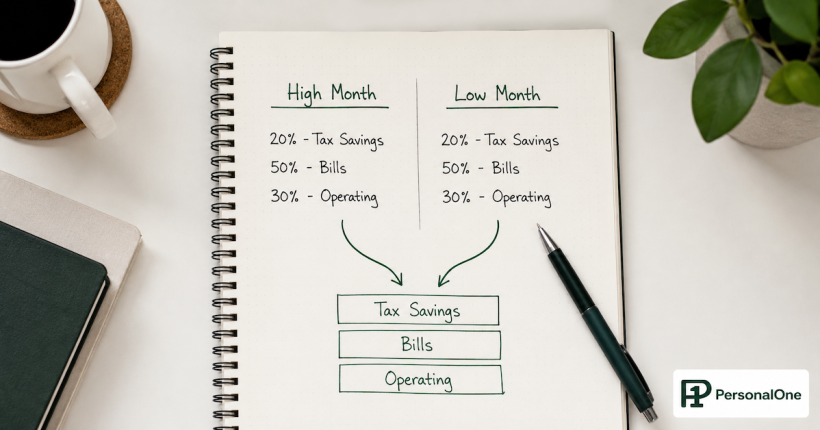
2. Immediate transfer: 25–30% to Tax Savings the same day. Non-negotiable for 1099 income. This happens before the money registers psychologically.
3. Remaining net amount stays in Income Holding as buffer. Builds during high months. Shrinks during low months.
4. On the 1st of each month: fixed transfer to Operating Account (e.g., $1,200). Same amount every month regardless of what income arrived.
5. On the 1st: fixed transfer to Bills Account (e.g., $1,800). Same amount every month. All autopay runs from here.
6. Whatever remains in Income Holding after monthly transfers is the buffer. This absorption of high and low months is the entire point of the system.
Two Very Different Months, Same Spending Outcome
March — $7,000 earned: $2,100 to Tax Savings (30%). $4,900 stays in Income Holding. April 1st: $1,200 to Operating, $1,800 to Bills. Buffer increases by $1,900.
April — $2,200 earned: $660 to Tax Savings (30%). $1,540 stays in Income Holding. May 1st: still $1,200 to Operating, $1,800 to Bills. Buffer decreases by $1,460. Operating and Bills accounts received the same amounts both months. Spending stays stable.
Building the Initial Buffer
The system requires a starting buffer in the Income Holding Account before the fixed transfer structure can function. Two to three months of total monthly needs must be held there before monthly transfers begin. Without it, the first low-income month breaks the system immediately.
Calculate your target: Monthly Operating budget plus monthly Bills total equals total monthly needs. Multiply by two for minimum buffer, three for a comfortable one. If monthly needs are $3,000, the minimum buffer target is $6,000.
Build it during high months: Sprint mode — pay minimum bills, spend minimally, bank everything possible in Income Holding. This is temporary sacrifice to build infrastructure.
Set aside taxes first: Even while building the buffer, 25–30% goes to Tax Savings immediately on every deposit. Build the buffer with after-tax income only.
Use windfalls strategically: Tax refunds, project bonuses, and large one-time payments go into Income Holding after the tax reserve is taken. This is the fastest path to the minimum buffer level.
Where to Open Each Account
Income Holding Account: Traditional bank or credit union with your main banking relationship. Requires free checking, no minimum balance, and easy transfers to other institutions.
Operating Account: Same bank as Income Holding for instant transfers. A separate bank is an option if additional separation between buffer and daily spending is desired.
Bills Account: Same bank as Operating simplifies management. Some people prefer a different bank to create friction against accessing bill money for spending — personal preference.
Tax Savings Account: Must be a separate bank — preferably an online high-yield savings account paying 4–5% APY. The one to two business day transfer delay creates exactly the friction needed to protect tax reserves from accidental use. The best savings accounts for 2026 covers the top FDIC-insured options with no minimum balance requirements.
Advanced Strategies Once the System Is Running
Tiered Operating Budget: Transfer a base amount monthly. When the Income Holding buffer is strong (more than three months of needs), add a bonus transfer of $200–$400. When the buffer is thin (less than two months), stick to the base only. This creates an automatic adjustment mechanism based on buffer health without requiring manual decisions.
Quarterly Buffer Reviews: Every three months, review the Income Holding balance and income trends. If the buffer is growing consistently, increase the monthly Operating transfer permanently. If the buffer is shrinking, decrease the transfer or refocus on income growth. Adjust to reality, not hope.
Fifth Account — True Savings: Once the buffer is solid at four-plus months and Income Holding consistently grows beyond operational needs, add a dedicated emergency fund and savings account. This is separate from both the operational buffer and the tax reserve — it is the wealth-building layer that the buffer infrastructure makes possible.
Common Mistakes That Break the System
Not separating taxes immediately. Spending gross income feels fine until the quarterly payment is due and the money is gone. Separating 25–30% on the day income arrives is the single most important habit in this system. Automate it wherever possible.
Raiding Income Holding during low months. The system works only if monthly transfers stay fixed. Using the buffer for extra discretionary spending defeats its purpose. If the buffer consistently runs low, decrease the monthly transfer amount going forward — do not break the structure retroactively.
Starting without adequate buffer. Two months of buffer minimum is a real requirement, not a suggestion. Starting with two weeks of buffer means the first low-income month breaks everything. Build runway before implementing fixed transfers.
Setting monthly transfers too high. Starting conservative preserves the buffer. Transferring $2,500 monthly with a growing buffer is better than transferring $3,200 and draining the buffer in three months. Start low and increase gradually as income patterns become clear.
Ignoring seasonal patterns. Most irregular income has predictable slow periods — January and August for many freelancers, winter for seasonal workers. If the slow months are predictable, build extra buffer before them proactively rather than responding reactively when they arrive.
Build the Complete Banking Infrastructure for Variable Income
Account structure for irregular income is one cluster in the complete banking systems framework. For the full architecture — income routing, paycheck flow, and how this system scales through every income type — see the Banking Systems hub.
Go Deeper: Banking for Irregular Income Guides
This article covered the complete four-account architecture. The guides below go deep on the specific setup decisions, account choices, and execution challenges the system surfaces.
Personal vs Business Bank Accounts: What Freelancers Need to Know
Whether to keep income in personal accounts, open a dedicated business checking account, or run a hybrid setup — the legal, tax, and practical implications of each choice for freelancers and self-employed workers.
Best Banks for Freelancers in 2026
The checking accounts, savings accounts, and banking setups that work best for the four-account irregular income architecture — evaluated on fees, transfer speed, ATM access, and features that matter for variable income earners.
How to Build a Buffer Account That Survives Your Slow Months
The complete buffer-building process for freelancers — how to calculate the right buffer target, how to build it during high-income months without breaking the current budget, and how to protect it when slow months arrive.
How to Pay Yourself a Consistent Salary as a Freelancer
How to set a fixed monthly salary from your Income Holding Account — how to calculate the right amount, what to do when the buffer is thin, and how consistent self-pay transforms the personal financial stability of variable income earners.
How to Set Up a Tax Reserve Account as a Freelancer
The complete setup for Account 4 in the system — where to open it, how to calculate the right percentage, how to automate the transfer on every deposit, and how to manage quarterly estimated payments so April 15 is never a crisis.
How to Route Variable Income Across Multiple Accounts
The step-by-step transfer sequence for routing irregular income correctly — timing, amounts, automation setup, and how to handle edge cases like very large payments, late payments, and months where multiple income sources arrive on different dates.
How to Protect Your Finances During a Freelance Slow Month
The specific protocol for managing a slow income month without breaking the account structure — when to reduce transfers, when to draw on the buffer, and how to recover buffer health in the months that follow.
How to Handle a Large Irregular Payment Without Blowing It
What to do when an unusually large payment arrives — the routing sequence, how much to assign to taxes, how much goes to buffer versus savings versus discretionary, and why large irregular payments are the highest-leverage moments in the entire system.
Resources
Official Sources
IRS — Self-Employed Individuals Tax Center
IRS Form 1040-ES — Estimated Tax for Individuals
FDIC — Deposit Insurance Coverage and Account Verification
More From This Cluster
Return to Banking Systems for the complete account architecture framework. For the budgeting and income averaging strategies that work alongside this account structure, see Income Volatility Management.
Frequently Asked Questions
How long does it take to build the initial two-month buffer?
Depends on income variability and current savings. If monthly needs are $3,000 and the buffer target is $6,000, saving $500 per month takes twelve months. If high-income months allow banking $1,500–$2,000, the buffer can be built in three to four months. Most freelancers take four to eight months building while managing current expenses. Tax refunds and large project payments are the fastest accelerators.
What if income is so irregular I cannot predict monthly needs?
Track six months of actual spending. Calculate the average across low and high months. Use that average minus 15% as the monthly Operating transfer. Start conservative — transfers can always increase, but decreasing them means the buffer is not working. The system accommodates unpredictability precisely because the buffer absorbs variation.
Should I keep Income Holding at the same bank as Operating and Bills?
Same bank simplifies transfers (instant, free, easy automation). Different banks creates more separation but adds one to three day transfer delays. Most people start at the same bank for simplicity. If raiding the Income Holding buffer is a problem, moving Operating and Bills to a different bank creates useful friction. Tax Savings should always be at a separate institution.
What happens if the buffer runs out completely?
Emergency protocol: pause or reduce Operating transfers temporarily while keeping Bills transfers funded to protect essential expenses. Shift Operating spending to survival mode. Take on extra work to rebuild buffer quickly. Once the buffer reaches one month again, resume conservative transfers. Buffer depletion means either income dropped below the sustainable level or the monthly transfers were set too high. Recalibrate based on new reality.
Can I use this system if I have a W-2 job plus side income?
Yes — a hybrid approach works well. The W-2 paycheck deposits normally since taxes are already withheld. Side income follows the irregular income protocol: deposits to Income Holding, 25–30% to Tax Savings, remainder stays as buffer or supplements Operating transfers. Many people keep W-2 income in standard checking and only route side income through the Income Holding structure.
How do I know if the buffer is too large?
If the Income Holding Account consistently stays above six months of monthly needs, the buffer is larger than necessary for volatility management. At that point, excess buffer should move to a dedicated emergency fund or investment account. The buffer's job is smoothing income volatility — once it exceeds six months, additional money should work harder elsewhere.
PersonalOne Money System
This content is researched, written, and owned by PersonalOne — a free financial education platform built to help Millennials and Gen Z build real financial systems.
Disclaimer: This content is for educational purposes only and does not constitute financial, tax, or accounting advice. PersonalOne is not a licensed financial advisor, CPA, or tax professional. Banking architecture, buffer strategies, and tax savings approaches should be tailored to your specific income patterns, expense structure, and tax situation. Self-employment income has specific quarterly payment obligations — consult a qualified tax professional for guidance. Always verify account terms, fees, and FDIC coverage with any institution before opening accounts.