2026
Home › Credit Building & Protection › Credit Utilization & Payment Strategy › What Is Credit Utilization and Why 30% Is a Myth
What You Need to Know
— Credit utilization is the percentage of your available credit being reported as used — it accounts for 30% of your FICO score.
— The 30% rule is a floor, not a target. The highest scorers carry 1 to 10% utilization — not 29%.
— FICO calculates utilization two ways simultaneously: across all cards combined and on each individual card. A single maxed-out card creates a penalty even when overall utilization looks fine.
— Utilization resets every month — there is no historical penalty. The score damage from high utilization can reverse in a single billing cycle.
Credit utilization is the second most powerful factor in your FICO score, accounting for 30% of the total calculation. Most people have heard of it. Far fewer understand how it actually works — and the 30% rule that gets repeated everywhere is a significant oversimplification that leads people to manage their utilization at the wrong target. The credit utilization and payment strategy system is built on the mechanics this guide explains.
This guide covers what credit utilization actually is, how FICO calculates it, what the real optimal ranges look like, and why the conventional wisdom around 30% is leaving points on the table for anyone who follows it as a ceiling rather than a floor.
What Credit Utilization Actually Means
Credit utilization is the ratio of your reported credit card balances to your total available credit limits. The formula is straightforward: add up all your reported balances, divide by your total credit limits, and multiply by 100. A $2,000 balance across cards with a combined $10,000 limit is 20% utilization.
The word "reported" is the part that matters most. Your utilization is not calculated based on what you owe when you make a payment or what your balance is on any random day of the month. It is calculated based on the balance your card issuer reports to the credit bureaus — which happens on your statement closing date, not your payment due date. The complete mechanics of how that reporting cycle works — what data gets sent, when it gets sent, and why the snapshot date determines your score — is covered in the guide on how credit card payments are reported to the bureaus.
This single distinction — reported balance versus actual balance — is why people who pay in full every month can still show high utilization on their credit report. The bureaus receive the snapshot from the closing date, not a confirmation that the balance was paid afterward.
Why 30% Is a Myth
The 30% rule originated as a simplified guideline: keep your balances below 30% of your credit limits to avoid score damage. That part is technically accurate — crossing 30% does begin to produce noticeable score penalties. The problem is how the rule has been repackaged and repeated as a target rather than a threshold.
Staying at 28% utilization does not produce a good score. It avoids one specific penalty tier. The FICO scoring model rewards progressively lower utilization all the way down to 1%. Someone managing to 28% is still leaving a meaningful number of points behind compared to someone managing to 8%.
The other problem with the 30% rule is that it implies a binary — either you are below it or above it. In reality, FICO applies a sliding scale of scoring adjustments across the full utilization range. Every percentage point closer to zero produces incremental score benefit, and every point above optimal produces incremental score cost. The 30% threshold is just one inflection point on that scale, not the finish line. The complete breakdown of each utilization band and what score response each produces is covered in the article on the best credit utilization ratio for your score.
The Utilization Scoring Ranges
1 to 10% — Optimal. Generates maximum available points for this factor. Where the highest scorers operate.
10 to 30% — Good. Minor scoring reduction. Where most responsible credit users land by accident.
30 to 50% — Noticeable impact. Score begins showing meaningful suppression.
50 to 70% — Significant damage. Lenders begin viewing profile as elevated risk.
Above 70% — Severe. Can suppress a score by 50 to 100 points or more depending on the overall profile.
How FICO Calculates Utilization Two Ways at Once
This is the part of credit utilization that surprises most people: FICO does not calculate utilization once. It calculates it twice — simultaneously evaluating your aggregate utilization across all accounts and your utilization on each individual card.
You can have excellent overall utilization and still take a per-card penalty. A person with four cards and a combined $20,000 limit who carries $1,500 in total balances has 7.5% aggregate utilization — firmly in the optimal range. But if $1,400 of that $1,500 sits on one card with a $2,000 limit, that single card is reporting 70% utilization and generating a separate per-card penalty regardless of how good the overall number looks.
The practical implication: managing overall utilization is necessary but not sufficient. Each individual card needs to stay below 30% on its own, with the optimal target being below 10% per card. This is why spreading balances across multiple cards — rather than concentrating them on one — can produce a better score even when the total dollar amount owed is identical. The guide on how to lower credit utilization without paying off your balance covers the redistribution tactics in full.
The limit side of the equation — how increasing your available credit on a specific card lowers per-card utilization without paying down a dollar of balance — is covered in the article on how to request a credit limit increase to lower your utilization.
What I've Seen
One of the most common misconceptions I've seen is people focusing only on their total utilization number while completely overlooking what's happening on individual cards.
In one case, someone had what looked like a strong profile on the surface — about $1,500 in total balances across roughly $20,000 in available credit. That put their overall utilization under 10%, which should have been optimal.
But nearly all of that balance was sitting on one card with a $2,000 limit. That card was reporting at around 70% utilization every month, even though the overall number looked excellent. Their score stayed lower than expected, and they couldn't figure out why.
The fix wasn't paying down more debt — it was redistributing it. Spreading the balance across two or three cards brought each one below 30%, and ideally closer to 10%, without changing the total amount owed.
The takeaway: FICO doesn't just evaluate how much you owe — it evaluates how that debt is distributed. You can have good overall utilization and still lose points if a single card is heavily used.
Why Utilization Is the Fastest Score Variable You Can Control
Unlike payment history, which carries a historical record that takes years to repair, or credit age, which only grows with time, utilization is recalculated fresh every single month. The bureaus receive your new reported balance when your statement closes, recalculate your utilization, and update your score accordingly. There is no memory of last month's high balance suppressing this month's score.
This makes utilization the single highest-leverage move for anyone who needs to improve their score fast. A score that has been suppressed by 60 to 80% utilization for months can recover most of that lost ground in a single billing cycle once balances come down and the new lower balance gets reported. No other credit factor responds that fast. If your score has been dropping despite responsible behavior, the article on why your credit score drops even when you pay on time identifies whether a utilization timing issue or another factor is the cause.
The monthly reset also means that utilization optimization is an ongoing practice, not a one-time fix. A score that reaches optimal utilization in January can fall back into poor utilization in February if spending patterns are not matched with a payment timing system. Managing what gets reported each month — not just what you owe — is the discipline that sustains the score improvement. The full picture of what actually moves your credit score — all five FICO factors and which actions produce the fastest results — is covered in that dedicated guide.
What Counts Toward Utilization and What Does Not
Not all credit accounts affect your utilization calculation. FICO includes revolving accounts — credit cards and lines of credit — in the utilization calculation. Installment loans like auto loans, student loans, mortgages, and personal loans are not included. Paying down a car loan does not lower your credit utilization. Only revolving credit balances relative to revolving credit limits drive this factor.
Charge cards — the type with no preset spending limit, like some American Express cards — are typically excluded from utilization calculations or handled differently depending on the scoring model, because there is no defined limit to calculate a percentage against.
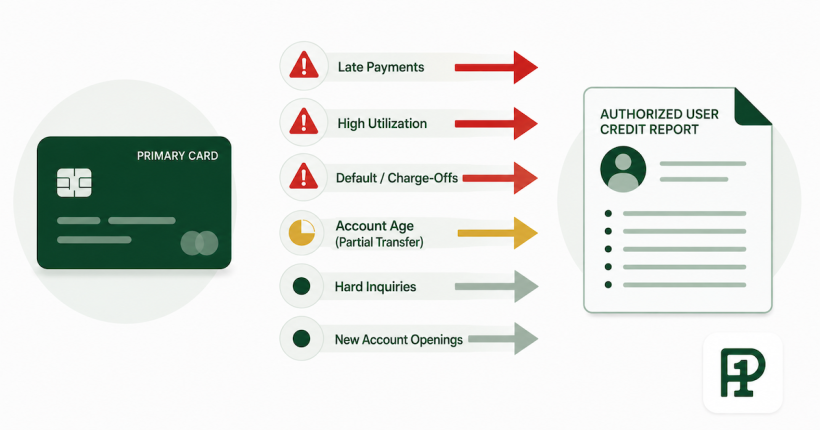
Authorized user accounts are included. If someone adds you as an authorized user on their credit card, that account's balance and limit are incorporated into your utilization calculation. This can work for or against you depending on how the primary cardholder manages the account. A high-utilization account you are added to can suppress your score the same way your own high-utilization card would. The full framework for managing utilization across multiple cards simultaneously — including how authorized user accounts factor into the calculation — is covered in the article on how to manage credit utilization across multiple cards.
The Zero Balance Nuance
A common assumption is that getting every card to $0 is the optimal outcome. It is not — or at least not entirely. FICO's scoring model is designed to evaluate active, responsible credit use. Having every revolving account report a $0 balance can result in a marginally lower score than having one card report a small balance in the 1 to 5% range.
The practical setup for maximum scoring: let one card close each month with a small balance — $50 to $100 on a $3,000 limit is sufficient — while keeping all other cards at zero. This signals active credit engagement without generating meaningful utilization. The score difference between all-zero and one-card-at-1-to-5% is typically 5 to 15 points, which matters most when a score is close to a tier threshold ahead of a major loan application.
How Paying Off Balances Interacts With Utilization
Paying off credit card debt and managing utilization are related but not identical activities. Paying off a balance eliminates the debt and the interest cost — but the utilization benefit only appears when the lower balance is reported on the next statement closing date. A payment made the day after a statement closes will not affect this month's reported utilization. It affects next month's.
This is why the timing of payments matters as much as the amount. The complete payment timing mechanics — including how to make a pre-close payment that controls what gets reported each cycle — are covered in the guide on how paying your credit card twice a month protects your score.
Build the Full Utilization System
Understanding what credit utilization is gets you started. The Credit Utilization & Payment Strategy cluster covers every lever — payment timing, limit increases, multi-card management, and the reporting mechanics that determine what your score sees each month.
Explore the Full StrategyGovernment Resources
CFPB — What Is a Credit Utilization Rate? — Official guidance on how utilization is calculated and why it matters for your credit score.
FTC — Understanding Your Credit — Federal overview of how credit scores are calculated and what factors lenders evaluate.
Return to the full credit building and protection guide for a complete overview of every credit strategy covered on PersonalOne.
Frequently Asked Questions
Is 30% credit utilization good or bad?
It is better than being above 30%, but it is not good by the standards of the highest-scoring profiles. The 30% threshold marks where noticeable score penalties begin — staying just below it avoids one penalty tier but leaves meaningful points behind. The optimal range is 1 to 10%. Someone managing to 29% is still well above where scores are maximized.
Does credit utilization reset every month?
Yes. Utilization is recalculated each time your card issuer reports your balance to the bureaus, which happens on your statement closing date. There is no historical component — only the current reported balance matters. A score suppressed by high utilization for months can recover substantially in a single billing cycle once balances are reported lower.
Does utilization on one card affect your overall score even if total utilization is low?
Yes. FICO calculates utilization both in aggregate and per individual card. A single card at 80% utilization generates a per-card penalty regardless of how low your overall utilization is. Keeping each individual card below 30% — ideally below 10% — matters as much as the aggregate number.
Do installment loans count toward credit utilization?
No. Credit utilization only includes revolving accounts — credit cards and lines of credit. Auto loans, student loans, mortgages, and personal loans are installment accounts and are not factored into the utilization calculation. Paying down an installment loan does not lower your credit utilization.
What is the ideal credit utilization percentage?
Between 1 and 10% produces the best scoring outcomes. Having at least one card report a small balance in the 1 to 5% range while all others report zero is the configuration that generates maximum available points for this factor in most FICO model versions. Zero utilization across all cards is slightly suboptimal compared to the one-card-with-a-small-balance approach, though the difference is typically modest.
How quickly will my score improve if I lower my utilization?
The improvement appears within one to two weeks of your next statement closing with the lower balance. The full cycle from payment to visible score change is typically 30 to 45 days. Because utilization has no historical component, the score can recover to its full potential in a single billing cycle — faster than any other credit factor responds to corrective action.
This content is for educational purposes only and does not constitute financial or credit advice. Credit score calculations vary by scoring model and individual credit profile. PersonalOne is a free financial education platform.