2026
Home › Credit Building & Protection › Credit Optimization for Approvals › How to Read Your Credit Report Like an Underwriter
Part of the Credit Optimization for Approvals cluster — the professional risk framework behind your file, not just the consumer checklist.
About the Author
Don Briscoe is a financial systems strategist with 12+ years of experience helping Millennials and Gen Z build income and financial stability. He founded PersonalOne to provide the financial education he wished existed — structured, honest, and free.
What You Need to Know
— Underwriters don't read a credit report top to bottom the way consumers do — they follow a specific sequence built around risk, not chronology
— A late payment's pattern matters more than its existence — clustered lates suggest a one-time event, scattered lates suggest something harder to explain
— Certain items automatically trigger a request for a Letter of Explanation, and most buyers only find out when the request lands mid-application
— Underwriters weigh compensating factors — low DTI, large reserves, long employment — against weaknesses, not just disqualifiers in isolation
— Reading your report this way before you apply means walking in already knowing what the underwriter will ask, instead of hearing it for the first time under pressure
If you want to read your credit report like an underwriter, the first thing to understand is that nobody reads it the way you've probably been taught to. Most consumer guides tell you to scan for errors, check your personal information, and watch for fraud — useful, but it's not remotely how the person actually deciding your loan reads the same document. An underwriter isn't hunting for mistakes. They're reading for a story, built out of patterns across your file, and that story is what actually determines whether you get approved, what conditions get attached, and what questions you'll be asked before closing. This is the checklist they're trained to run, translated into plain language, so you can read your own file the same way before anyone else does.
The Underwriter's Reading Order
Consumers tend to read a credit report the way it's laid out — account by account, top to bottom. Underwriters read in a different sequence, because their job isn't to catalog your accounts, it's to assess risk as efficiently as possible.
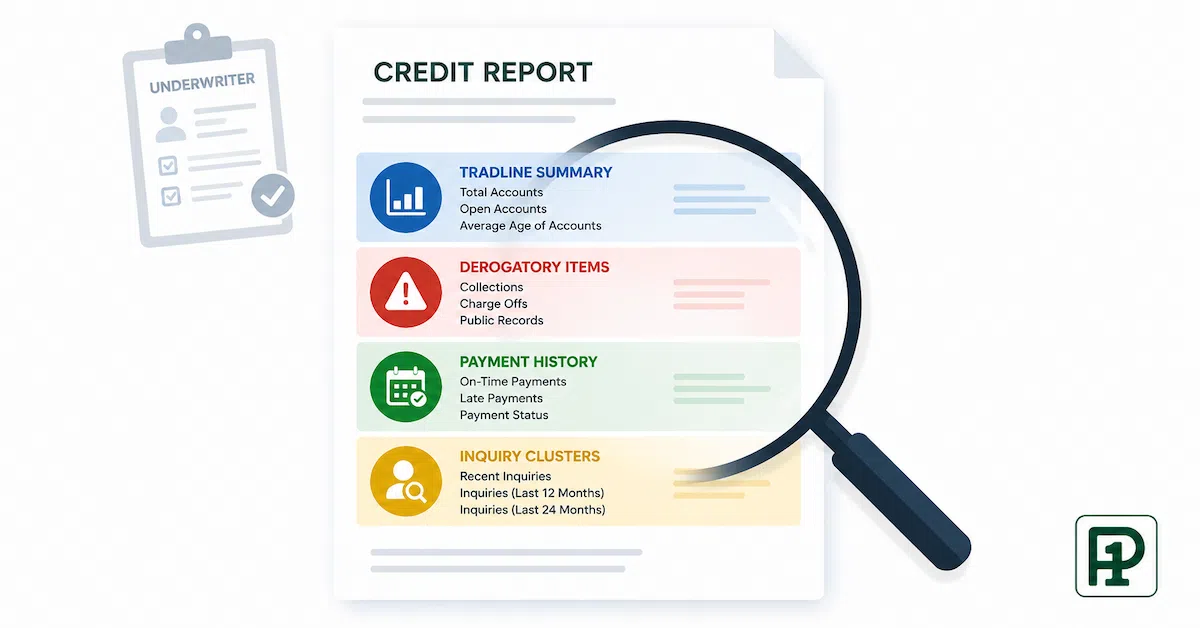
They typically start with the summary tradeline data — the high-level snapshot of total accounts, total balances, and overall utilization — to get a sense of the scale of what they're looking at before diving into detail. From there, they move directly to derogatory items: collections, charge-offs, late payments, public records. This is where the real risk assessment begins, and it happens before they've even looked closely at your payment history on accounts in good standing.
After derogatory items, they look at payment history patterns across all accounts — not just whether late payments exist, but how they're distributed over time. Then inquiry clusters: how many hard pulls happened recently, and whether they're spread across different credit types (a sign of comparison shopping) or concentrated in a short window across similar products (a sign of potential financial stress). A handful of mortgage inquiries within a two-week window reads as normal rate shopping and is typically treated as a single event for risk purposes. The same number of inquiries spread across credit cards, personal loans, and a mortgage all within a month reads very differently, since it suggests someone seeking credit broadly rather than comparing offers for one specific purchase. Public records come last in this sequence, since by that point the underwriter usually already has a working theory of your overall risk profile and is checking whether anything in the public record confirms or contradicts it.
Reading your own report in this order, rather than top to bottom, means you encounter the same red flags an underwriter will encounter, in the same sequence, which makes it far easier to anticipate what they'll ask about and prepare for it before the question ever comes.
The Pattern Recognition Underwriters Actually Run
This is the part almost no consumer guide explains, and it's the single biggest shift in how to think about your own file. An underwriter looking at a late payment isn't just registering that it happened — they're looking at where it sits relative to everything else on your report, because the pattern tells a different story than the event alone.
A single 30-day late payment from four years ago, sitting alone with nothing else around it, reads as an isolated incident. It barely registers as a risk signal on its own. But three 30-day late payments across different accounts, all landing within the same 90-day window, tell a completely different story — even though the total number of late payments might be similar to a borrower with three lates scattered randomly across several years. The clustered pattern suggests a specific, identifiable life event: a job loss, a medical crisis, a divorce, something that disrupted finances for a defined period and then resolved. The scattered pattern suggests something more chronic and harder to pin down or explain away.
This distinction matters enormously for how you'd explain your own file if asked. A clustered pattern has a clean, specific story attached to it — "I lost my job in March, was unemployed for four months, and these are the accounts that fell behind during that window before I caught everything back up." A scattered pattern is harder to narrate convincingly, because there isn't a single event tying it together. If your file has scattered lates, the more honest and more effective approach is usually addressing the underlying habit directly — automatic payments, calendar reminders, whatever closes the gap — rather than trying to construct an explanation that doesn't naturally exist.
The Letter of Explanation Trigger Map
Certain items on a credit report don't just get noted by an underwriter — they automatically generate a request for a Letter of Explanation, a written statement from you addressing the specific item before underwriting can proceed. Most buyers discover this requirement mid-application, already stressed, with limited time to respond. Knowing the trigger list in advance means writing these explanations on your own timeline instead of the underwriter's.
Common triggers include: recent hard inquiries from other lenders, especially multiple inquiries close together; any account in collections, regardless of size; gaps in employment history visible through income documentation; large or unusual deposits showing up on bank statements that don't match your regular income pattern; recently opened or closed accounts close to the application date; and any derogatory mark significant enough to affect the underwriter's risk assessment, even if it's old.
A good Letter of Explanation is short, factual, and specific — what happened, when, and why it won't recur. "I was between jobs for three months in early 2025 due to a layoff, which is when these two accounts fell behind. I've been continuously employed since June 2025 and all accounts have been current since then" does far more work than a long, defensive explanation. Avoid over-explaining or including unnecessary personal detail — underwriters are looking for a clear factual narrative, not a justification, and a tightly written explanation reads as more credible than a lengthy one. If you know in advance which items on your file are likely to trigger this request, you can draft the explanation calmly, well before an underwriter is waiting on it.
What I've Seen
A client once panicked when an underwriter requested a Letter of Explanation for a $4,000 deposit that had landed in their account two months before applying. It was a tax refund, completely unremarkable, but they hadn't documented it and scrambled to find the paperwork while the closing timeline ticked down. The explanation itself took five minutes to write once they had the right document. The stress came entirely from not knowing the request was coming, not from the deposit itself.
The takeaway: almost none of these requests are actually alarming once you understand why they're asked. The anxiety comes from being caught off guard, not from the underlying issue.
The Compensating Factors Framework
Underwriters don't evaluate your file by simply tallying up disqualifiers. They're also looking for compensating factors — strengths elsewhere in your profile that offset a specific weakness. Understanding which factors count as compensating, and how strong they need to be, lets you make genuinely strategic decisions about which weaknesses in your file are worth fixing and which ones are already neutralized by something else you bring to the application.
Common compensating factors include a low debt-to-income ratio relative to the loan program's threshold, cash reserves well above the minimum requirement, a long and stable employment history with the same employer or in the same field, a low loan-to-value ratio from a larger down payment, and a strong history of on-time payments on a similar type of obligation, like rent, even if formal credit history is thinner.
This framework changes the calculus on a lot of the other content in this cluster. If your middle FICO score sits right at a program's minimum threshold, strong reserves or a notably low DTI can be the difference between an approval that feels marginal and one that's genuinely solid, even without the score itself moving at all. Knowing this means you can sometimes make a more informed decision about whether closing a specific gap is worth the time and cash, or whether a compensating factor you already have is doing enough of that work on its own.
Running Your Own File Through the Walkthrough
Pull your full credit report and go through it in the underwriter's order rather than the order it's printed in:
- Start with the summary data — total accounts, total balances, overall utilization — to get the scale of your file before the detail.
- Move to derogatory items first. List every collection, charge-off, late payment, and public record with its date.
- Map your late payments against each other. Are they clustered in a specific window, or scattered across years? This tells you what story your file is already telling, and whether you have a clean explanation or a harder one.
- Check your inquiry history for the last 12 to 24 months. Are inquiries spread across different credit types, or clustered together in a short window on similar products?
- Identify anything on the Letter of Explanation trigger list above. For each one, draft a short, factual explanation now, while there's no deadline pressure.
- List your own compensating factors — your actual DTI, your reserves relative to your likely required minimum, your employment history, your down payment size. Be honest about which weaknesses in your file are genuinely offset by something else, and which ones aren't.
What usually comes out of this exercise is a much clearer picture than "my score is fine" or "my score isn't great." It's a specific list: this item will likely get a pass, this one will probably trigger a question I should prepare for, and this weakness is already covered by a strength I have elsewhere. That's the actual readiness an underwriter is assessing — not a single number, but a coherent file with a story that holds together under scrutiny.
Where to Go From Here, Depending on What You Find
Running this walkthrough usually surfaces a specific issue rather than a vague sense that something's off, and the right next step depends entirely on what that issue is.
If you find an error sitting among the derogatory items — something that shouldn't be there or is reporting incorrectly — the fix isn't to dispute it the moment you spot it. How to dispute errors on your credit report before applying for a mortgage covers the backward timeline for handling that correctly, since filing at the wrong moment can stall an approval rather than help it.
If the summary data shows your utilization is the main thing dragging down your file, whether to pay off debt before a mortgage walks through the specific math on which balances to target and by how much, rather than paying down whichever one feels most urgent.
And once you've addressed what the walkthrough turned up, the work isn't done the moment you apply — why your credit score drops before a mortgage closes covers the 90 days between application and closing, where a clean file can still take an unexpected hit if you're not watching the right things.
See your file the way the underwriter will.
Credit Karma gives you free, ongoing access to your full report so you can run this walkthrough yourself before anyone else reads your file.
Check Your Report Free (affiliate)Government Resources
CFPB: Understanding the Mortgage Financing Process — Federal guidance on how lenders evaluate credit, income, and risk during underwriting.
CFPB: Credit Reports and Scores — Consumer resources on how credit reporting and scoring work.
For the complete pre-application optimization framework, visit the Credit Optimization for Approvals cluster hub.
Frequently Asked Questions
Do all underwriters read a credit report in exactly the same order?
The general sequence — summary data, then derogatory items, then payment patterns, then inquiries, then public records — is broadly consistent because it reflects how risk assessment is taught and structured, but individual underwriters and automated underwriting systems can vary in exact emphasis. The framework here reflects the common pattern, not a universal, identical process at every lender.
Will I definitely get a Letter of Explanation request if one of these triggers applies to me?
Not always, but it's common enough that preparing in advance is worth the small amount of time it takes. Some lenders and automated underwriting systems are more or less sensitive to specific triggers, so the presence of a trigger increases the likelihood of a request without guaranteeing one.
Can strong compensating factors really offset a low credit score?
Within a range, yes. Compensating factors generally can't overcome a score that falls below a loan program's hard minimum, but for a score sitting near a threshold or affecting which rate tier you land in, factors like low DTI, strong reserves, and stable employment history can meaningfully strengthen an otherwise borderline file.
Is a clustered pattern of late payments always viewed more favorably than scattered ones?
Generally, yes, because a clustered pattern is easier to explain with a specific, time-bound event. That said, the severity and recency of the lates still matter — a tightly clustered pattern of serious delinquencies very close to an application date is still a real concern, even though it's more explainable than the same lates scattered randomly across years.
Should I write Letters of Explanation before I even apply?
Drafting them in advance is a good use of time if you've identified clear triggers on your file, since it means you're not writing under deadline pressure. You may not submit them until an underwriter actually asks, but having a clear, factual explanation ready removes most of the stress when the request does come.
Disclaimer: This content is for educational purposes only and does not constitute financial advice. PersonalOne is not a licensed financial advisor, broker, or investment professional. Individual financial situations vary — consult a qualified financial professional for personalized guidance.