August 24, 2026
Home › Credit Building & Protection › Credit Optimization for Approvals › Should You Pay Off Debt Before a Mortgage?
Part of the Credit Optimization for Approvals cluster — the three calculations that actually decide this, not a generic pros-and-cons list.
About the Author
Don Briscoe is a financial systems strategist with 12+ years of experience helping Millennials and Gen Z build income and financial stability. He founded PersonalOne to provide the financial education he wished existed — structured, honest, and free.
What You Need to Know
— There's no single right answer — the decision depends on three separate calculations, not a feeling about your overall debt load
— The DTI calculation tells you whether a specific debt is the one standing between you and approval, or between rate tiers
— The utilization math on credit cards isn't linear — going from 80% to 30% moves your score far more than going from 28% to 0%
— Draining cash reserves to pay off debt can disqualify you for a completely different reason than the debt itself ever would have
— Almost-paid-off installment debt sometimes doesn't even count meaningfully toward your DTI, making it the wrong target for your cash
— A simple decision matrix run against your actual numbers tells you, debt by debt, whether to pay it off, pay it down, or leave it alone
If you're trying to decide whether to pay off debt before a mortgage application, you've probably already found the standard advice: lower your DTI, but don't drain your savings, and watch out for credit score swings close to closing. All of that is true, and none of it tells you what to actually do with the specific debts sitting in front of you right now. The honest answer isn't yes or no — it's that paying off debt before a mortgage is really three separate decisions wearing one question's clothing, and each one is answered by a different calculation. Run all three against your real numbers and the right move for each debt you're carrying becomes obvious instead of a guess.
Calculation 1: The DTI Math That Actually Controls Approval
Debt-to-income ratio compares your total monthly debt obligations to your gross monthly income, and most lenders want it below 36% to 43% depending on the loan program. Every article on this topic mentions DTI. Almost none of them show you how to actually run the number against a specific debt before deciding whether to pay it off.
The question that matters isn't "how much debt do I have." It's "which specific payment, if eliminated, moves me from denied to approved, or from one rate tier into a meaningfully better one." A $300-a-month car payment that pushes your DTI from 44% down to 38% is worth eliminating even if it costs you some of your cash reserves, because it's the difference between qualifying and not. The math here is simple: take your current monthly debt total, subtract the payment in question, divide by your gross monthly income, and see whether the result crosses a threshold that actually matters for your loan program.
The detail that catches people off guard in the other direction: some lenders don't fully count installment debt with a short remaining term in their DTI calculation at all, particularly when fewer than 10 months remain on the loan. A $50-a-month personal loan with four payments left might not move your DTI in any meaningful way even if you pay it off completely, which means spending cash to eliminate it may not buy you anything on the approval side of the equation. Before paying off any installment debt specifically for DTI purposes, confirm with your loan officer whether your lender's guidelines exclude near-payoff balances — the answer changes whether this calculation even applies to that debt.
Consider a borrower earning $7,000 a month with $2,800 in total monthly debt obligations, landing at a 40% DTI — above the 38% threshold their lender needs for a particular loan program. Two debts are on the table: a $200-a-month credit card minimum and a $300-a-month car payment with 14 months remaining. Eliminating the car payment drops total debt to $2,500, bringing DTI to roughly 35.7%, clearing the threshold with room to spare. Eliminating the credit card instead only drops DTI to about 37.1% — still short of 38%, and likely not worth the cash if it doesn't actually solve the approval problem. The math, not which debt feels more urgent emotionally, is what should decide which one gets the available cash.
DTI isn't just a disqualifier underwriters check off — it's also one of the compensating factors they weigh against weaknesses elsewhere in your file. How to read your credit report the way an underwriter does covers how a strong DTI can offset other concerns, which sometimes changes whether a specific payoff is even necessary.
Calculation 2: The Utilization Math, Where Credit Cards Behave Differently
Paying off a credit card does two things at once: it changes your DTI a little, and it changes your credit utilization a lot — and utilization is where the math gets genuinely nonlinear in a way that catches people off guard.
Utilization scoring isn't a straight line from 0% to 100%. The scoring models weight the difference between very high and moderate utilization far more heavily than the difference between moderate and very low. Going from 80% utilization down to 30% on a single card can move your middle FICO score by 20 to 40 points, which is sometimes the exact difference between one mortgage rate tier and the next, worth tens of thousands of dollars over a 30-year term.
Going from 28% down to 0% on that same card, by contrast, often moves the score by something closer to 5 points — real, but nowhere near the same leverage. This is the part the standard "pay off your credit cards" advice misses entirely: the first chunk of any payment toward a high balance does dramatically more work than the last chunk, which has direct implications for how you should split limited cash across multiple cards rather than fixating on any single balance.
This changes the actual question from "should I pay off my credit cards" to "which card, paid down to which balance, gets me the most score movement per dollar spent." If you're carrying balances on multiple cards, the highest-leverage move is almost always bringing your highest-utilization card down to the 20% to 30% range first, rather than paying any single card down to zero while others sit untouched at 70% or 80%.
What I've Seen
A client once had $4,000 to put toward debt before a mortgage application and was planning to pay off one card completely, leaving a second card at 75% utilization untouched. We ran the math the other way instead — splitting the same $4,000 across both cards to bring each one down to roughly 25% utilization rather than zeroing out just one. Their middle FICO score moved nearly three times further than the original plan would have produced, for the exact same amount of money spent.
The takeaway: the dollar amount you have to spend matters less than where you spend it. Splitting the same money across the right balances almost always outperforms paying one account to zero.
Calculation 3: The Cash Reserves Trade-Off Nobody Quantifies
Every article on this topic warns against draining your savings to pay off debt. Almost none of them say how much you actually need to keep, which makes the warning impossible to act on with any precision.
Most mortgage lenders want to see reserves equal to two to six months of your total mortgage payment — principal, interest, taxes, and insurance combined — remaining in your accounts after closing costs and down payment are covered. The exact requirement varies by loan program and lender, with conventional loans on the lower end of that range for well-qualified borrowers and certain loan types or lower credit profiles pushing toward the higher end.
This creates a genuinely important trade-off that the cash reserves calculation makes concrete instead of abstract: if paying off a debt drops your post-closing reserves below your lender's required threshold, that payoff can disqualify you for an entirely different reason than the debt itself ever would have. Before paying off anything, calculate your expected post-closing reserves first — total cash on hand, minus down payment, minus closing costs, minus whatever you're considering spending on debt payoff — and confirm the remaining figure still clears your lender's minimum. If it doesn't, the math has just told you that debt isn't your problem to solve with this cash; reserves are.
Consider a borrower with $35,000 in total cash, putting $20,000 toward a down payment and $8,000 toward closing costs, leaving $7,000 remaining. Their mortgage payment, including taxes and insurance, comes to $2,200 a month, and their lender requires three months of reserves after closing — $6,600. That leaves only $400 of genuine cushion above the requirement. Spending $3,000 of that remaining cash to pay off a credit card would drop reserves to $4,000, below the $6,600 threshold, which can stall or sink the approval regardless of how much the payoff might have helped the credit side of the file. In this case, the math says leave the card alone, or find a smaller amount to put toward it that doesn't compromise the reserve requirement.
Run your own numbers before you decide.
The PersonalOne Debt Paydown Calculator lets you model different payoff amounts across your actual balances to see the real impact before you spend a dollar of it.
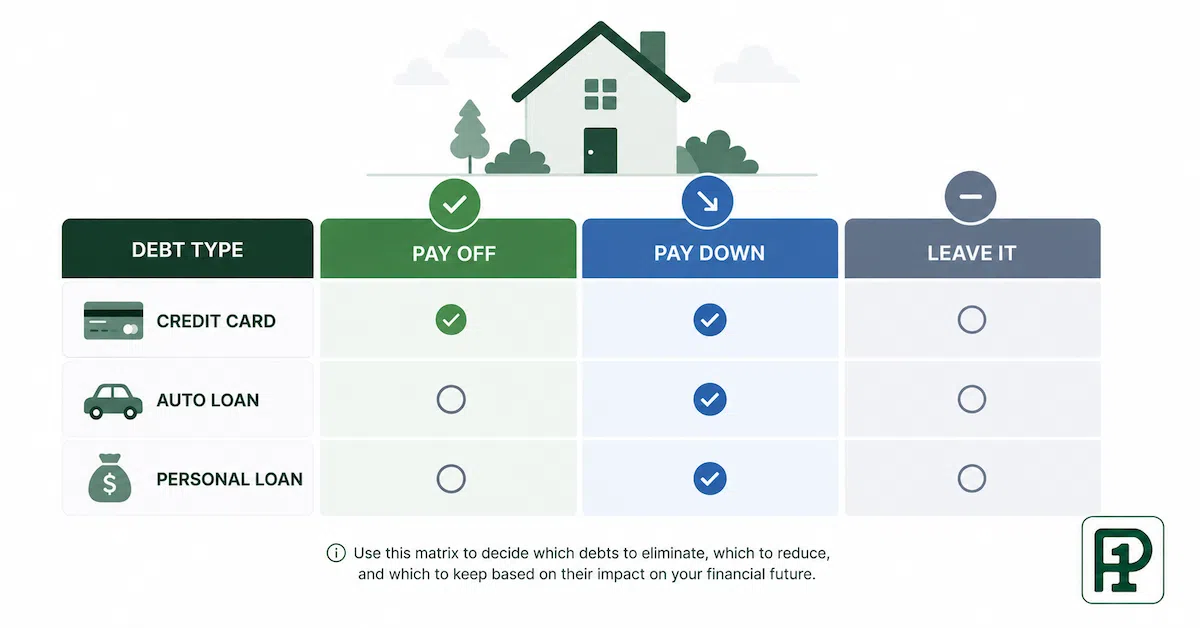
The Debt Payoff Decision Matrix
Run each debt you're carrying through all three calculations above, and one of three verdicts emerges for each one:
- Pay Off: The debt is small enough that paying it off entirely doesn't meaningfully threaten your reserves, and either the DTI calculation shows it's standing between you and approval, or it's a high-utilization card where full payoff is affordable without leaving other cards untouched at high balances.
- Pay Down: This is where most credit card debt lands. Rather than paying any single card to zero, bring your highest-utilization balances down to the 20% to 30% range, splitting available cash across multiple cards if you're carrying balances on more than one, since this is almost always the highest-leverage use of a limited amount of money.
- Leave It: The debt has a short remaining term that may not move your DTI meaningfully, paying it off would drop your reserves below your lender's required threshold, or the math simply doesn't justify the cash outlay relative to what it actually buys you in approval odds or rate tier.
Most readers carrying multiple debts will find they land in different boxes for different balances — pay down the maxed-out card, leave the near-payoff personal loan alone, and pay off the one installment debt that's genuinely dragging down DTI. That mix, not a single blanket decision, is usually what the numbers actually support. If you're unsure which box a specific debt belongs in, work through the calculations in order: check DTI impact first since that determines approval itself, then utilization impact for any revolving balances, and finally confirm the reserves math holds up before committing cash to either of the first two. A debt that passes the first two tests but fails the reserves check should move to Leave It regardless of how compelling the DTI or utilization case looked on its own.
Timing the Payoff Around Your Application
Once you know which debts to target, timing matters almost as much as the decision itself. A large payoff right before your statement closes on a credit card reports immediately and helps your utilization number. A payoff that happens after your statement has already closed for the month won't show up until the next cycle, which can leave you applying with a number that doesn't yet reflect the work you just did.
This is the same reporting-cycle mechanic behind why your credit score drops before a mortgage closes — knowing your statement closing dates lets you time a payoff to actually count before your lender's final pull, rather than paying down a balance and then wondering why the score hasn't moved yet.
If part of what's affecting your numbers is an actual error rather than a debt you owe, resist folding it into this same payoff timeline. Disputing a reporting error follows a different clock than paying down a balance, and filing at the wrong moment can stall your approval rather than help it. How to dispute errors on your credit report before applying for a mortgage covers the backward timeline for handling that piece correctly, separate from the debt payoff decisions covered here.
Government Resources
CFPB: What Is a Debt-to-Income Ratio? — Federal guidance on how DTI is calculated and why lenders use it.
CFPB: Understanding the Mortgage Financing Process — Guidance on how lenders evaluate finances, debt, and reserves during underwriting.
For the complete pre-application optimization framework, visit the Credit Optimization for Approvals cluster hub.
Frequently Asked Questions
Is it always better to pay off debt before applying for a mortgage?
No. It depends on which calculation applies to the specific debt. A debt that's barely affecting your DTI and would drain your required cash reserves if paid off can do more harm than good, even though paying off debt sounds universally responsible.
Should I pay off one credit card completely or spread payments across several?
Usually spreading payments across several cards to bring each one's utilization into a moderate range produces more score improvement than paying a single card to zero while others remain at high utilization, since the scoring impact of utilization isn't linear.
How much cash reserve do I actually need to keep after paying off debt?
Most lenders want two to six months of your total mortgage payment, including taxes and insurance, remaining in reserves after closing. The exact figure varies by loan program and lender, so confirm the specific number with your loan officer before deciding how much cash to put toward debt.
Does paying off a personal loan early always help my DTI?
Not necessarily. Some lenders don't fully count installment debt with a short remaining term, often under 10 months, in their DTI calculation. If that applies to your loan, paying it off may not change your qualifying numbers even though the debt disappears from your file.
When should I make a debt payoff so it shows up before my lender's final credit pull?
Pay it down before your card's statement closing date, not just before the due date. Reported utilization reflects your statement closing balance, so a payoff made after the statement has already closed for the month won't be reflected until the following cycle.
What if I can't decide which debt to target with limited cash?
Run each debt through all three calculations rather than trying to judge it by feel. A debt that looks small can be the one actually limiting your approval through DTI, while a debt that feels urgent might barely move your numbers at all. The calculations consistently outperform intuition here, since utilization and DTI math rarely line up with which balance feels most uncomfortable to carry.
Disclaimer: This content is for educational purposes only and does not constitute financial advice. PersonalOne is not a licensed financial advisor, broker, or investment professional. Individual financial situations vary — consult a qualified financial professional for personalized guidance.