July 2026
Home › Credit Building & Protection › Credit Score Building Strategies › What Affects Your Credit Score: The 5 Factors That Determine It
What You Need to Know
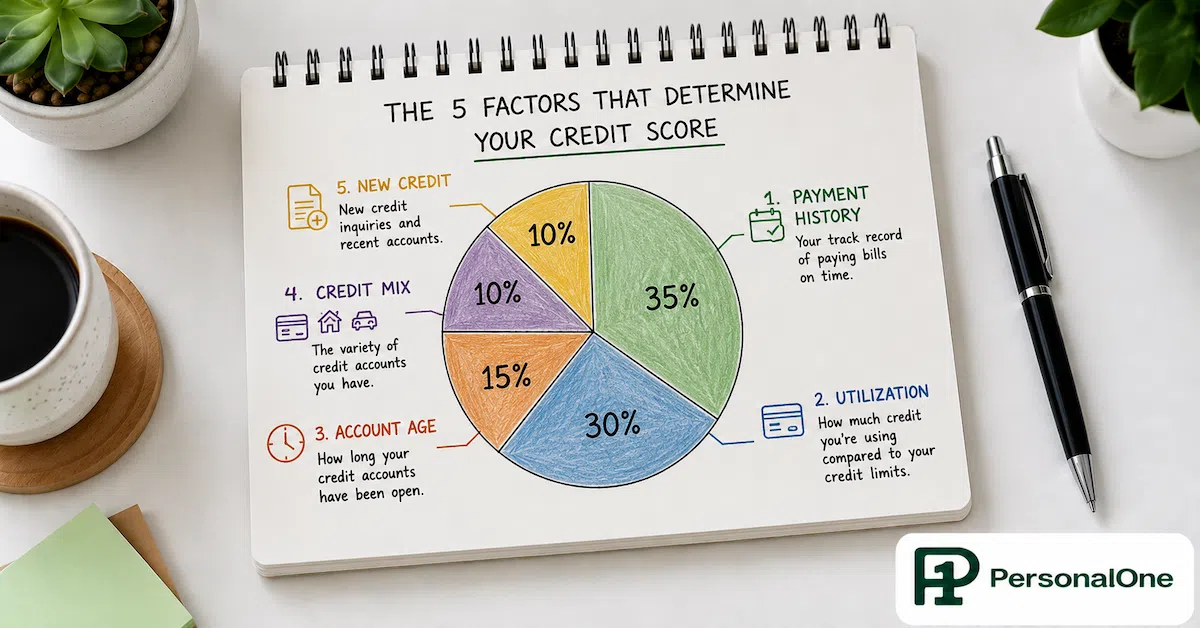
— Five factors determine a FICO credit score: payment history (35%), credit utilization (30%), length of credit history (15%), credit mix (10%), and new credit inquiries (10%). These percentages are approximate averages — the actual weight of each factor shifts based on the depth and age of a specific credit profile.
— Two factors — payment history and utilization — account for 65% of the score and are almost entirely within active control. Most score improvement work happens in these two categories.
— The factors interact. Paying off a loan can temporarily drop a score by reducing credit mix. Opening a new card temporarily drops a score by lowering average account age, then improves it by increasing available credit. Understanding interactions prevents confusing score movement.
— Utilization is the most volatile factor month to month because it reflects current balances, which change with every spending and payment cycle. Payment history is the most stable factor because it accumulates over years.
— This article is the foundational layer. Every other article in the Credit Building & Protection system connects back to one of these five factors.
What affects your credit score is one of the most searched personal finance questions — and one of the most incompletely answered. The standard response is a list of five factors with their percentage weights. That list is accurate. What it misses is the mechanism behind each factor: what specifically moves it, what damages it, how it interacts with the other four, and why score behavior that seems random becomes entirely predictable once the factors are understood at the mechanic level rather than the definition level.
This is the foundational article for the entire Credit Building & Protection system. Every credit strategy — building from zero, recovering from damage, optimizing an existing score, managing utilization — operates on these five factors. Understanding how they work individually and as a system is the prerequisite for every other credit decision.
The complete framework for using this knowledge to build a score strategically is in credit score building strategies.
Factor 1 — Payment History: 35%
Payment history is the largest single factor in the FICO score and the most straightforward to understand: every payment on every reported account is recorded as on-time or late, and that record accumulates over the life of the credit file. A clean payment record is the single most powerful thing a person can build for their credit score. A single 30-day late payment on an otherwise clean file can drop a score by 17–83 points depending on the starting score level, per FICO data.
What payment history includes:
— On-time payment status for every credit card, loan, mortgage, and line of credit that reports to the bureaus
— Late payments categorized by severity: 30 days, 60 days, 90 days, 120+ days
— Collection accounts, charge-offs, and bankruptcies
— How recently the negative event occurred (recency matters — a late payment from six years ago has far less impact than one from six months ago)
What moves it positively: Every month an account reports as paid on time adds a small positive data point. The effect is gradual in the upward direction and immediate in the downward direction. A file with 48 consecutive on-time payments carries significantly more weight in this factor than a file with 6.
What damages it: A payment reported 30 or more days past due. The damage scales with severity (30-day late is less damaging than 90-day) and with recency (recent lates are weighted more heavily than old ones). The full mechanics of how credit card payments affect your credit score — including the statement date vs payment date distinction that causes score drops even when bills are paid — covers this factor in depth.
The most important action: Automate the minimum payment on every account. A missed payment almost always happens from oversight, not inability. Automation eliminates the oversight risk entirely. If a score dropped unexpectedly and payment history is the suspected cause, why your credit score dropped covers the diagnostic sequence for identifying the specific cause.
Factor 2 — Credit Utilization: 30%
Credit utilization is the ratio of current credit card balances to credit card limits, expressed as a percentage. It is the second largest factor and the most volatile month to month because it reflects current balances — which change with every spending and payment cycle. A card with a $5,000 limit and a $500 balance is at 10% utilization. A card with a $1,000 limit and a $900 balance is at 90% utilization. Both numbers affect the score in real time at every reporting cycle.
How utilization is calculated: Two calculations matter simultaneously. Per-card utilization measures each card's balance against its individual limit. Total utilization measures the sum of all balances against the sum of all limits. A single card at 90% utilization damages the score even if the total utilization across all cards is low. Managing both numbers is necessary. For the full explanation, credit utilization covers the mechanics, the optimal thresholds, and the specific scoring impact at each utilization band.
The reporting date problem: Utilization is measured at the statement closing date, not the payment due date. A balance that is high when the statement closes gets reported as high utilization — even if paid in full five days later. This is the most common cause of confusing score drops for people who pay in full every month. Timing credit card payments to reduce the balance before the statement close date is the specific tactic that resolves this.
Target thresholds: Below 30% total and per-card is the standard guidance. Below 10% produces the best score outcome. Above 30% begins to produce meaningful score drag. Above 50% on any single card produces significant damage regardless of total utilization.
Why this factor resets monthly: Unlike payment history, which accumulates and persists, utilization has no memory. A month with 80% utilization followed by a month with 5% utilization produces a score that reflects the 5% — the prior month's high balance does not leave a lasting mark. This makes utilization the fastest factor to improve through active management.
Factor 3 — Length of Credit History: 15%
Length of credit history evaluates three age-related data points: the age of the oldest account, the age of the newest account, and the average age of all accounts. All three are considered simultaneously. A file with a 15-year-old card and a newly opened card has a high oldest account age but a lower average age than a file with only the 15-year-old card.
Why this factor matters most for beginners: A person starting from zero has no account age at all. This factor is the primary reason building a score from scratch takes 12–18 months to reach the "good" range — the account age contribution cannot be accelerated by behavior, only by time. The timeline for how account age builds and when it starts producing meaningful score contributions is covered in how long it takes to build credit.
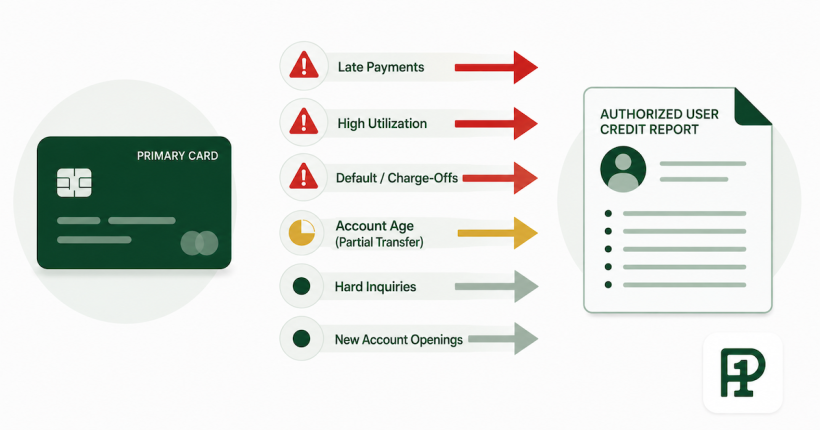
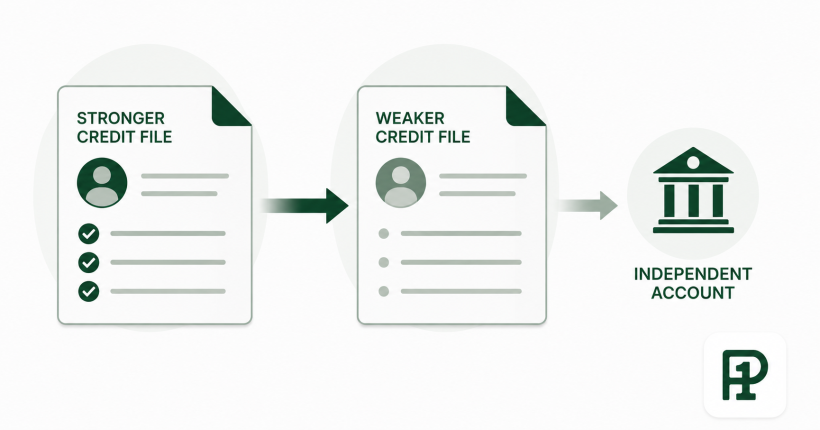
The authorized user shortcut: Being added as an authorized user on an account with a long positive history immediately reflects that account's age in the credit file. A person with no credit history who is added to a 12-year-old account will have a 12-year account contributing to their length-of-credit-history calculation from the first reporting cycle. The authorized user strategy is the only legitimate way to accelerate the account age factor.
Common mistake: Closing old accounts to simplify finances. The oldest account is the most valuable contribution to this factor. Closing it eliminates its contribution and lowers the average account age immediately. Keeping old accounts open — even unused ones — is the correct approach. A small annual purchase keeps the account active without requiring ongoing management.
Factor 4 — Credit Mix: 10%
Credit mix evaluates the diversity of account types in a credit file. FICO recognizes two primary categories: revolving credit (credit cards, lines of credit) and installment credit (auto loans, student loans, mortgages, personal loans). A file with both types demonstrates the ability to manage different forms of debt, which produces a slightly higher score than a file with only one type.
What it contributes: At 10% of the score, credit mix is the least impactful factor to actively pursue. Adding an installment loan solely to improve credit mix is rarely worth the cost and the hard inquiry unless the loan serves another financial purpose. The mix contribution improves naturally over time as people acquire car loans, student loans, and eventually mortgages — the credit mix fills in organically without requiring deliberate management.
Where it matters for beginners: A person with only credit cards and no installment accounts is missing one dimension of the mix. Adding a credit-builder loan — which builds payment history simultaneously — is the most efficient way to add installment credit to a thin file without taking on debt for its own sake.
The interaction with payment history: Paying off a loan eliminates an installment account from the active mix, which can produce a temporary score drop even though the debt is gone. This is one of the most common sources of the "my score dropped when I paid off my loan" confusion. The paid loan remains on the report for up to 10 years as a positive closed account, but its active contribution to credit mix ends at closure.
Factor 5 — New Credit Inquiries: 10%
New credit evaluates two related but distinct signals: recent hard inquiries from credit applications, and the presence of recently opened accounts. Each new hard inquiry typically lowers the score by 5–10 points temporarily. New accounts lower the average account age. Both effects are temporary and generally resolve within 6–12 months.
Hard vs soft inquiries: Hard inquiries occur when a lender pulls credit for an application decision. They appear on the credit report and affect the score. Soft inquiries — from checking your own score, pre-qualification checks, employer background checks — do not affect the score at all. The confusion between the two produces unnecessary anxiety about routine score monitoring.
Rate shopping protection: Multiple hard inquiries for the same type of loan (mortgage, auto, student loan) within a 14–45 day window are treated as a single inquiry by FICO. Shopping multiple lenders for the best mortgage rate does not compound the inquiry damage. This protection applies to rate-sensitive loan types but not to credit card applications.
When to apply for new credit: Avoid applying for new credit in the 3–6 months before a major loan application (mortgage, auto loan). The hard inquiry and the new account average-age reduction both produce temporary score dips that could affect the rate tier at a consequential moment. Space credit applications at least six months apart during active credit building.
How the Five Factors Interact
The factors do not operate independently. Decisions that improve one factor sometimes temporarily damage another. Understanding the interactions is what separates people who manage credit strategically from those who react to confusing score movements with no framework for interpretation.
Opening a new card: Hard inquiry lowers score by 5–10 points (new credit). New account lowers average age (length of history). But total available credit increases, which lowers utilization if balances stay the same (utilization). Net effect is often slightly negative immediately, neutral within 3 months, and positive within 6–12 months as utilization benefit outweighs the temporary age and inquiry impact.
Paying off an installment loan: Eliminates a monthly on-time payment stream (payment history contribution decreases slightly). Removes an installment account from active credit mix (mix contribution decreases). No direct utilization effect since installment loans are not included in the revolving utilization calculation. Score often dips 5–15 points immediately then stabilizes.
Closing a credit card: Reduces total available credit (utilization rises on remaining cards). If it was the oldest card, eliminates the oldest account age contribution (length of history drops). No payment history effect on closed accounts — they continue contributing positively for up to 10 years. Score impact depends heavily on how much of total available credit the card represented.
Most of the month-to-month score variation that feels unexplained is actually one of these interactions playing out. For a complete framework of why scores fluctuate and what each type of movement means, see why your credit score changes every month.
The Factor Summary: Where to Focus First
| Factor | Weight | Controllability | Speed of Impact | Priority |
|---|---|---|---|---|
| Payment History | 35% | High | Slow up / Fast down | Highest |
| Credit Utilization | 30% | Very High | Fast (resets monthly) | Highest |
| Length of History | 15% | Low (time-dependent) | Very slow | Medium |
| Credit Mix | 10% | Moderate | Slow | Lower |
| New Credit | 10% | High | Temporary negative, then neutral | Manage timing only |
The two highest-priority factors — payment history and utilization — are both highly controllable and together account for 65% of the score. Almost all score improvement work happens here. The remaining three factors either require time (account age), fill in naturally (credit mix), or just need timing management (new credit). For anyone working on score recovery specifically, how to recover from a low credit score covers the sequence for addressing each factor when the starting point involves existing negative items.
What I've Seen
Most people who come to me frustrated with their credit score are fighting the wrong factor. They focus heavily on opening new accounts and diversifying credit mix — the two factors that together account for 20% of the score — while underweighting utilization management, which accounts for 30% and resets every month. The fastest score improvement I see consistently comes from clients who shift their focus entirely to getting reported balances below 10% before statement close. A single billing cycle of sub-10% utilization on all cards often produces a 15–30 point improvement without any other change. That result is available to almost anyone with existing credit cards — it is just rarely the first thing people try.
Understanding the Factors Is the Foundation. Building on Them Is the System.
The complete framework for turning this knowledge into a credit building strategy — from first account through 740 and beyond — is in credit score building strategies. For the highest-leverage actions available right now, see how to increase your credit score quickly.
Frequently Asked Questions
Which factor is most important for building credit quickly?
Payment history and utilization together are the most important for anyone actively building or improving a score. Payment history requires time — each on-time payment adds a small positive increment month over month, and the effect compounds over 12–24 months. Utilization is the fastest factor to improve because it resets every billing cycle. Someone with existing credit cards who brings reported balances below 10% before statement close can see meaningful score improvement within 30–60 days. The combination of clean payment history plus low reported utilization is the engine of score growth for most people.
Does closing a credit card hurt your credit score?
Usually yes, in two ways. First, closing a card reduces total available credit, which raises utilization on remaining cards at the same spending level. Second, if the card is old, closing it may lower the average account age. The older and higher-limit the card, the more damaging the closure. The correct approach for unused cards is to keep them open and make a small purchase periodically to prevent the issuer from closing it due to inactivity. The only legitimate reason to close a card is an annual fee that exceeds the card's value.
Do student loans help your credit score?
Yes — in two ways. Student loans are installment accounts that add to credit mix diversity. Every on-time student loan payment contributes to payment history. A student loan that has been paid on time for several years represents a significant positive contribution to both factors. The negative aspect of student loans is the debt load itself, which affects debt-to-income ratio for lending purposes (though not the credit score directly) and the utilization calculation only if any portion is revolving credit.
How much does a hard inquiry lower your credit score?
A single hard inquiry typically lowers a credit score by 5–10 points, per FICO data. The effect is temporary and generally fades within 12 months, though the inquiry remains on the report for two years. Multiple hard inquiries compound the effect. For mortgage and auto loan shopping, FICO counts multiple inquiries of the same type within a 14–45 day window as a single inquiry — which means rate shopping does not multiply the damage. Credit card applications do not receive this protection — each application counts as a separate inquiry.
Why do different credit monitoring apps show different scores?
Because different apps use different scoring models. A banking app might show a FICO 8 score. Credit Karma shows a VantageScore 3.0. A mortgage lender might use FICO 5 from Equifax, FICO 4 from TransUnion, and FICO 2 from Experian simultaneously. Each model uses the same five underlying factors but weights them differently and applies different algorithms. The same person can legitimately have scores ranging from 680 to 730 across different models at the same moment. The score shown in any monitoring app is real — it is just one of many valid scores calculated from the same underlying credit file.
Official Sources
myFICO — What's in Your Credit Score (official FICO factor breakdown and weights)
CFPB — What Is a Credit Score?
AnnualCreditReport.com — Free Weekly Credit Reports from All Three Bureaus
Freddie Mac — The 5 Factors That Make Up Your Credit Score
PersonalOne Money System
This content is researched, written, and owned by PersonalOne — a free financial education platform built to help Millennials and Gen Z build real financial systems.
Disclaimer: This content is for educational purposes only and does not constitute financial advice. FICO factor weights are approximate averages published by FICO and may vary by individual credit profile and scoring model version. Always review your full credit report at annualcreditreport.com for account-specific information. PersonalOne is not a licensed financial advisor.