September 2026
Home › Credit Building & Protection › Authorized User Credit Strategy › Authorized User Strategy for Couples: Building Credit Together Without the Risk
What You Need to Know
— The couples AU strategy is not "add each other to each other's cards." It is a structured four-part framework: assess each partner's starting position, design the right AU structure for the goal, build independent credit in parallel, and protect both credit files through any relationship transition.
— For mortgage qualification, lenders use the lower of both partners' qualifying scores. One partner's strong score does not offset the other's weak one — both need to clear the rate tier threshold independently.
— AU status creates credit score improvement that reverses when the AU relationship ends. Both partners need independent credit accounts that persist regardless of what happens to the AU arrangement.
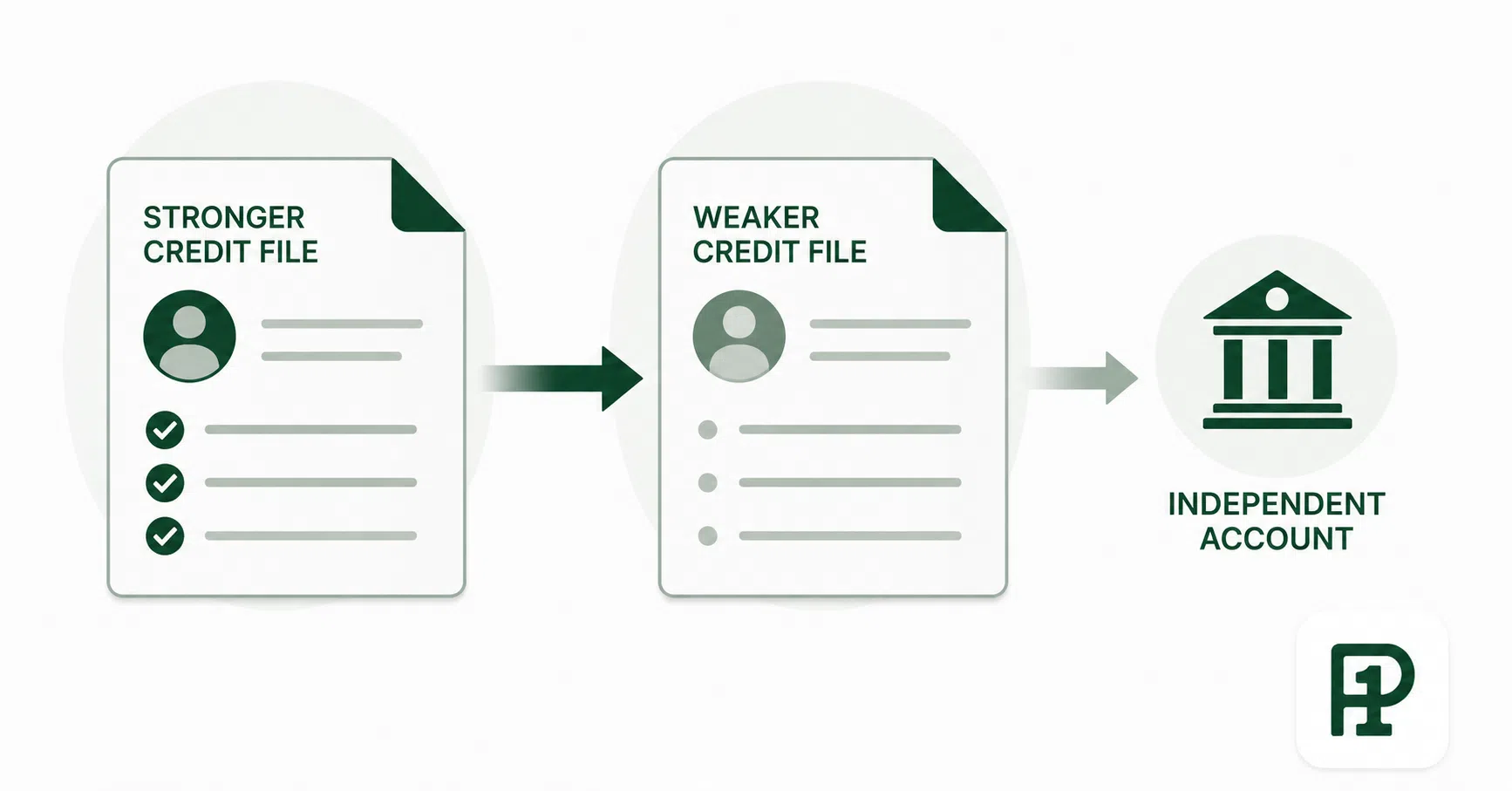
— The partner with the stronger credit profile is almost always the primary cardholder. The partner with the weaker profile is almost always the authorized user — not because of trust, but because of which account delivers the most benefit to which credit file.
— Never add a partner to your card without a clear conversation about spending rules, financial accountability, and what happens to the arrangement if the relationship changes. The structural risk is real regardless of how stable the relationship feels.
The authorized user strategy looks simple when couples consider it: one partner has a stronger credit profile, the other has a weaker one, and adding the weaker partner to the stronger partner's card seems like the obvious move. In practice, the authorized user strategy couples context is more nuanced than that — and the decisions made about how to structure the arrangement, which accounts to use, and what to build independently determine whether the strategy produces lasting credit improvement or a temporary score boost that collapses when circumstances change.
Most couples pursuing AU strategy are working toward a specific financial goal — mortgage qualification, a major loan application, or reaching a credit score threshold that unlocks better rates. Those goals have specific requirements that generic AU advice doesn't address. Lenders evaluating a joint mortgage application don't take the average of both partners' scores — they use the lower of the two qualifying scores. That reality changes the strategic calculation completely and makes the details of how the AU arrangement is structured matter enormously.
This guide covers the complete couples AU framework: how to assess each partner's starting position, how to design the AU structure for the specific goal, how to build independent credit in parallel so the improvement persists, and how to protect both credit files through any relationship transition.
Step 1 — Assess Each Partner's Starting Position
Before designing an AU arrangement, both partners need a clear picture of their current credit profile. The assessment is not a comparison exercise — it is a diagnostic that determines which accounts exist, what quality they are, and what each partner's credit file is actually missing.
What to Pull and Review
Both partners should pull their full credit reports from all three bureaus at AnnualCreditReport.com. Review four specific dimensions for each partner: account age (what is the oldest account, what is the average account age), utilization (what is the current overall utilization ratio and are there any high per-card utilization accounts), payment history (are there any late payments, collections, or derogatory marks, and how old are they), and account mix (are there revolving accounts, installment accounts, or is the file one-dimensional). The complete picture of what each scoring factor is and how it's calculated — which informs what the AU arrangement can and cannot fix — is covered in the article on how being an authorized user actually builds credit.
Identifying the Gap
The diagnostic produces a specific gap analysis for the weaker credit partner. A thin file with no derogatory marks and low utilization responds dramatically to AU addition — the primary account's age and history fill the gaps directly. A file with active late payments, collections, or high utilization on existing accounts responds less dramatically to AU addition because the negative items suppress the score independently of what the AU account contributes. AU strategy does not remove negative items from the weaker partner's own accounts. It adds positive history alongside them — which helps, but less than most people expect when significant negative history already exists.
What I've Seen
The pattern I see most often with couples pursuing AU strategy for mortgage qualification is one partner with a strong credit profile — 750+, long history, low utilization — and the other partner with a score in the 620 to 660 range, usually because of limited credit history rather than negative marks. The strong partner adds the weaker one to their oldest, lowest-utilization card. The weaker partner's score improves 30 to 55 points over two billing cycles. They apply for the mortgage and qualify at a better rate than they would have without the AU addition. That outcome is achievable and real. The mistake I see is when the couple stops there and never builds independent credit for the weaker partner. Two years later, the primary cardholder closes the card or the relationship changes and the AU status ends. The score drops back. The mortgage is already locked so it doesn't matter for that transaction — but every subsequent financial decision suffers. The AU strategy was the bridge. They forgot to build the destination.
Step 2 — Design the Right AU Structure for the Goal
The AU structure — which card, which partner as primary, which direction the arrangement runs — should be designed around the specific goal, not around convenience or generosity.
Which Partner Should Be Primary
The partner with the stronger credit profile is almost always the correct primary cardholder in a couples AU arrangement — not because of financial hierarchy or trust, but because the primary account's quality determines how much benefit the authorized user receives. A high-limit, old, low-utilization card with clean payment history from the stronger partner delivers maximum benefit to the weaker partner's credit file. The weaker partner's card — lower limit, shorter history, potentially higher utilization — would deliver a smaller benefit in reverse. The structural logic points clearly to which partner should hold which role.
Which Account to Use
Not every account the stronger partner holds is equally useful for AU purposes. The ideal account for AU addition is the one with the highest credit limit, lowest current utilization at statement close, longest account history, and cleanest payment record. If the stronger partner has three cards — a seven-year-old card with a $15,000 limit at 5% utilization, a three-year-old card at 40% utilization, and a new card opened last year — the choice is obvious. The seven-year-old card at 5% utilization delivers age, available credit, and payment history simultaneously. The 40% utilization card delivers available credit but creates a per-card utilization penalty. The new card delivers almost nothing. The full pre-addition evaluation checklist — including what to verify about utilization, payment history, account age, and issuer reporting — is covered in the article on when you should never add someone to your credit card.
The Mutual AU Arrangement
Some couples add each other to each other's cards — both partners become authorized users on the other's account simultaneously. This works when both partners have accounts of different quality and each can benefit from the other's strongest card. It also provides redundancy: if one card is closed or the arrangement on one card changes, the credit impact flows in one direction while the other arrangement continues. The consideration is that mutual AU arrangements require both partners to be comfortable with their spending patterns and balance levels appearing in each other's credit files. Both partners' utilization affects both credit files — which means one partner's high spending month creates a utilization problem for both credit reports, not just one.
Step 3 — The Mortgage Connection: Why Both Partners Need Independent Credit
The most common reason couples pursue AU strategy is mortgage qualification — either reaching a minimum score threshold to qualify at all or improving both scores enough to qualify at a favorable rate tier. Understanding how lenders evaluate credit scores in a joint mortgage application determines how the AU strategy should be sequenced relative to the application timeline.
How Joint Mortgage Applications Use Credit Scores
When two borrowers apply for a mortgage together, most lenders pull all three bureau scores for each borrower and use the middle score for each individual. Then they take the lower of the two qualifying scores as the basis for rate and approval decisions. A strong partner with a 760 score and a weaker partner with a 630 score does not average to 695 for mortgage purposes — the lender uses 630. That 630 score determines the rate tier, the loan amount eligibility, and in some cases the approval itself. This is why the weaker partner's score improvement through AU strategy can have a disproportionate impact on the mortgage outcome: moving from 630 to 680 can mean a meaningfully lower interest rate that saves tens of thousands of dollars over the loan term. The complete framework for preparing credit for a mortgage application is covered in the article on how to choose a mortgage lender.
The 90-Day Rule Before Any Major Application
Do not add or remove AU status within 90 days of a major credit application. Score changes from AU addition take one to two billing cycles to appear — adding a partner to your card three weeks before the mortgage application may not register in time, and any score fluctuation during the application window creates unnecessary risk. The optimal timing is to establish the AU arrangement four to six months before the target application date, verify the improvement appeared on all three bureaus, and then hold the arrangement stable through closing. The complete timeline framework for AU score impacts is covered in the article on how long authorized user status takes to affect your credit score.
Why AU Status Alone Is Not Enough for Mortgage Qualification
Mortgage lenders — particularly for conventional loans evaluated under Fannie Mae and Freddie Mac guidelines — want to see that each borrower has independently established credit history in their own name. A credit file that consists entirely or primarily of AU accounts raises underwriting questions even when the score looks acceptable. The weaker credit partner should be using the score improvement from AU status to open at least one independent account — a credit card, a secured card, a credit-builder loan — that builds primary credit history in their own name. That independent account persists regardless of what happens to the AU relationship and is what mortgage underwriters want to see alongside the AU tradelines.
Step 4 — Build Independent Credit in Parallel
The AU arrangement is a bridge, not a destination. The weaker credit partner should use the score improvement from AU addition to open their own independent credit accounts — preferably within the first six months of AU status, while their improved score is active. This is the step most couples skip, and it is the most consequential.
What Independent Credit Looks Like
The weaker partner should open at minimum one revolving credit account in their own name. A credit card approval becomes easier when the AU account is reporting and the score has improved. A secured card is available even if the score improvement is modest. A credit-builder loan from a credit union provides installment history without requiring approval based on existing credit. Any of these tools — applied for while the AU score improvement is active — creates an independent account that ages, builds payment history, and contributes to the credit file independently of the AU arrangement. The comparison between AU strategy and secured cards for building independent credit — and when to use which — is covered in the article on authorized user vs secured card for building credit faster.
How to Time the Independent Account Opening
Open the independent account after the AU addition has had one to two billing cycles to register and the score improvement is visible — but before any major credit application. The sequence: AU addition → wait two billing cycles → verify score improvement → open independent account → build three to six months of payment history on independent account → apply for major credit. This sequence ensures the independent account has a clean payment history established before lenders review the credit file and that the AU arrangement has delivered its score improvement before the application decision.
Step 5 — Protect Both Credit Files Through Any Relationship Transition
Relationship transitions — separation, divorce, or simply deciding to decouple financial accounts — affect AU arrangements in ways most couples never discuss before they happen. Planning for these scenarios is not pessimistic. It is the difference between a credit strategy that serves both partners long-term and one that leaves one partner financially exposed.
What Happens to Credit When AU Status Ends
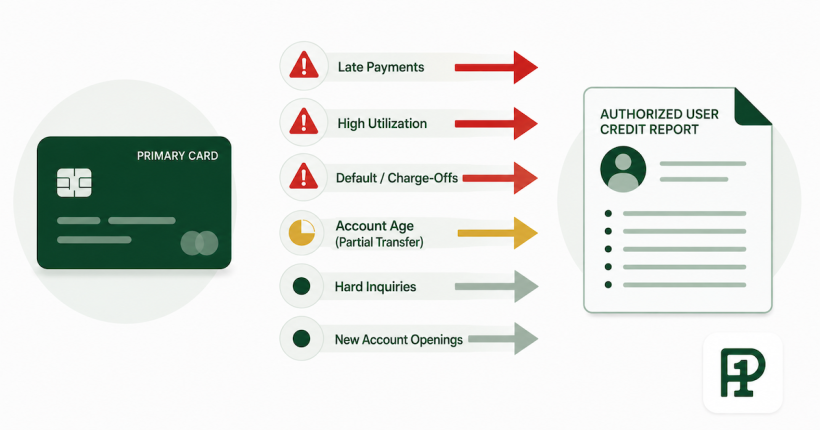
When an AU arrangement ends — by removal or by the primary cardholder closing the account — the AU tradeline disappears from the authorized user's credit report within one to two billing cycles. Any score improvement that depended on the AU account reverses. Account age contributed by the primary account is lost. Available credit from the account's credit limit is removed, raising the authorized user's utilization ratio. Payment history from the primary account no longer appears. If the weaker credit partner has not built independent credit during the AU period, the score can return to close to where it started — which is why building independent credit in parallel is non-negotiable, not optional. The full removal process and its consequences for both partners' credit files is covered in the article on how to remove yourself as an authorized user.
The Primary Cardholder's Exposure During Transition
The primary cardholder faces different risks during a relationship transition. If the authorized user continues spending on the card after the relationship has deteriorated — or if there is a dispute about charges — the primary cardholder is legally responsible for every charge regardless of who made them. Removing the authorized user immediately when a relationship changes is the correct protective action. The complete framework for when the primary cardholder's credit and finances are at risk from an AU arrangement — including the scenarios where removing someone is urgent — is covered in the article on when you should never add someone to your credit card.
How to Remove an Authorized User From Your Card
The primary cardholder can remove an authorized user at any time by calling the issuer or using the online account management portal. Most major issuers process the removal immediately. The authorized user's card is deactivated and no new charges are possible. Existing charges remain the primary cardholder's legal obligation. Any balance the authorized user charged before removal is still the primary cardholder's responsibility to pay. After removal, the AU tradeline disappears from the authorized user's credit report within one to two billing cycles. The full removal process from the primary cardholder's perspective is covered in the article on how to remove an authorized user from your credit card.
The Couples AU Conversation: What to Discuss Before Adding Anyone
The AU arrangement between partners requires a direct conversation about financial expectations before the addition is made — not after. The conversation prevents the arrangement from becoming a source of financial conflict and ensures both partners understand what the arrangement does and does not do for each credit file.
Spending Rules on the AU Card
Establish explicitly which card the authorized user will use the AU card for, what the monthly spending limit is, and how reimbursement works if the AU partner is charging personal expenses to the primary partner's account. The primary cardholder's credit score is directly affected by the balance on the account at statement close — high spending by the authorized user creates a utilization problem for both partners' credit reports if the balance isn't paid before statement close. A clear spending agreement prevents this from happening accidentally.
The Credit-Building Timeline
Both partners should understand the timeline — how long until the AU account appears on the weaker partner's credit report, what score improvement is realistic, when the weaker partner should open an independent account, and what the target score is before applying for the major financial decision driving the strategy. Setting explicit milestones prevents the strategy from running indefinitely without clear evaluation of whether it is working. The mechanics of how and when the AU account appears on the credit report — and the five variables that determine whether the impact lands at the high or low end of the expected range — is covered in the article on what happens to your credit when you're added to someone else's card.
The Contingency Plan
Every AU arrangement should have an explicit agreement about what happens to the arrangement if financial circumstances change — if the relationship changes, if the primary cardholder's financial situation changes, or if the weaker partner reaches their credit independence goals and no longer needs the AU account. Neither partner should enter the arrangement assuming it runs indefinitely without re-evaluation. The contingency plan is not a sign of distrust. It is a sign of a well-structured financial partnership.
Build a Complete Authorized User Strategy
The couples framework is one application. The Authorized User Credit Strategy cluster covers every dimension — when AU status helps, when it backfires, how to evaluate accounts, how to time removal, and how to build independent credit that sustains the improvement.
Explore the Full StrategyGovernment Resources
CFPB — Credit Reports and Scores — Official guidance on authorized user accounts, how they appear on credit reports, and your rights as a consumer under the Fair Credit Reporting Act.
CFPB — Mortgage Tools and Resources — How mortgage lenders use credit scores in joint applications, what qualifies as eligible credit history, and how to prepare your credit profile before applying.
AnnualCreditReport.com — Free weekly reports from all three bureaus — both partners should pull and review their complete credit files before designing the AU arrangement.
Return to the full credit building and protection guide for the complete framework covering every credit strategy covered on PersonalOne.
Frequently Asked Questions
Should we add each other to each other's cards, or just one of us to the other's?
The decision depends on the credit quality of each partner's accounts and the specific goal. If only one partner has an account that delivers meaningful benefit — high limit, long history, low utilization, clean payment record — the one-directional arrangement is correct. If both partners have accounts that could benefit the other, mutual AU addition works and provides redundancy. The starting point is evaluating each account's quality and determining which one delivers the most benefit to the partner who needs it most.
Does the weaker partner's credit improvement persist if we break up?
Not from the AU account itself. When the AU arrangement ends, the AU tradeline disappears from the authorized user's credit report and the score improvement reverses. The improvement persists only through independent accounts the weaker partner opened during the AU period. This is why building independent credit in parallel — while the score improvement is active — is the most important strategic action for the weaker credit partner. AU status is a bridge. Independent accounts are the destination the bridge leads to.
How does a joint mortgage application use our credit scores?
Most lenders pull all three bureau scores for each borrower and use the middle score for each individual. They then use the lower of the two qualifying scores as the basis for rate and approval decisions. One partner's strong score does not offset the other's weaker score — the lower score determines the rate tier. This means improving the weaker partner's score through AU strategy and independent credit building has a disproportionate impact on the mortgage outcome because it directly affects the score the lender uses.
Can I add my partner to my card if they have bad credit?
Yes — there is no credit check when adding an authorized user. The primary cardholder's credit is not affected by the authorized user's existing credit history. The AU addition benefits the authorized user's credit profile, not the primary cardholder's. The primary cardholder's risk is behavioral — if the authorized user spends heavily and the balance rises, the primary cardholder's utilization is affected. The structural risk management is clear spending agreements and monitoring the account balance before each statement close.
What happens to our credit if we get divorced?
AU arrangements end when either partner is removed from the account or when the account is closed. The authorized user's credit file loses the AU tradeline and its score contribution within one to two billing cycles. The primary cardholder retains the account and its full history. Any independent accounts each partner has built during the marriage remain with that individual regardless of relationship status. This is why both partners should establish independent credit during the marriage — not as a contingency for divorce, but as a component of financial health that protects both individuals through any circumstance.
This article is for educational purposes only and does not constitute financial, legal, or credit advice. Credit outcomes vary based on individual credit profiles, issuer reporting policies, and scoring model versions. Consult a qualified financial or legal professional for guidance specific to your situation. PersonalOne is a free financial education platform.