September 2026
Home › Credit Building & Protection › Authorized User Credit Strategy › How to Remove an Authorized User From Your Credit Card
What You Need to Know
— Removing an authorized user takes effect immediately with most major issuers. Their card is deactivated the same day. Any charges they make after removal are declined — but charges made before removal that have not yet posted remain your legal obligation.
— After removal, the AU tradeline disappears from the removed user's credit report within one to two billing cycles — 30 to 60 days. Any score improvement they received from the account reverses during that window.
— Your credit is not meaningfully affected by the removal itself. Your account history, payment record, and credit limit remain intact. If the AU was a heavy spender, their removal may actually lower the account's utilization and modestly improve your score.
— Request a new card number from the issuer after removal — especially if the relationship has deteriorated. The removed AU's card number may still be saved in online stores, subscriptions, or digital wallets and can continue generating charges until the number is changed.
— You do not need the authorized user's permission or cooperation to remove them. The primary cardholder controls addition and removal entirely.
Removing an authorized user from your credit card is a decision the primary cardholder controls completely — no permission required, no joint agreement needed, no waiting period. The process itself takes minutes. What most primary cardholders do not fully understand before removing someone is what happens next: which charges remain their responsibility, what the removal does to the removed user's credit report, whether they need a new card number, and how the removal affects their own account and credit profile.
This article covers the complete removal process — every available method, what to do immediately after, the security steps that most guides overlook, and a clear picture of the credit consequences on both sides of the account. It also covers the timing considerations that determine whether a balance dispute is clean or complicated, and the different approach that makes sense depending on whether the removal reason is a relationship change, a credit goal achieved, or a financial protection situation requiring immediate action.
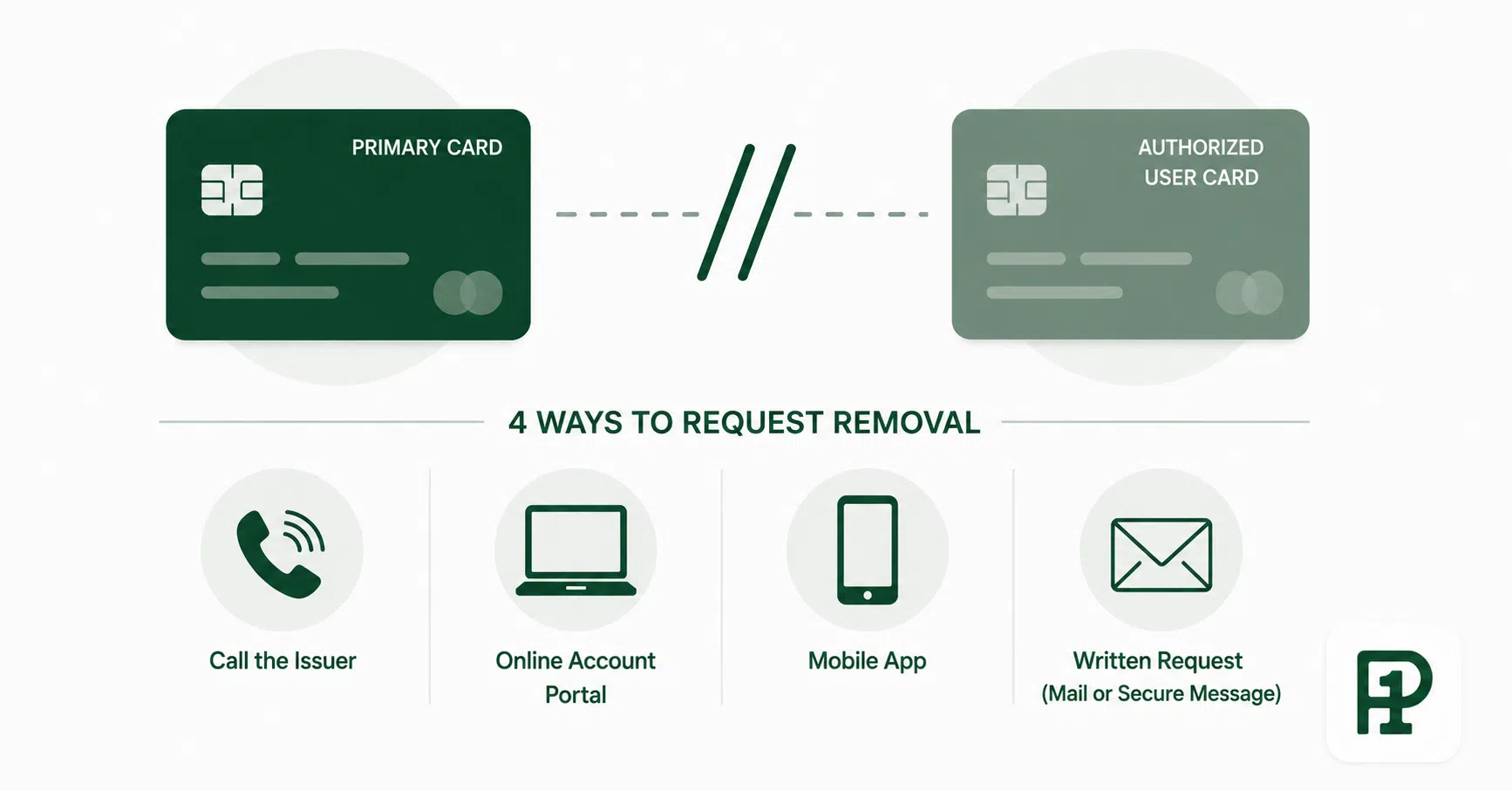
The Four Removal Methods
Every major card issuer supports at least two of the four available removal methods. Phone is universal. Online and app access depend on the issuer. Mail is available but slow and appropriate only as a follow-up confirmation, not a primary method. All four accomplish the same outcome — the difference is speed and documentation.
Method 1 — Phone (Universal, Fastest for Immediate Situations)
Call the number on the back of your credit card. Identify yourself as the primary cardholder and request removal of the authorized user by name. Have the account number, the authorized user's name, and your own verification information ready. The representative will confirm the removal and deactivate the AU's card number immediately in most cases. Request confirmation that the removal has been processed before ending the call — ask for a confirmation number or reference ID if the issuer provides one. This method is the right choice when urgency matters — relationship ended, unauthorized charges have appeared, or financial protection is the driver.
Method 2 — Online Account Portal (Available at Most Major Issuers)
Log into your account through the issuer's website. Navigate to account management, card management, or account settings — the exact path varies by issuer but is typically labeled "Authorized Users" or "Manage Users." Select the user you want to remove and confirm. The removal processes immediately in most cases. Take a screenshot of the confirmation screen as documentation. This method is appropriate when the situation is not urgent and you want a digital record of the removal date and confirmation.
Method 3 — Mobile App
Many issuers have added authorized user management directly to their mobile app in recent years. The path is typically: select the account, navigate to account settings or card management, find authorized users, and select remove. The process is identical to the online portal but accessible from a mobile device. Confirm the removal completed before closing the app and take a screenshot of the confirmation if available.
Method 4 — Certified Mail (Confirmation Only, Not Primary)
Some issuers technically accept written removal requests by mail — but given that phone and online removal are immediate, mail is only appropriate as a follow-up confirmation document after a phone removal, not as the primary removal method. If you use mail as a follow-up, send via certified mail with return receipt. Include: your name, account number, the authorized user's name, the date of the phone call where removal was requested, and the confirmation number if provided. Retain the return receipt as documentation that the issuer received the written confirmation.
What I've Seen
The removal method mistake I see most often is completing the removal call without requesting a new card number. The primary cardholder removes the authorized user, the AU's physical card stops working — but the AU had saved the card number in Amazon, a streaming service, and their Apple Pay wallet before the relationship ended. Those stored payment methods continue processing charges against the old card number for weeks because the account number itself has not changed. The primary cardholder gets a statement with charges they don't recognize from subscriptions the AU set up months earlier and assumed would keep running. The fix is simple: at the end of the removal call, ask the representative to issue a new card number for your account. New number, new card mailed to you, all stored payment methods using the old number are automatically declined. It takes thirty seconds to request and saves significant frustration.
Immediately After Removal — The Four Security Steps
Completing the removal call or online process is step one. Four additional steps protect your account from charges that the removal itself does not block.
Step 1 — Request a New Card Number
The removed AU's physical card is deactivated the moment removal processes. But the card number associated with your account — the 16-digit number on the face of the card — can still be used for card-not-present transactions (online purchases, phone orders, subscriptions) if the AU had it memorized or stored in their own payment systems. Request a new card number from the issuer during the same call or session that processes the removal. Most issuers issue new card numbers at no cost and mail the new card within five to seven business days. Until the new card arrives, your existing card continues to work for your own charges — the account is not interrupted.
Step 2 — Review the Account for Pending Charges
Pull up the account's recent transaction history immediately after removal and scan for any pending charges that have not yet posted. Pending charges that were initiated before removal — purchases the AU made in a store or online before their card was deactivated — remain your legal obligation even after the removal is complete. Identifying these charges now, before the statement closes, allows you to address them directly rather than discovering them on the statement. If the AU charged significant amounts immediately before you initiated removal, those charges are yours to pay regardless of the removal.
Step 3 — Update Your Own Stored Payment Methods
If you requested a new card number, update your own stored payment methods — subscriptions, recurring charges, digital wallets, online retailers — with the new card number before the old one is deactivated. Most issuers give the existing card number a brief grace period before it stops working entirely, but the exact window varies. Update your payment methods within the first 48 hours of receiving the new card to avoid any disruption to your own recurring charges.
Step 4 — Notify the Removed User
Whether to notify the removed user directly depends on the relationship context. In a straightforward situation — the AU has achieved their credit goals and is transitioning to their own card — advance notification allows them to prepare for the score change and open an independent account before the AU tradeline disappears. In a financial protection situation where the relationship has deteriorated, notification may not be appropriate before removal is completed. In any case, if notification is appropriate, it should communicate: when the removal took effect, that their card has been deactivated, and that their credit report will reflect the removal within one to two billing cycles. The complete picture of what happens to the removed AU's credit report and how to help them prepare for the transition is covered in the article on how to remove yourself as an authorized user.
What Happens to Your Credit After Removing an Authorized User
Primary cardholders frequently worry that removing an authorized user will damage their own credit. In almost all cases, it does not — and in some cases it modestly improves the primary cardholder's credit position.
What Does Not Change
Your account history — every payment, every year of account age, every on-time payment notation — remains entirely intact. Removing an authorized user does not affect the account's standing, payment history, or credit limit. The account continues to age and contribute to your average account age. Your payment history for the account continues to build. Nothing about the account's positive contribution to your credit profile changes as a result of the removal.
What May Improve
If the authorized user was a heavy spender who regularly ran up a significant balance on the account, their removal may reduce the account's ongoing utilization. Lower utilization at statement close means a lower balance-to-limit ratio reporting to the bureaus each month — which can modestly improve your utilization score factor. This is a secondary effect, not the reason to remove someone, but it is worth understanding for primary cardholders who have seen their utilization rise since adding the AU.
What to Watch For
The one scenario where removal can create a short-term fluctuation is if the authorized user's spending behavior changes between the removal date and the statement close. If the AU makes large purchases in the days before removal is processed — charges that post before the deactivation takes effect — those charges appear on your statement and contribute to the closing balance reported to the bureaus. This is why reviewing pending charges immediately after removal and, in urgent situations, timing the removal to fall shortly after a statement close rather than before it reduces the exposure window.
What Happens to the Removed User's Credit Report
Understanding the credit consequences for the removed authorized user is important for two reasons: it allows primary cardholders to communicate the impact accurately when notification is appropriate, and it informs the timing strategy if the AU needs to take protective steps before the tradeline disappears.
When the Tradeline Disappears
After the removal processes, the AU tradeline — the complete account record that appeared on the removed user's credit report — disappears within one to two billing cycles, typically 30 to 60 days. The tradeline does not disappear instantly on the day of removal. It continues to appear on the removed user's credit report until the issuer's next monthly reporting cycle updates the bureaus with the account's current authorized user roster, at which point the bureaus remove the tradeline from the former AU's file.
The Score Recalculation
When the tradeline disappears, the scoring model recalculates the removed user's credit score without the account's contribution. Any score improvement the AU received from the account — through account age, available credit, payment history, or credit mix — reverses. The recalculated score reflects only the AU's remaining independent credit accounts. If the removed user had opened their own independent credit accounts during the AU period, those accounts remain and cushion the score drop. If the AU arrangement was the primary credit-building mechanism with no independent accounts built in parallel, the score can return close to where it started before the AU addition. The complete timeline of AU credit impact — including what builds during AU status and what disappears after removal — is covered in the article on how long authorized user status takes to affect your credit score.
The Transition Window
The 30 to 60 day window between removal and tradeline disappearance is the most important period for the removed AU. If the AU has not yet opened independent credit accounts, this window — while their score is still elevated from the AU tradeline — is their best opportunity to apply for their own card or credit-builder product before the score recalculates downward. Primary cardholders who have a cooperative relationship with the removed AU can serve the AU's long-term credit health by giving advance notice of the intended removal with enough lead time for the AU to open an independent account at the improved score level before the tradeline disappears.
Timing Strategy — When to Remove Relative to the Billing Cycle
The billing cycle timing of the removal affects the balance exposure window and the statement documentation of the removal date.
Remove After Statement Close, Not Before
Removing an authorized user shortly after a statement close — in the first days of a new billing cycle — minimizes the exposure window between removal and the next statement. Any charges the AU made before removal in the current billing cycle were captured on the statement that just closed. The new billing cycle that begins after statement close has a clean start. If you remove the AU five days into the new cycle and they had not yet made new charges in that cycle, the new statement will show only your own charges.
Avoid Removing Before Statement Close When Balance Is High
If the AU has been spending heavily in the current billing cycle and the statement has not yet closed, removing them does not remove their pending charges from the statement balance. Those charges post to the statement regardless of the removal timing. In situations where the AU's spending behavior is the driver of the removal, the strategy of removing shortly after statement close — rather than mid-cycle — produces a cleaner financial picture and reduces the risk of a surprise statement balance.
Urgent Situations Override Timing Strategy
If the removal is driven by relationship breakdown, suspected fraud, or unauthorized charges, remove immediately regardless of billing cycle position. The financial exposure from continued AU access to the account outweighs the billing cycle optimization in any urgent situation. Timing strategy applies to planned removals in cooperative situations — not to protective removals where speed is the priority.
Removal Context — The Right Approach for Each Situation
The mechanics of removal are the same regardless of why you are removing someone. The communication approach and the steps you take before and after removal differ significantly depending on which of four common situations applies.
Situation 1 — Credit Goal Achieved, Transitioning to Independence
The AU was added to help them build credit and has now built enough of a score to qualify for their own accounts. This is the planned, cooperative removal. The right approach: give the AU advance notice — ideally 60 to 90 days before removal — so they can open their own independent accounts while their improved score is still active and before the AU tradeline disappears. The transition planning article for this scenario is covered in the article on the authorized user credit strategy cluster hub, which maps the full progression from AU status to credit independence.
Situation 2 — Relationship Change, Couples or Partners
The AU is a partner or spouse and the relationship has changed. The approach depends on whether the separation is cooperative or not. In a cooperative separation, advance notice allows both parties to protect their credit positions before removal. In an adversarial separation, remove immediately and request a new card number in the same call — the financial protection takes priority over the AU's transition planning. The complete couples AU framework — including what to do with each partner's credit when the relationship changes — is covered in the article on authorized user strategy for couples.
Situation 3 — Overspending or Financial Disagreement
The AU is not managing their spending in accordance with the agreement made when they were added. The approach: remove promptly, request a new card number, review pending charges, and document the removal date. If the AU disputes charges after removal, the removal confirmation date and any reference number from the issuer call are the primary documentation. Charges that posted before the removal date are the primary cardholder's obligation. Charges attempted after the removal date should be declined automatically. The full framework for the situations where the risk of AU status outweighed the benefit — and the warning signs to watch for before those situations develop — is covered in the article on when you should never add someone to your credit card.
Situation 4 — Financial Protection, Primary Cardholder's Circumstances Changed
The primary cardholder's own financial situation has changed — income reduction, new financial obligations, or simply a need to reduce exposure — and removing the AU is part of a broader financial restructuring. Remove promptly, request a new card number, and address the AU's credit transition if the relationship allows for a cooperative conversation. The AU's credit consequences from removal are real but not permanent if they have built independent credit during the AU period.
Removal vs Closing the Account — An Important Distinction
Some primary cardholders consider closing the account entirely rather than simply removing the authorized user. These are not equivalent actions and produce very different outcomes for the primary cardholder's credit profile.
What Closing the Account Does to Your Credit
Closing a credit card account removes the account's credit limit from your available revolving credit — which raises your overall utilization ratio immediately. It also removes the account from your average account age calculation over time (closed accounts remain on your credit report for up to ten years but eventually age off, reducing your average account age when they do). Closing an account is rarely the right action for the sole purpose of removing an authorized user. The authorized user can be removed without closing the account, the account's positive history continues to benefit your credit profile, and no utilization damage occurs.
When Closing Is Appropriate
Closing the account is appropriate when the account itself — not just the AU relationship — should end. An account with a high annual fee that is no longer providing value, an account with terms that have changed unfavorably, or a card that no longer serves your financial system are valid reasons to close. But those reasons are independent of the AU relationship. Remove the AU first, then evaluate the account separately on its own merits. Do not close an account with long positive history simply to remove an authorized user — the removal accomplishes the goal without the credit impact that account closure creates.
Understand the Complete Authorized User Picture
Removal is one decision point in the full AU framework. The Authorized User Credit Strategy cluster covers when to add, how to evaluate accounts, when to remove, and how both parties' credit files are affected at every stage.
Explore the Full StrategyGovernment Resources
CFPB — How to Remove an Authorized User From Your Credit Card Account — The federal consumer guidance on the removal process, your rights as the primary cardholder, and the steps that follow removal.
CFPB — Credit Reports and Scores — How authorized user tradelines appear on credit reports, how removal affects both parties' credit files, and how to monitor credit reports after any account change.
AnnualCreditReport.com — Free weekly reports from all three bureaus — both the primary cardholder and the removed AU should pull their reports 60 days after removal to confirm the tradeline has processed correctly on both sides.
Return to the full credit building and protection guide for the complete framework covering every credit strategy on PersonalOne.
Frequently Asked Questions
How quickly does removing an authorized user take effect?
The removal takes effect immediately with most major issuers — the AU's card is deactivated and declined for new purchases within minutes of the removal being processed. The AU tradeline disappears from the removed user's credit report within one to two billing cycles, typically 30 to 60 days after the removal date, when the issuer's next monthly reporting update reaches the bureaus.
Am I responsible for charges the authorized user made before I removed them?
Yes. All charges that posted to the account before the removal date remain the primary cardholder's legal obligation regardless of who made them. Charges that were initiated before removal but had not yet posted as of the removal date also remain your obligation once they post. You are not responsible for charges declined after the removal takes effect. This is why reviewing pending charges immediately after removal and, in urgent situations, requesting a new card number simultaneously are important protective steps.
Will removing an authorized user hurt my credit score?
No — not meaningfully. Your account history, payment record, credit limit, and account age contribution to your credit profile all remain unchanged. The account continues to report to the bureaus as your account with your full payment history. If the AU was spending heavily and the removal reduces the account's utilization, your score may modestly improve over the following one to two billing cycles as lower balances are reported.
Does the authorized user's credit score drop immediately when removed?
No — not immediately. The AU's credit score does not change on the day of removal. The score changes when the AU tradeline disappears from their credit report, which happens within one to two billing cycles after removal. During that window, their credit report still shows the AU account and their score remains at its current level. This transition window is the best time for the removed AU to open independent credit accounts before the score recalculates downward.
Should I close the account or just remove the authorized user?
Remove the authorized user — do not close the account for this purpose. Closing a credit card reduces your available revolving credit and raises your utilization ratio immediately. It can also reduce your average account age over time. Removing the authorized user accomplishes exactly what is needed without any of those credit consequences. Evaluate the account separately on its own merits and close it only if the account itself — not the AU relationship — is the reason for the decision.
Do I need to do anything about the removed user's physical card?
The physical card is deactivated when the removal processes and will be declined if used anywhere after that point. You do not need to physically retrieve the card. The more important security step is requesting a new card number from the issuer, which blocks any card-not-present transactions — online purchases, phone orders, subscriptions — that used the card number saved in the AU's digital wallets, online store accounts, or subscription services. The old card number continues working for those stored payment methods until the number is changed.
This article is for educational purposes only and does not constitute financial or legal advice. Removal processes, card number reissuance policies, and billing cycle timing vary by issuer. Verify current procedures directly with your card issuer. Credit bureau processing timelines are estimates and may vary. PersonalOne is a free financial education platform.