September, 2026
Home › Credit Building & Protection › Credit Optimization for Approvals › Credit Score Targets by Loan Type
Part of the Credit Optimization for Approvals cluster. Not sure where you stand yet? Start with Am I Ready to Apply for Credit? Have a recent late payment on file? See how it affects your score and timing in the FAQ below.
About the Author
Don Briscoe is a financial systems strategist with 12+ years of experience helping Millennials and Gen Z build income and financial stability. He founded PersonalOne to provide the financial education he wished existed — structured, honest, and free. Follow
Quick Answer: Credit Score Targets by Loan Type
— Conventional mortgage: 620 minimum, but 740+ unlocks the best rates and avoids the steepest pricing penalties.
— FHA mortgage: 580 for 3.5% down, 500 for 10% down — the most accessible mortgage program, with mortgage insurance as the tradeoff.
— VA mortgage: no official government minimum, but most lenders set their own floor around 580–620.
— Auto loan: no hard minimum either, but 661+ is the line between "approved" and "approved at a rate that doesn't cost thousands extra."
— Private student loan: 650–680 typically required without a cosigner; federal loans don't check credit at all.
— Rewards credit card: 690+ for reliable approval into premium rewards categories; the gap between "approved" and "approved for the good one" is often 50–80 points.
There is no single credit score that determines whether you get approved for credit. There are five or six different ones, depending on what you're applying for — a mortgage lender, an auto lender, and a private student loan underwriter are each looking at a different threshold, weighting different factors, and pricing risk differently above and below that threshold. A 680 score that comfortably qualifies for an FHA mortgage might get a rewards credit card application declined and a personal loan offer at a mediocre rate.
This guide breaks down the actual score targets lenders use across the major loan types, what changes above and below each threshold, and how to figure out which target actually applies to what you're planning to apply for. Score targets are only part of what lenders look at — there are five other factors they weigh at the same time. If your score isn't where it needs to be yet, how to improve your credit score before applying covers the specific pre-application moves that close the gap fastest.
Credit Score Targets by Loan Type: Comparison
| Loan Type | Minimum Score | Score for Best Terms | Key Tradeoff Below Target |
|---|---|---|---|
| Conventional Mortgage | 620 | 740+ | Higher rate, higher PMI cost, harder approval |
| FHA Mortgage | 500 (10% down) / 580 (3.5% down) | 680+ | Larger required down payment under 580 |
| VA Mortgage | No official minimum | 620+ | Lender overlay requirements still apply |
| USDA Mortgage | No official minimum | 640+ | Most lenders set 640 as a practical floor |
| Auto Loan | No hard minimum | 661+ (prime), 781+ (superprime) | Rate gap between tiers can exceed $13,000 over a loan term |
| Private Student Loan | 650–680 (no cosigner) | 720+ | Cosigner required below threshold |
| Federal Student Loan | No credit check (Direct loans) | N/A — rate is set by program, not score | PLUS loans check for adverse credit history only |
| Rewards Credit Card | No fixed minimum, practically 670+ | 690–720+ | Denial or fallback to a lower-tier card |
| Personal Loan | 580–600 (subprime lenders) | 720+ | APR can run 3–4x higher below 640 |
Mortgages: The Loan Type With the Most Program Variation
Mortgage credit score requirements vary more than any other loan type because the government backs several distinct programs, each with its own risk tolerance. FHA loans require a minimum 500 score with 10% down or 580 with 3.5% down, VA loans have no official minimum though most lenders require 580 to 620, conventional loans require 620, and USDA loans typically require 640. Jumbo loans, which exceed conforming loan limits, typically require 700 to 720 or higher given the larger amounts at risk.
USDA loans are the program most people have never heard of, largely because they're restricted to designated rural and some suburban areas, but they're worth knowing about if you qualify by location and income. Like VA loans, USDA doesn't set an official government minimum score, but most participating lenders apply their own floor around 640 in practice. The tradeoff for the relaxed score requirement and frequently zero down payment option is the income limit, which is set relative to the area's median income and excludes many higher earners regardless of credit profile.
The number that actually matters for cost is well above these program minimums. Conventional loans typically require a minimum credit score of 620, though most lenders prefer 640 or higher, and borrowers with scores above 740 receive the most favorable interest rates and terms. That 740 threshold is the practical target, not the 620 minimum — the minimum gets you in the door, but the rate you receive is priced on a sliding scale above it.
FHA loans trade a lower score requirement for an ongoing cost: every FHA loan requires mortgage insurance regardless of down payment, with an upfront premium and a monthly premium that, with less than 10% down, lasts the life of the loan. This is the core tradeoff worth understanding before assuming FHA is automatically the easier or cheaper path — it's the more accessible path, not necessarily the lower-cost one, especially for someone who could realistically reach 620+ within a reasonable timeframe and qualify conventional instead.
If you're close to one of these thresholds and spot an error on your report while preparing to apply, resist the urge to dispute it immediately. How to dispute errors on your credit report before applying for a mortgage covers the timing trap that catches a lot of otherwise well-prepared borrowers — filing at the wrong moment can stall the exact approval you're trying to protect.
Auto Loans: No Official Floor, But a Real Pricing Cliff
Auto lenders rarely publish a hard minimum score because the loan is secured by the vehicle itself — if a borrower defaults, the lender can repossess and resell. That collateral makes auto loans more accessible across the credit spectrum than mortgages or private student loans. But accessibility doesn't mean uniform pricing. A 720 FICO score sits in the prime tier carrying an average new-car APR of roughly 6.0% to 7.0%, while borrowers with superprime credit average 4.66% APR, and the gap between superprime and deep subprime tiers on a $30,000 60-month loan is roughly $219 per month and $13,140 in total interest.
That $13,140 figure is the real cost of treating "approved" as the goal instead of "approved at a good rate." For prime rates and the best terms, a score of 660 or higher is generally needed, while scores between 601 and 660 still qualify at most lenders but with higher rates. If a car purchase isn't urgent, closing even a 30-to-50-point gap before applying can shift an approval from one rate tier into the next, which on a multi-year loan is a meaningfully different total cost.
What I've Seen
One pattern shows up constantly with mortgage-ready readers: they check their score, see a number above the program minimum, and assume they're set. A 645 clears the conventional 620 floor with room to spare. But 645 and 740 are not the same approval — one gets a mortgage, the other gets a mortgage at a meaningfully better rate, often the difference between a comfortable payment and a stretched one.
In one case, a reader was six weeks from a mortgage pre-approval at 668. We didn't rush the application. Paying down two credit cards to under 10% utilization before the next statement close moved the score to 701 within one billing cycle — no new accounts, no waiting years, just a targeted utilization fix timed to the lender's pull date. That 33-point jump moved the rate quote down by a noticeable margin on the pre-approval letter.
The takeaway: clearing the minimum is not the goal. Knowing the target for best terms — and whether a 30-day utilization fix can realistically close the gap before the application date — is the actual question worth answering before applying for anything.
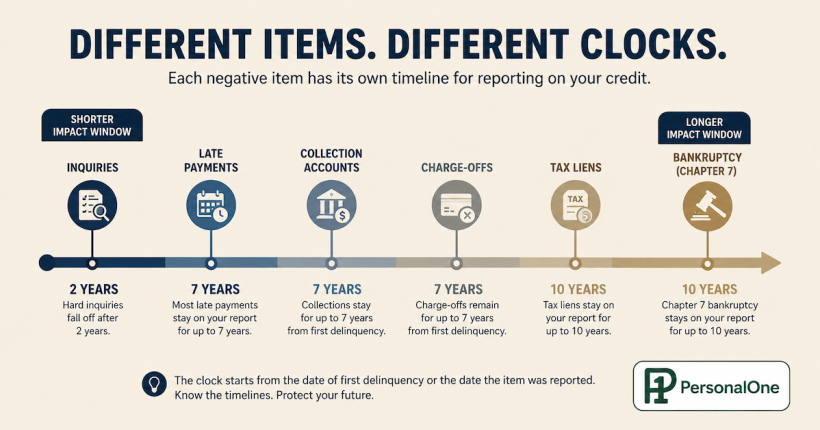
Not every gap closes that fast. A utilization fix moves the needle in a single billing cycle because it's not tied to a fixed legal timeline — but if the gap is being held down by an aging collection or late payment, the math changes. How long negative items stay on your credit report breaks down the difference between the legal removal date and the much earlier point where the score impact actually fades, which matters more for timing an application than the calendar date the item disappears.
Student Loans: Federal Doesn't Check, Private Does
Student loans split into two entirely different credit-scoring worlds. Most federal student loans, including Direct Subsidized and Unsubsidized Loans, don't require a credit check at all, which is why they're the right option for students who need help paying for school but don't yet have established credit histories. Direct PLUS Loans are the exception — they check for an adverse credit history rather than a specific score, so a thin file with no negative marks generally clears that bar.
Private student loans work like any other credit product. Private lenders typically require a credit score of at least 650, and often 680 or higher, to approve a student loan without a cosigner. Below that threshold, a cosigner with strong credit becomes close to mandatory rather than optional — and the cosigner's score and history matter as much as the primary borrower's for both approval and the rate offered.
Rewards Credit Cards and Personal Loans: The Approval-Rate Gap
Rewards credit cards and personal loans share a pattern that's different from secured loans like mortgages and auto financing: there's no collateral backing the lender, so the score threshold for approval and the score threshold for good terms sit closer together, and both sit higher than secured products. A premium rewards card with a strong sign-up bonus and high earn rates is realistically gated around 690 to 720, even though no issuer publishes that number as an official cutoff.
Personal loans follow a similar shape. Subprime lenders will extend personal loans to scores as low as 580 to 600, but the APR at that tier is routinely three to four times higher than what a 720+ borrower receives on the same loan amount and term. Below roughly 640, it's worth running the math on whether a personal loan is actually the better tool compared to a 0% promotional balance transfer or a smaller, more targeted purpose-built loan — the headline approval doesn't tell the whole cost story.
Before applying cold to either product, it's worth checking how prequalification and preapproval actually work across different loan types. Rewards cards and personal loans are exactly where this distinction costs people the most, since a soft-pull check can confirm whether your score clears the realistic threshold before a hard inquiry is on the line.
Know Your Target Before You Apply
Knowing the score target is only half the picture. The PersonalOne credit readiness framework covers the other factors lenders weigh — debt-to-income, payment history stability, and account age — so you know exactly where you stand before submitting an application.
Framework-first. Less willpower. More infrastructure.
Resources
CFPB: Mortgage Resources and Tools — Consumer Financial Protection Bureau guidance on mortgage credit requirements and shopping for rates.
Federal Reserve: Consumer Credit Data — Federal Reserve data on consumer credit terms and lending standards across product types.
For the complete pre-application optimization framework, visit the Credit Optimization for Approvals cluster hub.
Frequently Asked Questions
What credit score do I need to buy a house?
It depends on the program. Conventional loans require a 620 minimum, FHA allows as low as 500 with a 10% down payment or 580 with 3.5% down, VA loans have no official government minimum though most lenders set their own floor around 580 to 620, and USDA loans typically require 640. The score that gets the best rate on any of these programs is meaningfully higher than the minimum — for conventional loans specifically, that's generally 740 and above.
What credit score do I need to buy a car?
There's no universal minimum since auto loans are secured by the vehicle itself, making approval possible across nearly the entire credit spectrum. But the rate you receive changes significantly by tier: 661 and above is generally considered the line for prime rates, while scores above 780 access the lowest available rates. Below 660, approval is still common but at a noticeably higher APR.
Do federal student loans check your credit score?
No, not for standard Direct Subsidized and Unsubsidized Loans — these are available regardless of credit history or score. Direct PLUS Loans are the exception: they check for an adverse credit history rather than a specific score threshold, so a thin or short credit file with no negative marks typically still qualifies.
What credit score do I need for a private student loan?
Most private lenders require at least 650, and often prefer 680 or higher, to approve a loan without a cosigner. Below that range, a cosigner with strong credit becomes close to a requirement rather than an option, and the cosigner's credit profile factors into both approval and the interest rate offered.
Why does my score qualify for one loan type but get declined for another?
Because each loan type uses a different risk model and a different threshold. Secured loans like mortgages and auto loans have collateral backing them, which makes lenders more flexible on score requirements. Unsecured products like rewards credit cards and personal loans carry more risk for the lender with nothing to repossess, so the practical approval threshold sits higher even without an officially published minimum. A score that comfortably clears an auto loan's prime tier can still fall short of a premium rewards card's unofficial cutoff.
Is it worth waiting to improve my score before applying?
It depends on how close the score is to the next pricing tier and how time-sensitive the purchase is. A 30-to-60-day utilization fix can move a score 30 to 50 points if the issue is a high reported balance, which is often enough to shift into the next rate tier. If a recent late payment is part of the picture, how late payments affect your score before an application covers the separate timing question of when that specific mark stops being a lender concern. The math is specific to the loan type and the size of the gap, not a universal rule.
This content is for educational purposes only and does not constitute financial advice. PersonalOne is not a licensed financial advisor, broker, or investment professional. Individual financial situations vary — consult a qualified financial professional for personalized guidance. Credit score requirements, loan terms, and lender policies are subject to change and vary by individual lender, even within the same loan program. Always verify current requirements directly with the lender before applying.