September, 2026
Home › Credit Building & Protection › Credit Optimization for Approvals › How Long Negative Items Stay on Your Credit Report
What You Need to Know
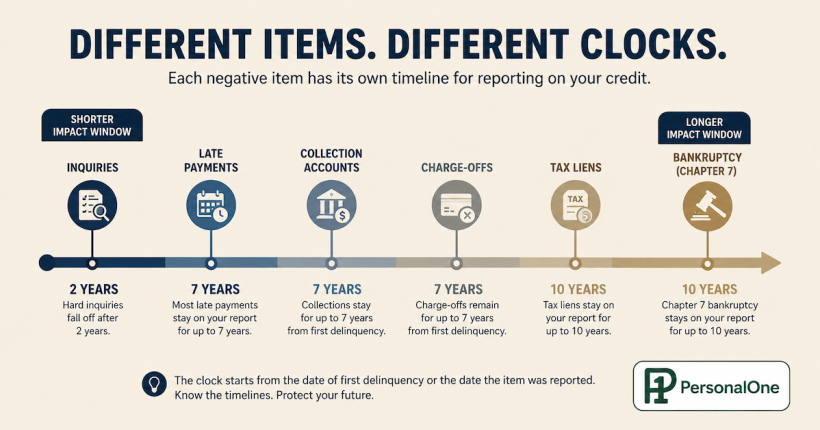
— Most negative items fall off your credit report after 7 years; Chapter 7 bankruptcy stays for 10
— That 7-year window is the legal clock, controlled by the Fair Credit Reporting Act
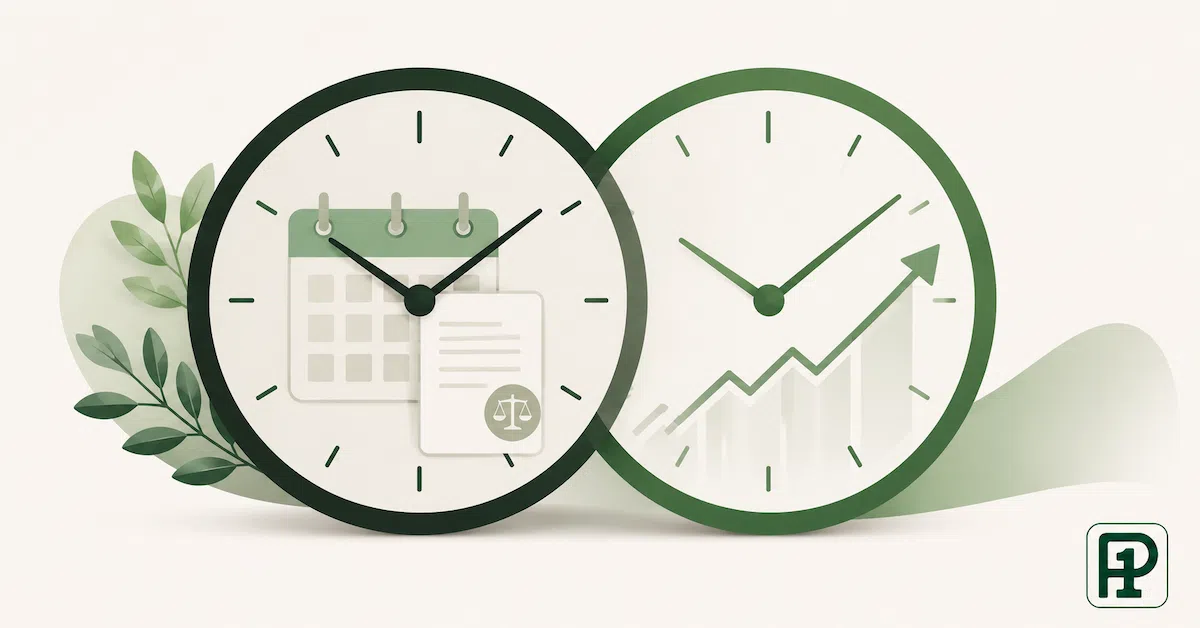
— A second, separate clock exists: the score-recovery clock, when your score stops feeling the weight of the item
— Score recovery often happens within 2 to 3 years, well before the legal removal date
— Knowing both clocks changes what you do while you wait instead of waiting passively
If you've searched how long negative items stay on credit report, chances are you're not asking out of curiosity. You're staring down a collection, a charge-off, or a late payment, doing the math on how long it's going to follow you around, and wondering if there's anything to do besides wait. The number everyone cites is 7 years — sometimes 10, if it's a bankruptcy — and that number is accurate. The Fair Credit Reporting Act (FCRA) sets that as the legal ceiling, and no bureau, collector, or credit repair company can shorten it for you. But that number, on its own, tells an incomplete story. It answers when the item legally has to disappear from your report. It says nothing about when your score actually stops paying attention to it — and those two timelines are rarely the same. Most people assume they're stuck in credit purgatory for the full stretch, treating the years in between as dead time. They aren't. Understanding both clocks, and which one actually controls your next loan approval, changes what you do while the legal clock keeps ticking in the background.
The Legal Clock: The FCRA 7-Year Rule for Negative Items
The FCRA's removal windows break down by item type:
- Late payments: 7 years from the date of the missed payment
- Collections accounts: 7 years from the date of first delinquency on the original account
- Charge-offs: 7 years from the date of first delinquency
- Chapter 7 bankruptcy: 10 years from the filing date
- Chapter 13 bankruptcy: 7 years from the filing date
- Civil judgments and tax liens: Reporting varies; many have been removed from credit reports entirely in recent years, though court and public records may still surface elsewhere
The detail that trips people up most is the start date. For collections and charge-offs, the clock does not reset when a collector buys the debt, when it's reported again, or when you make a partial payment. It starts on the date of first delinquency on the original account — the day you first fell behind, before it was ever sent to collections. If a collector reports a more recent date to make the item look fresher, that's a reporting error you can dispute.
The Score Clock: When the Damage Actually Fades
Here's what almost no one explains clearly: the legal removal date and the date your score stops caring are two different things.
Credit scoring models — both FICO and VantageScore — weight negative items by recency, not just presence. A collection that happened five months ago is actively dragging your score down. The same collection at five years old is, in most scoring models, doing very little. It's still visible on your report. It's just no longer the loudest thing on it.
This is the gap nobody builds content around, and it matters because it changes the decision in front of you. If you believe you're stuck with damaged credit for a full 7 years, you wait. If you understand that your score is already recovering well before that — often somewhere in the 2 to 3 year range, depending on what else is on your file and how you manage new accounts — you act.
What I've Seen
The clients who recover fastest aren't the ones with the fewest negative marks — they're the ones who stop treating the 7-year window as a waiting period. I've watched two clients with nearly identical collections accounts end up in very different places 18 months later. One checked their report once and put it out of their mind. The other opened a secured card, kept utilization under 10%, and paid everything on time every month. The second client's score had recovered most of its ground well before the collection was anywhere near falling off. The negative item didn't disappear faster. It just stopped being the only thing the score was reacting to.
What Actually Moves the Score Clock Forward
The score clock isn't passive — it responds to what you do while the legal clock keeps counting in the background. A few things consistently speed up score recovery during the waiting period:
- New positive payment history. Every on-time payment on an active account adds fresh, positive data that scoring models weight more heavily than old negative data.
- Lower utilization on open accounts. If you still have credit cards in good standing, keeping balances low relative to limits matters more as old negatives age.
- No new negative marks. A single new late payment or collection resets the clock on damage — it doesn't just add to the old item, it gives the scoring model fresh recency to react to.
- A thicker, cleaner credit mix over time. Adding a secured card or small installment loan and managing it well gives the model more recent, positive information to weigh against the old item.
None of this erases the negative item early. The legal clock doesn't move. But the score impact softens faster than most people expect — and that's the part you have some control over.
A Realistic Timeline: What Recovery Actually Looks Like Month by Month
It helps to see this as a rough timeline rather than an abstract idea. Consider a collection account that reports in month one. In the first few months, the score impact is at its sharpest — this is the period where the negative item is the newest, most relevant data point the scoring model has, and it weighs accordingly.
By months six through twelve, if no new negative marks have appeared and existing accounts are being managed well, the score typically begins a slow climb. The collection hasn't gone anywhere, but it's no longer the freshest thing in the file. By the one-year mark, many people see meaningful recovery, particularly if they've added a secured card or kept utilization low during this window.
Between years one and three, this is usually where the bulk of the score recovery happens for people who are actively managing their credit during the wait. The negative item is aging, new positive history is accumulating, and the gap between "damaged" and "recovered" narrows considerably. This is also the range where the timeline most depends on what else is happening in the file — someone with multiple accounts in good standing recovers faster here than someone with a thin file and no other active credit.
By years five through seven, the collection is approaching its legal removal date, and for most people who've kept the rest of their file clean, the score impact by this point is minimal to none. The legal clock finally catches up to where the score clock already was.
This timeline shifts earlier or later depending on the starting conditions, but the shape holds across most cases: the sharpest damage happens early, the most controllable recovery happens in the middle years, and the legal removal at the end is often more of a formality than a turning point by the time it arrives.
A Note on Multiple Negative Items Aging at Different Rates
Most credit files with damage don't have just one negative item — they have several, often landing at different times. A late payment from two years ago, a collection from eighteen months ago, and a charge-off from six months ago are all on different points of their own individual clocks, both legal and score-related.
This matters because the newest item on the file tends to dominate the score impact, even if older items are technically still reporting. If you're tracking your recovery, pay closest attention to your most recent negative mark's age, not the oldest one. The oldest item may be doing very little at this point, while a more recent one is still carrying real weight. This is also why a single new late payment can feel like it undoes months of progress — it briefly becomes the newest, most relevant data point again, even if the rest of the file has been clean for a long stretch.
How to Verify Your Credit Report Timeline Is Accurate
Negative items don't always disappear automatically the day they're supposed to. Reporting errors happen, and outdated information sometimes lingers past the legal window. To check:
- Pull your free credit reports from all three bureaus at AnnualCreditReport.com, the only source authorized by federal law for free reports.
- Locate the account and check the "date of first delinquency" or "date opened" field, not the date it was reported to collections.
- Count 7 years forward (10 for Chapter 7 bankruptcy) from that date.
- If the item is still showing after that date has passed, dispute it directly with the credit bureau reporting it.
If you find an error in this process — wrong dates, an account that should already be gone, or information that isn't yours — the dispute process under the FCRA is the same one used for any reporting error. We walk through that process step by step in how to dispute a credit report error that's costing you an approval.
Want to see where your score actually stands right now?
Credit Karma gives you free, ongoing access to your score and report so you're not guessing during the wait — you're watching it move.
Check Your Score Free (affiliate)What to Do While You Wait
Waiting out a negative item doesn't have to mean waiting passively. The most useful approach treats the next 7 years as a window to act in, not a sentence to serve:
- Keep every active account current — no exceptions, since one new late payment resets the recency clock on damage
- Track your score periodically so you can see the recovery curve for yourself rather than guessing at it
- If you're carrying balances on open cards, focus on bringing utilization down before applying for anything new
- Use a tool like our Credit Score Impact calculator to see roughly how specific changes — paying down a balance, adding a new account, an old item dropping off — could move your number
- If you're working toward a specific approval, plan timing around the score clock, not the legal clock, since that's the one that actually determines whether you qualify
This approach fits directly into credit optimization for loan approvals — the goal isn't to make the negative item vanish early, it's to build enough positive, recent history that the old mark stops being the deciding factor when a lender looks at your file.
Once you're ready to test that progress, it's worth understanding how prequalification and preapproval actually work before applying anywhere, so you check your standing with a soft pull instead of risking a hard inquiry on an application you weren't ready for yet.
Why the Score Clock Moves Faster for Some People Than Others
The 2-to-3-year score recovery window isn't fixed. It shifts depending on where your credit stood before the negative item landed and what the rest of your file looks like while it ages.
If you had a long, clean credit history before a single late payment or collection appeared, the damage tends to fade faster, because the scoring model has years of positive data to weigh it against. One bad mark on an otherwise strong file reads very differently than one bad mark on a thin file with little other history.
If the negative item appeared early in your credit history, or alongside other problems — high utilization, multiple late payments, a thin file with few accounts — the score clock runs slower. There's less positive data to offset the damage, so the negative item carries more relative weight for longer. This is the most common reason two people with what looks like the same collection account end up on very different recovery timelines.
It's also why opening one new account and managing it well rarely moves the needle as fast as people expect. A single new positive account is a small data point next to a file that's otherwise thin or damaged. Recovery accelerates when several positive signals stack — on-time payments, low utilization, account age — not from any single fix.
Tracking recovery is more useful when you know what you're recovering toward. Credit score targets by loan type lays out the actual thresholds lenders use, since "recovered" means something different depending on whether you're aiming for a mortgage, an auto loan, or a rewards credit card.
If the Negative Items Came From Debt You're Still Working Through
Everything above assumes the underlying debt is already resolved — paid, settled, or charged off and behind you. If you're still actively dealing with collections or charge-offs you haven't resolved yet, the timeline questions matter less than the recovery strategy itself. Our charge-offs, collections, and late payments recovery guide walks through that process in more detail.
Government Resources
Continue Learning About Credit Optimization
Understanding how negative items age is one piece of preparing your credit for an approval. The complete framework for building, protecting, and using your credit strategically is in the credit building and protection guide.
Frequently Asked Questions
Does paying off a collection account remove it from my credit report early? No. Paying a collection settles the debt but does not erase the reporting history. The account will typically show as "paid" rather than "unpaid," which can help with how some lenders view it manually, but the 7-year clock still runs from the original date of first delinquency.
Why does my score keep dropping even though the negative item happened months ago? Scores often dip hardest in the first few months after a negative item reports, then gradually recover. If your score is still dropping well after the event, check for other factors — a new hard inquiry, rising utilization, or an additional missed payment.
Do closed accounts in good standing also disappear after 7 years? Positive closed accounts can stay on your report for up to 10 years, and that's a good thing — they continue contributing positive history. The 7-year rule applies specifically to negative information, not to closed accounts in good standing.
What happens the day a negative item is supposed to fall off but doesn't? This happens more often than it should. If the date has passed and the item is still showing, file a dispute directly with the bureau reporting it, citing the FCRA's 7-year (or 10-year, for Chapter 7 bankruptcy) limit and the original date of delinquency.
Can a credit repair company get a negative item removed before the 7 years is up? Only if the item is inaccurate, unverifiable, or outdated — in which case you can dispute it yourself for free under the FCRA. No company can legally remove accurate, verified negative information early, regardless of what they advertise.
Disclaimer: This content is for educational purposes only and does not constitute financial advice. PersonalOne is not a licensed financial advisor, broker, or investment professional. Individual financial situations vary — consult a qualified financial professional for personalized guidance.