Updated: April 26, 2026
Home › Credit Guide › Credit Optimization for Approvals › Am I Ready to Apply for Credit? The Lender-Ready Framework
TL;DR
— Credit scores alone do not determine approval — lenders evaluate five readiness factors: credit score, debt-to-income ratio, payment history stability, credit utilization, and account age.
— Three readiness levels exist: Not Ready (fix fundamentals first), Borderline Ready (strategic improvements needed), and Lender-Ready (approval likely with competitive terms).
— Debt-to-income ratio matters more than most people realize — even with a 720 score, a DTI above 43% typically means denial for mortgages and many loans.
— Timing impacts readiness — recent late payments, new accounts, or hard inquiries can temporarily disqualify an application even when the score looks acceptable.
— Self-assessment before applying prevents wasted applications that create hard inquiries, drop the score, and delay actual readiness by 3 to 6 months.
The credit readiness framework addresses a scenario that plays out thousands of times daily: someone checks their credit score, sees 680 or 700, concludes that looks acceptable, applies for a credit card or loan, and gets denied. They are confused, frustrated, and now carrying a hard inquiry that dropped their score by 5 to 10 points. The problem is not that the score was misleading — it is that credit scores are one component of what lenders evaluate, not the complete picture.
A 720 credit score does not guarantee approval if the debt-to-income ratio is 50 percent. Three new accounts opened in the past six months can trigger denial regardless of score. An eight-month-old credit history produces skepticism from underwriters even when the payment record is clean. Credit readiness is the complete picture of whether a financial profile is positioned for approval with competitive terms — not just whether the score clears a threshold.
This framework covers all five factors lenders evaluate, the three readiness levels that determine where any profile currently stands, a self-assessment checklist, product-specific application thresholds, and a real 9-month case study showing the path from Not Ready to Lender-Ready. The complete foundation for understanding where each readiness factor originates is in the Credit Guide authority hub.
What Credit Readiness Actually Means
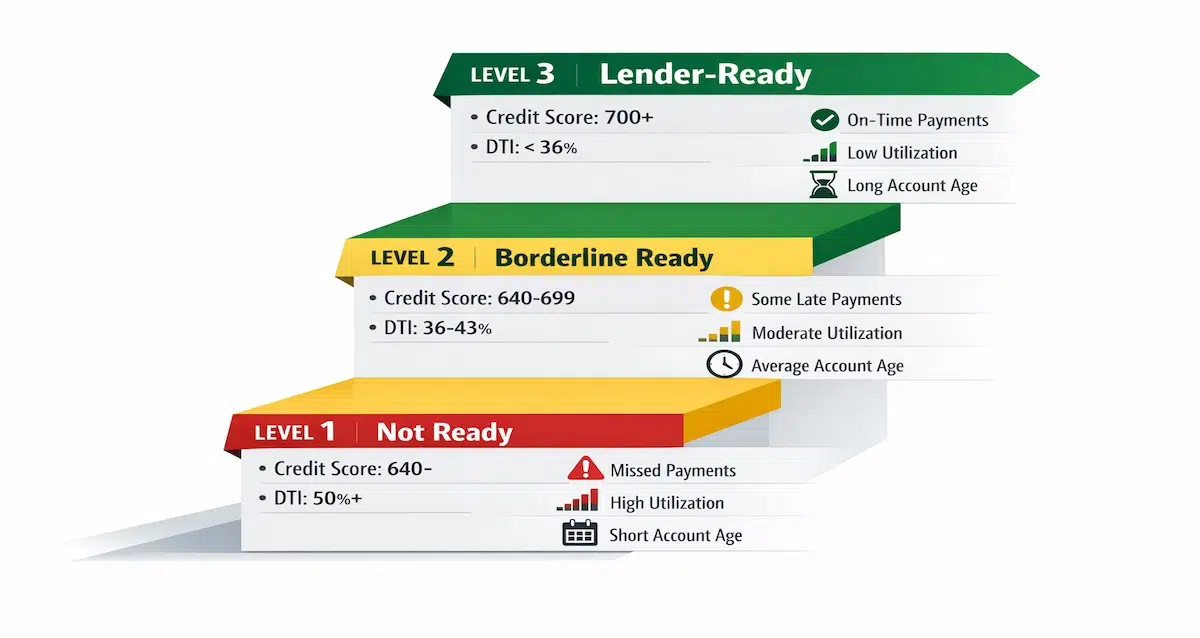
Credit readiness is the state of having a financial profile positioned such that lenders view the applicant as a low-risk borrower likely to repay as agreed — resulting in approval for credit products at competitive interest rates. Most people treat it as binary: either ready or not. In reality readiness exists on a spectrum with three distinct levels that determine both approval odds and the terms offered.
Level 1 — Not Ready. Fundamental credit issues exist that need to be fixed before applying for anything beyond secured products or credit-builder loans. Applying at this level results in near-certain denial plus hard inquiry damage that delays readiness further.
Not Ready — Characteristics
Credit score below 640 or no credit history at all
Any payment 30+ days late within the past 12 months
Collections or charge-offs still reporting
Credit utilization above 70% across multiple cards
Debt-to-income ratio above 50%
Recent bankruptcy or foreclosure within 2 to 4 years
Timeline to readiness: 6 to 18 months of focused credit repair and debt reduction depending on severity.
Level 2 — Borderline Ready. Approval is possible but uncertain. Higher interest rates, lower limits, or co-signer requirements are likely. Strategic improvements over 2 to 4 months can move a profile to Level 3.
Borderline Ready — Characteristics
Credit score 640 to 699
No late payments in past 12 months but some in past 24 months
Credit utilization 40 to 60%
Debt-to-income ratio 36 to 43%
Credit history 1 to 3 years old
1 to 2 hard inquiries in past 6 months
Timeline to readiness: 2 to 4 months of targeted improvements — pay down utilization, avoid new inquiries, build payment history.
Level 3 — Lender-Ready. The profile is positioned for approval with competitive terms. Lenders view the applicant as low-risk. Most applications are approved assuming income requirements are met, and favorable rates and credit limits follow.
Lender-Ready — Characteristics
Credit score 700+ (720+ for premium terms)
Perfect payment history for past 24+ months
Credit utilization under 30% (ideally under 10%)
Debt-to-income ratio under 36%
Credit history 3+ years with mix of account types
0 to 1 hard inquiries in past 6 months
Stable income with documentation
Outcome: High approval odds, best available rates, higher credit limits, favorable terms across product types.
The Five Factors That Determine Readiness
Lenders build a complete risk profile from multiple data points rather than making a single score-based decision. Understanding what actually moves each factor explains why readiness thresholds exist and which levers produce the fastest improvement. The credit optimization for approvals framework covers how to position each factor before submitting any application.
Factor 1 — Credit Score (The Entry Gate). The credit score is the first filter. Most lenders have minimum score requirements by product type, and falling below the minimum means automatic rejection before a human reviews the application.
Typical Minimum Score Thresholds by Product
Secured credit cards: no minimum or 300+
Basic credit cards: 580 to 620
Rewards credit cards: 670 to 700
Premium credit cards: 720 to 750
Personal loans: 640 to 680
Auto loans: 620 to 660 (subprime exists below but at significantly higher rates)
Mortgages — conventional: 620 to 640
Mortgages — best rates: 740+
Meeting the minimum score means the application will be considered — not that it will be approved. A 640 score technically qualifies for a conventional mortgage, but borderline performance on every other factor still produces denial.
Factor 2 — Debt-to-Income Ratio (The Capacity Check). DTI measures what percentage of gross monthly income goes toward existing debt payments. It tells lenders whether the applicant can afford additional debt regardless of credit score. The calculation is total monthly debt payments divided by gross monthly income multiplied by 100.
DTI Calculation Example
Gross monthly income: $5,000
Credit card minimums: $350 | Student loan: $400 | Car payment: $450
Total monthly debt: $1,200
DTI: ($1,200 ÷ $5,000) × 100 = 24% — Lender-Ready
DTI thresholds by readiness level: under 36% is excellent and lender-ready for most products. 36 to 43% is borderline — approval possible but at higher rates or with restrictions. Above 43% is high risk and means likely denial for mortgages and difficulty with most other loans. Above 50% means approval is unlikely except through subprime products at unfavorable terms. Even a 750 credit score paired with a 48% DTI signals financial overextension to lenders. The path to improving DTI before applying is covered in the credit utilization and payment strategy cluster.
Factor 3 — Payment History Stability (The Reliability Check). Payment history represents 35 percent of a credit score, but lenders evaluate the pattern and recency of payments beyond just the score impact. Any payment 30 or more days late within the past 12 months is treated as a current financial stress signal. Late payments from 12 to 24 months ago are less damaging but still visible. A pattern of multiple late payments across several months or years is significantly worse than a single isolated incident. A 90-day late is dramatically more damaging than a 30-day late.
Payment history readiness thresholds: Not Ready if any 30+ day late payment occurred within the past 12 months. Borderline if late payments exist between 12 and 24 months ago with perfect history since. Lender-Ready requires perfect on-time payment history for 24 or more consecutive months. A single 30-day late payment from 18 months ago can still affect readiness even after the score has recovered — lenders see it in the file and factor in recency as part of risk assessment.
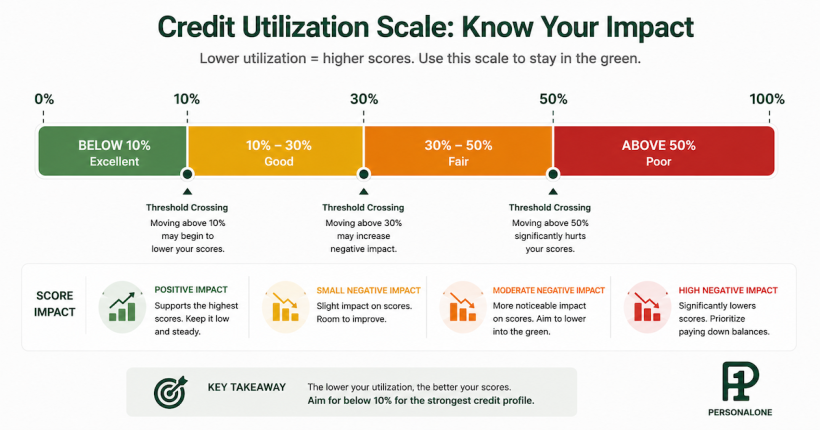
Factor 4 — Credit Utilization (The Spending Control Check). Utilization represents how much available credit is currently in use. It makes up 30 percent of the credit score and is the fastest-changing factor in the credit profile because it updates monthly as balances change.
How lenders interpret utilization: under 10% signals excellent control. 10 to 30% signals responsible use. 30 to 50% signals moderate concern. 50 to 70% suggests financial stress. Above 70% is a major red flag indicating near-maxed credit. Individual card utilization matters alongside total utilization — a single card maxed at 95% while others sit at 10% signals poor management even when the overall total looks acceptable.
Factor 5 — Credit History Age and Mix (The Experience Check). Lenders want to see demonstrated experience managing credit over time rather than a recent good streak. This factor combines account age — 15 percent of the credit score — and credit mix — 10 percent of the score.
Readiness thresholds by history age: Not Ready if credit history is under 6 months old. Borderline if history is 6 months to 2 years. Lender-Ready requires 3 or more years of history with diverse account types including both revolving and installment credit. Opening multiple new accounts in a short period — 3 to 6 months — damages average account age and signals instability. Underwriters notice patterns like five new accounts in four months and interpret them as credit-seeking desperation regardless of whether the score reflects the damage yet.
Self-Assessment: Where Do You Stand?
Answer yes or no to each of these six questions. Be precise rather than optimistic — an inaccurate self-assessment produces denied applications and hard inquiry damage that delays actual readiness.
1. Is your credit score 700 or higher?
2. Is your debt-to-income ratio under 36%?
3. Have you had zero late payments (30+ days) in the past 24 months?
4. Is your credit utilization under 30% overall with no individual card above 70%?
5. Is your oldest credit account at least 2 years old?
6. Have you opened fewer than 2 new accounts in the past 6 months?
Scoring your results:
5 to 6 yes answers — Lender-Ready: positioned for approval with competitive terms
3 to 4 yes answers — Borderline Ready: targeted improvements over 2 to 4 months move you to lender-ready
0 to 2 yes answers — Not Ready: focus on fundamentals for 6 to 12 months before applying
What to Do at Each Readiness Level
If Not Ready — Priority: Fix Fundamentals. Do not apply for anything beyond secured credit cards or credit-builder loans. Every application creates a hard inquiry that damages the score further and extends the timeline to readiness. The three priorities in sequence are stopping new damage, building positive payment history, and reducing debt burden.
Stop new damage: set up autopay for minimum payments on all accounts, dispute any errors on credit reports immediately, do not apply for any new credit including store cards, and contact creditors about any collections or charge-offs to negotiate removal.
Build positive history: make every payment on time without exception for the next 12 to 24 months. If no credit history exists, open a secured card and use it for small purchases paid in full monthly. Consider becoming an authorized user on an account with a long history of perfect payments — the complete strategy for this approach is in the authorized user credit strategy cluster.
Reduce debt burden: pay down high-balance cards to move utilization below 70%, then 50%, then 30% in sequence. If DTI is above 50% the debt burden is the critical bottleneck — increase income, reduce expenses, or both before any application.
If Borderline Ready — Priority: Strategic Improvements. The profile is close. Identifying the single factor creating the most drag and attacking it specifically produces the fastest path to lender-ready. Two to four months of focused effort is typically sufficient if the bottleneck is correctly identified.
If the score is borderline (640 to 699): prioritize getting utilization under 30% — this can produce a 30 to 50 point improvement quickly since utilization updates monthly. Dispute any errors on credit reports. Make all payments early rather than just on time for the next three to four months. Avoid any new account applications or hard inquiry events entirely. The credit score building strategies cluster covers the tactical improvements that produce score movement within 30 to 90 days.
If DTI is borderline (36 to 43%): pay down credit card balances aggressively — even $1,000 to $2,000 in reduction changes the monthly minimum payment obligation and shifts the DTI calculation. Consider adding income to increase the denominator rather than only reducing the numerator. Avoid taking on any new debt in the improvement period.
If recent late payments exist from 12 to 24 months ago: build 6 to 12 additional months of perfect payment history to demonstrate current reliability. Consider writing a goodwill letter to the creditor asking for removal if the late payment was an isolated incident caused by a specific hardship event.
If Lender-Ready — Priority: Maintain and Optimize. The profile is in the position most people are working toward. Maintenance is straightforward: autopay everything, keep utilization under 30% at all times and under 10% when possible, limit new applications to one or two per year, monitor credit reports quarterly for errors or fraud, and keep DTI under 36% as new obligations are added.
Strategic optimization at this level: shop multiple lenders when applying because a strong profile provides negotiating leverage. Request credit limit increases on existing cards to improve the utilization ratio without creating new hard inquiries. Consider refinancing existing loans at better rates now that the profile qualifies. Use credit strategically for rewards and benefits while paying statements in full monthly. The credit card selection and strategy cluster covers how to optimize this phase effectively.
Five Common Readiness Mistakes That Delay Approval
Applying because the monitoring app score looks good. Most credit monitoring apps display VantageScore rather than FICO. VantageScore can run 20 to 40 points higher than the FICO score lenders actually use for underwriting decisions. Seeing 710 on Credit Karma and applying based on that number can result in denial when the actual FICO is 678. Check the actual FICO score directly from Experian, myFICO.com, or a credit card that provides FICO scores before applying.
Ignoring DTI because pre-qualification tools do not ask for it. Many credit card pre-qualification tools perform soft pulls without requesting income or debt information. The actual application requires full financial disclosure. A profile that pre-qualifies based on credit score alone can still be denied at application when DTI is revealed to be 47 percent. Calculate DTI manually before applying and address it if it exceeds 43 percent.
Applying to multiple lenders simultaneously to compare offers. Submitting four or five applications in a short window creates four or five hard inquiries. If all result in denial, the score drops 15 to 25 points and the profile is less ready than before the applications were submitted. Use pre-qualification soft pull tools to evaluate approval odds before submitting any actual application. Only submit hard pull applications when pre-qualified and confident in the outcome.
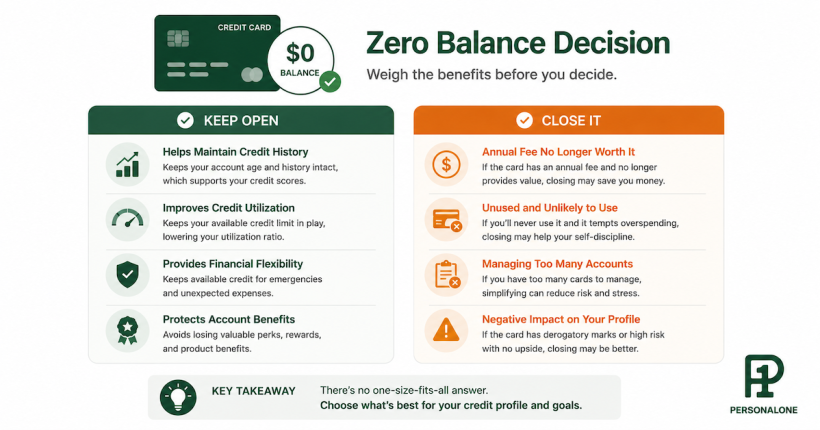
Closing old cards to simplify the credit profile. Closing unused accounts reduces total available credit, which spikes the utilization ratio, and lowers average account age simultaneously — both negative readiness signals. Keep old cards open with zero balances and use them for one small purchase every six months to prevent automatic closure for inactivity.
Taking on new debt in the months before a major application. A new car loan three months before a mortgage application adds to DTI, creates a hard inquiry, and lowers average account age. All three changes can shift a lender-ready profile back to borderline and either cost the mortgage approval or produce a higher interest rate. Avoid all new debt for 6 to 12 months before applying for any major loan.
Case Study: Jordan's 9-Month Path to Lender-Ready
Jordan, 28, wanted to purchase a condo and needed a conventional mortgage. His starting profile placed him firmly in Not Ready territory on three of the five factors.
Starting Position — Not Ready
Credit score (FICO): 655
DTI: 42% ($2,100 in monthly debt payments on $5,000 gross income)
Credit utilization: 68% ($6,800 balance on $10,000 total available credit)
One late payment from 14 months prior
Oldest account: 4 years old (adequate but not ideal for mortgage)
Months 1 to 3 — Address immediate issues. Jordan disputed an error on his credit report — an old collection account that was not his — and had it removed. Score moved from 655 to 672. He applied his tax refund to $2,000 in credit card balances, dropping utilization from 68% to 48%. He set up autopay on all accounts to prevent any further late payments from that point forward.
Months 4 to 6 — Strategic improvements. Jordan started a freelance graphic design side income adding approximately $800 per month. This income increase moved DTI from 42% to 36% with the same debt obligations — demonstrating that DTI can be improved from either side of the equation. He continued paying down credit card balances, getting utilization to 33%. Score reached 695.
Months 7 to 9 — Final push to lender-ready. Jordan paid down remaining credit card balances to get utilization under 20%. He avoided all new credit applications. The late payment from 14 months earlier was now 23 months in the past, substantially reducing its underwriting impact. Final score: 718.
Final Position — Lender-Ready
Credit score (FICO): 718
DTI: 32% ($2,100 payments on $6,600 gross income)
Credit utilization: 18%
Perfect payment history for 24 consecutive months
No new hard inquiries in past 6 months
Result: Approved for conventional mortgage at 6.2% APR with 5% down. Had he applied at month zero with the original profile, denial was the likely outcome. A subprime offer at 8 to 9% APR was the best realistic alternative — a difference representing tens of thousands in additional interest over the loan term.
When to Actually Apply — Thresholds by Product Type
Credit cards — standard and rewards: Credit score 700 or higher (720 or higher for premium cards). Utilization under 30%. No late payments in past 24 months. Fewer than 2 new accounts in past 6 months. DTI under 43%.
Personal loans: Credit score 680 or higher (700 or higher for competitive rates). DTI under 40%. Stable income with documentation. No late payments in past 12 months. Credit history 2 or more years.
Auto loans: Credit score 660 or higher (720 or higher for best rates). DTI under 45% including the new car payment. Stable employment for 6 or more months at current position. Down payment of 10 to 20 percent of vehicle price ready.
Mortgages: Credit score 640 or higher minimum (740 or higher for best rates). DTI under 43% including the new mortgage payment. Perfect payment history for 24 or more months. Stable employment for 2 or more years in the same field. Down payment plus closing costs saved. No new debt in past 6 to 12 months. Emergency fund intact after the down payment is applied.
Credit readiness is not about gaming the system. It is about understanding what lenders actually evaluate and positioning the profile as a low-risk borrower before submitting applications. The 2 to 4 months invested in moving from borderline to lender-ready saves years of paying higher interest rates — on a mortgage, the difference between borderline and lender-ready terms can represent $10,000 to $30,000 in total interest cost. How the credit profile connects to the complete financial picture lenders evaluate is covered in the How Credit, Banking and Cash Flow Work Together authority hub.
Readiness is the strategy. The score is just the entry point.
The complete Credit Optimization for Approvals cluster covers how to position every factor lenders evaluate — not just the score — before submitting any application.
Credit Optimization for Approvals → Credit Guide Hub →Resources
AnnualCreditReport.com — Free credit reports from all three bureaus
CFPB — What Is a Debt-to-Income Ratio?
FICO Loan Savings Calculator — How score improvements affect loan costs
Continue Learning in the Credit Guide
This article covers the five-factor credit readiness framework and the three readiness levels. The complete strategy for building, protecting, and optimizing your credit profile is in the Credit Guide authority hub.
Related clusters: Credit Score Building Strategies — Credit Utilization & Payment Strategy — Authorized User Strategy — Credit Card Selection & Strategy
Frequently Asked Questions
What is the minimum credit score needed to be lender-ready?
There is no universal minimum because readiness depends on all five factors simultaneously. As a general guideline: 700 or higher positions a profile well for most credit cards and personal loans with competitive terms. 680 to 699 can produce approvals but often at higher rates. 640 to 679 is borderline — approval may be possible but premium products will typically decline. Below 640, only secured products and credit-builder loans are realistic options. A 720 score with a 48% DTI or recent late payments is still not lender-ready — the score gets the application considered, but the complete profile determines the outcome. Focus on crossing 700 while simultaneously addressing utilization, DTI, and payment history rather than pursuing higher scores in isolation.
How long does it take to go from not ready to lender-ready?
Timeline varies by starting position and severity of issues. Starting from a thin file with no negative marks: 6 to 12 months of perfect payment history with low utilization typically produces lender-ready status for basic products. With recent late payments within the past 12 months: 12 to 18 months minimum to build sufficient clean history. With collections, charge-offs, or bankruptcy: 18 to 24 months or more depending on severity and age. The fastest improvement lever is credit utilization — paying down high balances can shift readiness within 60 to 90 days since utilization updates monthly. DTI reduction and account age building cannot be accelerated by the same degree. Most borderline-ready profiles reach lender-ready in 3 to 6 months of targeted focus on the specific bottleneck factor.
Does checking my own credit hurt my readiness?
No. Checking credit through AnnualCreditReport.com, credit monitoring services, or a credit card's built-in score feature creates a soft inquiry that has no impact on the credit score or readiness level. Soft inquiries are invisible to lenders. Hard inquiries — created when an actual credit application is submitted and a lender pulls the full report — typically drop the score 5 to 10 points each and remain on the report for 24 months. The strategy of applying to multiple lenders to see who approves creates multiple hard inquiries while providing no useful information if denial results. Use pre-qualification soft pull tools to assess approval odds before submitting any hard pull application.
What if I meet all readiness criteria and still get denied?
Three explanations cover most cases. First, issuer-specific rules beyond general readiness criteria — Chase's 5/24 rule automatically denies applicants who have opened 5 or more credit cards across all issuers in the past 24 months regardless of score or DTI. Second, verification issues — income that cannot be confirmed, recent address changes triggering identity verification problems, or discrepancies between application data and credit report information. Third, a specific threshold difference — some lenders use 36% as their DTI cutoff rather than the general 43% benchmark, meaning a profile that appears lender-ready by general standards still fails that lender's specific criteria. Request the adverse action letter lenders are legally required to provide — it identifies the exact factors that caused the denial and clarifies what to address before reapplying.
Should I wait to be extra ready or apply when I hit the minimums?
For credit cards and smaller personal loans, apply once solidly lender-ready — the marginal score improvement from 720 to 750 produces minimal benefit for most card approvals, and the score continues improving through responsible use after approval. For mortgages and large auto loans, the calculus changes because market interest rate conditions interact with individual readiness. Locking in a lower market rate at a 720 score may produce better total outcomes than waiting 6 months for a 745 score while rates rise. For borderline profiles (680 score, 40% DTI), waiting 4 to 6 months to improve specifically to lender-ready thresholds before applying typically saves more in interest cost than the time investment costs.
How does income affect readiness beyond the DTI calculation?
Three ways beyond DTI. First, many lenders have minimum income requirements for specific products — premium rewards cards often require $50,000 to $75,000 or more in annual income regardless of credit profile, producing automatic denial below that threshold. Second, income stability matters as much as income amount — consistent employment in the same field for 2 or more years is viewed more favorably than higher income across multiple job changes in the same period. Third, income type affects verification and underwriting treatment — W-2 salaried income is the most straightforward to verify and most trusted by lenders. Self-employment income requires two years of tax returns and is often discounted 20 to 25% in underwriting calculations. Gig economy and commission-based income is typically averaged over two years and may require additional documentation.
Disclaimer: This article is for educational purposes only and does not constitute financial, legal, or lending advice. Credit readiness criteria, lending standards, and approval requirements vary significantly by lender, product type, and individual circumstances. The thresholds provided represent general industry benchmarks and are not guarantees of approval or specific terms. Lenders may use different scoring models and proprietary criteria not covered in this framework. Consult a qualified financial advisor or credit counselor for guidance specific to your situation. PersonalOne is not responsible for decisions made based on this content and is not affiliated with any lender or credit bureau.