Updated: April, 2026
Home › Banking Systems › The 3-Account System › Banks vs. Microfinance
Banks vs. Microfinance: How Financial Institutions Shape the Economy (And Which One Actually Serves You)
What You Need to Know
— Traditional banks are built for scale — they serve corporations, governments, and people with documented income and credit history
— Microfinance institutions are built for access — small loans, community-based accountability, and financial inclusion where banks do not reach
— FinTech is closing the gap between both — mobile money platforms and online banks are changing who gets access and at what cost
— The type of institution matters as much as the specific bank — most people are best served by a multi-institution structure
— Understanding how these systems work globally makes you a smarter banking consumer domestically
Why This Topic Is More Useful Than It Sounds
Here is something most personal finance content skips entirely: the bank you choose is not just a preference. It is a structural decision that reflects what different types of financial institutions are actually built to do — and most people have never thought about it that way.
By the end of this article, you will know exactly which type of institution should hold your savings, your checking, and your credit — and why putting all three in one place is almost always costing you money.
Traditional banks, microfinance institutions, credit unions, and online banks are not interchangeable. They were built for different purposes, optimized for different customers, and produce very different outcomes depending on what you need from them. Understanding the difference at a macro level makes the personal banking decisions you face every day significantly easier to get right.This article covers how traditional banking and microfinance work, where they diverge, what FinTech is doing to both, and — most practically — what it all means for how you structure your own accounts. The full account structure framework lives in the Banking Systems hub if you want the complete picture.
Traditional Banking: Built for Scale
Traditional banks are the financial backbone of global commerce. They move massive amounts of capital, fund large-scale infrastructure, manage the financial operations of corporations and governments, and process the international payments that keep global trade running. Your checking account, your car loan, your international wire transfer — all of it runs through systems built to operate at scale.
Banks source capital from deposits, shareholders, interbank lending markets, and in some cases central bank facilities. That multi-source capital structure gives them the ability to fund projects and extend credit at volumes no other institution type can match. The FDIC reports that insured U.S. commercial banks hold tens of trillions of dollars in assets — a figure that reflects just how central they are to how the broader economy accesses money.
The tradeoff for that scale is selectivity. Traditional banks are optimized for people with documented income, established credit history, and minimum deposit balances. People who fall outside those criteria — informal economy workers, recent immigrants, small entrepreneurs in underserved markets — are often excluded not by intention but by structural design.
The Practical Reality
Traditional banks are often the right choice for credit products — mortgages, business loans, lines of credit. They are frequently the wrong choice for savings accounts, where their APYs are a fraction of what FDIC-insured online banks pay on the same deposit.
Microfinance: Built for Access
Microfinance grew from a simple but powerful observation: people excluded from traditional banking still need financial tools to build income and stability. Microfinance institutions, or MFIs, typically provide small loans — called microcredit — to low-income entrepreneurs and households that traditional banks will not serve. The most widely cited model is the Grameen Bank, founded by Muhammad Yunus in Bangladesh in 1983, which proved that small loans to very low-income borrowers could be repaid at high rates when the lending model was built around community accountability rather than collateral.
Where traditional banks require collateral, documented income, and credit history, MFIs often extend credit through group lending models — community members who co-guarantee each other's loans, creating accountability through relationships rather than financial assets. That structure makes microfinance viable for borrowers who would never qualify for a bank loan but who are reliable credit risks within their local context.
The World Bank's Global Findex Database consistently shows that large portions of the global adult population remain unbanked — without a basic transaction account at any formal institution. Microfinance addresses part of that gap. FinTech is increasingly addressing the rest through mobile platforms that do not require a bank account or an MFI loan at all.
Economic Impact: Macro vs. Micro
The economic impact of traditional banking operates at the macro level. Banks fund industrial growth that creates large-scale employment, enable multinational trade, and manage the corporate and government financial infrastructure that underpins economic stability. When banks stop lending — as they did in the 2008 financial crisis — the effect on the broader economy is immediate and severe because so much economic activity depends on the credit they provide.
Microfinance impact works differently. A small loan that enables a household to buy inventory, equipment, or livestock can generate income that improves nutrition, funds education, and creates savings that were not possible before. These effects are harder to measure at the macroeconomic level but are deeply significant at the household level — which is precisely where the global unbanked population experiences economic life.
The Scale of the Gap
The World Bank estimates that over a billion adults worldwide remain unbanked, concentrated in Sub-Saharan Africa, South Asia, and parts of Latin America.
Microfinance exists largely because traditional banking has not closed that gap — and likely cannot, given the structural mismatch between scale-optimized banking and the financial needs of informal economy participants.
How Each Institution Responded to Crisis
The COVID-19 pandemic showed exactly how differently these institution types operate under stress. Traditional banks had access to central bank liquidity facilities and government-backed relief programs — in the U.S., the Paycheck Protection Program, mortgage forbearance frameworks, and Federal Reserve asset purchase programs all supported bank stability during the acute phase. Banks focused on large-scale restructuring and maintaining systemic stability for major clients.
Microfinance institutions were dealing with a different reality. Their borrowers — informal economy workers, market vendors, small-scale entrepreneurs — experienced immediate income disruptions with no forbearance frameworks available. MFI responses involved direct renegotiation of repayment terms, grace period extensions, and emergency liquidity support from development finance institutions. CGAP documented extensively that the institutions that survived with the least damage were those with the most flexible repayment structures and the strongest borrower relationships.
The contrast is instructive: large institutions weathered the crisis through systemic mechanisms. Smaller ground-level institutions weathered it through relationship flexibility. Neither approach works universally — each works in the context it was designed for.
FinTech: Closing the Distance Between Both Worlds
The most significant development in global finance over the past decade is not the growth of traditional banking or microfinance. It is the emergence of financial technology platforms that are reducing the cost, friction, and geographic constraints of financial service delivery across both.
Mobile money platforms — M-Pesa in Kenya being the most cited example — have enabled millions of people who never had a bank account to send, receive, save, and borrow money through a mobile phone. These platforms do not require a bank account or an MFI loan. They operate as an entirely separate financial access layer sitting between informal cash economies and formal banking systems. In markets where mobile money has scaled, the unbanked rate has dropped significantly faster than in markets where only traditional bank expansion was attempted.
In developed markets, FinTech is changing banking from the other direction — eliminating minimum balance requirements, offering FDIC-insured high-yield savings at rates that traditional banks cannot match, and making account opening frictionless. The online bank charging no monthly fees and paying 4%+ APY on savings is a FinTech-enabled institution, not a traditional one. And that distinction matters directly for how you should be thinking about where your paycheck lands and what institution handles it.
The regulatory challenge is real. Traditional banking regulation was built around physical branches, standardized products, and predictable balance sheet structures. Mobile money platforms, neobanks, and peer-to-peer lending platforms do not fit those frameworks cleanly. The core tension is balancing consumer protection — deposit insurance, fraud protection, lending regulation — with the access and cost advantages that FinTech institutions provide.
What This Means for Your Banking Structure
Here is the practical payoff from understanding all of this: the type of institution matters as much as the specific bank. Most people consolidate everything at one institution by default — and that default is usually costing them money.
Traditional large banks are optimized for credit products and relationship-based services. They are the right choice for a mortgage, a business line of credit, or complex financial products that require in-person support. They are frequently the wrong choice for a savings account, where APYs at major traditional banks often trail FDIC-insured online alternatives by a significant margin.
Online banks and credit unions are optimized for low-cost, high-yield deposit accounts and fee-free checking. They are typically the right home for the savings and checking accounts that form the operational core of a personal financial system. Understanding how to build that structure across the right accounts is exactly what the multi-account budgeting system covers.
Credit unions occupy a specific and underused niche. Member-owned and not-for-profit, they typically offer better rates on both deposits and loans than traditional banks. For personal loans, auto loans, and credit cards, a credit union is often the best available option — the not-for-profit structure produces meaningfully better terms for members who qualify.
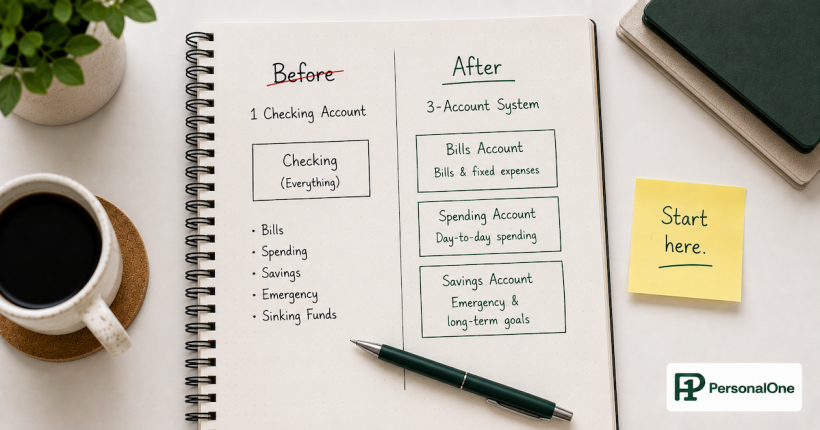
The practical conclusion is a multi-institution structure: an FDIC-insured online bank for savings and daily checking, a credit union or traditional bank for credit products, and a clear understanding of which institution handles which job. That structure is not complicated to build — but it requires knowing the difference between institution types, which is exactly what the global banking and microfinance landscape makes visible.
Understanding institutions is step one. Building your system is step two.
Now that you know what each institution type is built for, the next step is structuring your accounts the right way — the right money at the right institution, connected and automated. The complete framework is in the Banking Systems hub.
Explore the Banking Systems Hub →Resources
Official Sources
FDIC — National Survey of Unbanked and Underbanked Households — Data on why U.S. households remain outside the formal banking system and what barriers persist.
World Bank — Global Findex Database — The most comprehensive global data set on financial inclusion, account ownership, and barriers to banking access.
FDIC Money Smart — Financial Education Program — Free financial education resources on banking basics, account selection, and consumer protection.
Continue Learning
This article is part of the 3-Account Banking System cluster. For the complete account structure framework that connects institution choice to automation and long-term financial control, continue into the Banking Systems hub.
Frequently Asked Questions
Is microfinance only relevant in developing countries?
No. The principle is universal — providing financial access where traditional systems do not reach. In the U.S., community development financial institutions and credit unions serve a similar function for underserved domestic communities, offering small-dollar loans and accessible accounts to borrowers who do not qualify for traditional bank credit.
Do traditional banks and microfinance institutions compete with each other?
Rarely in practice, because they serve largely non-overlapping markets. Traditional banks are not competing for borrowers that MFIs serve, because those borrowers do not meet standard bank qualification criteria. Where FinTech is making a difference is in enabling collaboration — banks providing capital to MFIs, which deploy it at the ground level with the local relationship knowledge that a bank cannot replicate.
Are online banks and neobanks actually safe?
FDIC-insured online banks are as safe as any traditional bank for deposits up to $250,000 per depositor per institution. The FDIC guarantee applies regardless of whether the institution has physical branches. The key question is always FDIC insurance status — always confirm before opening an account. Some FinTech platforms hold deposits at partner banks rather than being banks themselves, which adds a layer worth understanding before committing.
Why do so many people still not have bank accounts?
The FDIC's household survey identifies minimum balance requirements, distrust of banks, high fees, documentation barriers, and the perceived irrelevance of bank accounts as the primary reasons U.S. households remain unbanked. FinTech and online banks are addressing several of these barriers more effectively than traditional bank expansion programs have historically managed.
What is the best type of bank for everyday personal finance?
Most people are best served by a multi-institution approach rather than consolidating everything at one bank. An FDIC-insured online bank for high-yield savings and fee-free checking, a credit union for credit products, and a traditional bank for complex financial needs covers the full range at the best available terms across each category.
How does understanding global banking make me a better personal finance decision-maker?
Because it removes the default assumption that all banks are basically the same. Once you understand that different institution types were built for fundamentally different purposes, choosing where to open accounts becomes a strategic decision rather than a habit. That shift alone can improve your savings rate, reduce fees, and lower your borrowing costs meaningfully over time.
Disclaimer: This article is for informational and educational purposes only and does not constitute financial advice. Banking products, rates, and institutional features vary and change over time. Always verify FDIC insurance status and current account terms directly with any financial institution before opening an account. Consult a qualified financial professional before making significant financial decisions. PersonalOne is not responsible for decisions made based on this content.