August, 2026
Home › Credit, Banking & Cash Flow › Cash Flow Optimization & Financial Control › The Cash Flow Alignment Strategy
What You Need to Know
— The cash flow alignment strategy is the complete framework for sequencing income, obligations, savings, and credit card payments into one coordinated financial cash flow system.
— Alignment is not a one-time fix — it is a designed sequence that runs automatically each pay cycle and produces the right financial behaviors as default outputs.
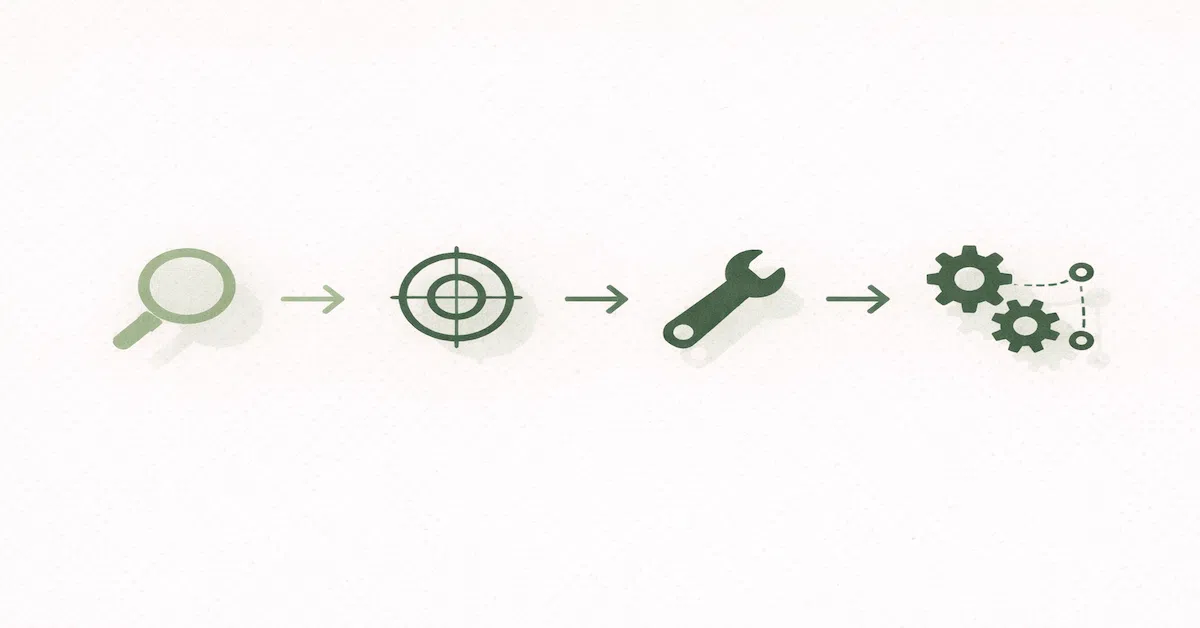
— The strategy has four phases: map the current cash flow, identify the misalignment points, make the scheduling adjustments, then automate the aligned sequence.
— The full alignment produces six compounding benefits: bill reliability, utilization control, savings consistency, debt payoff acceleration, reduced financial stress, and a credit profile that improves passively.
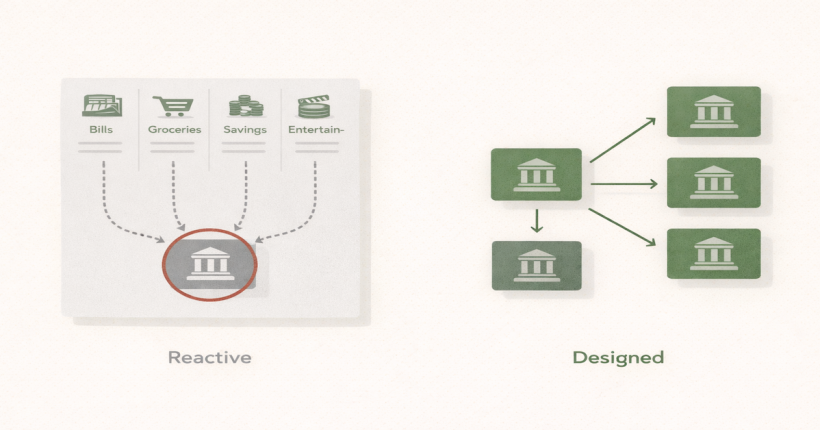
— The financial cash flow system this strategy builds is the optimization layer that runs on top of the banking structure and account separation established earlier in this hub.
The financial cash flow system that produces maximum financial control is not built through better budgeting or stronger willpower — it is built through deliberate alignment of the timing relationships between income, obligations, savings, and credit management. The cash flow alignment strategy is the framework that maps those timing relationships, identifies the misalignment points that produce financial stress, and replaces them with a coordinated sequence that runs automatically each pay cycle.
This article is the implementation guide for the full alignment strategy — the four-phase process from current-state mapping through automated execution, with the specific decision framework for every common household scenario.
Phase 1: Map the Current Cash Flow
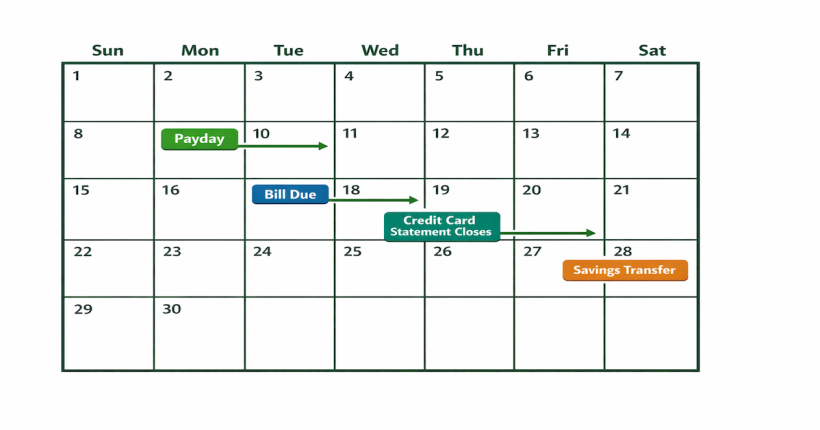
Before alignment can be designed, the current cash flow pattern must be mapped accurately. This means documenting four things: when income arrives (dates and amounts for all income sources), when fixed obligations are due (dates and amounts for every recurring bill, debt payment, and subscription), when credit card statement close dates fall (the date each issuer captures the balance for reporting), and what the account balance trajectory looks like through a typical pay cycle — the high point after payday and the low point before the next paycheck.
The gap between the post-payday high and the pre-paycheck low is the cash flow spread for the period. A wide spread that crosses zero — balance going negative or near-zero before the next paycheck — indicates a fundamental misalignment that is producing the timing conflicts responsible for overdrafts, late fees, or credit card bridging. A narrow spread that stays comfortably above zero throughout the cycle indicates a well-functioning cash flow system or a household with significant income surplus relative to obligations.
Phase 2: Identify the Misalignment Points
Three misalignment patterns produce most household cash flow problems. Identifying which pattern or combination of patterns applies determines which adjustments will produce the most improvement.
Obligation clustering ahead of income. Fixed obligations cluster in the days immediately before a paycheck arrives, drawing down the account balance to near zero while the next income has not yet processed. The fix is moving the clustered obligations to dates three to seven days after the paycheck arrives — requesting due date adjustments from the relevant providers to shift the obligation window into the post-income period.
Statement close date landing before paycheck. Credit card statement close dates fall before the most recent paycheck has arrived, meaning no funds are available to make a pre-statement payment that reduces reported utilization. The fix is requesting a statement close date change from each card issuer, moving the close date to five to seven days after the paycheck arrives to create the pre-payment window.
No savings allocation before spending. No automated savings transfer runs at payday, meaning savings accumulate only from whatever remains after spending — which is typically nothing or minimal. The fix is adding a savings transfer to the payday automation sequence that runs before the spending account is funded, converting savings from reactive to structural.
Phase 3: Make the Scheduling Adjustments
The scheduling adjustments are made in priority order: highest-impact first, lowest-flexibility last.
Priority 1: Credit card statement close dates. These are almost always adjustable and have the most direct credit score impact. Call each issuer, request the close date change, and confirm the effective date. This adjustment alone can produce credit score improvement within two billing cycles by enabling consistent pre-statement payments.
Priority 2: Bill due dates for adjustable obligations. Utilities, insurance, and many debt payments will accommodate date changes. Move these to fall within three to seven days after the paycheck relevant to that period. Obligations paid from the first paycheck of the month should fall between the 3rd and 8th. Obligations paid from the 15th paycheck should fall between the 18th and 22nd.
Priority 3: Buffer for fixed obligations. For obligations whose dates cannot be adjusted — rent in many cases, some loan payments — build a buffer in the bills account equal to the obligation amount. The buffer covers the obligation regardless of paycheck timing and is replenished by the next paycheck. This eliminates the timing risk for fixed-date obligations without requiring any date change.
Alignment is a one-time build. Automation makes it permanent.
The complete cash flow optimization framework covers the full alignment sequence for every common pay schedule and household configuration.
Explore Cash Flow Optimization & Financial Control →Phase 4: Automate the Aligned Sequence
Once the scheduling adjustments are made, the aligned sequence must be automated to deliver its benefits reliably. Manual management against an aligned schedule is better than manual management against a misaligned one — but automation is what makes the improvement permanent, because it removes the sequence from the decision environment where stress, distraction, or a busy week could interrupt it.
The automation sequence runs in this order on each payday: savings transfer first, to the savings account, before any other allocation. Bills account reserve confirmed at the required level to cover all obligations in the coming period. Spending account funded with the discretionary allocation. Credit card pre-statement payments scheduled for three to five days before each card’s close date. Due date autopay set for each card’s remaining balance on or before the due date. Each element runs on a fixed schedule without requiring monthly action.
The six compounding benefits of the fully aligned and automated sequence: bill coverage becomes reliable by design. Credit utilization stabilizes at a consistently lower level. Savings accumulate without requiring monthly decision-making. Debt payoff accelerates when extra payment allocations are added to the sequence. Financial stress from timing uncertainty decreases as the predictability of the system becomes apparent. The credit profile improves passively as the consistent behavioral inputs compound in the credit history over months and years. The safeguards that prevent this system from breaking down when life disrupts the normal pattern are covered in the final article in this cluster.
Resources
CFPB — How to Create a Budget and Stick With It
CFPB — What Is a Credit Utilization Rate?
FDIC — Money Smart Financial Education Program
Federal Reserve — Survey of Consumer Finances
This article is part of the Credit, Banking & Cash Flow integration system on PersonalOne — the complete framework for building a personal finance infrastructure that runs reliably by design.
Frequently Asked Questions
How long does Phase 1 mapping take?
For most households, 30 to 45 minutes in one sitting. You need three months of bank statements to identify the recurring obligation dates, your pay stub or direct deposit history to confirm paycheck dates, and the account details for each credit card to find statement close dates. The investment is one session. The map it produces is the diagnostic tool that identifies exactly which adjustments will produce the most improvement.
What if I have more than two paychecks per month?
Weekly pay creates four income events per month, which gives more alignment flexibility than biweekly or semi-monthly schedules. The approach is to assign specific obligations to specific paychecks rather than treating all income as a single monthly pool. Paycheck 1 covers Week 1 obligations. Paycheck 2 covers Week 2 obligations. And so on. The savings transfer runs from every paycheck, ensuring consistent accumulation regardless of which week’s obligations are heavier. Credit card pre-statement payments are funded from whichever paycheck falls closest before the statement close date.
How often should I revisit the alignment once it is set up?
Review the alignment annually or whenever a significant income or obligation change occurs. Income increases should trigger a recalibration of the savings transfer amount. New debt obligations should be built into the bills account reserve and autopay sequence. Changes to existing obligations — refinancing, subscription changes, insurance renewals at different amounts — should update the bills account reserve calculation. The alignment structure itself does not change frequently, but the dollar amounts running through it should be reviewed and updated to reflect current financial reality at least once per year.
Disclaimer: This content is for educational purposes only and does not constitute financial advice. Individual financial situations vary — consult a qualified financial professional for personalized guidance.