August, 2026
Home › Credit, Banking & Cash Flow › The Financial Infrastructure System › Why Budgeting Fails Without Banking Structure
What You Need to Know
— Budgeting without personal finance infrastructure is like navigating without a map — you know the destination but the tools you are using cannot get you there reliably.
— A budget is a set of numbers. Banking structure is the physical infrastructure that enforces those numbers by making the right financial behaviors happen by default.
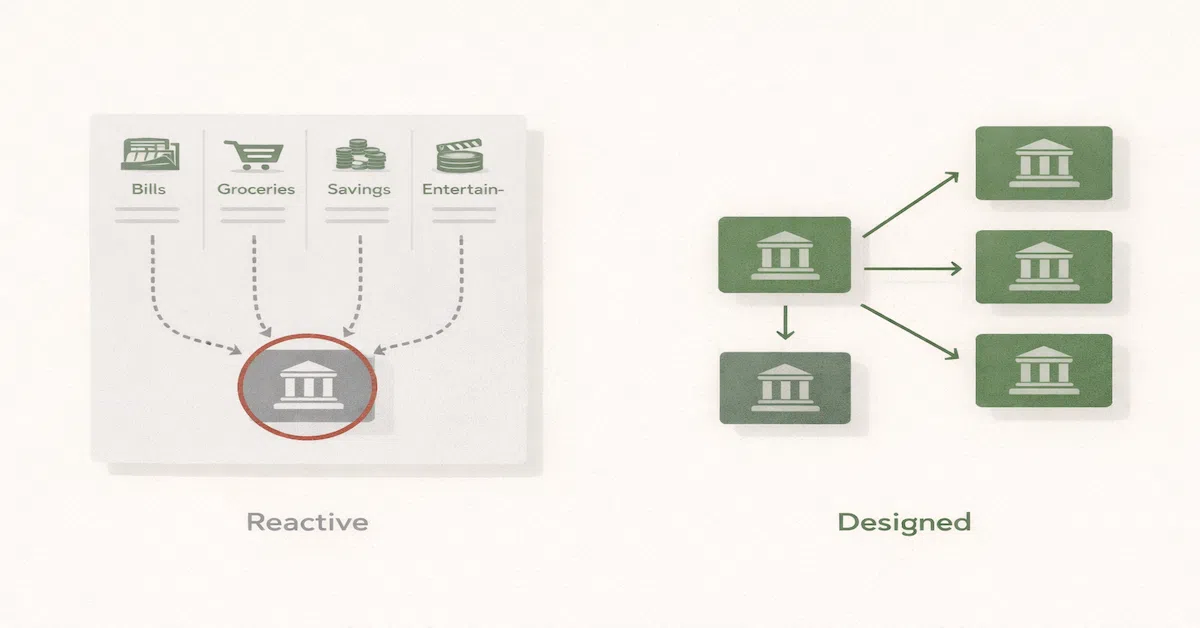
— Without account separation, every budget category competes against every other category inside a single account balance — and the visible balance always wins over the mental category.
— The pattern of budgeting working for two to three months then breaking down is almost always caused by missing banking structure, not by insufficient motivation or discipline.
— Building the personal finance infrastructure beneath the budget is what converts a temporary improvement into a permanent system.
Budgeting fails without personal finance infrastructure for the same reason that traffic management fails without roads — the plan for where things should go is irrelevant without the physical infrastructure that determines where things actually go. A budget that assigns money to categories is a plan. Banking structure is the infrastructure that executes the plan. Without the infrastructure, the plan exists only in memory, where it competes against visible account balances that do not reflect any of the category distinctions the budget made.
Most people who have experienced repeated budgeting failure have not failed because of poor financial knowledge or insufficient willpower. They have failed because the infrastructure layer beneath the budget was never built, and without that layer, the budget cannot be maintained regardless of how clear the plan is.
What a Budget Actually Is and What It Is Not
A budget is a decision about where money should go. It assigns amounts to categories — rent, groceries, savings, entertainment — and creates a plan for how income will be allocated across those categories each month. A well-designed budget accurately reflects the household’s income, obligations, and priorities. It is a useful planning tool.
A budget is not, by itself, a mechanism for enforcing those allocations. It does not prevent money designated for rent from being spent on groceries. It does not make the savings allocation happen before spending decisions are made. It does not create a visible limit on discretionary spending that stops when the limit is reached. A budget without banking structure is a plan without execution infrastructure — and plans without execution infrastructure fail predictably when life introduces stress, unexpected expenses, or simply a bad week where attention is elsewhere.
The Three Ways Budgets Break Without Structure
The category competition failure. When all money occupies a single checking account, every category in the budget competes for the same balance. The budget may specify that $400 is for groceries and $800 is for rent, but both amounts live in the same account. A grocery shopping trip on the 20th of the month does not reduce only the grocery category — it reduces the same balance that the rent payment will draw from on the first. The category assignment existed in the budget document. It never existed in the account. The budget broke not because the plan was wrong, but because no structure enforced the plan.
The savings timing failure. Most budgets assign a savings category that is funded from whatever remains after other spending occurs. This approach makes savings the lowest-priority allocation in the system — every spending decision that runs over its intended category depletes the savings fund before any savings actually happen. The behavioral economics research on savings behavior confirms this pattern: households that save from what remains after spending accumulate significantly less than households that automate savings before spending decisions are made, at identical income levels. The budget had savings as a category. The banking structure never made savings happen before the spending that was supposed to leave it intact.
The visibility failure. Budgets that are tracked manually using apps or spreadsheets require accurate, continuous data entry to maintain useful visibility. When a busy week, a stressful event, or simply the friction of the tracking process interrupts the data entry, the budget loses accuracy and the household reverts to spending against the account balance rather than against the budget categories. The budget existed as a tool. The banking structure — specifically, account separation that makes category balances visible without any tracking — was never built. The budget required ongoing effort to maintain. The banking structure would have maintained itself.
What Banking Structure Does That Budgeting Cannot
Banking structure enforces the budget’s category decisions physically rather than mentally. When bill money routes to a bills account that is not accessible for spending, the rent category is not competing with groceries — it is in a different account. When savings transfer on payday before spending money moves to the spending account, savings happen before any spending decision can deplete them. When the spending account balance is the only balance visible during discretionary spending, the limit is enforced by the account rather than by mental tracking.
The CFPB’s consumer financial research identifies automated savings and bill payment as the most reliable behavioral interventions for improving household financial outcomes — more reliable than tracking, more reliable than budgeting apps, more reliable than any awareness-based intervention. Automation works because it removes the category allocation from the decision environment rather than asking the decision-maker to maintain accurate mental accounting in real time. Account structure is what makes automation work for spending limits as well as for savings — the spending account has a physical balance limit that the budget category never had.
The budget is the plan. The banking structure is what makes it hold.
Build the infrastructure beneath the budget and the categories enforce themselves — without tracking apps, mental accounting, or willpower to maintain them every month.
Explore the Financial Infrastructure System →How to Add Banking Structure to an Existing Budget
If a budget already exists, adding banking structure beneath it does not require redesigning the budget. It requires converting the budget’s category allocations into account transfers. The savings category becomes an automated payday transfer to a savings account. The bills allocation becomes the balance reserved in a dedicated bills account after the transfer. The spending allocation becomes the amount transferred to a spending account each pay period. The budget categories are now enforced by account balances rather than by mental tracking.
The transition takes one session to implement. The budget amounts do not need to change — only the infrastructure through which they flow. The immediate result is that the budget stops requiring active maintenance to hold. The account structure holds it instead. The longer-term result is that financial outcomes that required ongoing effort to produce become automatic — savings accumulate consistently, bills are covered reliably, spending stays within the discretionary allocation without tracking, and the credit behaviors downstream of this cash flow improvement compound over time.
The complete model for how all three layers connect — account infrastructure, cash flow routing, and credit optimization — is covered in how credit, banking, and cash flow actually work together and in the three systems that control your financial life.
Resources
CFPB — How to Create a Budget and Stick With It
CFPB — Track Your Spending With This Easy Tool
FDIC — Money Smart Financial Education Program
Federal Reserve — Survey of Consumer Finances
This article is part of the Credit, Banking & Cash Flow integration system on PersonalOne — the complete framework for building a personal finance infrastructure that runs reliably by design.
Frequently Asked Questions
I have tried every budgeting app and none of them stick. Is this why?
Almost certainly yes — at least partly. Budgeting apps are tracking tools. They report on what has already happened and help you see spending patterns. They do not change the infrastructure through which spending decisions are made. A tracking app that shows you overspent on dining last month tells you what happened. Account separation that limits your dining spending to the balance in your spending account changes what can happen next month. One is diagnosis. The other is infrastructure. Both are useful, but infrastructure is what makes the improvement durable.
Does this mean I should stop tracking my spending?
Not necessarily — tracking has value for calibrating the account transfer amounts and identifying spending patterns that the account structure should accommodate. The distinction is between tracking as a control mechanism (which account structure does more reliably) and tracking as a calibration tool (which remains useful). Once the account structure is in place, tracking serves as a periodic check-in rather than the primary financial management tool, which reduces the effort required to maintain it and makes the occasional check-in more sustainable than the continuous tracking that most budgeting approaches require.
What if my spending genuinely exceeds my income?
Account separation makes this visible immediately and unambiguously — when the spending account runs out before the end of the pay period, the shortfall is structural rather than invisible. That clarity is more useful than a single account that masks the overspend until the end of the month when damage has already been done. When spending genuinely exceeds income, the banking structure reveals it clearly and the solution is either income-side (earning more) or spending-side (specific category reduction) — which is a different problem requiring a different solution than the infrastructure problem this article addresses.
Disclaimer: This content is for educational purposes only and does not constitute financial advice. Individual financial situations vary — consult a qualified financial professional for personalized guidance.