August 2026
Home › Credit, Banking & Cash Flow › Cash Flow Optimization & Financial Control › The Cash Flow Mistakes That Damage Your Credit Score
What You Need to Know
— Most credit score damage is not caused by deliberate credit mismanagement — it is caused by cash flow mistakes that produce credit problems as downstream effects.
— The financial flow control strategy that protects a credit score is almost entirely about fixing the cash flow behaviors that produce credit damage, not about managing the credit profile directly.
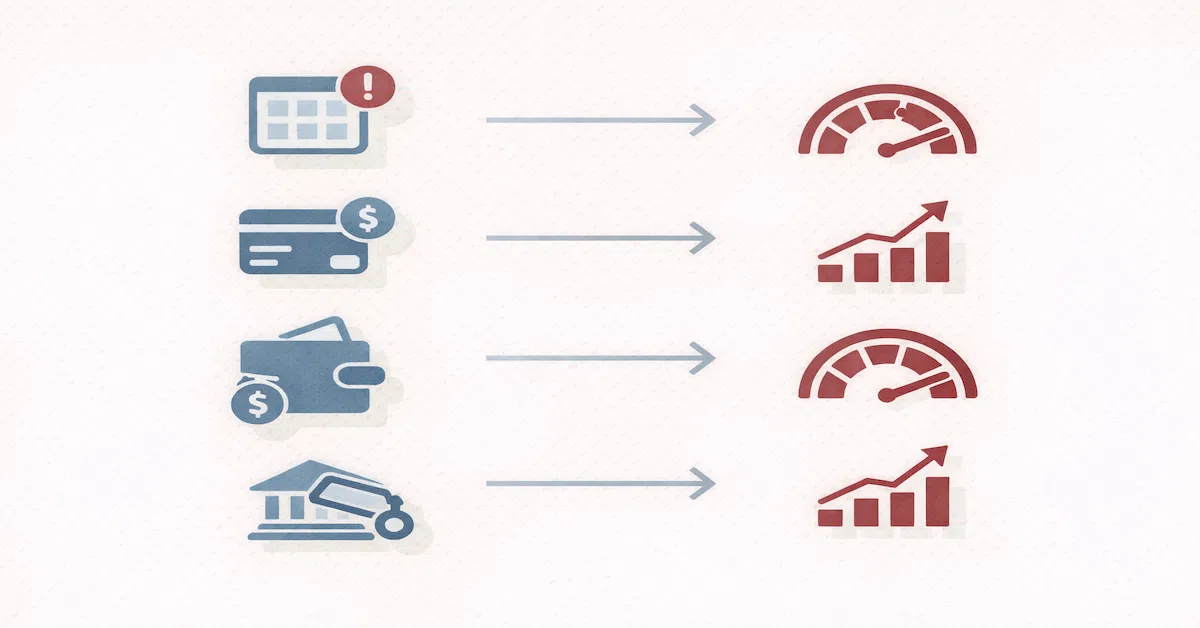
— Five specific cash flow mistakes produce the most credit score damage: late payments from timing gaps, high utilization from no pre-statement payment, balance rollovers from minimum-only payments, emergency credit use that spikes utilization, and payment timing errors that report the wrong balance.
— Every one of these mistakes has a structural fix that eliminates it through system design rather than requiring ongoing vigilance.
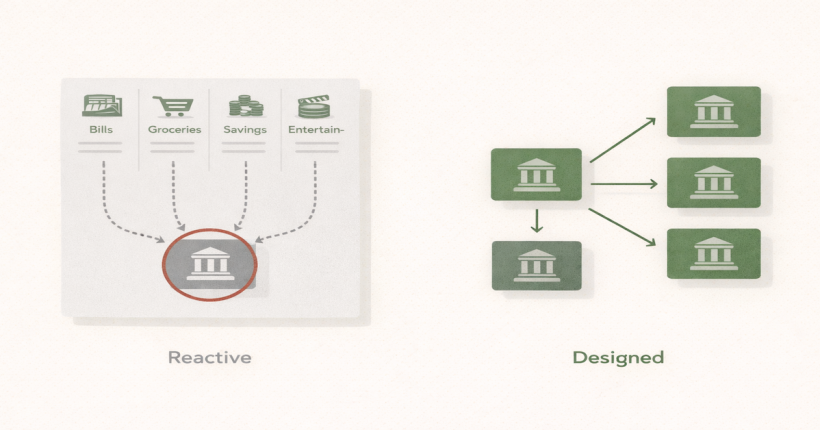
— The financial flow control strategy that resolves all five mistakes simultaneously is the aligned, automated cash flow system built across this cluster.
The financial flow control strategy that protects a credit score is primarily a cash flow strategy, not a credit strategy. Most credit score damage traces back to cash flow mistakes — timing gaps that cause late payments, account structures that produce high utilization at statement close, and the absence of automated systems that would have prevented both. Understanding the specific cash flow mistakes that damage credit scores most reliably is the prerequisite for fixing them at the structural level rather than applying direct credit interventions to symptoms that will recur until their cash flow causes are addressed.
This article maps the five most common cash flow mistakes that damage credit scores, explains the exact mechanism through which each mistake produces credit damage, and provides the structural fix that eliminates each mistake without requiring ongoing monitoring or behavioral discipline to maintain.
Mistake 1: Late Payments From Timing Gaps
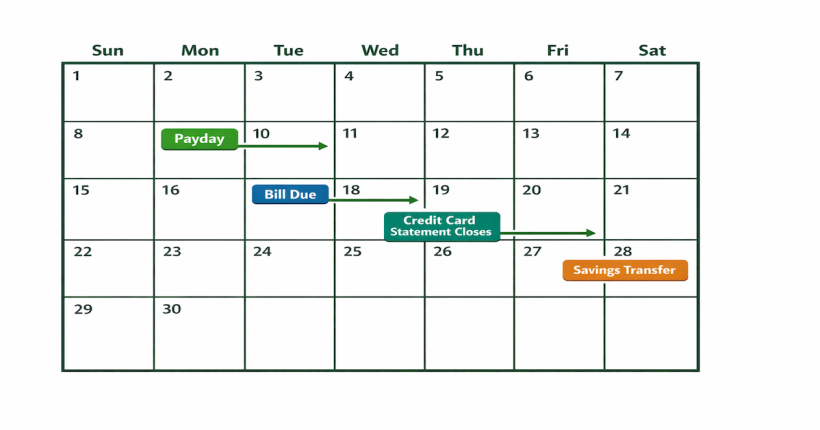
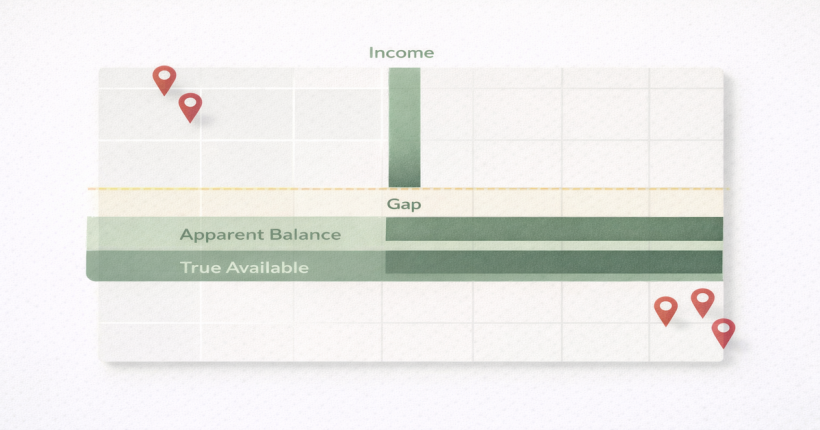
The cash flow mistake: Bill due dates fall before the paycheck that was supposed to fund them has arrived. The household intended to pay on time but the timing gap between income arrival and obligation due date left the account underfunded when the payment was supposed to process.
The credit damage: Payment history is the largest factor in credit scoring, accounting for approximately 35% of the score in most models. A single late payment — recorded when a payment is 30 or more days past due — can drop a score by 50 to 100 points depending on the profile, and the derogatory mark remains on the credit report for seven years.
The structural fix: Bill due dates adjusted to fall three to seven days after the paycheck that funds them, combined with a buffer in the bills account that covers the gap for fixed obligations whose dates cannot be moved. Both fixes are covered in detail in the paycheck, bill, and credit card alignment article. The late payment risk disappears structurally when timing gaps are designed out of the system rather than managed reactively.
Mistake 2: High Utilization From No Pre-Statement Payment
The cash flow mistake: Credit card balances are paid only at the due date, after the statement close date has already captured the month’s full spending balance and reported it to the credit bureaus. No pre-statement payment was made to reduce the reported balance.
The credit damage: Credit utilization is the second-largest factor in credit scoring. A balance of $1,800 on a $2,000 limit card reported at 90% utilization suppresses the score significantly even if paid in full the following week. The damage recurs every month the pattern continues, producing a chronically suppressed score for otherwise responsible borrowers.
The structural fix: Automated pre-statement payment from the bills account, timed three to five days before each card’s statement close date. As documented throughout the cash flow timing and credit utilization cluster, this single automation change produces measurable credit score improvement within one to two billing cycles.
Mistake 3: Balance Rollovers From Minimum-Only Payments
The cash flow mistake: Only the minimum payment is made each month. The remaining balance rolls forward, accruing interest and keeping the utilization figure elevated month after month. The minimum payment was made on time — payment history is protected — but the balance never materially decreases.
The credit damage: Persistent high utilization from carrying balances compounds over time. Each month the balance reports high utilization, the score reflects it. Additionally, high-interest charges on the carried balance reduce the cash flow available for extra payments, savings, or the pre-statement payments that would improve the utilization figure — creating a self-reinforcing cycle of suppressed score and constrained cash flow.
The structural fix: Automated extra payment above the minimum, sized to materially reduce the principal each month. As covered in the debt payoff cash flow article, building the extra payment into the bills account automation rather than treating it as discretionary is what makes it consistent through every month rather than only in months with surplus.
Mistake 4: Emergency Credit Use That Spikes Utilization
The cash flow mistake: An unexpected expense exceeds the available cash balance, and a credit card is used to cover it. The resulting balance spike is significant relative to the credit limit and is captured at statement close before it can be paid down.
The credit damage: Utilization spikes from emergency credit use are often the largest single utilization events in a credit profile, producing sudden score drops that can take two to three billing cycles to fully recover from even after the balance is paid. For households without an emergency fund, this pattern recurs whenever a normal unexpected expense appears — which is regularly.
The structural fix: An emergency fund in the savings account that covers unexpected expenses without requiring credit card use. The CFPB and Federal Reserve both document the strong relationship between emergency savings access and credit profile stability. An emergency fund of even one month of expenses eliminates most of the credit utilization spikes that result from routine unexpected costs.
Every one of these mistakes has a structural fix. The aligned cash flow system eliminates all five simultaneously.
The complete cash flow optimization framework builds the automated structure that prevents each of these mistakes from producing credit damage — without requiring ongoing vigilance to maintain.
Explore Cash Flow Optimization & Financial Control →Mistake 5: Payment Timing Errors That Report the Wrong Balance
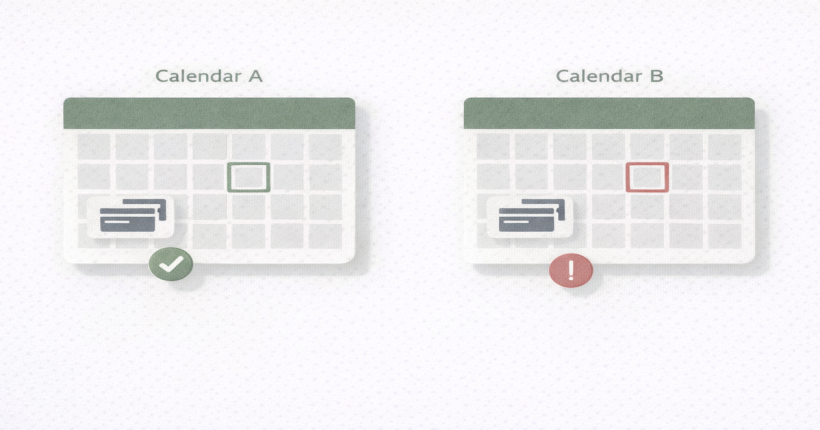
The cash flow mistake: Payments are made on approximately the right schedule but without awareness of the statement close date, occasionally falling just after the close rather than before. This timing error reports the full spending balance rather than the post-payment balance, producing a higher utilization figure than the intended payment timing would have created.
The credit damage: Inconsistent utilization reporting — sometimes low, sometimes high depending on whether the payment accidentally fell before or after the close date — produces a fluctuating score that does not reflect the household’s actual credit behavior. Lenders who review the profile during a high-utilization month see a different picture than the household believes they are presenting.
The structural fix: Automated pre-statement payment scheduled five days before the statement close date rather than timed by memory or habit. The five-day buffer accommodates weekends, bank processing delays, and slight variations in statement close date without risk of the payment falling after the close. Once the automation is set, the payment timing is consistent every month regardless of what else is happening in the household schedule.
Resources
CFPB — Credit Reports and Scores
CFPB — What Is a Credit Utilization Rate?
Federal Reserve — Economic Well-Being of U.S. Households 2024: Savings and Investments
FDIC — Money Smart Financial Education Program
This article is part of the Credit, Banking & Cash Flow integration system on PersonalOne — the complete framework for building a personal finance infrastructure that runs reliably by design.
Frequently Asked Questions
How quickly does credit score recover after these cash flow mistakes are corrected?
Recovery speed varies by mistake type. Utilization-related damage — Mistakes 2, 3, 4, and 5 — recovers within one to two billing cycles once the correct payment behavior is in place, because utilization is recalculated monthly from current reported balances. A late payment mark (Mistake 1) does not disappear from the credit report for seven years, but its scoring impact diminishes over time as positive payment history accumulates. A 30-day late payment becomes less impactful after 12 to 24 months of clean payment history following it. The highest-priority correction is preventing any new late payment marks while addressing the utilization-related mistakes simultaneously.
If my credit score is already damaged, should I focus on credit repair or cash flow repair first?
Cash flow repair first, in almost every case. Direct credit interventions — paying down balances, disputing errors, adding authorized user accounts — produce temporary improvements that require the same cash flow problems to not recur. If the cash flow problems that produced the damage are still present, the credit improvements reverse as the cash flow issues continue generating late payments or high utilization. Fix the banking structure and cash flow alignment first, and many of the credit improvements will follow automatically as the corrected system begins reporting better behaviors to the bureaus each month.
Does having an emergency fund really affect credit scores?
Indirectly but meaningfully. The Federal Reserve’s consumer financial data shows a strong correlation between emergency savings and credit profile stability. The mechanism is Mistake 4 above: households without emergency savings use credit cards to cover unexpected expenses, producing utilization spikes that damage scores. Households with even a small emergency fund absorb the same unexpected expenses from cash rather than credit, keeping utilization stable. The emergency fund does not appear on the credit report. Its effect on the credit score is mediated entirely through utilization behavior, which is why the cash flow system that builds and protects the emergency fund is the most reliable credit protection strategy available.
Disclaimer: This content is for educational purposes only and does not constitute financial advice. Individual financial situations vary — consult a qualified financial professional for personalized guidance.