June, 2026
Home › Credit, Banking & Cash Flow › Banking Structure & Cash Flow Control › Why One Checking Account Breaks Your Budget
What You Need to Know
— A single checking account breaks budgets not because of overspending, but because of money fungibility — when all money is in one place, the brain treats all of it as available to spend.
— Mental categories — “this is my rent money, this is my food money” — exist only in memory, where they are reliably overridden by the visible account balance.
— This is a documented cognitive pattern, not a discipline failure. The fix is structural, not motivational.
— Account separation makes the categories real and visible, removing mental accounting from the financial system entirely.
— The full banking structure and cash flow control framework covers the complete account design that replaces mental accounting with structural accuracy.
One checking account breaks budgets because of a phenomenon economists call money fungibility — the property of money that makes all units of it identical and interchangeable. A dollar designated for rent and a dollar designated for a restaurant meal are the same dollar. The designation exists only in the account holder’s intention, and intentions are not the same as structural constraints.
Most people who struggle with budgeting are not failing because they spend too much on any particular category. They are failing because the account structure they use makes it cognitively impossible to maintain accurate category distinctions against a single, undifferentiated balance. The problem is not motivational. It is structural — and understanding the structural mechanism that causes it makes the structural solution obvious.
The Fungibility Problem Explained
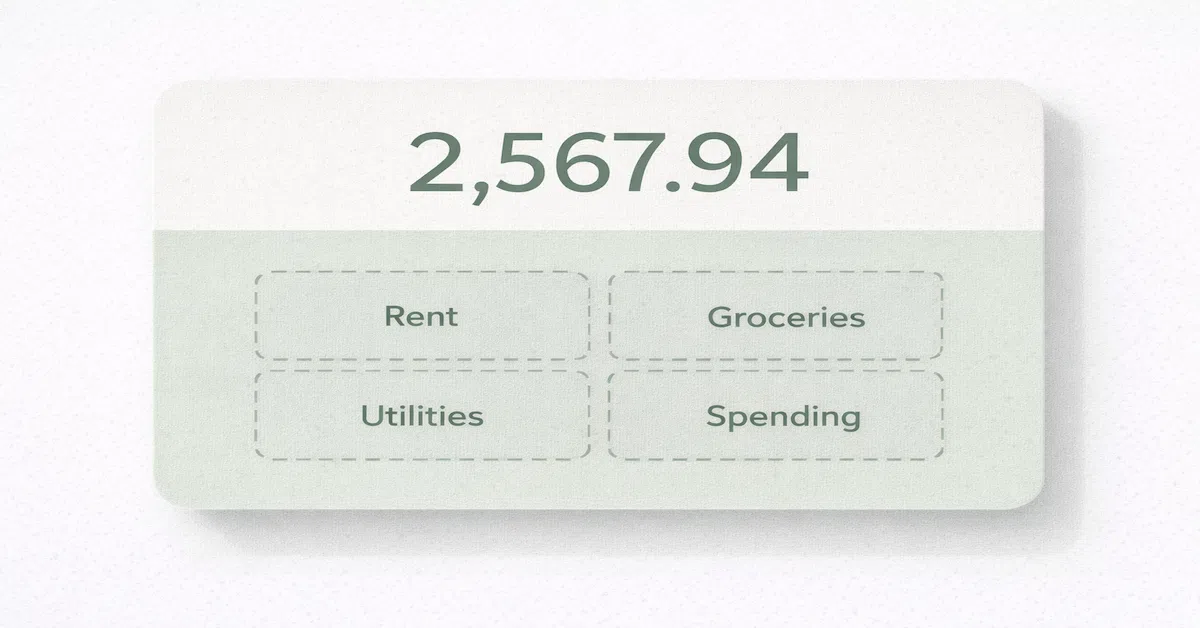
When a paycheck arrives in a single checking account, the balance increases by the full paycheck amount. That balance now represents multiple categories of money simultaneously: the portion committed to this month’s rent, the portion allocated for groceries, the portion that will cover utilities, the portion intended for savings, and whatever is left for discretionary spending. But the account shows one number, and the human brain responds to that number as the answer to “how much do I have?”
Behavioral finance research documents this as a form of mental accounting failure. People create subjective categories for money — “this is for bills,” “this is for groceries” — but the physical fungibility of money in a single account undermines those categories whenever a spending decision is made and the visible balance looks sufficient. The category label is in memory. The available balance is on the screen. The screen wins.
This is not a failure of intelligence or willpower. It is the predictable output of how human cognition processes concrete visible information versus abstract remembered designations. The CFPB’s financial education research identifies this pattern as one of the primary mechanisms behind budgeting failure — people know what categories they should respect but cannot maintain accurate mental tracking against a single balance when spending decisions happen in real time.
Why Tracking and Apps Do Not Fully Solve It
Budgeting apps and expense tracking tools help, but they do not solve the fungibility problem at its root. They show what was spent after the fact, which is useful for identifying patterns but does not change the information available at the moment of a spending decision. At the checkout, the app is in a different app on the phone. The checking account balance is in the banking app. The decision is made against the banking app number — the only number that represents immediate reality.
The only information that reliably influences spending decisions at the point of decision is the account balance itself. This is why the hidden cash flow problem persists even among people who actively track their spending: tracking tells you where money went, but it does not change what the balance shows before the decision is made. Account separation changes the balance itself — so that the number visible in the spending account is always an accurate answer to “how much can I spend right now?” without any mental arithmetic or category tracking required.
What Happens When Categories Compete in One Account
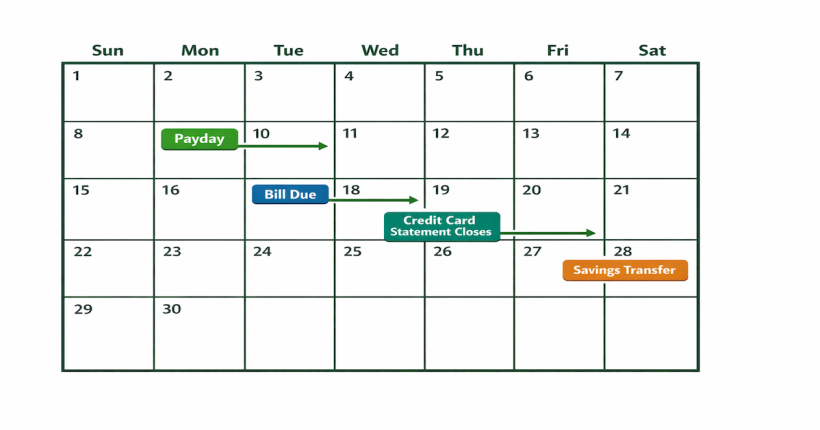
The month-to-month pattern produced by a single checking account is consistent and predictable. In the days immediately after payday, the balance is high and spending feels unconstrained. In the middle period, spending continues at a pace calibrated to the post-payday balance rather than to the post-obligations balance. In the final period before the next payday or before major obligations process, the balance falls below what is needed — producing shortfalls, overdraft risk, or credit card use to bridge the gap.
This pattern recurs monthly regardless of income level, because it is produced by the account structure rather than by the income amount. Increasing income into a single-account structure typically increases the spending in the high-balance period proportionally, maintaining the same end-of-period squeeze at a higher absolute level. The structure produces the pattern. Changing the income does not change the structure.
The fix is one account structure change. The result is a budget that enforces itself.
When the spending account balance is the only money available for spending, the budget stops requiring mental accounting. The account does the work. See exactly how to design and implement that structure.
See the Account Separation Strategy →The Structural Alternative
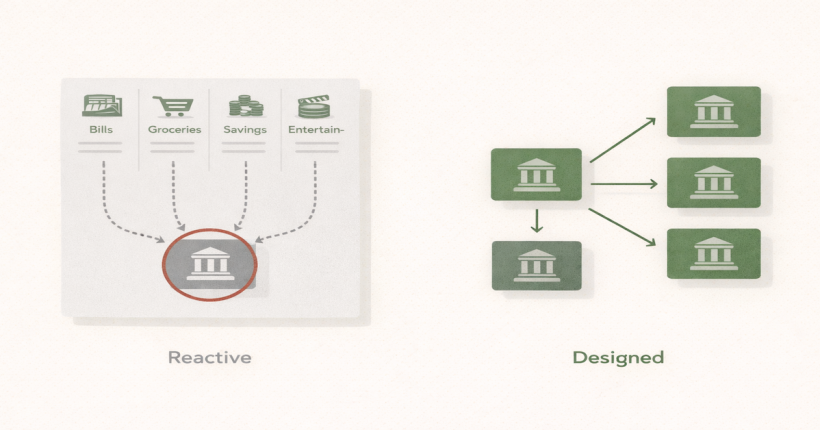
Account separation resolves the fungibility problem by making the category distinction physical rather than mental. When bill money is in a bills account and spending money is in a spending account, the fungibility of money within each account is irrelevant — all dollars in the spending account are spending dollars, and there is no category conflict to resolve. The budget enforces itself through account structure rather than through ongoing mental tracking.
The separation also changes the behavioral dynamics around spending decisions. When the spending account balance reaches zero, spending naturally stops — not because of discipline, but because the account is empty. Refilling it requires an intentional transfer from another account, which adds a natural friction layer that creates pause before any unplanned spending that would require pulling from a different purpose. That friction is behavioral infrastructure. It produces the outcomes that willpower and tracking were supposed to produce, without requiring willpower or tracking to maintain.
The account separation strategy article covers the specific account design, the transfer automation that makes it run without ongoing management, and the implementation steps for transitioning from a single-account structure without disrupting existing bill payments or direct deposits.
Resources
CFPB — How to Create a Budget and Stick With It
FDIC — Money Smart Financial Education Program
CFPB — Track Your Spending With This Easy Tool
This article is part of the Credit, Banking & Cash Flow integration system on PersonalOne — the complete framework for building a personal finance infrastructure that runs reliably by design.
Frequently Asked Questions
Is this really about the account structure, or am I just spending too much?
Run this diagnostic: add up all your fixed monthly obligations — rent, utilities, insurance, minimum debt payments, subscriptions. Subtract that total from your monthly take-home income. The remainder is your actual discretionary budget. Compare that number to what you typically spend on non-fixed categories. If you are spending within the discretionary budget but still running short, the problem is structural — you are spending committed money because the account structure makes it visible as available money. If you are consistently spending more than the discretionary budget across all categories, the issue is spending levels rather than structure — though the structural fix still helps by making the overage visible immediately rather than after the damage is done.
I have tried budgeting apps and they have not helped. Why would this be different?
Budgeting apps track what happened. Account separation changes what information is available at the moment spending happens. The key difference is timing: a tracking app shows you that you overspent after the fact, which is useful for awareness but cannot change the decision that has already been made. A separated spending account shows you the accurate available balance before the spending decision, which is the only information that can influence the decision in the moment. One is a reporting tool. The other is infrastructure that changes the default behavior.
Disclaimer: This content is for educational purposes only and does not constitute financial advice. Individual financial situations vary — consult a qualified financial professional for personalized guidance.