August 17, 2026
Home › Credit, Banking & Cash Flow › Banking Structure & Cash Flow Control › Why Your Bank Accounts Control Your Financial Life
TL;DR
— Your bank accounts are not just places to store money — they are the infrastructure that controls how money moves, which bills get paid, and what financial behaviors happen by default.
— The account structure you use determines whether your financial system produces stability or chaos — not your income level, not your discipline.
— Most financial instability is a structural problem: the wrong account design creates conditions where avoidable mistakes are the path of least resistance.
— Getting the account structure right is the highest-leverage financial change most people can make, because every other financial behavior runs on top of it.
— The full banking structure and cash flow control framework covers how to design the account infrastructure that produces stability by default.
Your bank accounts control your financial life more directly than your income, your spending habits, or your financial knowledge combined. The account structure you use — how many accounts you have, which types of money go into which accounts, and how transfers between them are organized — determines what financial behaviors happen automatically and which ones require ongoing effort and willpower to maintain.
This is not a minor operational detail. It is the most fundamental design decision in your personal finance infrastructure, and most people make it by default — opening whatever account the bank offered when they were 18 and never reconsidering whether that structure is producing the outcomes they want.
How Account Structure Determines Financial Outcomes
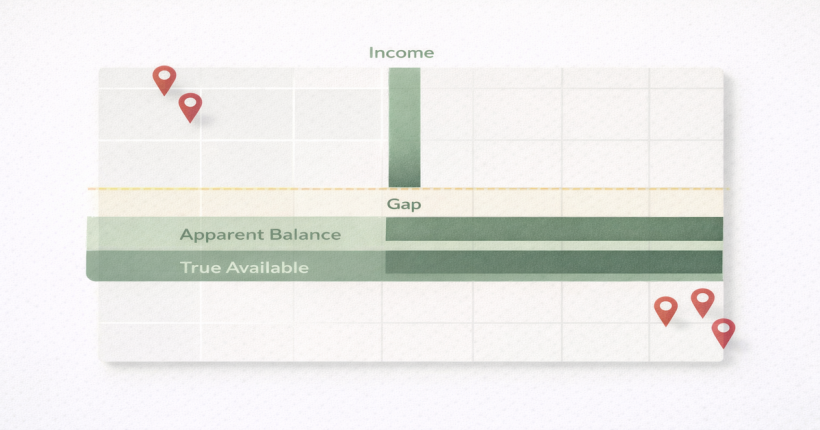
The relationship between bank account structure and financial outcomes operates through a simple mechanism: what you can see available in your account is what you believe you have available to spend. If your account balance shows $1,400 two days after payday, your brain registers $1,400 as available — regardless of whether $800 of that is already committed to rent, utilities, and the minimum credit card payment that will process in ten days.
This is not a willpower failure. It is how human beings process visible information. Account balances are visible. Future obligations are abstract. When the two compete for the same dollars, the visible number wins most of the time — not because of poor judgment, but because the account structure made the wrong comparison the only one available.
The Federal Reserve’s consumer financial research documents this pattern across income levels: households that cannot cover unexpected expenses are not primarily households with low income. They are households whose account structures do not separate available-to-spend money from committed money, which means every spending decision draws from the same pool as fixed obligations and creates conditions for shortfall even when income would be technically sufficient to cover both.
The Three Things Your Account Structure Controls
Whether bills get paid on time. A structure where bill money and spending money occupy the same account creates constant competition between them. A structure where bill money is routed to a dedicated account immediately after income arrives eliminates that competition. The bill account balance is not available for spending — it is designated for obligations. Bills get paid on time not because of effort or memory, but because the money for them was never available for any other purpose.
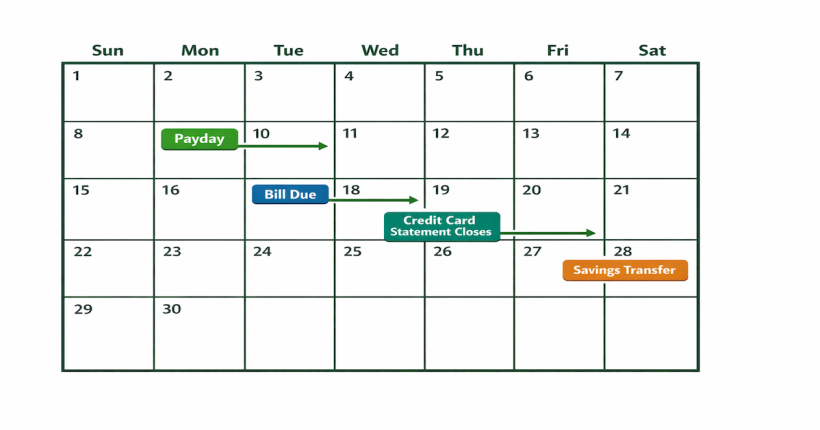
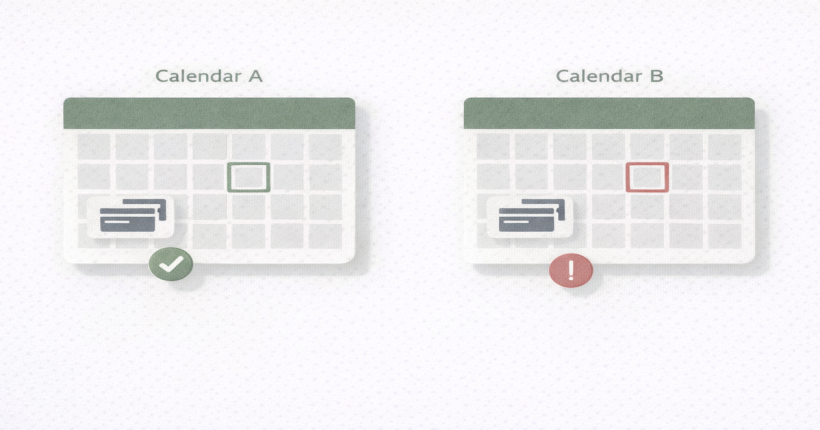
What your credit utilization looks like at statement date. Credit card utilization — the ratio of balance to credit limit at the time the statement closes — is one of the most significant factors in credit scoring. A household that pays the full balance every month but carries high utilization at statement date will see a worse credit score than a household with the same spending behavior and a structure that reduces the balance before statement close. Account structure directly governs what utilization the credit bureaus see.
How much discretionary spending actually happens. The spending account approach — where discretionary money is transferred to a separate account in a specific amount after bills and savings are allocated — creates a hard boundary around spending that a single account never provides. When the spending account balance reaches zero, spending stops. Not because of willpower, but because the account is empty. The structure enforces the limit that mental accounting never can.
Why the Default Account Structure Fails Most People
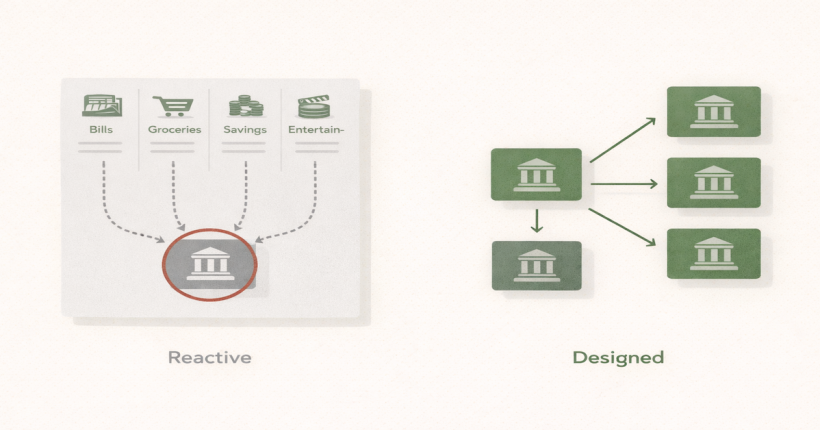
The default account structure most people use — one primary checking account, possibly one savings account — was not designed for financial system performance. It was designed for bank operational convenience and marketing simplicity. It is the minimum viable product for storing and accessing money, not the optimal infrastructure for managing financial obligations and building wealth simultaneously.
The CFPB’s consumer financial research identifies a consistent pattern among households that struggle with bill payment and savings accumulation: they are not primarily households with insufficient income. They are households with account structures that create the conditions for financial instability regardless of income level. The same income flowing into a well-designed account structure produces stable, predictable financial outcomes. Flowing into a single-account structure, it produces month-to-month instability that feels chronic and income-dependent but is actually structural and solvable.
Account structure is the fix. The full framework shows you exactly how to design it.
The banking structure and cash flow control cluster covers every account design decision — from the minimum viable structure to handling irregular income — with the specific implementation steps that make the transition straightforward.
Explore Banking Structure & Cash Flow Control →What a Functional Account Structure Looks Like
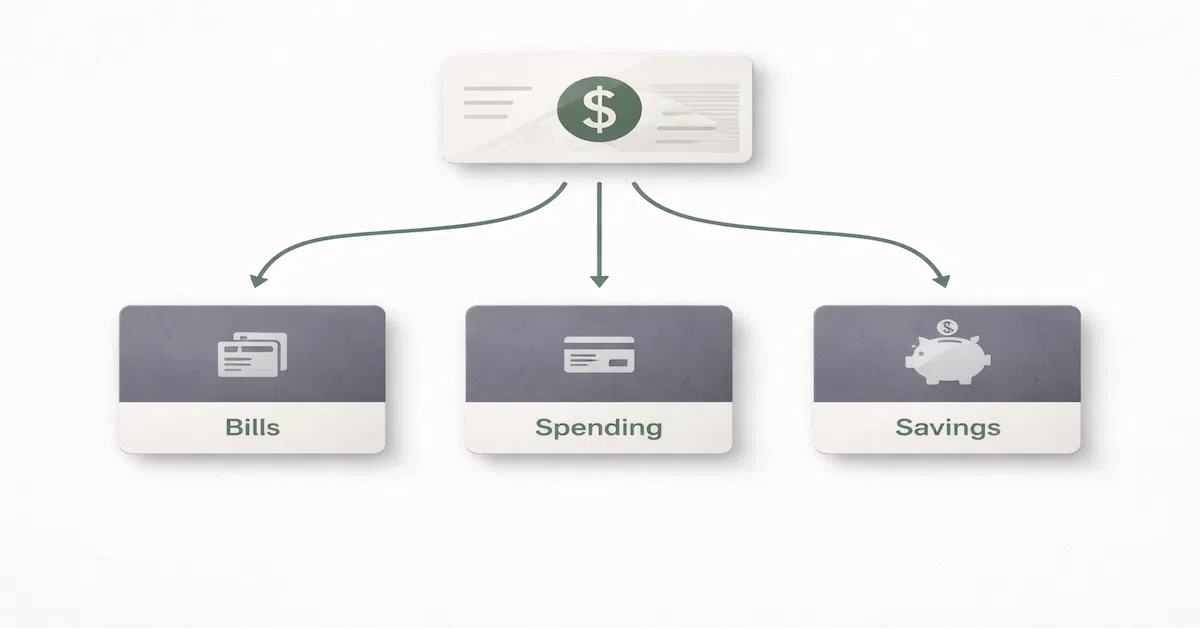
A functional account structure separates money by purpose rather than combining all money in a single balance. The minimum viable separation for most households involves three distinct roles: an income-receiving and bill-paying account, a discretionary spending account, and a savings account. Income arrives in the bills account. An automated transfer immediately moves the discretionary budget to the spending account and the savings allocation to savings. What remains in the bills account is exactly the money designated for fixed obligations — and that money does not move until the obligations process.
This structure changes the question from “how much do I have?” to “how much do I have for this purpose?” — and that question has a clear, accurate, actionable answer in every account at every point in the month. The cognitive load of managing money drops significantly because the account structure is doing the categorization work that mental accounting was never reliable enough to do.
The account separation strategy covers the specific structure design, the automation rules, and the practical steps for implementing this from a single-account starting point. It is the most actionable next step from this article.
Resources
FDIC — Money Smart Financial Education Program
CFPB — How to Create a Budget and Stick With It
Federal Reserve — Economic Well-Being of U.S. Households 2024
This article is part of the Credit, Banking & Cash Flow integration system on PersonalOne — the complete framework for building a personal finance infrastructure that runs reliably by design.
Frequently Asked Questions
If I earn enough to cover my bills, why do I still run short every month?
Almost certainly because your account structure makes all of your money look available simultaneously, even when a significant portion is already committed to obligations that have not processed yet. When the visible balance includes bill money, spending money, and savings money in one number, spending decisions are made against the full balance rather than against the actual discretionary portion. The result is consistent shortfall that feels like an income problem but disappears almost immediately when account separation routes the categories into separate balances.
Does having more bank accounts make finances more complicated?
Counterintuitively, no — done correctly, multiple accounts simplify financial management by reducing the number of decisions required each month. Instead of constantly monitoring a single balance and mentally tracking which portions are committed, each account has a clear, unambiguous purpose. The spending account answer is always “how much can I spend?” The bills account answer is always “are my obligations covered?” Two different questions, two different accounts, zero cognitive overlap.
Will this actually improve my credit score?
Yes, through two mechanisms. First, reliable on-time bill payment — which the bills account structure makes automatic — is the single most significant factor in credit scoring. Second, account separation makes it easier to pay credit card balances down before statement date, which directly reduces the utilization that credit bureaus measure. Both improvements are structural outcomes of the account design, not behavioral outcomes requiring ongoing effort.
Disclaimer: This content is for educational purposes only and does not constitute financial advice. Individual financial situations vary — consult a qualified financial professional for personalized guidance.