July 2026
Home › Credit, Banking & Cash Flow › Cash Flow Optimization & Financial Control › Why Most Debt Payoff Plans Fail Without Cash Flow Systems
What You Need to Know
— Most debt payoff plans fail because they are strategy without infrastructure — the payment method (avalanche or snowball) is correct, but there is no money flow optimization system ensuring the extra payment actually happens every month.
— The extra payment is the first casualty of any cash flow disruption — an unexpected expense, a timing gap, a tight month — because it was treated as discretionary rather than structural.
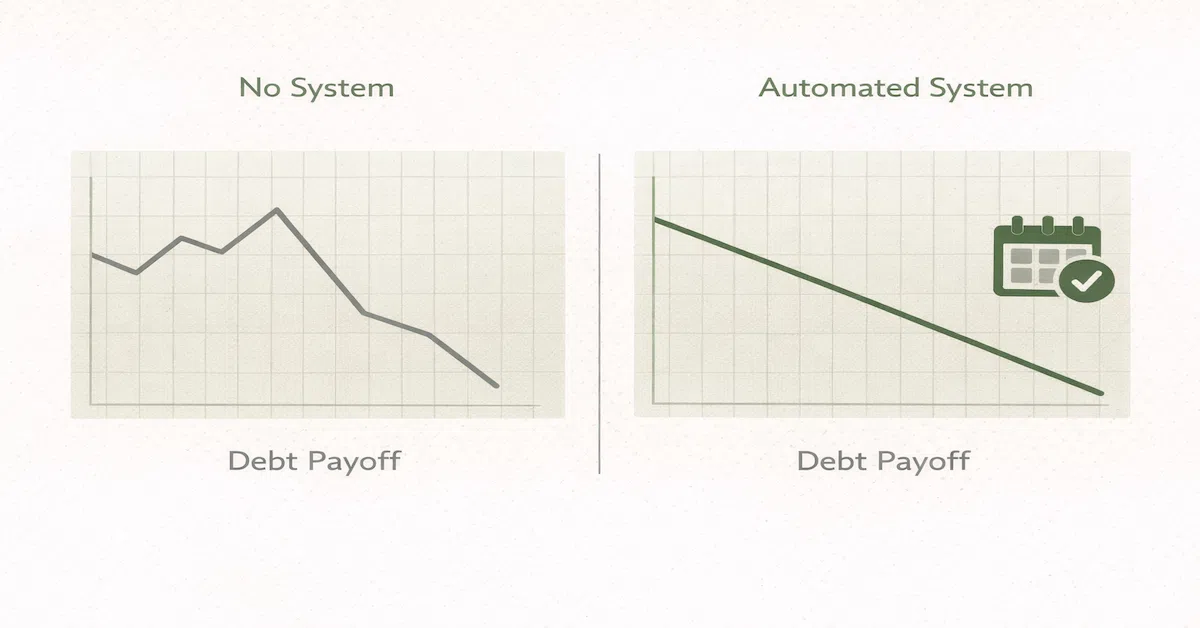
— Debt payoff that is built into the cash flow system as an automated allocation runs through every disruption rather than stopping at the first one.
— The structural fix is converting debt payoff from a monthly decision into a monthly automation — a scheduled extra payment that processes from the bills account on the same schedule as the minimum payment.
— The money flow optimization system that makes debt payoff automatic is what separates plans that work from plans that start, stall, and restart repeatedly.
A money flow optimization system that accelerates debt payoff is not primarily about choosing the right payoff method — the avalanche approach (highest interest rate first) and snowball approach (smallest balance first) are both effective strategies with well-documented outcomes. The reason most debt payoff plans fail is not the strategy. It is the absence of the cash flow infrastructure that ensures the extra payment actually happens every month regardless of what else is happening in the household.
The extra payment is the element of every debt payoff plan that is most vulnerable to disruption. Minimum payments are non-negotiable — missing them triggers late fees and credit damage. The extra payment above the minimum is the discretionary element that produces the payoff acceleration. And because it is discretionary, it is the first thing that disappears when a cash flow squeeze, an unexpected expense, or a difficult month arrives. Without a system that removes it from the discretionary category and makes it as automatic as the minimum payment, debt payoff plans stall at predictable intervals regardless of how good the strategy is.
Why the Extra Payment Keeps Getting Skipped
The extra payment gets skipped for a structural reason, not a motivational one. In the standard debt payoff approach, the extra payment is made from whatever surplus remains in the checking account after regular monthly expenses. That surplus is the most vulnerable balance in any household’s cash flow — it is what gets consumed first by any unexpected expense, any month where discretionary spending runs slightly over, or any timing gap that leaves the account lower than expected when the extra payment was supposed to process.
The behavioral economics research on debt repayment documents this pattern consistently: households that intend to make extra payments do so in months where everything goes smoothly and do not in months where any disruption occurs. Because disruptions are normal rather than exceptional — a car repair, a medical copay, a utility bill that was higher than expected — the extra payment gets skipped in a significant fraction of months. The debt payoff timeline extends by months or years from what the strategy projected, not because the method was wrong but because the cash flow system was not built to protect the extra payment from disruption.
The Structural Fix: Making the Extra Payment Automatic
The fix is converting the extra payment from a monthly decision into a monthly automation. When the extra payment is scheduled as a fixed automated transfer from the bills account on the same date as the minimum payment, it is no longer discretionary. It processes regardless of what else is happening that month. The bills account must be adequately reserved to cover both the minimum and the extra payment — which requires building the extra payment into the bills account reserve calculation from the start rather than treating it as surplus-dependent.
This single change — moving the extra payment from the spending environment to the bills account automation — is what separates debt payoff plans that complete on schedule from those that stretch indefinitely. The strategy does not need to change. Only the infrastructure through which the strategy is executed needs to change, and that infrastructure change is a single automation setup that runs indefinitely once configured.
The CFPB recommends paying more than the minimum on high-interest debt specifically because of the compound interest cost of extended payoff timelines. A credit card charging 22% annual interest costs more in interest each month the balance carries than most conservative investments return. The extra payment is the highest-return financial behavior available to households carrying high-interest debt — and making it automatic ensures it delivers that return consistently rather than only in months when cash flow cooperates.
How to Build Debt Payoff Into the Cash Flow System
Step 1: Calculate the sustainable extra payment amount. The extra payment must be sized so the bills account can cover both the minimum and the extra payment in every month — including months with higher-than-average discretionary expenses. Start conservatively: an extra payment that runs reliably every month produces more payoff acceleration than a larger extra payment that gets skipped in difficult months. Even $50 above the minimum, automated and consistent, outperforms a $200 intended extra payment that is skipped four months out of twelve.
Step 2: Add the extra payment to the bills account reserve calculation. The bills account reserve is the total of all fixed monthly obligations the account must cover. Add the extra debt payment amount to this total. The bills account transfer at payday must now be large enough to cover this higher reserve. If the current bills account transfer does not accommodate this, the spending account allocation needs to decrease by the corresponding amount — making the trade-off between discretionary spending and debt payoff visible and explicit.
Step 3: Automate both payments for the target debt. Set up the minimum payment as autopay on or before the due date. Set up the extra payment as a second scheduled transfer on the same date or one day before. When the target debt is paid off, cancel the extra payment for that account and immediately redirect the same dollar amount to the next target in the payoff sequence — this is the debt snowball or avalanche continuation mechanism, and it must be deliberately reconfigured rather than left to the surplus to absorb.
The strategy is correct. The infrastructure is what makes it work.
The complete cash flow optimization framework shows how to build debt payoff into the automated sequence alongside savings, bills, and credit management so every element runs reliably by design.
Explore Cash Flow Optimization & Financial Control →The Compounding Effect of Consistent Extra Payments
The financial impact of consistent extra payments compounds significantly over the life of a debt. On a $5,000 credit card balance at 22% APR with a $150 minimum payment, the minimum-only payoff timeline is approximately four and a half years with over $2,700 in total interest. Adding $100 in automated extra payments reduces the timeline to under two and a half years and cuts total interest by more than $1,500. The extra payment costs $100 per month. The return on that $100 — $1,500 in avoided interest — is a 125% return on the first year of extra payments alone, with no investment risk.
This is why the CFPB and financial education research consistently identify high-interest debt payoff as the highest-priority financial behavior for households carrying such balances. The return is guaranteed, the risk is zero, and the infrastructure change required to make it consistent — one automated payment added to the bills account sequence — is among the simplest financial system improvements available. The cash flow alignment strategy covers how to position the extra payment in the full automated sequence so it runs alongside every other obligation without competing for timing or funding.
Resources
CFPB — Credit Reports and Scores
CFPB — How to Create a Budget and Stick With It
Federal Reserve — Economic Well-Being of U.S. Households: Banking and Credit
FDIC — Money Smart Financial Education Program
This article is part of the Credit, Banking & Cash Flow integration system on PersonalOne — the complete framework for building a personal finance infrastructure that runs reliably by design.
Frequently Asked Questions
Should I use avalanche or snowball for debt payoff?
Both methods work when the extra payment is automated and consistent. The avalanche method — targeting the highest interest rate first — minimizes total interest paid and produces the fastest mathematical payoff. The snowball method — targeting the smallest balance first — produces earlier wins that some households find motivationally helpful. If consistency is a challenge, the snowball’s early wins may sustain the behavior better than the avalanche’s mathematically superior but slower initial progress. If the infrastructure is automated and the extra payment runs reliably regardless of motivation, the avalanche produces a better financial outcome. Choose based on which is more likely to stay in place given your specific behavioral patterns.
What if an unexpected expense exceeds the bills account buffer?
The debt payoff extra payment is the right thing to pause in a genuine emergency that exceeds the buffer — after the emergency fund is depleted and before any other obligation is missed. The minimum payment must continue. The extra payment can be paused for one or two cycles if absolutely necessary, then restarted when the buffer is replenished. What should not happen is permanently reducing the extra payment in response to a temporary disruption. The system returns to the automated extra payment as soon as the disruption is resolved. This distinction — temporary pause versus permanent reduction — is what keeps the payoff timeline from extending indefinitely in response to normal life variability.
How does debt payoff interact with savings accumulation?
The priority sequence for most households is: emergency fund to one month of expenses first, then high-interest debt payoff, then emergency fund to three months, then investment contributions alongside remaining debt payoff. This sequence ensures the emergency buffer exists before the extra debt payment is stressed by the first unexpected expense, which is the most common early failure point for debt payoff plans. The exact threshold between these priorities depends on the interest rate of the debt relative to expected investment returns — debt above approximately 8% APR almost always warrants payoff priority over investment contributions at the margin.
Disclaimer: This content is for educational purposes only and does not constitute financial advice. Individual financial situations vary — consult a qualified financial professional for personalized guidance.